
Font size
 Worksheets
comm between net exam
Total questions: 28
Worksheet time: 16mins
How do hosts ensure that their packets are directed to the correct network destination?
They always direct their packets to the default gateway, which will be responsible for the packet delivery.
They send a query packet to the default gateway asking for the best route.
They have to keep their own local routing table that contains a route to the loopback interface, a local network route, and a remote default route.
They search in their own local routing table for a route to the network destination address and pass this information to the default gateway.
What information does the loopback test provide?
The TCP/IP stack on the device is working correctly.
The device has end-to-end connectivity
DHCP is working correctly.
The device has the correct IP address on the network.
The Ethernet cable is working correctly.
Why is NAT not needed in IPv6?
The problems that are induced by NAT applications are solved because the IPv6 header improves packet handling by intermediate routers.
Any host or user can get a public IPv6 network address because the number of available IPv6 addresses is extremely large.
The end-to-end connectivity problems that are caused by NAT are solved because the number of routes increases with the number of nodes that are connected to the internet.
Because IPv6 has integrated security. There is no need to hide the IPv6 addresses of internal networks.
What is one advantage that IPv6 simplified header offers over IPv4?
efficient packet handling
smaller-sized header
smaller-sized source and destination IP addresses
little requirement for processing checksums
A computer can access devices on the same network but cannot access devices on other networks. What is the probable cause of this problem?
The computer has an incorrect subnet mask.
The cable is not connected properly to the NIC.
The computer has an invalid IP address.
The computer has an invalid default gateway address.
What routing table entry has a next hop address associated with a destination network?
Directly connected routes
Local routes
C and L source routes
Remote routes
What are two services provided by the OSI network layer? (Choose two.)
performing error detection
routing packets toward the destination
collision detection
encapsulating PDUs from the transport layer
placement of frames on the media
Which parameter does the router use to choose the path to the destination when there are multiple routes available?
the higher metric value that is associated with the destination network
the higher gateway IP address to get to the destination network
the lower metric value that is associated with the destination network
the lower gateway IP address to get to the destination network
What is a basic characteristic of the IP protocol?
user data segmentation
media dependent
connectionless
reliable end-to-end delivery
What is the aim of an ARP spoofing attack?
to flood the network with ARP reply broadcasts
to associate IP addresses to the wrong MAC address
to overwhelm network hosts with ARP requests
to fill switch MAC address tables with bogus addresses
Where are IPv4 address to Layer 2 Ethernet address mappings maintained on a host computer?
Neighbor table
Routing table
ARP cache
MAC address table
A network technician issues the arp -d * command on a PC after the router that is connected to the LAN is reconfigured. What is the result after this command is issued?
The ARP cache is cleared.
The ARP cache is synchronized with the router interface.
The current content of the ARP cache is displayed.
The detailed information of the ARP cache is displayed.
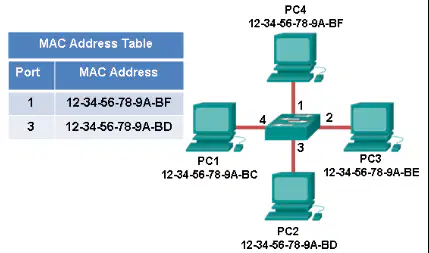
Refer to the exhibit. The exhibit shows a small switched network and the contents of the MAC address table of the switch. PC1 has sent a frame addressed to PC3. What will the switch do with the frame?
The switch will discard the frame.
The switch will forward the frame to all ports except port 4.
The switch will forward the frame only to port 1 and 3.
The switch will forward the frame only to port 2.
The switch will forward the frame to all ports.
Under which two circumstances will a switch flood a frame out of every port except the port that the frame was received on? (Choose two.)
The frame has the broadcast address as the destination address.
The destination address is unknown to the switch.
The source address in the frame is a multicast address.
The source address in the frame header is the broadcast address.
The destination address in the frame is a known unicast address.
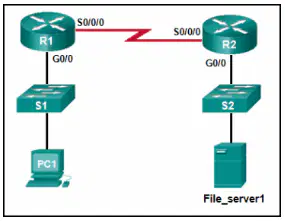
Refer to the exhibit. PC1 attempts to connect to File_server1 and sends an ARP request to obtain a destination MAC address. Which MAC address will PC1 receive in the ARP reply?
the MAC address of S2
the MAC address of File_server1
the MAC address of the G0/0 interface on R1
the MAC address of the G0/0 interface on R2
the MAC address of S1
What statement describes the function of the Address Resolution Protocol?
ARP is used to discover the IP address of any host on the local network.
ARP is used to discover the IP address of any host on a different network.
ARP is used to discover the MAC address of any host on the local network.
ARP is used to discover the MAC address of any host on a different network.
Which two functions are primary functions of a router? (Choose two.)
flow control
microsegmentation
packet forwarding
path selection
domain name resolution
What are two functions of NVRAM? (Choose two.)
to store the startup configuration file
to store the ARP table
to retain contents when power is removed
to store the routing table
to contain the running configuration file
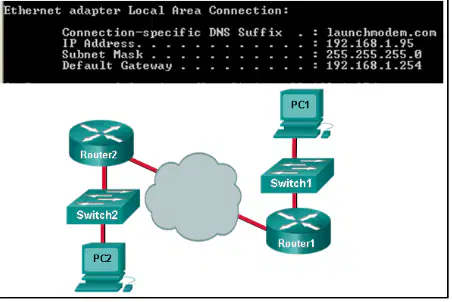
Refer to the exhibit. Consider the IP address configuration shown from PC1. What is a description of the default gateway address?
It is the IP address of the ISP network device located in the cloud.
It is the IP address of the Router1 interface that connects the company to the Internet.
It is the IP address of Switch1 that connects PC1 to other devices on the same LAN.
It is the IP address of the Router1 interface that connects the PC1 LAN to Router1.
Which three commands are used to set up secure access to a router through a connection to the console interface? (Choose three.)
password cisco
line vty 0 4
line console 0
enable secret cisco
login
What happens when the transport input ssh command is entered on the switch vty lines?
The switch requires remote connections via a proprietary client software.
The switch requires a username/password combination for remote access.
Communication between the switch and remote users is encrypted.
The SSH client on the switch is enabled.
A new network administrator has been asked to enter a banner message on a Cisco device. What is the fastest way a network administrator could test whether the banner is properly configured?
Exit global configuration mode.
Reboot the device
Exit privileged EXEC mode and press Enter.
Power cycle the device.
Enter CTRL-Z at the privileged mode prompt
What will happen if the default gateway address is incorrectly configured on a host?
The host cannot communicate with other hosts in the local network.
The host will have to use ARP to determine the correct address of the default gateway.
The host cannot communicate with hosts in other networks.
The switch will not forward packets initiated by the host.
A ping from the host to 127.0.0.1 would not be successful.
What are two potential network problems that can result from ARP operation? (Choose two.)
Manually configuring static ARP associations could facilitate ARP poisoning or MAC address spoofing.
Multiple ARP replies result in the switch MAC address table containing entries that match the MAC address of hosts that are connected to the relevant switch port.
Network attackers could manipulate MAC address and IP address mappings in ARP messages with the intent of intercepting network traffic.
Large numbers of ARP request broadcasts could cause the host MAC address table to overflow and prevent the host from communicating on the network.
On large networks with low bandwidth, multiple ARP broadcasts could cause data communication delays.
What is the effect of using the Router# copy running-config startup-config command on a router?
The contents of ROM will change.
The contents of NVRAM will change.
The contents of flash will change.
The contents of RAM will change.
Which term describes a field in the IPv4 packet header that contains a unicast, multicast, or broadcast address?
Destination IPv4 address
Protocol
TTL
Header checksum
What property of ARP allows hosts on a LAN to send traffic to remote networks?
Local hosts learn the MAC address of the default gateway.
The destination MAC address FF-FF-FF-FF-FF-FF appears in the header of the Ethernet frame.
The port-to-MAC address table on a switch has the same entries as the ARP table on the switch.
The source MAC address appears in the header of the Ethernet frame.

Refer to the exhibit:
10.118.62.1
10.118.63.65
10.62.63.254
209.165.200.87
10.118.62.196

