
 Worksheets
Computer Assesment 6 Grader
Total questions: 45
Worksheet time: 23mins
Which one is an input device?
Printer
Keyboard
Speaker
Monitor
Software that is free to use is called…
Shareware
Freeware
Hardware
Processor
Which component makes the computer run faster when increased?
Keyboard
RAM
Monitor
Mouse
What is digital data made of?
Words
Colors
0 and 1
Symbols
Which device changes analogue sound into digital data?
Speaker
Microphone
Monitor
Flash drive
Which processor should someone choose if they want faster performance?
The one with the lowest speed
The one with the highest speed
The cheapest one
The most colorful one
Which storage unit is the largest?
KB
MB
GB
TB
A computer case that is more expensive because of its design is related to…
Speed
Aesthetic
Storage
Software
Why can’t computers process analogue data directly?
Because analogue data is expensive
Because analogue data uses colors
Because computers only understand digital data (0 and 1)
Because analogue data is slow
Sofia wants to choose software with more features and tools. Which type should she choose?
Freeware
Open source
Paid software
Trial version
A computer that needs to edit large videos will need…
Low RAM and slow processor
High RAM and fast processor
Small storage
No graphics card
A robot is better than a human when…
The task needs creativity
The task is dangerous and repetitive
The task needs feelings
The task changes every day
Sequence means…
Repeating a task
Making choices
Running commands in order
Stopping a program
A set of step-by-step instructions is called…
Model
Story
Algorithm
Hardware
If–else is an example of…
Sequence
Loop
Selection
Event
Which block in Scratch repeats actions?
Motion block
Repeat block
Sound block
Looks block
What happens first in a sequence?
Last command
First command
Random command
Middle command
A loop is useful when…
You want something to happen once
You want something to happen many times
You stop an action
You choose between two choices
Which one is a condition?
Move 10 steps
If score > 10
Say “Hello”
Repeat 5 times
Which program behavior uses "selection"?
Always repeating
Choosing based on a situation
Saying hello
Moving randomly
When you click the green flag in Scratch, this is called…
Loop
Event
Sprite
Variable
Which program uses a loop correctly?
If score > 5
Say “Welcome”
Repeat 10 times: move 10 steps
Set score = 0
A variable is used to…
Draw shapes
Store changing information
Make sounds
Add color
Which situation uses selection?
Running all commands
“If raining, bring umbrella”
Standing still
Jumping repeatedly
The correct order of sequence is…
Middle → Last → First
First → Second → Third
Last → First → Third
Random order
“Repeat until score = 10” is an example of…
Sequence
Conditional loop
Event
Variable
In an algorithm to “Make Fry Eggs”, which step should be first?
Flip the egg
Break the egg
Prepare the pan
Add salt
What will happen if there is no selection in a program?
The program becomes fast
The program cannot make decisions
The program repeats
The program stops
Why are loops important?
To run commands once
To reduce repeated writing of code
To make code slow
To make code random
A program says:
IF number % 2 = 0 → print “Even” ELSE → print “Odd”
What is this an example of?
Loop
Condition and selection
Event
Variable
Which situation needs both loop AND selection?
Saying “Hello” once
Repeating a game until the player guesses correctly
Moving one step
Changing costume
A flowchart diamond symbol is used for…
Start
End
Decision
Process
A variable “lives” decreases every time the player is hit. This uses…
Static value
Updating variables
No selection
Only sequence
Which program is more efficient?
Move 10 steps (written 10 times)
Repeat 10 times → move 10 steps
If move
Say “Move”
A student writes an algorithm but forgets to include a condition. What problem may occur?
The program becomes colorful
The program cannot choose actions
The program becomes louder
The program becomes bigger
A loop inside another loop is called…
Broken loop
Half loop
Nested loop
Double code
Why do programmers use flowcharts before coding?
To decorate the code
To visualize and plan the logic clearly
To slow down the work
To shorten the program name
What is the correct order for making a cup of tea?
Pour tea → Add sugar → Boil water
Boil water → Pour tea → Add sugar
Add sugar → Drink → Boil water
Drink → Boil water → Add tea
A flowchart that shows
'Start → Input number → Add 10 → Display result → End'
What will the output come out if input = 5?
10
15
20
5
Which is the correct step to make a sandwich?
Eat sandwich → Make sandwich → Buy ingredients
Buy ingredients → Make sandwich → Eat sandwich
Make sandwich → Eat → Buy bread
Buy bread → Eat sandwich → Make sandwich
A student writes:
Step 1: Start,
Step 2: Input A, B,
Step 3: Sum = A + B,
Step 4: Output Sum,
Step 5: End.
What does the algorithm do?
Subtracts two numbers
Multiplies two numbers
Adds two numbers
Divides two numbers
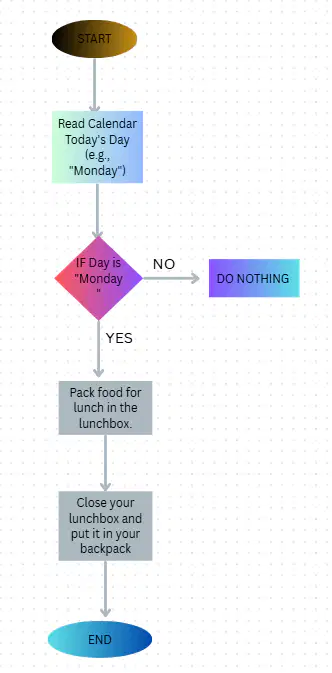
Find the error.
the input symbol
no input data
the flow line to end when do nothing
the process symbol
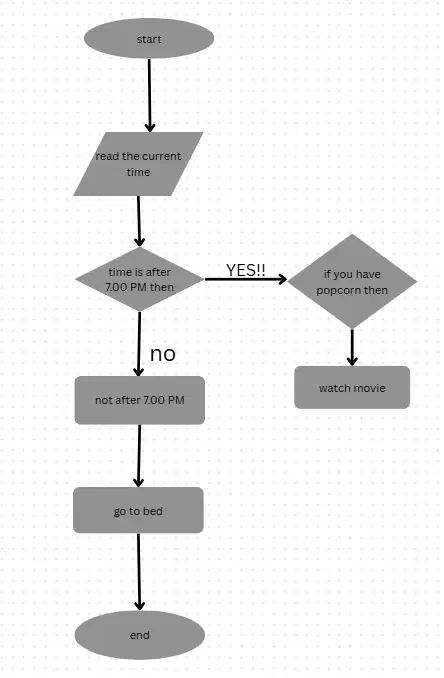
Read this algorithm:
Deciding on Movie Night
1. START
2. Read Current Time
3. Decision 1: IF Time is after 7:00
PM THEN
4. [YES Path] Decision 2: IF you have
popcorn THEN
5. [YES-YES Path] Start the movie!
6. [YES-NO Path] ELSE (No popcorn), Go
to bed.
7. [NO Path from Descision 1] ELSE (Time
is not after 7:00 PM), Go to bed.
8. END
Note:
Your family decides on a movie based on two rules:First, check the time: IF it is after 7:00 PM, you can watch a movie. ELSE, you cannot (and you stop).Second, check the snacks (only if you can watch): IF you can watch a movie and you have popcorn, THEN you start the movie. ELSE (if no popcorn), you just go to bed.
Find the error on the flowchart beside
there is no input
on the popcorn option there is not "no option"
there is no end flowchart after " watching movie"
on the popcorn option there is "yes option"

How many variable are mention there?
6
7
8
9
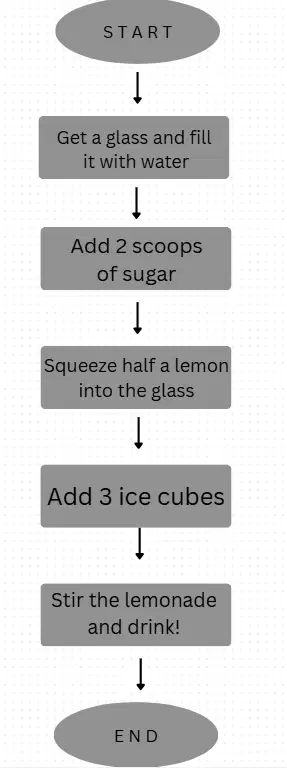
I have the following algorithm:
Making a Glass of Iced Lemonade
1. START
2. Get a glass and fill it with water.
3. Add 2 scoops of sugar.
4. Squeeze half a lemon into the glass.
5. Add 3 ice cubes.
6. Stir the lemonade and drink!
7. END
Which of the following statements is correct based on the algorithm and the flowchart result.
The start symbol on algorithm is wrong
there is a wrong arrangement on the flowchart
the process symbol on flowchart is not correct.
the algorithm and flowchart is precises and correct.

