
Font size
 Worksheets
Major Issues for the United States in World War II (so far)
Total questions: 23
Worksheet time: 13mins
Match the following
forbade President from selling weapons, making loans or giving assistance to warring nation
Neutrality Act
allowed U.S. to lease supplies to Britain and other nations fighting against Germany
Lend Lease Act
U.S. banned exports of iron, steel & oil to Japan
Embargo on exports
Which isolationist argument emphasized prioritizing domestic recovery over foreign wars during the late 1930s?
Preventing entangling alliances with Europe
Focus on domestic issues and economic recovery
Defense of democracy and human rights abroad
Strategic necessity to counter Axis expansion
Which rationale best reflects interventionists’ moral reasoning for aiding Allied nations?
Support allies to preserve freedom and human rights
Avoid foreign conflicts seen as European disputes
Reduce military spending to protect the economy
Maintain neutrality to safeguard independence
Select ALL arguments commonly used by isolationists before U.S. entry into WWII.
The League of Nations proved alliances ineffective
Axis expansion posed a direct threat to independence
Resources should be spent at home, not on wars
WWII was a European dispute without U.S. obligation
Match each position with its core reasoning.
Isolationism
Avoid foreign entanglements and focus domestically
Interventionism
Support allies against Axis threats to democracy
Neutrality debate
Weigh costs and risks of involvement versus staying out
Which action best illustrates the peacetime-to-wartime conversion of U.S. industry during World War II?
Automakers retooled to build tanks and planes
Banks expanded civilian home mortgage lending
Retailers opened more department store locations
Farmers shifted to luxury crop production
Match each wartime economy element to its description.
Arsenal of Democracy
U.S. supplying weapons to Allies
Rationing
Limiting civilian use of scarce goods
Raw materials management
Coordinating steel, rubber, and fuel
Factory conversion
Retooling plants to make military equipment
Which agency managed conscription (the draft) to rapidly expand the U.S. military during World War II?
Office of Price Administration
Civilian Conservation Corps
War Production Board
Selective Service System
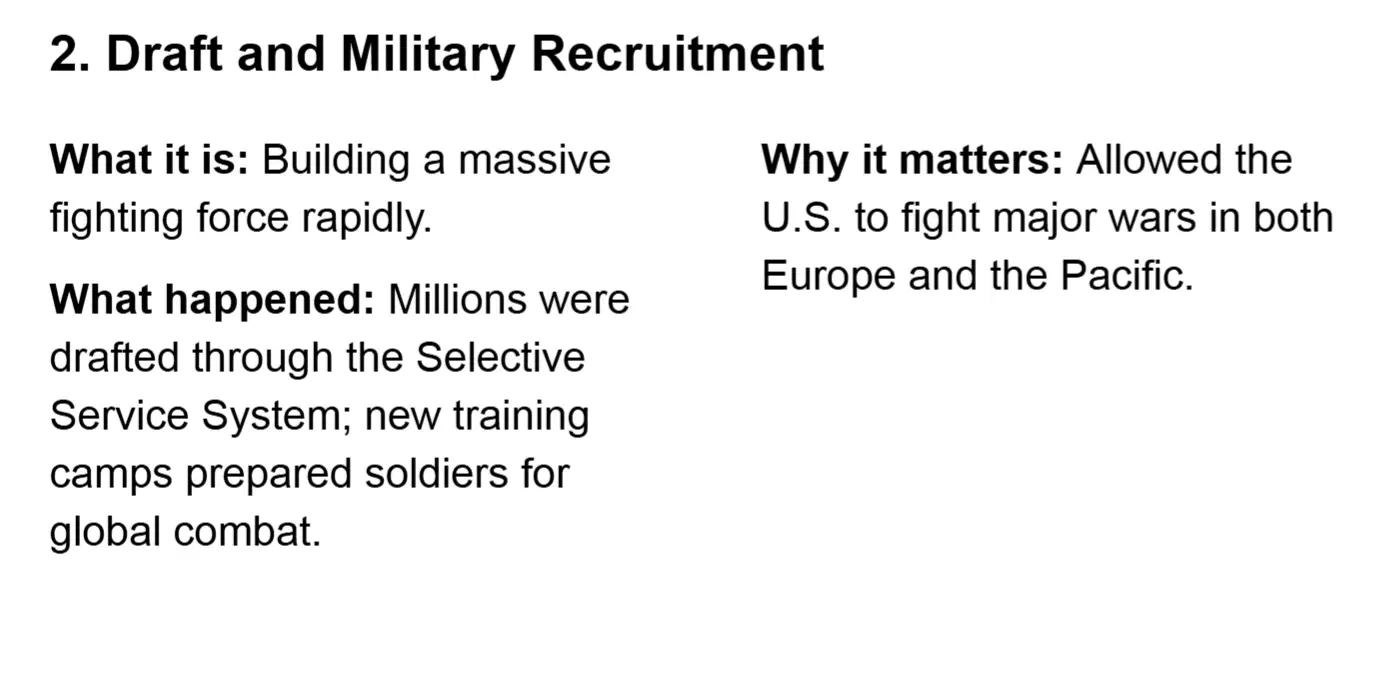
What was the primary purpose of new training camps established during World War II?
Teach civilian rationing practices
Prepare soldiers for global combat
Train diplomats for peace conferences
Recruit officers for domestic policing
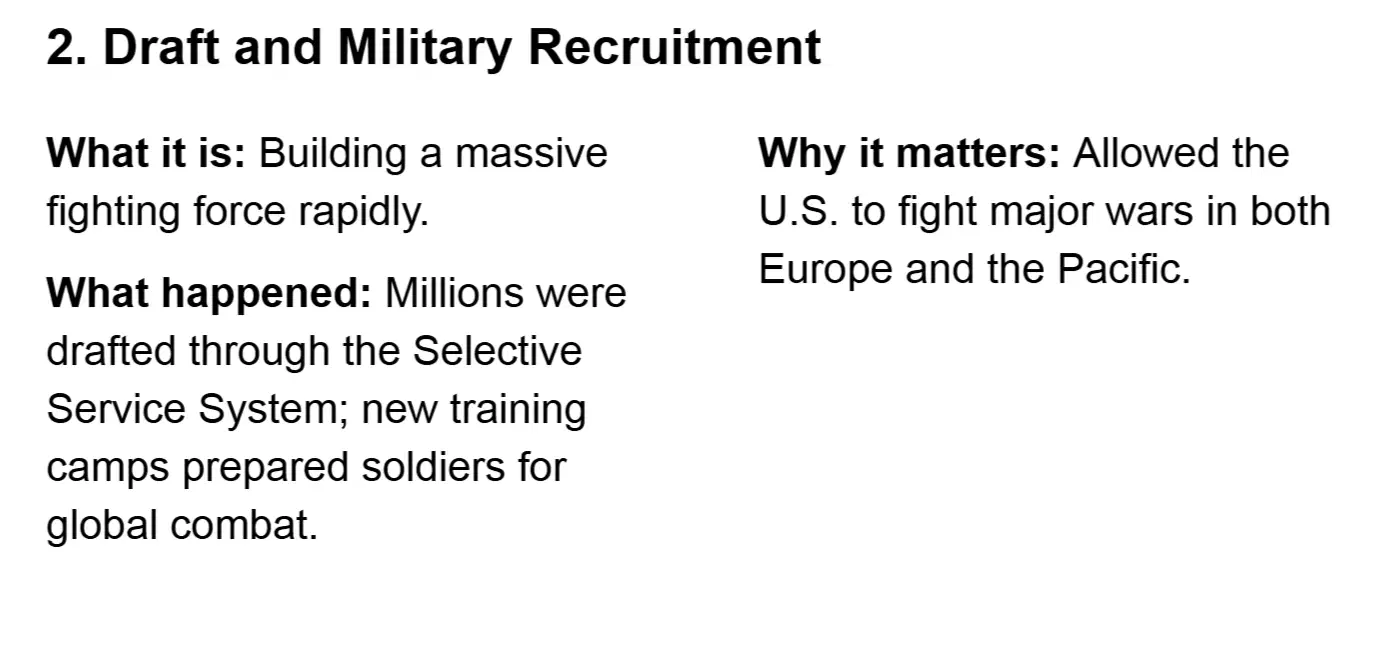
Which outcomes resulted from draft and recruitment efforts in World War II? Select all that apply.
Millions entered service through conscription
Domestic industry halted to fund the military
Training focused only on local defense
The U.S. fielded forces in Europe and the Pacific
Which event directly led to the United States entering World War II?
Italian campaign in North Africa in 1940
Soviet-German nonaggression pact in 1939
Japanese attack on Pearl Harbor in 1941
German invasion of Poland in 1939
On December 7, 1941, what was the primary tactic Japan used against the U.S. at Pearl Harbor?
A ground invasion of Oahu beaches
A submarine blockade of the harbor
A sudden air assault on naval vessels
A prolonged artillery bombardment
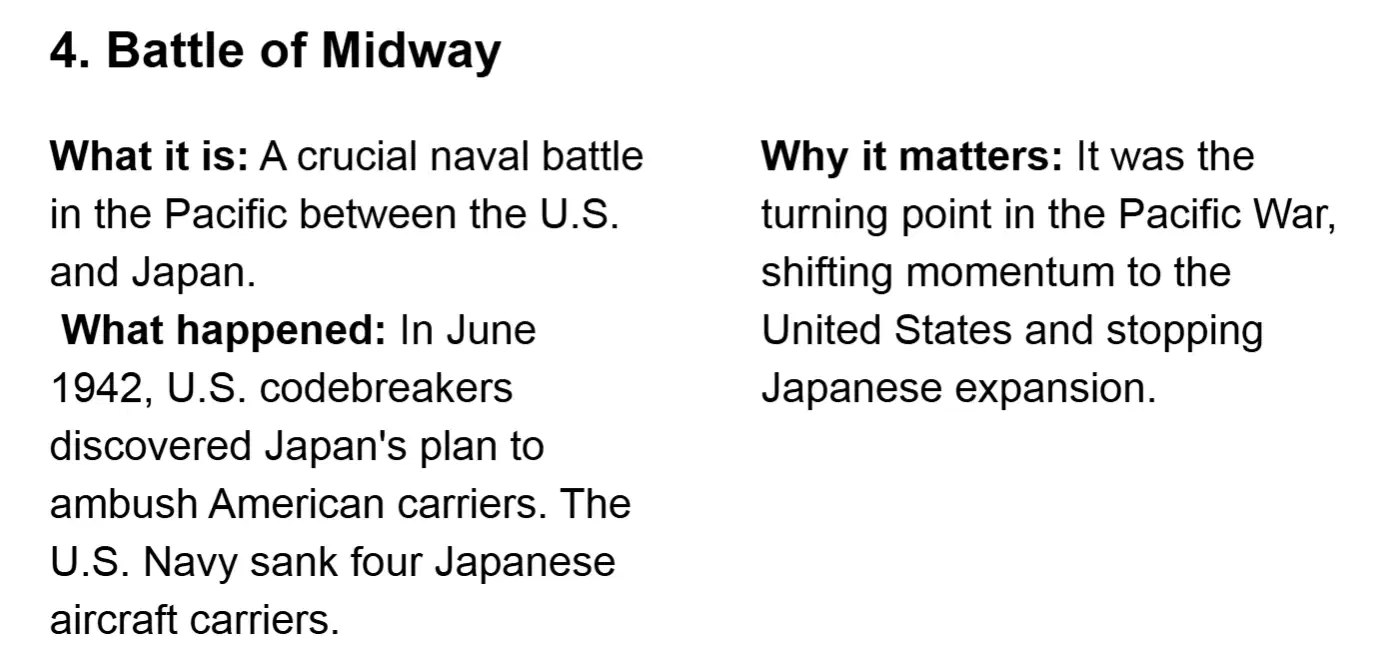
Match each element of the Battle of Midway to its outcome.
U.S. codebreaking
Plan discovered and foiled
Japanese ambush plan
Four Japanese carriers sunk
U.S. carrier strikes
Shifted toward the United States
Pacific War momentum
Enabled preemptive U.S. response

Which statement best explains the U.S. two-front war strategy during WWII?
Prioritized Germany while fighting Japan across the Pacific
Delayed all operations until allies defeated Germany
Focused only on Japan and avoided battles in Europe
Split evenly between Europe and Africa without Pacific battles
Which statement best describes the Japanese American incarceration during World War II?
Voluntary wartime relocation for community safety
Limited detentions of noncitizens in coastal cities
Forced relocation and incarceration of Japanese Americans
Temporary evacuation of foreign nationals only
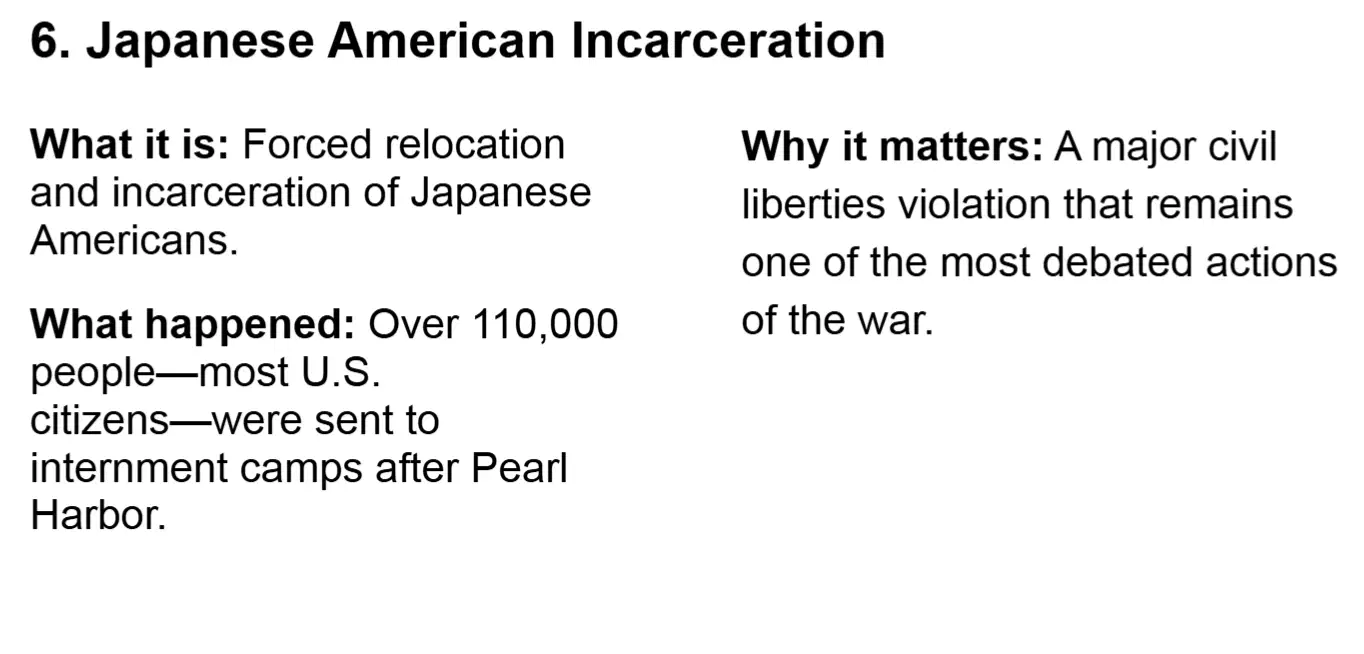
Match each phrase to its corresponding idea about the incarceration.
Civil liberties violation
Rights were denied to citizens
Internment camps
Facilities used to detain families
Pearl Harbor aftermath
Trigger for mass relocation policies
Debated actions of the war
Ongoing controversy in U.S. history
Which development best describes women’s roles on the home front during WWII?
Taking industrial and support positions
Leaving factories for domestic work
Avoiding military-related employment
Returning to prewar gender norms
Match each activity to how women contributed on the home front during WWII.
Factory labor
Producing war materials
Military support service
Clerical, nursing, communications
Traditionally male jobs
Shipyards, mechanics, transport
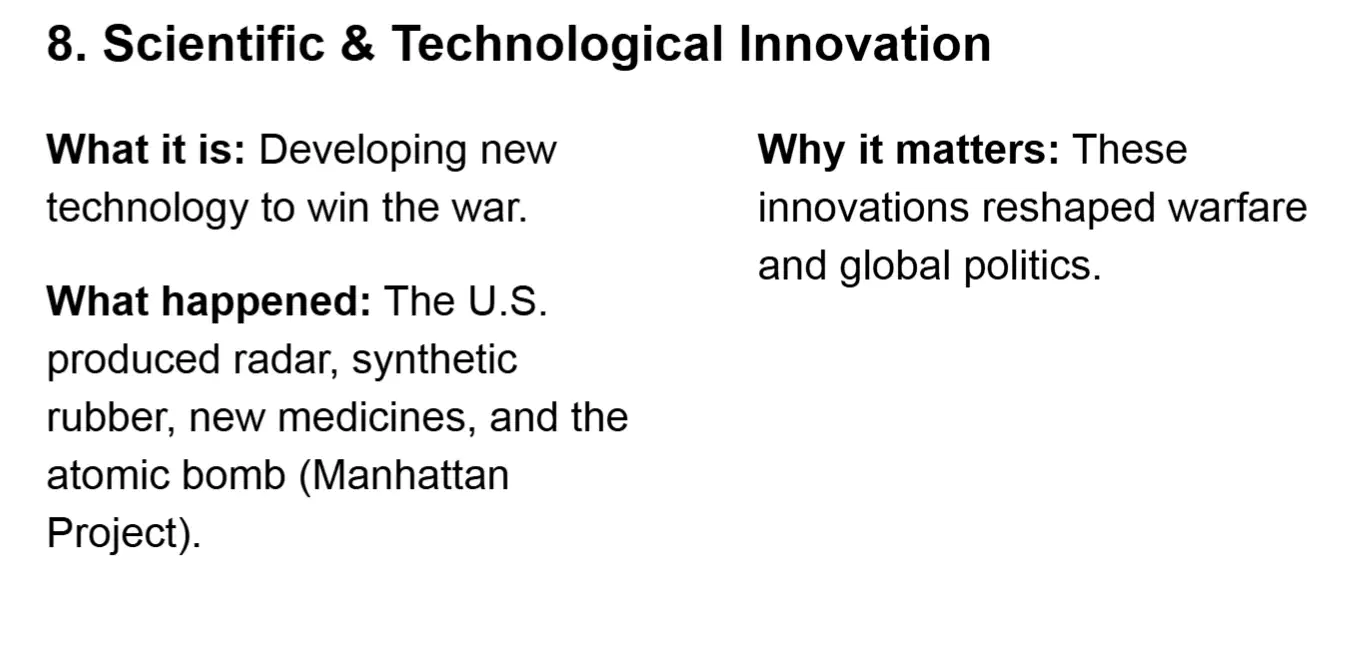
Match each WWII innovation to its primary impact.
Radar
Improved detection of enemy movement
Synthetic rubber
Maintained tire and equipment production
New medicines
Reduced deaths from infection
Manhattan Project
Developed the first atomic weapons
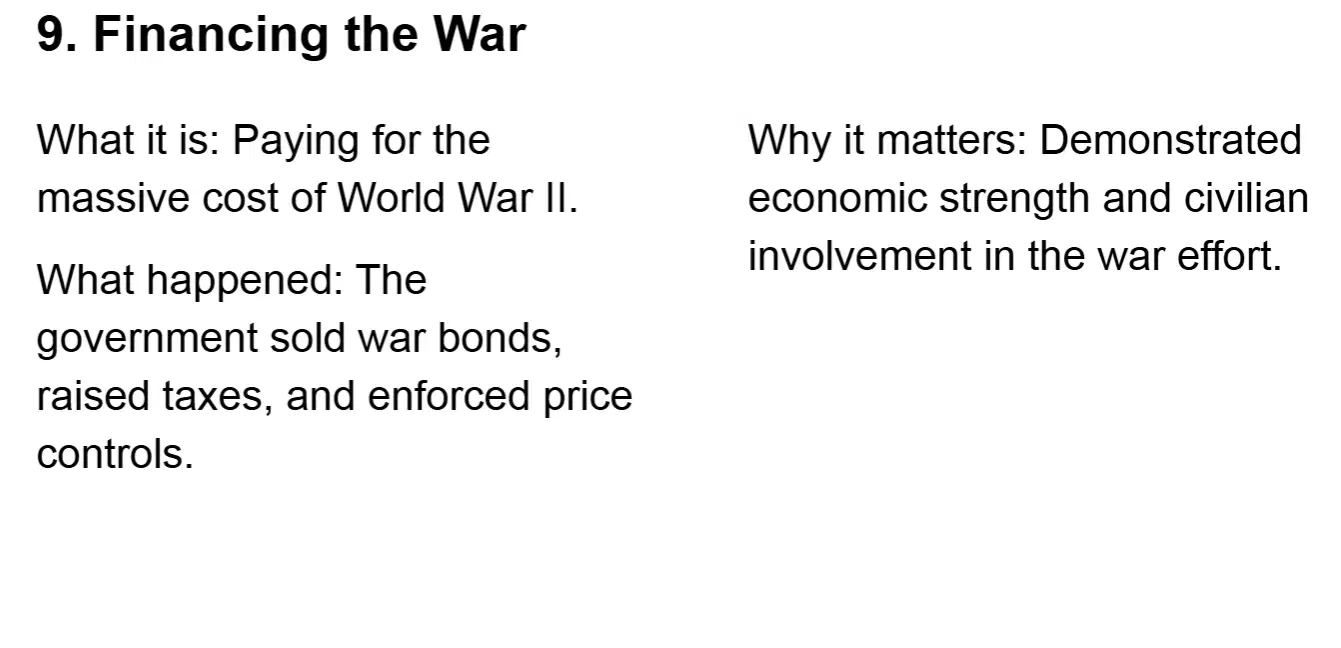
Which policy best describes how the U.S. curbed inflation while financing World War II?
Eliminating taxes to boost consumption
Unlimited rationing with no set limits
Strict price controls to stabilize markets
Loose monetary expansion without controls
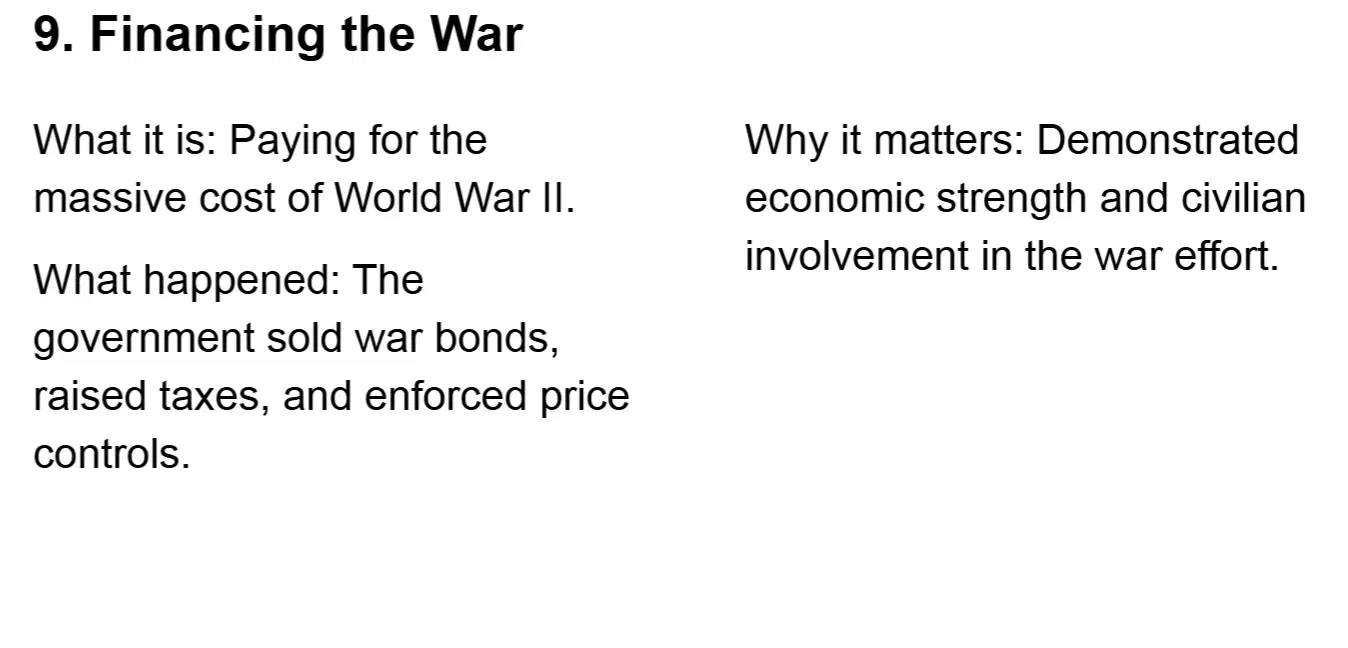
Match each wartime financing method with its primary purpose.
War bonds
Mobilize civilian savings for government funding
Raised taxes
Increase government revenue through taxation
Price controls
Prevent runaway prices in essential goods
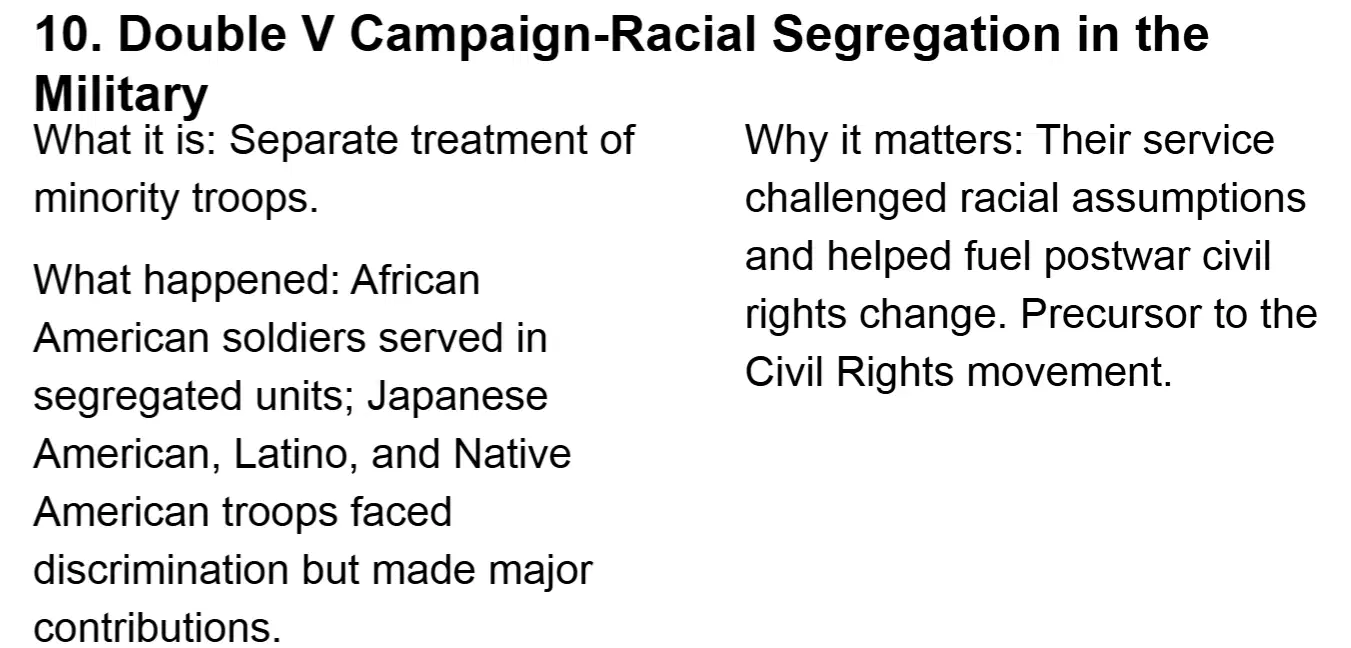
Which statement best explains the Double V Campaign during World War II?
Support for isolationism and limited engagement
Military draft exemption for minority troops
Immediate end of all segregation in wartime
Victory abroad and equality at home goals
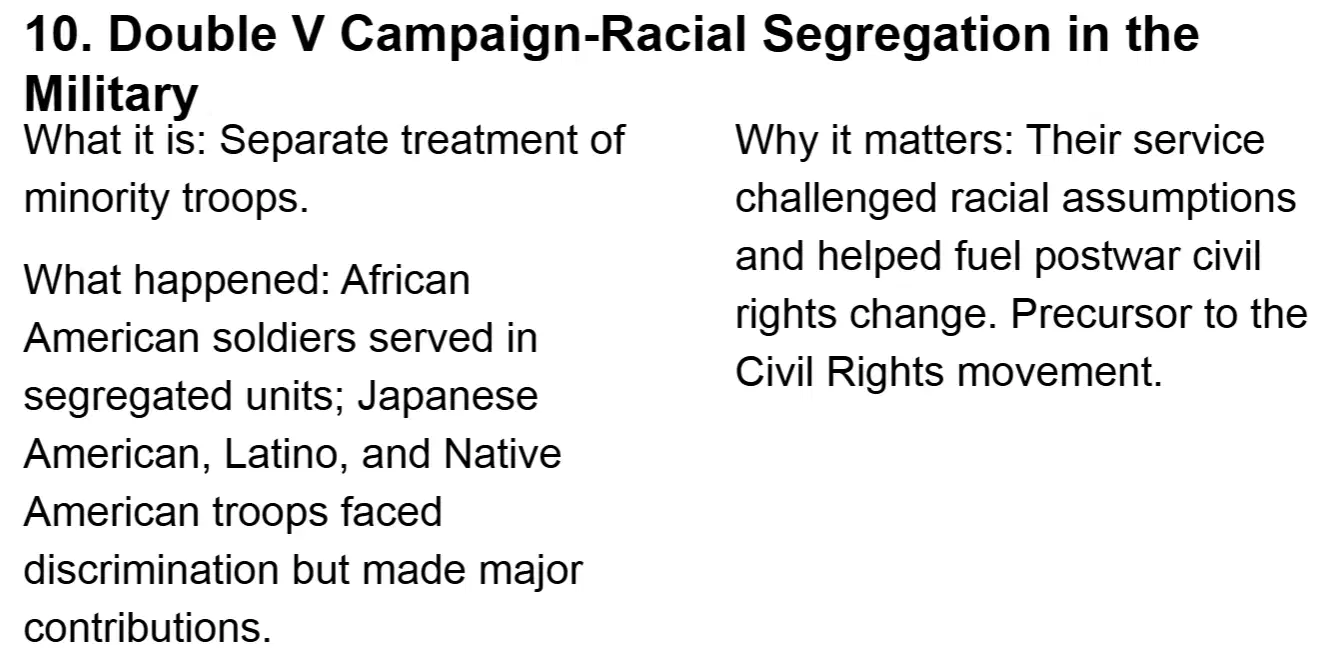
Match each minority group with its WWII experience described.
African American soldiers
Served in segregated military units
Japanese American troops
Faced discrimination yet made contributions
Latino service members
Faced discrimination yet made contributions
Native American troops
Faced discrimination yet made contributions

