
 Worksheets
World History Exam 2025
Total questions: 50
Worksheet time: 25mins
Name
Class
Date
1.
Read each question and choose the best answer.
"While some economists argue that full employment can be restored if wages are allowed to fall to lower levels, Keynesians maintain that employers will not employ workers to produce goods that cannot be sold. Because they believe unemployment results from an insufficient demand for goods and services, Keynesianism is considered a "demand-side" theory that focuses on short-run economic fluctuations.
Keynes argued that investment, which responds to variations in the interest rate and to expectations about the future, is the dynamic factor determining the level of economic activity. He also maintained that deliberate government action could foster full employment. Keynesian economists claim that the government can directly influence the demand for goods and services by altering tax policies and public expenditures." —Encyclopædia Britannica
John Maynard Keynes argued that the best way to lower unemployment is to
a)
A. increase demand for goods and services by cutting government costs.
b)
B. allow the market to set interest rates for loans to businesses.
c)
C. increase government spending in order to increase demand for goods and services.
d)
D. allow interest rates to increase in order to lower unemployment rates.
2.
Read each question and choose the best answer.
"My most immediate concern is in carrying out the purposes of the great work program just enacted by the Congress. Its first objective is to put men and women now on the relief rolls to work and, incidentally, to assist materially in our already unmistakable march toward recovery... We must begin now to make provision for the future. That is why our social security program is an important part of the complete picture. It proposes, by means of old age pensions, to help those who have reached the age of retirement to give up their jobs and thus give to the younger generation greater opportunities for work and to give to all a feeling of security as they look toward old age.
Provisions for social security, however, are protections for the future. Our responsibility for the immediate necessities of the unemployed has been met by the Congress through the most comprehensive work plan in the history of the Nation. Our problem is to put to work three and one-half million employable persons now on the relief rolls. It is a problem quite as much for private industry as for the government."—Franklin D. Roosevelt, Fireside Chat, April 28, 1935
What connection did President Roosevelt draw between social security and unemployment?
a)
A. President Roosevelt argued that the social security program only related to future welfare and had no connection to unemployment.
b)
B. President Roosevelt stated that social security would ease unemployment by encouraging older workers to retire and opening up jobs for younger workers.
c)
C. President Roosevelt explained that social security benefits are expensive and that this cost would drive up the unemployment rate.
d)
D. President Roosevelt argued that social security might increase or decrease unemployment so he also proposed a comprehensive work plan.
3.
Read each question and choose the best answer.
"It has taken the rapid industrialization of the last few decades, with its mass-production methods, to teach us that a man might become a victim of circumstances far beyond his control, and finally it took a depression to dramatize for us the appalling insecurity of the great mass of the population, and to stimulate interest in social insurance in the United States. We have come to learn that the large majority of our citizens must have protection against the loss of income due to unemployment, old age, death of the breadwinners and disabling accident and illness, not only on humanitarian grounds, but in the interest of our National welfare. If we are to maintain a healthy economy and thriving production, we need to maintain the standard of living of the lower income groups in our population who constitute 90 per cent of our purchasing power."—Frances Perkins, National Radio Address delivered February 25, 1935
In the speech above, Frances Perkins is discussing the benefits of which New Deal program?
a)
A. the Wagner Act
b)
B. the Social Security Act
c)
C. the Works Progress Administration
d)
D. the National Recovery Administration
4.
Read each question and choose the best answer.
"The country needs and, unless I mistake its temper, the country demands bold, persistent experimentation. It is common sense to take a method and to try it. If it fails, admit it frankly and try another. But above all, try something!"—Franklin D. Roosevelt, speech at Oglethorpe University, May 22, 1932
What actions did Roosevelt take during the first year of his presidency that show the sentiment expressed in this quote?
a)
A. President Roosevelt asked his wife, Eleanor, to gather information about the conditions faced by ordinary Americans.
b)
B. President Roosevelt acted quickly and proposed a number of major relief and reform bills in his first Hundred Days in office.
c)
C. President Roosevelt reassured Americans and explained his policies through his "fireside chat" radio broadcasts.
d)
D. President Roosevelt reached out to leaders of European nations to collaborate in restoring the global banking system.
5.
Which New Deal program was founded with the primary goal of creating jobs for young men?
a)
A. the Tennessee Valley Authority
b)
B. the Civilian Conservation Corps
c)
C. the Agricultural Adjustment Act
d)
D. the National Recovery Administration
6.
“It is hereby declared to be the policy of Congress to remove obstructions to the free flow of interstate and foreign commerce which tend to diminish the amount thereof; and to provide for the general welfare by promoting the organization of industry for the purpose
of cooperative action among trade groups, to induce and maintain united action of labor and management under adequate governmental sanctions and supervision, to eliminate unfair competitive practices, to promote the fullest possible utilization of the present productive capacity of industries, to avoid undue restriction of production (except as may be temporarily required), to increase the consumption of Industrial and agricultural
products by increasing purchasing power, to reduce and relieve unemployment, to improve standards of labor, and otherwise to rehabilitate industry and to conserve natural resources.”—Section 1, National Industrial Recovery Act, 1933
The National Industrial Recovery Act
a)
A. developed codes of fair competition to regulate industries.
b)
B. insured bank loans used for building and repairing homes.
c)
C. built bridges, dams, power plants, and government buildings.
d)
D. granted federal funds to state and local agencies to help the unemployed.
7.
“When we open the door, swirling whirlwinds of soil beat against us unmercifully, and we are glad to go back inside and sit choking in the dirt. We couldn’t see the streetlight just in front of the house. One morning, early, I went out during a lull, and when I started to return I couldn’t see the house. I knew the direction, so I kept on coming, and was quite close before I could even see the outline. It sure made me feel funny.”—”Grace,” Dust
Bowl survivor, 1935
What can you infer from this account about the main economic effect of the Dust Bowl on
the Great Plains region?
a)
A. It affected the development of transportation networks in the Great Plains region.
b)
B. It affected the ability to produce profitable crops in the Great Plains region.
c)
C. It affected the health of the people living in the Great Plains region.
d)
D. It affected the social well being of communities in the Great Plains region.
8.
“We had been poor, but we knew every night there was a bed there, and this was our room. . . . But that all of a sudden changed. When you’re small, you can’t figure these things out. You know something’s not right and you don’t like it, but you don’t . . . let that get you down. You sort of just continue to move.”—Cesar Chavez
In what way does Chavez’s statement reflect the experience of many American during the
Depression?
a)
A. Many rural farmers lost their homes.
b)
B. Many wealthy investors lost their fortunes.
c)
C. Many families relied on soup kitchens to feel them.
d)
D. Many Mexican Americans were forced to return to Mexico.
9.
“God invited us all to come and eat and drink all we wanted. He smiled on our land and we grew crops of plenty to eat and wear. . . . [But then] Rockefeller, Morgan, and their crowd stepped up and took enough for 120,000,000 people and left only enough for
5,000,000 for all the other 125,000,000 to eat. And so the millions must go hungry and without those good things God gave us unless we call on them to put some of it back.”— Huey Long radio broadcast, 1934
In this broadcast, Long opposes the New Deal because he believes that the solution to poverty is
a)
A. to return to the days of Rockefeller and J. P. Morgan.
b)
B. to create a more powerful federal government.
c)
C. to redistribute income that has become concentrated in the hands of the wealthy.
d)
D. to allow riches to “trickle down” from the wealthy to the poor
10.
What approach did Hoover initially take to end the Great Depression?
a)
A. allowing businesses more freedom from regulation
b)
B. using federal resources to stimulate in the economy
c)
C. appealing to the wealthy to volunteer time and money
d)
D. raising taxes, interest rates, and the amount of money in circulation
11.
Read each question and choose the best answer.
“We intend to begin on the 1st of February unrestricted submarine warfare. We shall endeavor in spite of this to keep the United States of America neutral. In the event of this not succeeding, we make Mexico a proposal of alliance on the following basis: make war together, make peace together, generous financial support and an understanding on our part that Mexico is to reconquer the lost territory in Texas, New Mexico and Arizona. The settlement in detail is left to you. You will inform the President of the above most secretly as soon as the outbreak of war with the United States of America is certain and add the suggestion that he should, on his own initiative, invite Japan to immediate adherence and at the same time mediate between Japan and ourselves. Please call the President's attention to the fact that the ruthless employment of our submarines now offers the prospect of compelling England in a few months to make peace. Signed, Zimmermann.”
The Zimmermann Note proposed
a)
A. an invasion of the United States by Mexico.
b)
B. an attack on the United States by Germany.
c)
C. that in case of war, Mexico join with Germany against the United States.
d)
D. that Germany declare war on the United States.
12.
Read each question and choose the best answer.
“Whoever, when the United States is at war, shall willfully make or convey false reports or false statements with intent to interfere with the operation or success of the military or naval forces of the United States, or to promote the success of its enemies, or shall willfully make or convey false reports, or false statements, . . . or advocate, teach, defend, or suggest the doing of any of the acts or things in this section enumerated and whoever shall by word or act support or favor the cause of any country with which the United States is at war or by word or act oppose the cause of the United States therein, shall be punished by a fine of not more than $10,000 or imprisonment for not more than twenty years, or both....”
Based on the content, this quotation comes from which of the following acts?
a)
A. the Sedition Act
b)
B. the Volstead Act
c)
C. the Espionage Act
d)
D. the Selective Service Act
13.
Read each question and choose the best answer.
“The special shells the men call “shells on wheels” are whizzing by continuously. They explode silently and have no smell but can be deadly. They killed several men yesterday. One of my men refused to put his mask on because he couldn’t smell anything. All of a sudden, he was dizzy, foaming at the mouth and his skin went black, then he went rigid and died.” —Paul Truffaut, March 5, 1917
In this text, which form of warfare from World War I is Truffaut discussing?
a)
A. chemical warfare
b)
B. naval warfare
c)
C. conventional warfare
d)
D. aerial warfare
14.
Read each question and choose the best answer.
"1918 has gone: a year momentous as the termination of the most cruel war in the annals of the human race; a year which marked the end, at least for a time, of man's destruction of man; unfortunately a year in which developed a most fatal infectious disease causing the death of hundreds of thousands of human beings." — Journal of the American Medical Association, December 28, 1918
To which disease does the author of the text refer?
a)
A. cholera
b)
B. influenza
c)
C. typhoid
d)
D. yellow fever
15.
Read each question and choose the best answer.
“Only a tranquil Europe can be a stable Europe …. [There] must be a peace without victory …. Victory would mean peace forced upon the loser, a victor's terms imposed upon the vanquished. It would be accepted in humiliation…. and would leave a sting, a resentment, a bitter memory upon which terms of peace would rest, not permanently, but only as upon quicksand.” —Woodrow Wilson, "Peace Without Victory" speech, January 22, 1917
Based on this quotation, what did Wilson want to achieve with the end of the war?
a)
A. the expansions of the United States' interests
b)
B. a lasting peace in Europe
c)
C. stronger United States alliances
d)
D. protection of weaker nations from aggressors
16.
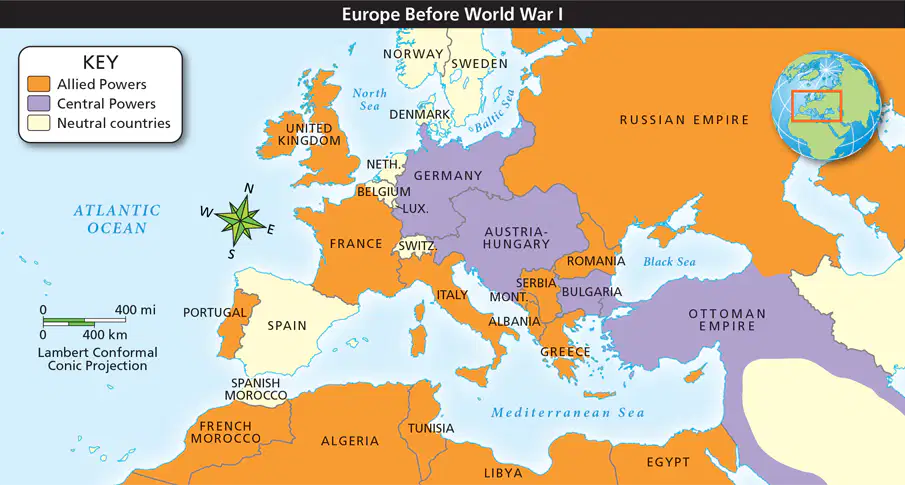
Read each question and choose the best answer.
Based on the map, which neutral country shares a border with two Central Power nations?
a)
A. Switzerland
b)
B. Norway
c)
C. Spain
d)
D. Belgium
17.

Read each question and choose the best answer.
The Committee on Public Information, which produced movies that encouraged American patriotism during World War I, such as “Under Four Flags,” was an agency of which institution?
a)
A. Women's International League for Peace and Freedom
b)
B. American Red Cross
c)
C. the Bureau of the Hollywood Film Industry
d)
D. the United States government
18.
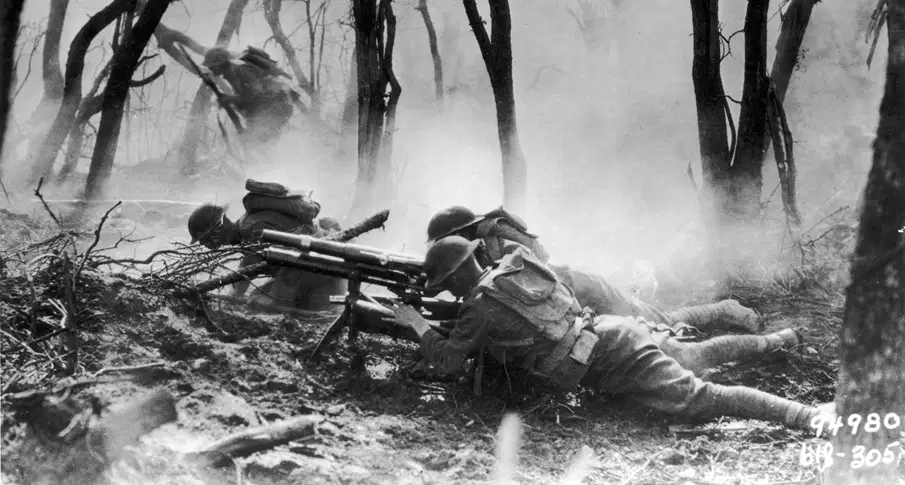
Read each question and choose the best answer.
Which of the following statements about World War I is illustrated by this photo?
a)
A. Soldiers from many countries fought in this war.
b)
B. Governments provided soldiers with uniforms for the first time.
c)
C. The war included fighting in deserts.
d)
D. Highly destructive weapons were widely used in the war.
19.
Read each question and choose the best answer.
What was the goal of the War Industries Board during World War I?
a)
A. to regulate industries related to the war effort
b)
B. to found companies that could supply military goods during the war
c)
C. to select workers for industries that supported the war effort
d)
D. to encourage the conservation of resources used in wartime industries
20.
Read each question and choose the best answer.
In which country did American forces do most of their fighting in World War I?
a)
A. Germany
b)
B. the United Kingdom
c)
C. France
d)
D. the Netherlands
21.
How did the American Expeditionary Force give the Allies an advantage over Germany?
a)
A. They forced German troops to retreat into Germany.
b)
B. They help raise Allied morale and strengthened Allied resistance to German attacks.
c)
C. They help to train French and British troops.
d)
D. They provided conveys to protect Allied shipping in the Atlantic.
22.
Why were President Wilson's fourteen points disregarded at the Paris Peace Conference?
a)
A. The Allied victors did not want to encourage nationalism.
b)
B. Wilson's ideal of national self-determination threatened the interests of other Allied powers.
c)
C. The Allies did not want to dismantle the Ottoman Empire.
d)
D. The Allies considered the American proposals not idealistic enough.
23.
Read each question and choose the best answer.
"The resolution now before the Senate is a declaration of war. Before taking this momentous step, and while standing on the brink of this terrible vortex, we ought to pause and calmly and judiciously consider the terrible consequences of the step we are about to take.
No close student of recent history will deny that both Great Britain and Germany have, on numerous occasions since the beginning of the war, flagrantly violated in the most serious manner the rights of neutral vessels and neutral nations under existing international law as recognized up to the beginning of this war by the civilized world.
The reason given by the President in asking Congress to declare war against Germany is that the German Government has declared certain war zones, within which, by the use of submarines, she sinks, without notice, American ships and destroys American lives....
The first war zone was declared by Great Britain. She gave us and the world notice of it on the 4th day of November, 1914....
Both of these orders declaring military zones were illegal and contrary to international law. It is sufficient to say that our Government has officially declared both of them to be illegal and has officially protested against both of them...." —Senator George William Norris, Congressional Record, April 4, 1917
Based on the statement, why did Senator Norris oppose American involvement in the World War I?
a)
A. Because American involvement would have no impact on the outcome of the war.
b)
B. Because both Great Britain and Germany had violated international law.
c)
C. Because American involvement would only lead to greater devastation for both sides.
d)
D. Because the Germans were justified in their aggression against the Allies.
24.
Read each question and choose the best answer.
"I can never be anything else but an American, and I must think of the United States first, and when I think of the United States first . . . I am thinking of what is best for the world, for if the United States fails, the best hopes of mankind fail with it." —Henry Cabot Lodge, letter to President Woodrow Wilson, 1919
In this letter opposing United States entry into the League of Nations, what effects does Senator Lodge think the treaty would have on the United States and the world?
a)
A. short-term benefit for the United States, but long-term danger for the world
b)
B. danger for the United States and for the best long-term hopes for the world
c)
C. short-term danger for the United States but long-term benefits for both the United States and the world
d)
D. dangers for the world, but long-term benefits for the United States
25.
Read each question and choose the best answer.
Which of the following was a great American war hero during World War I?
a)
A. former president Theodore Roosevelt
b)
B. Commodore George Dewey
c)
C. Alfred T. Mahan
d)
D. Alvin York
26.
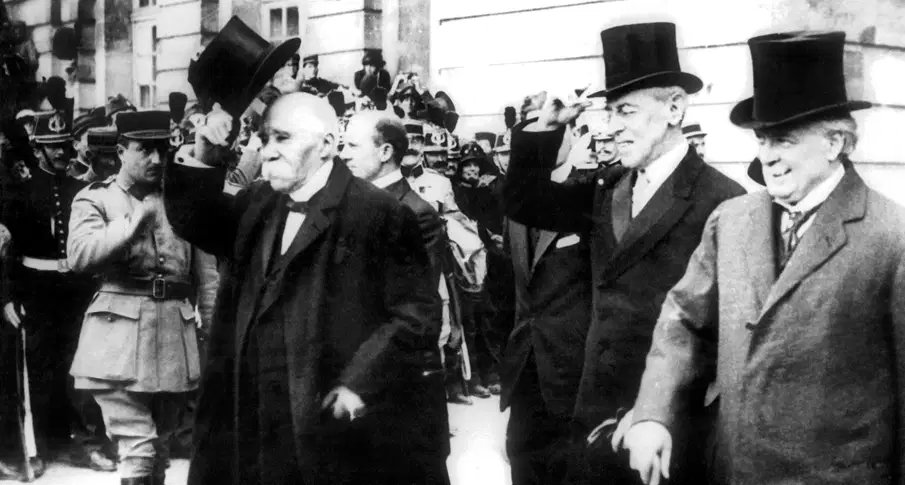
Read each question and choose the best answer.
Which leader, seen in the picture, led the American delegation to negotiate the Treaty of Versailles at the end of World War I?
a)
A. Lloyd George
b)
B. Henry Cabot Lodge
c)
C. John J. Pershing
d)
D. Woodrow Wilson
27.
Read each question and choose the best answer.
In Europe, World War I was a defensive rather than offensive war mainly due to the use of
a)
A. tanks.
b)
B. trenches.
c)
C. poison gas.
d)
D. aircraft.
28.
Read each question and choose the best answer.
At which stage of the fighting did the United States enter World War I?
a)
A. the beginning
b)
B. shortly after the beginning
c)
C. three years into the war
d)
D. too late to play an important role in the war
29.
What was the event that sparked World War 1 by causing Austria-Hungary to declare war on Serbia?
a)
Assassination of Archduke Ferdinand
b)
Assassination of Gavrilo Princip
c)
Assassination of Abraham Lincoln
d)
Assassination of Winston Churchill
30.
What were the causes of World War 1?
a)
Napoleon returning from exile to regain control of France and Europe
b)
Militarism, Imperialism, Nationalism, Advances in weapons
c)
Militarism, Alliances, Imperialism, Nationalism
d)
Mussolini, Aguinaldo, Imperialism, Nazi's
31.
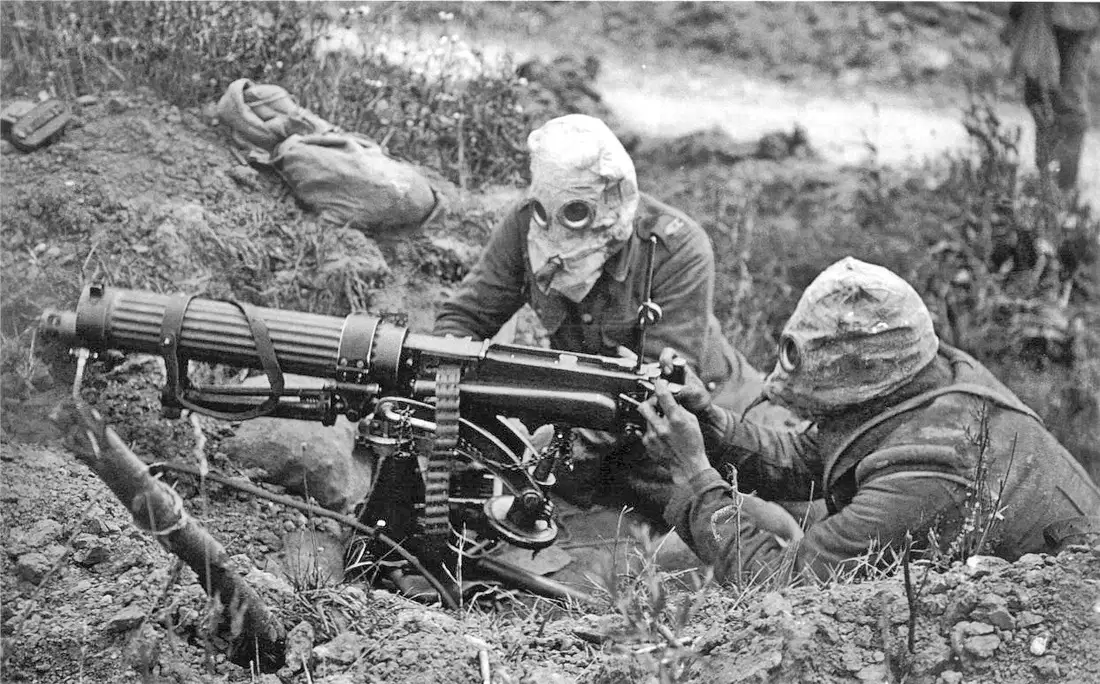
Pictured above was a new weapon to the battlefields of World War 1. What is the weapon called that fires bullets rapidly?
a)
Poison Gas
b)
Grenades
c)
Trench warfare
d)
Machine gun
32.
What caused the United States to enter World War 1?
a)
Bombing of Pearl Harbor
b)
The loss of Germany as a market
c)
The increased amount of threats of Germany to invade Russia
d)
Unrestricted submarine warfare by Germany against American ships
33.
Who was the President during World War I?
a)
Warren Harding
b)
Woodrow Wilson
c)
Franklin D. Roosevelt
d)
Theodore Roosevelt
34.
What is imperialism? Why did Europe want to imperialize Africa?
a)
One country expands its influence over a foreign country. To exploit natural resources.
b)
To spread the industrial revolution to foreign nations and Africa was first place chosen by Europe
c)
Where multiple countries attempt to take over Europe to gain natural resources
d)
Rule by a king or queen and to expand kingdoms to Europe
35.
In 1907, Britain formed the Triple Entente (later to become the Allied Powers), with France and Russia. This is an example of ________________________________________
a)
Militarism
b)
Alliances
c)
Imperialism
d)
Nationalism
36.
Which country contributed to the outbreak of war by encouraging Austria to declare war on Serbia and by giving them a “blank check” of support?
a)
Russia
b)
Great Britain
c)
Italy
d)
Germany
37.
Why did Russia join World War I?
a)
Because their heir to the throne was assassinated.
b)
Because Austria declared war on Serbia, and Russia was Serbia's ally.
c)
Because they hoped to defeat Germany to gain control of its colonies.
d)
None of the above.
38.
At the start of the war, Germany implemented the Schlieffen Plan. This was their military strategy to:
a)
use submarines to sink British ships in order to win the war
b)
disrupt the supply chain to the Allies
c)
avoid a two-front war
d)
build better trenches than the Allies
39.
What neutral country did Germany invade in order to carry out the Schlieffen Plan?
a)
Russia
b)
Switzerland
c)
Spain
d)
Belgium
40.
The stretch of land from Belgium to France where most trench warfare was fought during WWI was known as the:
a)
Eastern Front
b)
Western Front
c)
Balkans
41.
The Zimmermann Telegram proposed a German alliance with which country against the United States?
a)
China
b)
Cuba
c)
Mexico
d)
Canada
42.
Which of the following describes the Treaty of Versailles?
a)
It prevented the U.S. from joining the League of Nations
b)
It gave Britain and France control over Germany
c)
It forced Russia to give up much of its land to Germany
d)
It contributed to the start of WWII because it treated Germany so harshly
43.
Annexation of U.S. Territory is best explained by which example
a)
The Union's defeat of the Confederate States, and as a result, imposing Reconstruction policies
b)
Abraham Lincoln's decision to use land promised to the Native Americans in the Great Plains for the construction of the Transcontinental Railroad and the Homestead Act
c)
The United States support of white farmers in Hawaii who claimed to have been unfairly treated by the Hawaiian monarchy, as a result the United States will remove the monarchy in Hawaii and replace it with the U.S. government
d)
None of the Above
44.
Social Darwinism is best explained in imperialism as.....
a)
The belief held by some in the late 19th century that certain nations and races were superior to others and therefore destined to rule over weaker nations
b)
Redistribution of wealth between the rich class and poor class of people in the urban areas throughout the United States
c)
An effort to discredit greedy corporations and corrupt politicians having an unhealthy relationship at the expense of the American people
d)
None of the Above
45.
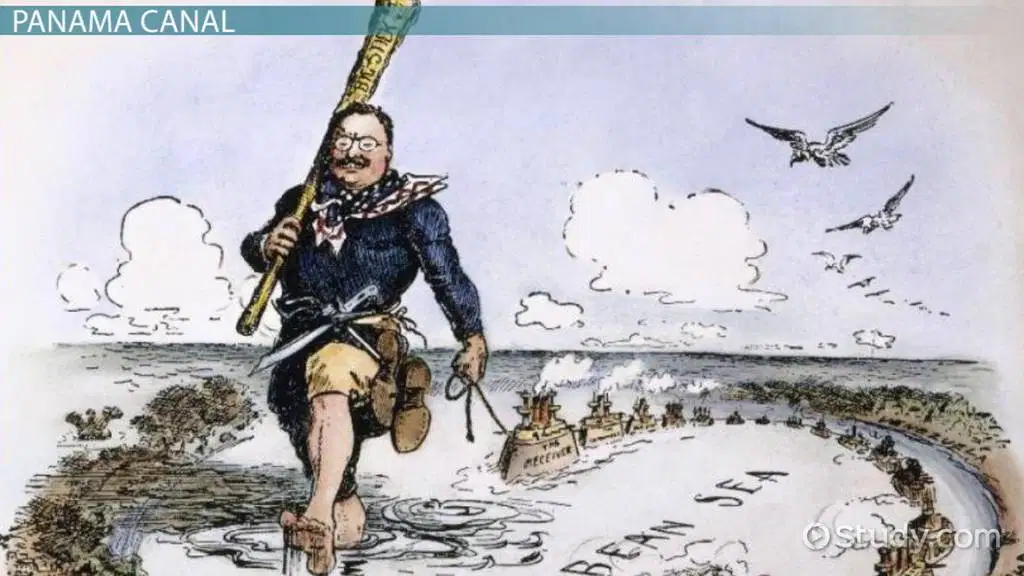
Based on the political cartoon....what policy put forth by the United States will give the U.S. the right to claim itself as the "Police of the American Continent"
a)
Monroe Doctrine and the Roosevelt Corollary
b)
Laissez Faire
c)
Square Deal
d)
Civil Service Act
46.
The main focus and goal of the foreign policies of Roosevelt, Taft, and Wilson centered around which region of the American continent?
a)
North American
b)
Latin America
c)
Canada
d)
Greenland
47.
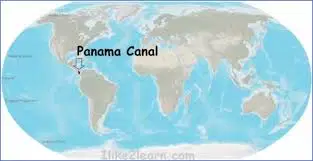
The map below shows the location of the Panama Canal...Which of the following best describes the importance of completing the Panama Canal
a)
Created a security buffer between South America and the United States
b)
Made it easier for U.S. NAVAL and merchant ships to move between the Pacific and Atlantic Ocean
c)
It prevented cheap Latin American goods from flooding the U.S. market
d)
It allowed for a direct trade route from Europe to east Asia
48.
President William Howard Taft developed the Dollar Diplomacy policy to support —
a)
United States citizens traveling to Europe
b)
equal trading rights in Japan
c)
United States businesses investing in Latin America
d)
trade with the Philippines
49.
Between 1900 to 1914, Germany tripled its spending on warships, making it Europe's 2nd strongest Navy.
a)
Militarism
b)
Alliances
c)
Imperialism
d)
Nationalism
50.
What were the Fourteen Points?
a)
a plan for the post-war world peace authored by President Woodrow Wilson
b)
the constitution for the League of Nations - a secret alliance system
c)
the final terms of surrender for Germany, authored by Russian leader Lenin.
d)
the foundation for the "war guilt" clause
100 %

