wayground logo

Free Printable Worksheets

NEW

Font size

S
M
L
XL
Worksheets

1st Year Christmas Exams Revision

Total questions: 69

Worksheet time: 48mins
Name
Class
Date
1.

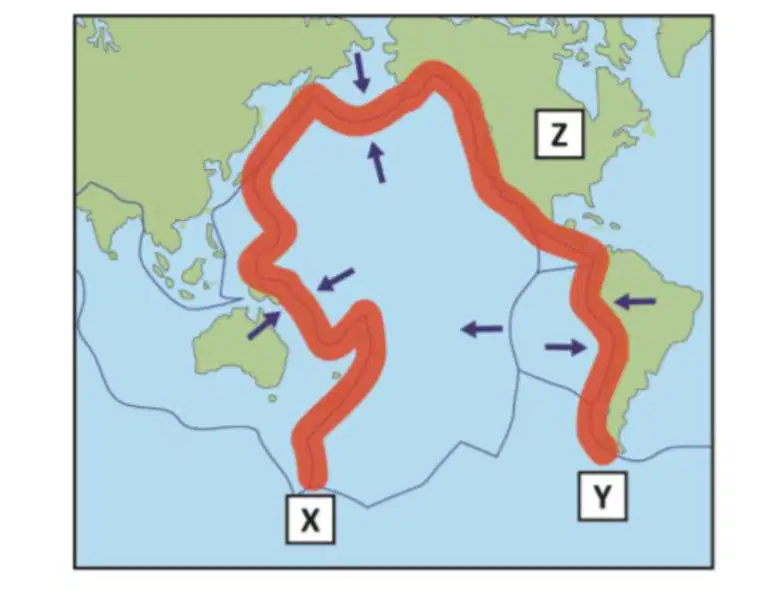
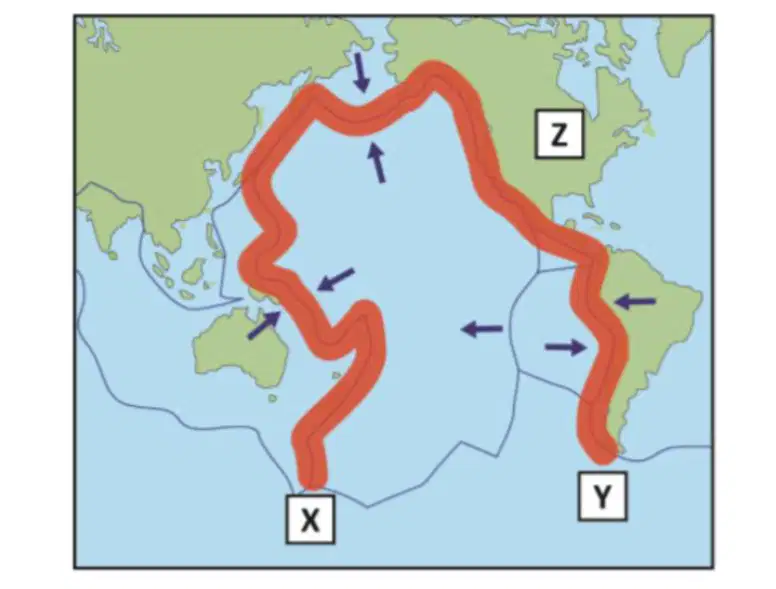
What is area marked X-Y known as?

a)

Pacific Ring of Fire

b)
Seismic Belt
c)
Zone of Volcanic Activity
d)
Belt of Earthquakes
2.

A seismometer is an instrument used to measure force and how long an earthquake lasts.

a)

True

b)

False

3.

At the Pacific Ring of Fire do plates collide or separate?

a)
Plates separate.
b)
Plates collide.
4.

The liquid rock is called ______

a)

crust

b)

ash

c)

magma

5.

What´s that?

a)

Ash cloud

b)

Lava

c)

Magma

6.

What´s that?

a)

crater

b)

magma

c)

lava

7.

What is a dormant volcano?

a)

molten rock

b)

the center of a volcano

c)

will never erupt again

d)

a volcano that is sleeping, but could erupt agian
8.
A dead volcano is called what?
a)
active
b)
dormant
c)
extinct
9.
Which of the following terms are used to describe a volcano that may erupt at any time? 
a)
Dormant volcano
b)
Active volcano
c)
Extinct volcano
d)
Shield volcano
10.

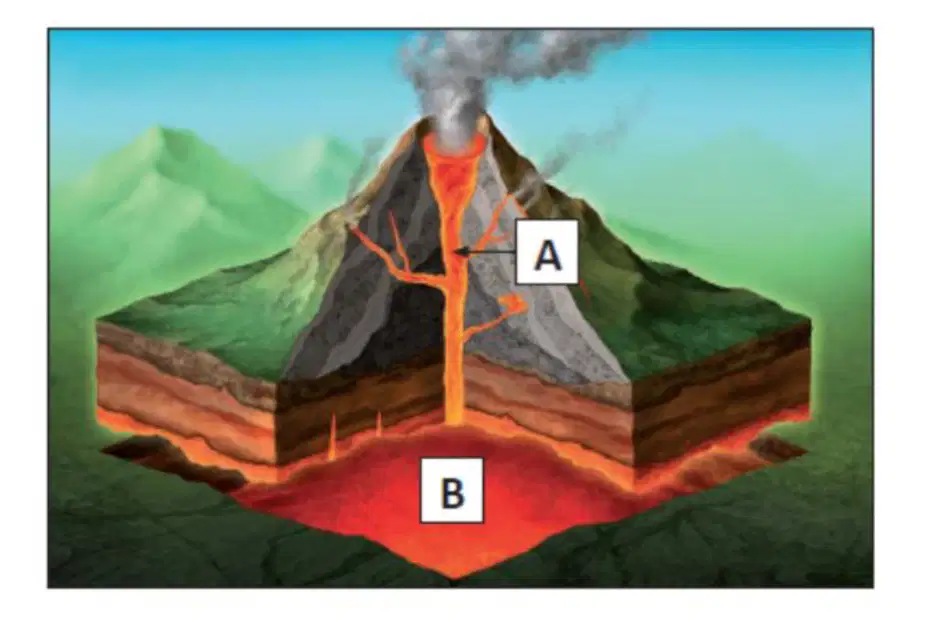
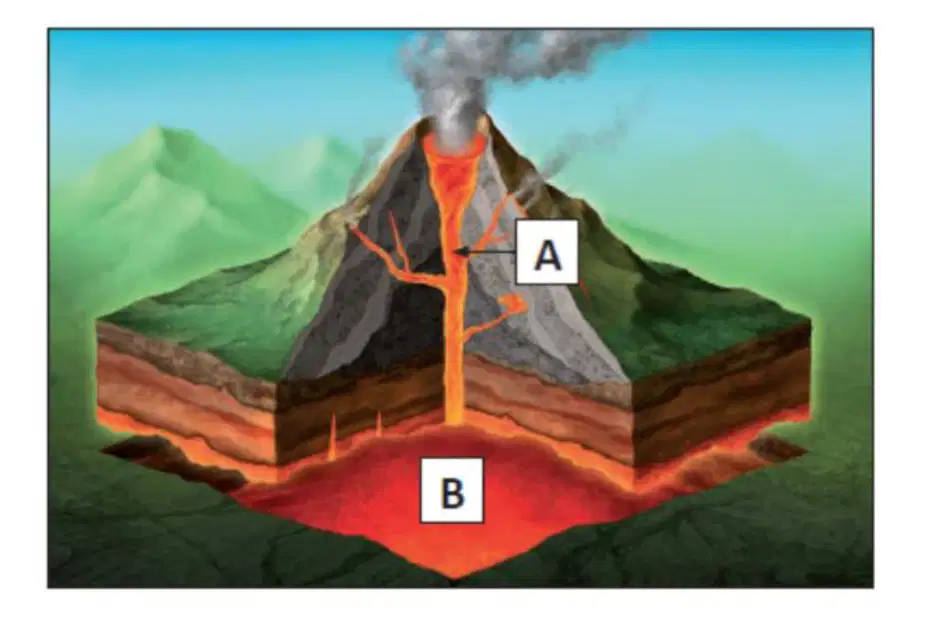
What’s the part labelled A known as?

a)

Magma chamber

b)

Vent

c)

Crater

d)

Parasitic Cone

11.

What is located at B?

a)
Magma chamber
b)
Volcanic vent
c)
Lava flow
d)
Crustal rock
12.

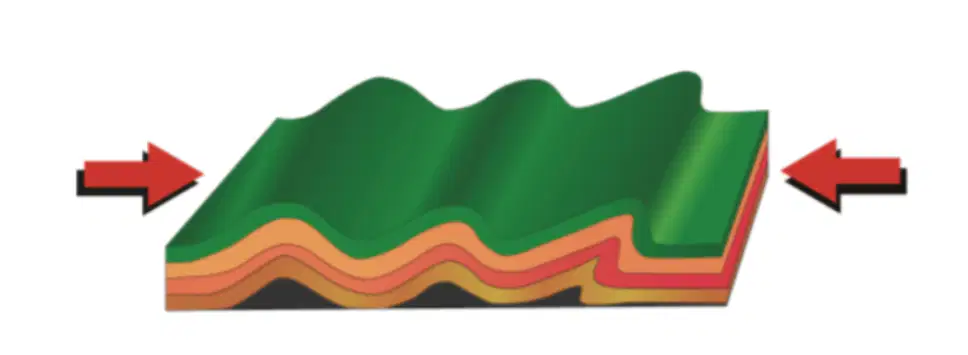
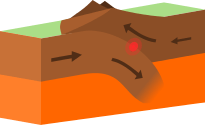
What process in occurring?

a)

Erosion

b)

Deposition

c)

subduction

d)

folding

13.
Which type of rock forms from extreme heat and pressure?
a)
Igneous
b)
Sedimentary
c)
Organic
d)
Metamorphic
14.
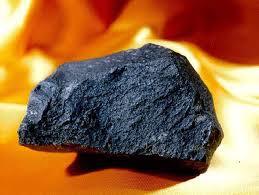
This rock was found near the mouth of a volcano. What type of rock is this?
a)
Sedimentary
b)
Igneous
c)
Metamorphic
15.
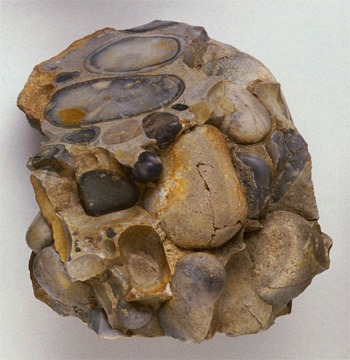
This rock was formed by smaller pieces of rock that settled at the bottom of a lake millions of years ago. What type of rock is this?
a)
Sedimentary
b)
Igneous
c)
Metamorphic
16.

What scale is used to measure the strength of an earthquake?

a)
Geological hazard scale
b)
Seismic intensity scale
c)
Tsunami warning scale
d)
Richter scale or Moment Magnitude scale (Mw)
17.

Name of fold mountain range found in Europe

a)
The Alps
b)
The Pyrenees
c)
The Carpathians
d)
The Apennines
18.

Name a fold mountain range found in South America

a)
Andes
b)
Appalachian Mountains
c)
Himalayas
d)
Rocky Mountains
19.

Name a fold mountain range found in North America

a)
Sierra Nevada
b)
Appalachian Mountains
c)
Cascade Range
d)
Rocky Mountains
20.

Where in Ireland can limestone be found

a)

Connemara

b)

The Burren, County Clare.

c)

The Giants Causeway, Co. Antrim

d)

Croagh Patrick, Co. Mayo

21.

Where in Ireland can basalt be found

a)
Killarney National Park, County Kerry
b)

The Burren , County Clare

c)
Cliffs of Moher, County Clare
d)
Giant's Causeway, County Antrim
22.

Where in Ireland can marble be found

a)

The Giants Causeway, Co. Antrim

b)

Green Marble in Connemara, County Galway

c)

The Burren, Co. Clare

d)
County Dublin
23.

What type of rock is Limestone

a)
Sedimentary rock
b)
Volcanic rock
c)
Metamorphic rock
d)
Igneous rock
24.

What type of rock is Basalt

a)
Metamorphic rock
b)
Igneous rock
c)
Sedimentary rock
d)
Volcanic rock
25.

What type of rock is marble

a)
Metamorphic rock
b)
Volcanic rock
c)
Sedimentary rock
d)
Igneous rock
26.

What type of rock is Quartzite

a)
Igneous rock
b)
Metamorphic rock
c)
Sedimentary rock
d)
Volcanic rock
27.

Suggest one way how cities can protect themselves from earthquakes
a)
Build taller skyscrapers for better views.
b)
Increase the number of parking lots in the city.
c)
Implement strict building codes for earthquake-resistant structures.
d)
Encourage more outdoor festivals and events.
28.

Whats the plate labelled Z called?

a)
Atlantic Plate
b)
Eurasian Plate
c)

North American Plate

d)
Indian Plate
29.

Once the earths continents are we know them today were all stuck together forming one large landmass called….

a)
Laurasia
b)
Gondwana
c)
Atlantis
d)
Pangaea
30.

The plates constantly moving. This is process known as …..

a)
continental drift
b)
oceanic currents
c)
plate tectonics
d)
tectonic shifts
31.

True or False: Plates move due to ocean currents.

a)
True
b)
False
32.

True or False: The Earth’s crust is its thinnest layer.

a)
False
b)
True
33.

True or False: The inner core is the hottest layer of the earth.

a)
False
b)
True
34.

True or False: Continents are moving very slowly.

a)
True
b)
False
35.

Name one environmental impact of exploiting rocks?

a)
Air contamination
b)
Habitat destruction
c)
Water pollution
d)
Soil erosion
36.

Name one social impact of exploiting rocks?

a)
Increased biodiversity
b)
Enhanced local economy
c)
Improved infrastructure
d)
Displacement of local communities
37.

Name one economic impact of exploiting rocks?

a)
Decreased job opportunities in mining sectors.
b)

Increased job opportunities in mining sectors.

c)
Lower demand for construction materials.
d)
Reduced investment in local businesses.
38.

(a)       Living and working in a mountainous area has its advantages and disadvantages. Explain ONE advantage and ONE disadvantage.

a)
Advantage: Abundant wildlife and outdoor activities; Disadvantage: Harsh weather conditions and limited job opportunities.
b)
Advantage: Peaceful environment and low crime rates; Disadvantage: High cost of living and poor infrastructure.
c)
Advantage: Strong sense of community and local culture; Disadvantage: Difficulty in transportation and fewer entertainment options.
d)
Advantage: Fresh air and beautiful scenery; Disadvantage: Isolation and limited access to services.
39.

Which is the anticline and syncline

a)
Anticline is the downward arching fold; syncline is the upward bending fold.
b)
Anticline is a horizontal layer; syncline is a vertical layer.
c)
Anticline is the upward arching fold; syncline is the downward bending fold.
d)
Anticline is a flat structure; syncline is a steep structure.
40.

The place on the Earth's surface, above the origin of the earthquake.

a)

Epicenter

b)

Focus

c)

Surface

d)

Crust

41.

The place where an earthquake originates inside the Earth's surface is called...

a)

Epicenter

b)

Focus

c)

Underground

d)

Crust

42.
What type of plate boundary is this?
a)
Plate
b)
Divergent
c)
Convergent
d)
Transform
43.
A divergent boundary occurs when plates ....
a)
Pull apart
b)
Come together
c)
Slide past each other
d)
subducting
44.

Which of the following is the name of the ancient supercontinent formed 280 Million Years ago.

a)

Pangea

b)

Gondwanda

c)

Laurasia

d)

Neverland

45.
The outside layer of the earth is called ______________________.
a)
core
b)
crust
c)
mantle
d)
outer core
46.
What are the names of the two types of crust
a)
continental and oceanic
b)
ocean and upper
c)
lower and upper
d)
pizza and subway
47.
The Earth's crust is made up of several __________ that are like puzzle pieces. 
a)
puzzle pieces
b)
crust parts
c)
saucers
d)
tectonic plates
48.
What is a tectonic plate?
a)
A unknown continent
b)
A piece of the crust of Earth
c)
An ancient plate from the Aztec
d)
A plate that is stronger than iron.
49.
What causes the tectonic plates to move?
a)
Wind
b)
Convection currents
c)
Tides
d)
Lava
50.
Which of the following occurs because of convection currents?
a)
Tectonic plates on the crust move.
b)
The mantle increases in size.
c)
Pressure in the crust increases.
d)
Pressure in the crust decreases.
51.
In the mantle magma rises and sinks, this is called ______________. 
a)
a conduction current
b)
a hot spot
c)
a volcanic eruption
d)
a convection current
52.
What is the process which suggests that the continents are carried by convection currents in the mantle
a)
mantle movement
b)
crust circulation
c)
break movement
d)
continental drift
53.

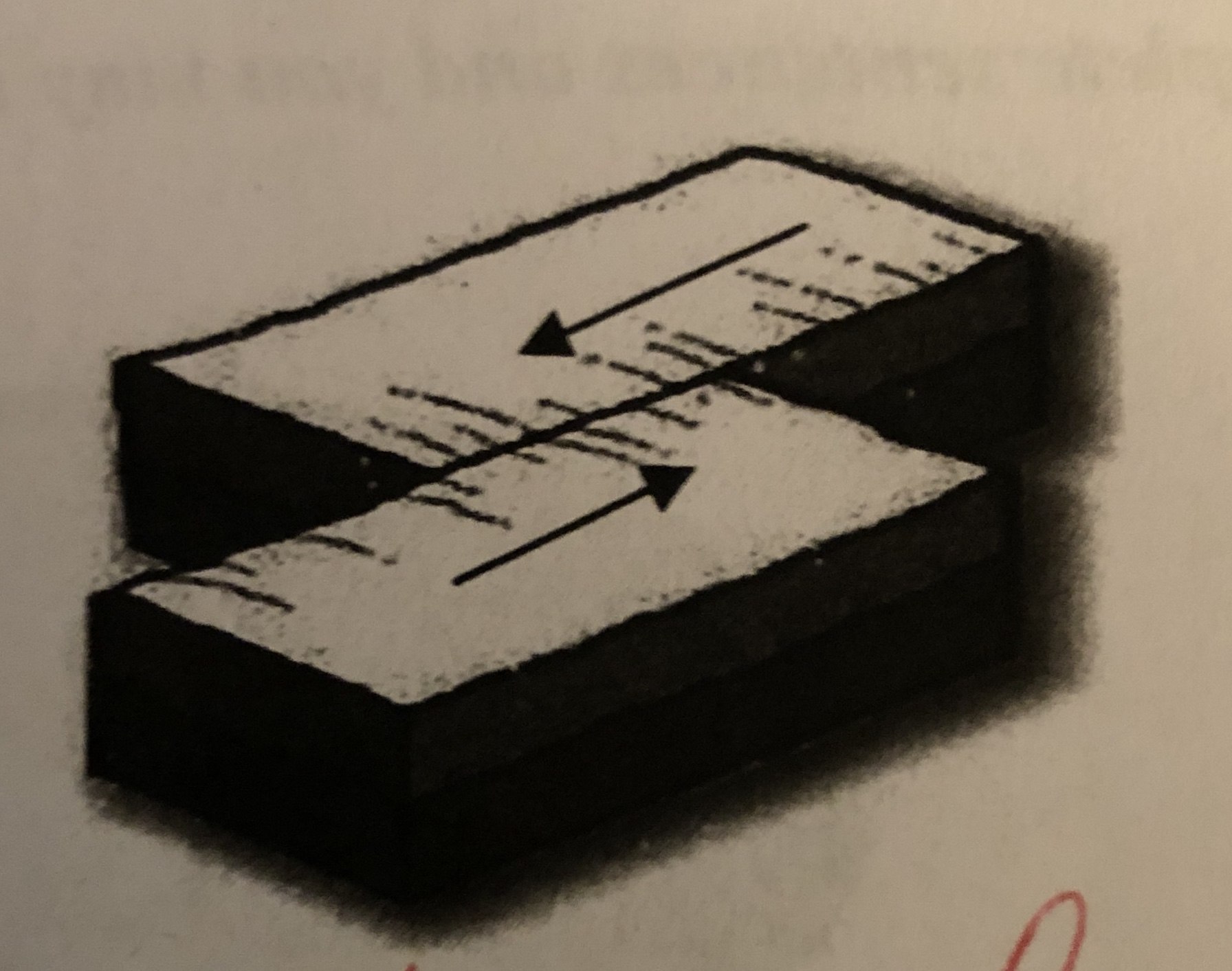
The diagram illustrates a strike slip fault. What is another name for a strike slip fault?

a)

convergent subduction boundary

b)

convergent collision boundary

c)

transform boundary

d)

divergent boundary

54.

Two plates that move away from each other are..

a)

Divergent

b)

Converging

c)

Transforming

d)

None of the above

55.

Mountains are formed at ______ plate boundaries

a)

transform

b)

divergent

c)

convergent

d)

None of the above

56.

What type of boundary is this?

a)

convergent

b)

divergent

c)

transform

57.
Name the boundary
a)
convergent boundary
b)
divergent boundary
c)
transform boundary
d)
sergent boundary
58.
Name the boundary
a)
convergent boundary
b)
divergent boundary
c)
transform boundary
d)
sergent boundary
59.
Convergent Plate Movement can create
a)
Rifts
b)
Mountains
c)
Ocean Ridges
d)
Radiation
60.
Divergent Plate movement can create
a)
Convection Currents
b)
Conduction
c)
Mountains
d)
Rifts and ocean ridges
61.
A Plate Boundary where two plates move toward each other is called
a)
Convergent Boundary
b)
Divergent Boundary
c)
Transform Boundary
d)
Subduction
62.
A plate boundary where two plates move away from each other is called
a)
Divergent Boundary
b)
Convergent Boundary
c)
Transform Boundary
d)
Subduction
63.
Which of the following is where one plate slides under another plate?
a)
submarine zone
b)
divergence zone
c)
subduction zone
d)
lower zone
64.

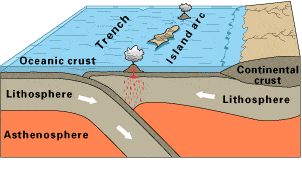
Observe this diagram of a plate boundary. One statement BEST describes what is happening. It is that

a)

the oceanic crust is melting.

b)

the denser ceanic crust is subducting under the less dense oceanic crust

c)

volcanic islands are forming.

d)

the tectonic plates are moving away from each other.

65.
What type of event will occur at this boundary?
a)
Earthquake
b)
Volcano Eruption
c)
Tornado
d)
Mountain Building
66.
What geologic feature/event would you most likely to find at a divergent boundary between two pieces of oceanic crust?
a)
Rift Valley
b)
Mid-Ocean Ridge
c)
Island Arc
d)
Flat land
67.

What are the three types of plate boundaries?

a)

Divergent boundaries, convergent boundaries, and transform boundaries

b)

Subduction boundaries, collision boundaries, and sliding boundaries

c)

Tectonic boundaries, fault boundaries, and rift boundaries

d)

Oceanic boundaries, continental boundaries, and island boundaries

68.

What is the term for the shaking or trembling of the Earth's surface caused by the sudden release of energy in the Earth's crust?

a)

ground shaking

b)

tremor

c)

seismic activity

d)

earthquake

69.

Why does oceanic crust subduct below continental crust?

a)

Continental crust is denser than oceanic crust

b)

Oceanic crust is more drawn to earth's iron core

c)

Oceanic crust is denser than continental crust

d)

Oceanic crust is further below continental crust so it's the first to subduct