
NEW
Font size
 Worksheets
U.S. History: Reagan and the Cold War (Worksheet Extraction)
Total questions: 35
Worksheet time: 18mins
What was the focus of the congressional investigation into the Iran-Contra Affair?
U.S. military involvement in Middle Eastern countries
U.S. government involvement in an arms exchange program
U.S. secret operations to destabilize the Shah’s government
U.S. security efforts to reduce drug smuggling over borders
Which action did President Reagan encourage to help end the Cold War? "If we’re destined by history to compete, militarily, to keep the peace, then let us compete in systems that defend our societies rather than weapons which can destroy us both and much of God’s creation along with us." —Ronald Reagan, October 24, 1985
establishment of strict economic sanctions
publication of classified information
development of strategic defense initiatives
deployment of troops as peacekeepers
Use the list below to answer the question. Accomplishments of President ________ ? • Served during the end of the Cold War • Promoted fiscally conservative policies • Increased military spending Which name completes this title?
John F. Kennedy
Lyndon B. Johnson
Jimmy Carter
Ronald Reagan
What was President Ronald Reagan’s response to the Soviet policy of glasnost?
He negotiated a treaty to cut agricultural subsidies in both countries.
He dismissed the diplomatic approach as anti-American propaganda.
He set aside ideological differences to find common political ground.
He asked Congress to increase import tariffs to protect domestic goods.
Which two leaders agreed to the Intermediate-Range Nuclear Forces (INF) Treaty in 1987?
Harry S. Truman and Josef Stalin
John F. Kennedy and Nikita Khrushchev
Richard M. Nixon and Leonid Brezhnev
Ronald Reagan and Mikhail Gorbachev
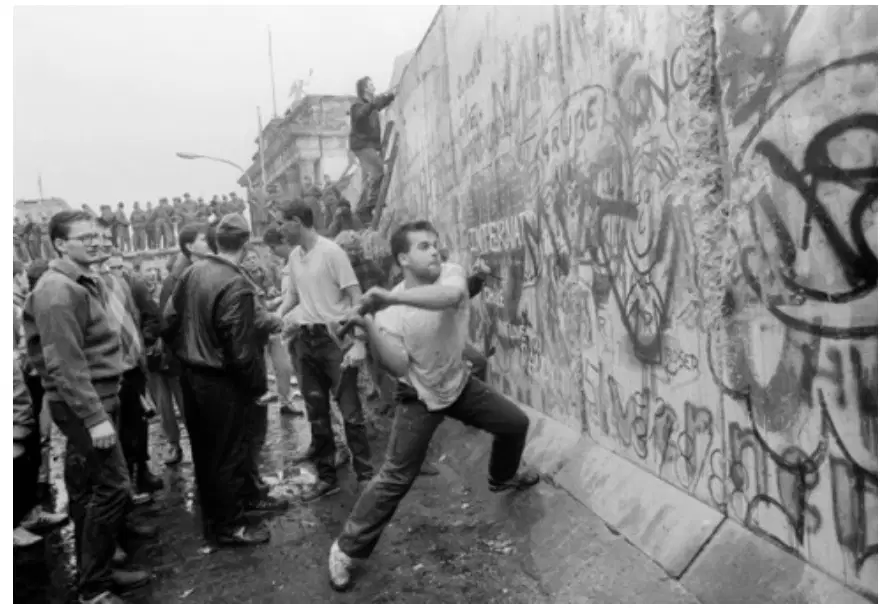
This picture shows an event in 1989. Why is this event considered a turning point in the Cold War?
It left the Soviet Union open to invasion from Western Europe.
It removed a physical and symbolic barrier between Eastern and Western Europe.
It brought Germany into the Warsaw Pact as a full partner.
It proved that the American military was stronger than the Soviet military.
President Reagan’s policy of trickle-down economics relied on what idea to stimulate the economy?
raising taxes on the wealthy to fund social programs
creating jobs by increasing government programs
increasing government regulation of the economy
lowering taxes and reducing government spending
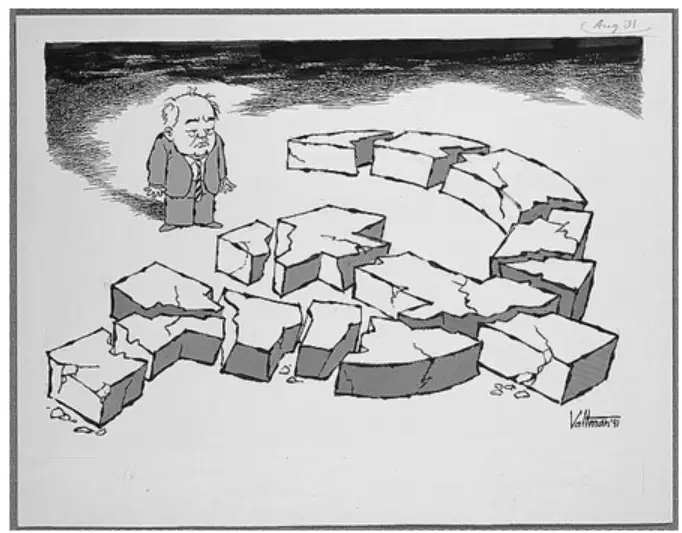
This political cartoon by Edward Valtman was published in The Waterbury Republican in 1991. What would Ronald Reagan argue was the cause of the situation depicted in this cartoon?
the increased military spending during the 1980s designed to put enormous pressure on the Soviet Union
the theory of realpolitik that dominated the negotiations with the Soviet Union conducted by Secretary of State Henry Kissinger
the pursuit of détente by President Richard Nixon during his trips to Moscow and China
the impact of various revolutionary movements in Eastern Europe during the previous decade

This is the headline from The New York Times on January 21, 1981. Based on this headline, which idea best reflects the national mood during the four years prior to this event?
Americans were happy in the late 1970s and pleased to have another Democratic president.
Americans were troubled by the economic and foreign policy issues of President Carter.
Americans were solely focused on winning the Cold War and building the space program.
Americans were supportive of President Carter’s handling of the Iran Hostage Crisis.
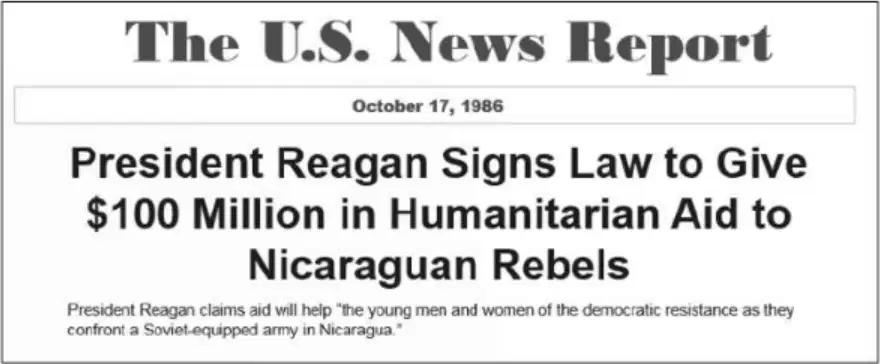
This headline could have appeared in a newspaper in 1986. The action in this headline supports what conclusion about American humanitarian aid?
The United States provides humanitarian aid to groups in need despite ideological differences.
The United States is committed to helping end poverty in all parts of the world.
The United States sometimes uses humanitarian aid to support its political agenda.
The United States only provides humanitarian aid in the event of a natural disaster.
This is an excerpt from President Ronald Reagan’s Inaugural Address in 1981:
"Idle industries have cast workers into unemployment, human misery, and personal indignity. Those who do work are denied a fair return for their labor by a tax system which penalizes successful achievement and keeps us from maintaining full productivity."
What tactic did President Reagan use to address the problem he mentions in this excerpt?
increasing government spending to create jobs
providing tax breaks for businesses
extending welfare benefits to more citizens
raising taxes on the wealthiest citizens
This is a list of economic policies enacted by a president:
*reduced corporate taxes;
*increased defense spending;
*lowered personal income tax rates;
*reduced government spending on social programs.
Which president enacted these economic policies?
Jimmy Carter
Ronald Reagan
Bill Clinton
Barack Obama
This is a description of a popular group in the 1980s:
"The Moral Majority was a fundamentalist Christian organization founded by televangelist Jerry Falwell in 1979. The Moral Majority was established to preserve 'traditional' American values and to combat increasing support for social movements and culture changes. The organization opposed gay rights, abortion, feminism, and other liberal movements during the 1980s."
How did this group impact the United States?
It contributed to a conservative resurgence in the country.
It led to increased support for social welfare programs.
It weakened support for Republican candidates in elections.
It influenced southerners to join the Democratic Party.
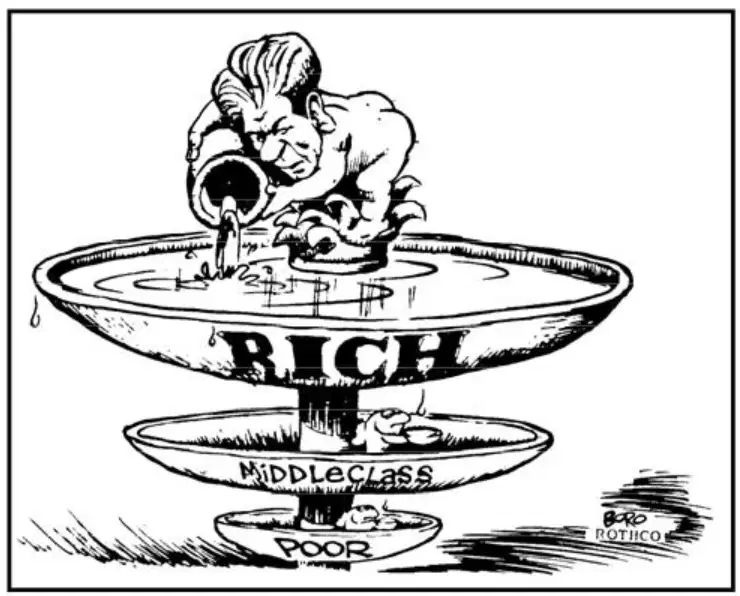
This political cartoon depicts President Ronald Reagan. What criticism of President Reagan’s economic policies is reflected in this cartoon?
The poor received too much government assistance as part of President Reagan’s policies.
The rich benefited the most from President Reagan’s policies.
The middle class grew too large as a result of President Reagan’s policies.
The rich paid too-high tax rates under President Reagan’s policies.

This is an excerpt from the Republican Party platform of 1980. Based on this excerpt, what were the goals of the Republican Party in 1980?
adoption of a pro-choice amendment and more separation between church and state
passage of laws to protect Americans in the workplace and an equal rights amendment
less government regulation in business and a stronger foreign policy
more oversight over banks and a peaceful approach toward the Soviet Union
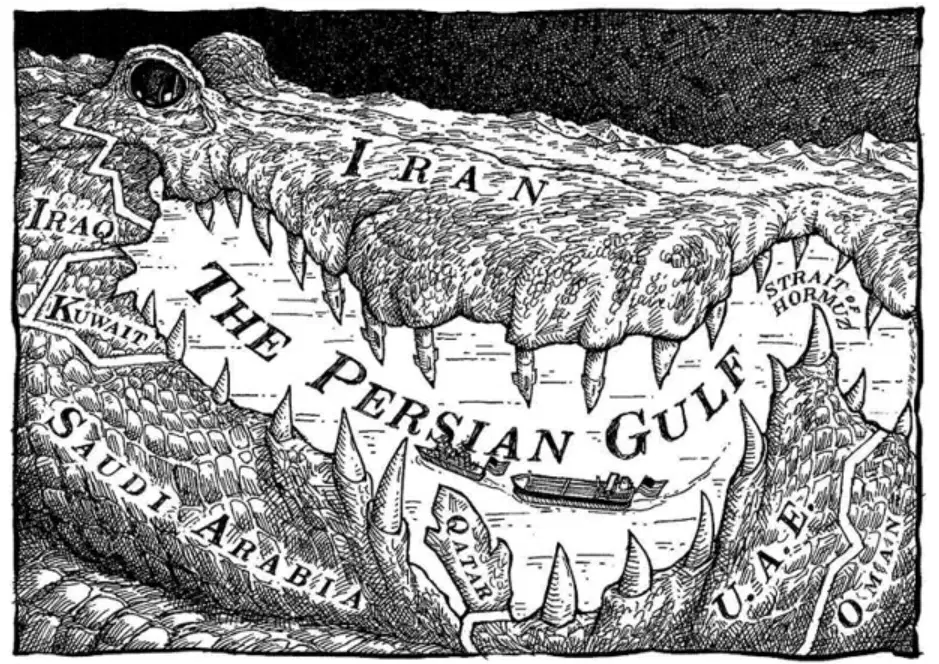
This political cartoon was published in 1990. The illustration shows the words “The Persian Gulf” inside the open jaws of a crocodile-like monster made of surrounding countries labeled Iran, Iraq, Kuwait, Saudi Arabia, Qatar, U.A.E., and Oman, with a tanker ship in the water. This cartoon expressed the concern that what region of the world posed a threat to the United States?
Africa
Asia
Latin America
Middle East
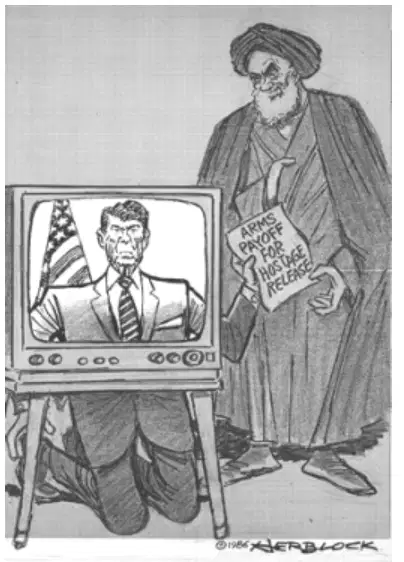
Analyze the political cartoon, and answer the question. The image shows a U.S. leader on television while kneeling before a robed figure holding a sign that reads “Arms for the Release of Hostages.” What political scandal is depicted in this cartoon?
Teapot Dome
Watergate
Iran-Contra
Whitewater
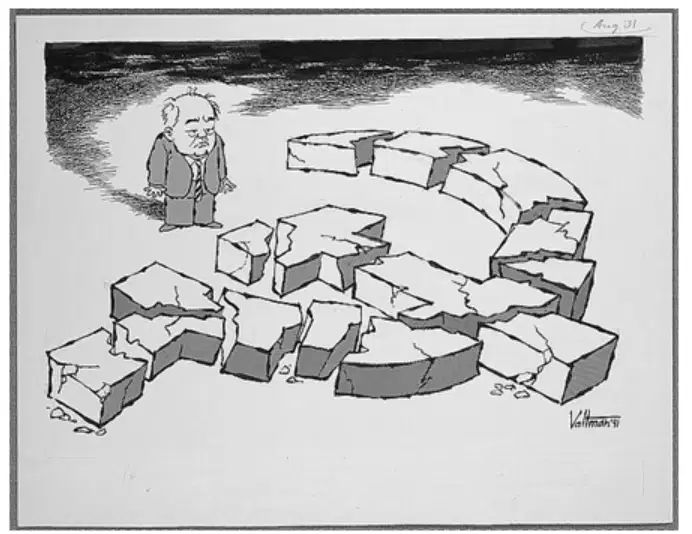
This political cartoon by Edward Valtman was published in The Waterbury Republican in 1991. It depicts a large hammer-and-sickle symbol breaking apart into scattered pieces while a statesman looks on. What event is Valtman referencing in this cartoon?
the dissolution of the Soviet Union
the fall of China to communism
the destruction of the Berlin Wall
the Paris Accords ending the Vietnam War
This is an excerpt from an account of a resident of the Love Canal neighborhood in New York.
“It is really something, if you stop and think about it, that underneath [the] field were poisons, and on top of it was a grade school and a playground. We later found out that the Niagara Falls School Board knew the filled-in canal was a toxic dump site. We also know that they knew it was dangerous because, when the Hooker Chemical Corporation sold it to them for one dollar, Hooker put a clause in the deed declaring that the corporation would not be responsible for any harm that came to anyone from chemicals buried there. That one-dollar school site turned out to be some bargain!”
The information in this excerpt led to which action by the federal government?
taking over private chemical companies to ensure they operated within safety guidelines
approving land purchases made by public school systems to ensure soil was properly tested
passing regulations to minimize the environmental impact of pollution
suing chemical companies to force them to pay the medical expenses for affected residents
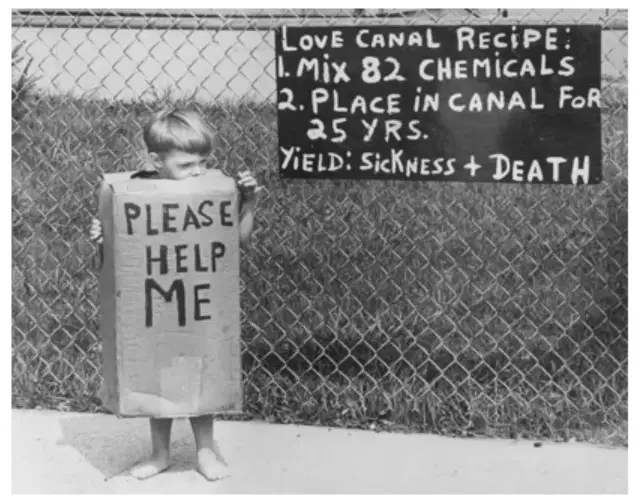
This photograph was taken in 1978. How did the message in this photograph impact the United States?
It brought attention to the harmful effects of environmental pollution.
It increased awareness about the impact of poverty on children.
It reduced support for the use of government regulations on large corporations.
It increased support for the use of nuclear power to provide energy for the nation.
President Ronald Reagan’s social and economic policies were reflective of a shift toward which idea?
conservatism
isolationism
liberalism
sectionalism
How did the Moral Majority movement influence the politics of the 1970s and 1980s?
It encouraged a greater emphasis on environmental protection and an end to pollution.
It influenced leaders to take a more conservative approach to addressing social issues.
It advocated for a reduction in defense spending as a strategy to end the Cold War.
It pushed for government-sponsored programs to address social issues such as poverty.

This headline reports on an event during the 1970s. How was America’s energy policy impacted by this headline?
All nuclear power plants in the nation were shut down because they were too dangerous.
Fears of additional accidents led to a ban on the construction of new power plants.
More power plants were built because the need for inexpensive energy outweighed the risks.
Nuclear power plants were moved from densely populated areas to rural parts of the country.
What statement best summarizes the impact of Roe v. Wade?
Men and women began receiving equal pay for equal work.
Gender discrimination became illegal.
Women were granted the right to get an abortion.
Women were permitted to take maternity leave.
Which president would most likely agree with Ronald Reagan's trickle-down economic policies?
Herbert Hoover
Franklin D. Roosevelt
Lyndon B. Johnson
John F. Kennedy

This is the headline from The New York Times on December 20, 1989. Why did President George H. W. Bush authorize the action in this headline?
to combat drug trafficking and stop drugs from coming into the United States from Panama
to take control of the Panama Canal and ensure the United States could use it
to prevent the Panamanian leader from taking over other Latin American countries
to liberate Panama after it was invaded by Colombia’s totalitarian leader
Why did the United States become involved in the Persian Gulf War?
to obtain access to more oil in the Middle East
to protect their ally, Kuwait, and maintain stability in an oil-rich region
to overthrow the dictatorship of Saddam Hussein
to limit the spread of terrorist camps across the Middle Eastern region
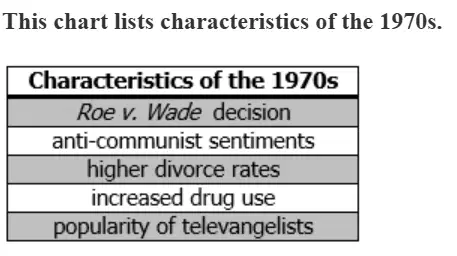
This chart lists characteristics of the 1970s. What impact did these characteristics have on the United States in the 1980s?
They led to a decline in the number of churches in the nation.
They led to the election of a liberal president.
They led to a resurgence in the conservative movement.
They led to more support for welfare programs.
In the early 1990s, the United States became involved in the Persian Gulf War because Iraq invaded the nation of ______.
Afghanistan
Iran
Kuwait
Saudi Arabia
As president, Ronald Reagan proposed an economic plan that came to be nicknamed “Reaganomics.” As part of this plan, what action did President Reagan propose to improve the economy?
expanding social welfare programs
providing tax cuts to the wealthy
increasing the national debt
raising taxes on large corporations
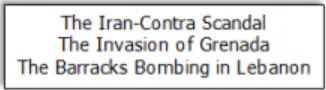
Study the list, and answer the question. In what decade did these events take place?
1960s
1970s
1980s
1990s
What impact did the fall of the Berlin Wall have on East and West Germany?
After the fall of the Berlin Wall, Germany was left weak and was invaded by the Soviet Union.
After the fall of the Berlin Wall, the two countries were united under communist rule.
After the fall of the Berlin Wall, the two countries were united under democratic rule.
After the fall of the Berlin Wall, countries like France and Great Britain became communist.
Which event symbolized the end of the Cold War and the collapse of communist control in Eastern Europe?
The signing of the Camp David Accords
The fall of the Berlin Wall
The Watergate scandal
The Cuban Missile Crisis
What was a significant consequence of the Iran-Contra Affair for the Reagan administration?
It led to the resignation of the Vice President
It resulted in increased public distrust of the government
It ended all U.S. aid to Central America
It caused the United States to withdraw from the United Nations
What was the Strategic Defense Initiative ("Star Wars") that increased defense spending under Reagan?
a bomber plane
a communications system
a missile defense system
a type of nuclear bomb

