wayground logo

Free Printable Worksheets

Font size

S
M
L
XL
Worksheets

AMERICAN REVOLUTION TEST - Regular

Total questions: 32

Worksheet time: 16mins

Name
Class
Date
1.
1) Which was an advantage of the AMERICAN COLONISTS entering the American Revolution?
a)
knowledge of the land
b)
a powerful navy
c)
well trained, experienced soldiers that wore redcoats
2.
2) Which was an advantage of the BRITISH entering the American Revolution?
a)
a powerful navy
b)
the leadership and experience of George Washington
c)
a desire for independence
3.
4) Which of the following is TRUE about the Battle of Bunker Hill?
a)
The British started with the high ground.
b)
The colonists suffered more casualties than the British.
c)
It took the British three times tries up the hill before capturing the hill.
4.
5) What was the significance of the Battle of Bunker Hill?
a)
It proved neither side would not be easy to defeat.
b)
It was the battle that convinced the French to join the colonists.
c)
It was the last victory for the colonists.
5.
6) Which of the following was an action taken by the SECOND CONTINENTAL CONGRESS?
a)
voted on the 1st President of the United States
b)
made the wild turkey America's official animal
c)
sent the Olive Branch Petition to be sent to England
6.
8) The Second Continental Congress met in ...
a)
Boston
b)
New York
c)
Philadelphia
7.
9) The president of the Continental Congress was ... (HINT: He signed his name LARGE on the Declaration of Independence so King George would have no trouble reading it!)
a)
George Washington
b)
John Adams
c)
John Hancock
8.
10) Colonel George Washington was appointed General of the Continental Army by the Continental Congress. Which BEST describes the men he was getting in his army?
a)
20,000 men in the Massachusetts militia who had little fighting experience
b)
Mostly mercenary soldiers from other countries
c)
The army was mostly made up of colonists who remained loyal to Britain
9.
11) The British left Boston in the spring of 1776 because ...
a)
George Washington joined the British Navy.
b)
More than 15,000 Massachusetts militia men surrounded the city of Boston.
c)
The American navy blockaded the port of Boston.
10.
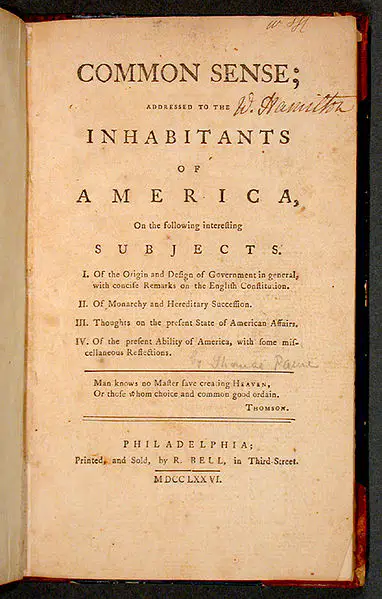
12) Who was the author of the pamphlet, Common Sense?
a)
Thomas Jefferson
b)
Thomas Paine
c)
George Washington
11.
13) What was the purpose of the pamphlet, Common Sense?
a)
To convince Parliament to repeal all of the taxes
b)
To convince colonists to remain loyal to King George III
c)
To convince colonists that independence from Britain was necessary
12.
14) What is the meaning of the excerpt from Common Sense: "Small islands not capable of protecting themselves, are the proper objects for kingdoms to take under their care; but there is something very absurd, in supposing a continent to be perpetually governed by an island".
a)
The call for independence is tough, but when it is done, it will feel right.
b)
There should be no more calls for peace with the British.
c)
It doesn't make sense to have the island of Britain ruling over the continent of America from thousands of miles away.
d)
13.
16) A major idea found in the DECLARATION of INDEPENDENCE is that people are born with certain...
a)
Breakup Rights
b)
Bye bye baby rights
c)
Natural Rights
14.
17) Which list identifies the THREE main ideas in the DECLARATION OF INDEPENDENCE?
a)
Natural Rights, Bye Bye Baby, Electing a President
b)
Natural Rights, British Wrongs, Independence
c)
I Love History, Independence, Future Security
15.
18) Who was the main author of the Declaration of Independence?
a)
Thomas Jefferson
b)
Thomas Paine
c)
Samuel Adams
16.
19) Americans officially declared their independence from Britain on ...
a)
June 17, 1775
b)
July 4, 1776
c)
December 25, 1776
17.
20) What is the meaning of the excerpt from the Declaration of Independence: "We hold these truths to be self-evident, that all men are created equal; that they are endowed with certain unalienable rights, that among these are life, liberty, and the pursuit of happiness".
a)
Individuals have some basic rights that are obvious and should not be taken away.
b)
The citizens have the right to change or replace the government.
c)
England has repeatedly interfered with colonists’ rights.
d)
18.
21) The BRITISH captured this city in 1776 (after the Battle of Long Island) and drove Washington's army into New Jersey.
a)
Saratoga (New York)
b)
New York City (New York)
c)
Pittsburgh (Pennsylvania)
19.
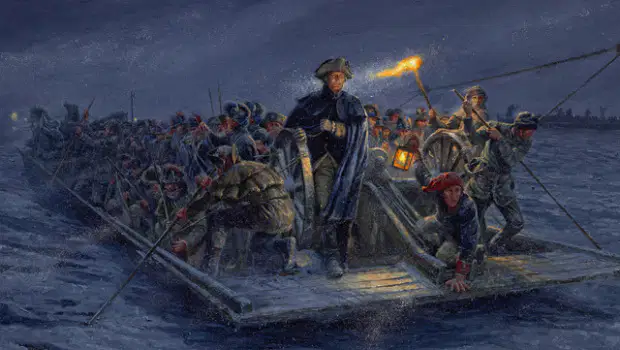
22) What was one reason that factored into George Washington's decision to attack Trenton?
a)
Armies didn't normally fight during the winter time ... and the British would be surprised.
b)
Washington flipped a coin ... it was "heads" so the attack was on!
c)
The Continental Army was on a winning streak at that time.
20.
23) What BEST describes the outcome of the Battle of Trenton?
a)
George Washington and his men surrounded British General Charles Cornwallis on a peninsula.
b)
The French decided to become allies with America.
c)
George Washington and his men captured the Hessians and the city of Trenton.
21.
24) Which BEST describes why American soldiers were successful at the Battle of Trenton?
a)
They used guerrilla warfare to pick off Native American scouts.
b)
They used the element of surprise by attacking during a holiday.
c)
They placed cannons on top of a hill overlooking Trenton.
22.
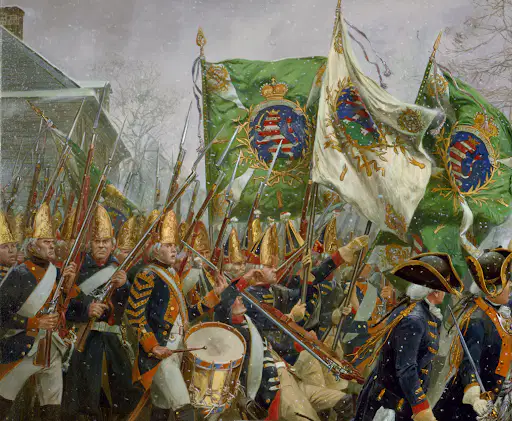
25) At the Battle of Trenton, Who were the Hessians?
a)
German mercenaries
b)
French soldiers hired to fight for the Americans
c)
Colonists who wrote letters to various colonies on important events
23.

African American's during the Revolutionary War fought for,,,,,,,,

a)
loyalty to Britain
b)
wealth and power
c)
freedom and rights
24.

How did women influence the American Revolutionary War?

a)
Women influenced the war by leading military campaigns and drafting treaties.
b)
Women influenced the American Revolutionary War by managing resources, supporting boycotts, and participating in various roles including spies and nurses.
c)
Women contributed by forming alliances with Native American tribes and British loyalists.
25.

Why was The Battle of Saratoga considered the turning point of The Revolutionary War?

a)
The battle led to immediate British surrender and peace negotiations.
b)
It was primarily fought over control of New York City and its resources.
c)
The Battle of Saratoga is considered the turning point of The Revolutionary War because it secured French support for the American cause.
26.

Who served as a diplomat with the French in order to get them on the American side during The Revolutionary War?

a)
John Adams
b)
Thomas Jefferson
c)
Benjamin Franklin
27.

Which of the following was not a hardship faced at Valley Forge?

a)
Harsh winter conditions
b)
Lack of military leadership
c)
Insufficient food supplies
28.

What was the name of the Prussian General who trained the troops at Valley Forge?

a)
General Paul von Hindenburg
b)

Baron Friedrich Wilhelm von Steuben

c)
General Wilhelm von Kluck
29.

How did the fighting in the North differ from that of the South during the Revolutionary War?

a)
The North had conventional battles while the South utilized guerrilla tactics.
b)
The North engaged in skirmishes while the South avoided direct confrontations.
c)
The North relied on guerrilla tactics while the South had conventional battles.
30.

What was the name of the agreement that ended The Revolutionary War?

a)
Treaty of Versailles
b)
Treaty of Ghent
c)
Treaty of Paris
31.

What was the significance of The Battle of Yorktown?

a)
It marked the decisive victory for American forces and led to the end of the Revolutionary War.
b)

It marked the beginning of the Revolutionary War due to it being a major skirmish in the south

c)

It resulted in a temporary truce between the forces of the British, French and Americans.

32.

Who were the 13 Colonies fighting during The Revolutionary War?

a)

Franch

b)

Spain

c)

England