
 Worksheets
H: Benchmark 2
Total questions: 79
Worksheet time: 40mins
Name
Class
Date
1.
what is an example of nonrenewable natural resources? check all that apply
a)
Wind
b)
Oil
c)
Sun
d)
Coal
2.
what is an example of renewable natural resources? check all that apply
a)
Wind
b)
Oil
c)
Sun
d)
Coal
3.
what two major events have changed the course of human history and the way we interact with natural resources? check all that apply
a)
Discovery of smart phones
b)
Agricultural Revolution
c)
Exploration of Space
d)
Industrial revolution
4.
what is an ecological footprint?
a)
Is a count of how many animals and plants are found in a specific ecosystem
b)
Is a way to measure how much food a person needs to eat to stay healthy
c)
Is a measure of the demands made by one person or group on global natural resources
d)
Is a calculation of how many trees and flowers are planted in a local park
5.
An ecological footprint includes? check all that apply
a)
the number of people living in a specific region
b)
the types of animals and plants found in a particular area
c)
the resources needed to dispose of the waste
d)
materials and resources consumed
6.
what is the definition of Tragedy of the Commons?
a)
Refers to a joyful celebration held by a community in honor of their shared resources
b)
When a shared resource is unregulated, individuals will consume it at a selfish rate
c)
Is when people cooperate effectively to manage and conserve shared resources
d)
Is a term used when individuals take good care of shared resources and use them responsibly
7.
We use Inductive Reasoning to?
a)
prove scientific theories and hypotheses
b)
analyze cause-and-effect relationships in experiments
c)
compares new things to the rules of the natural world
d)
look for patterns or rules in the natural world
8.
what type of data uses descriptions and words?
a)
categorical data
b)
quantitative data
c)
qualitative data
d)
Numerical data
9.
We use Deductive Reasoning to?
a)
look for patterns or rules in the natural world
b)
discover new scientific facts and phenomena
c)
analyze historical events and their consequences
d)
compares new things to the rules of the natural world
10.
what type of data uses numbers and measurements?
a)
categorical data
b)
quantitative data
c)
qualitative data
d)
Numerical data
11.
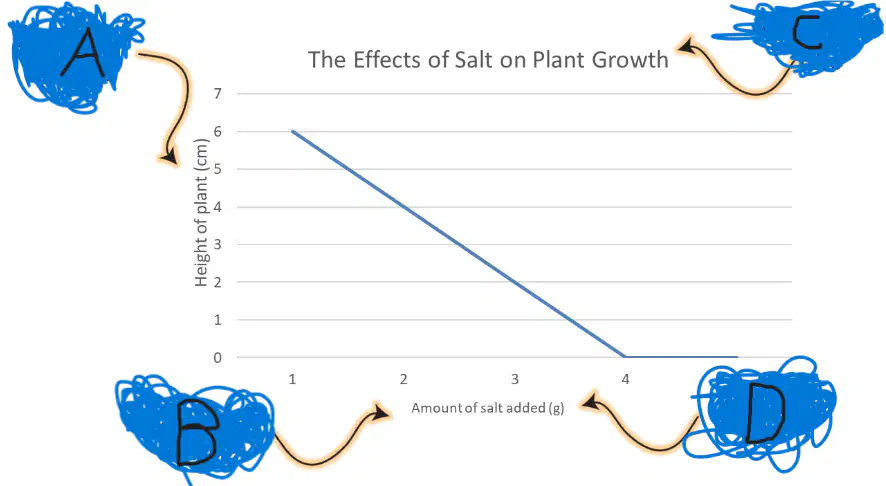
The independent variable is
a)
A
b)
B
c)
C
d)
D
12.
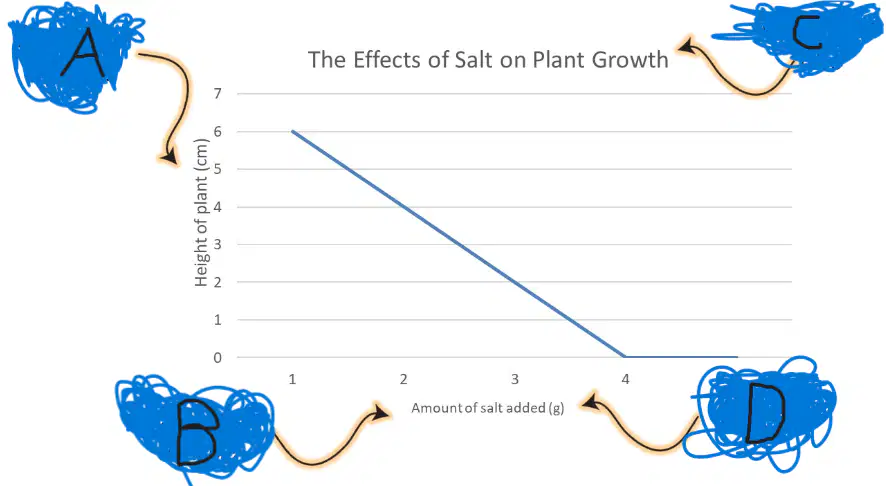
The dependent variable is
a)
A
b)
B
c)
C
d)
D
13.
what is the definition of Anthropocentrism?
a)
places the most value on human populations and human welfare
b)
places value on each and every organism, including humans
c)
places value on the ecosystem or community as a whole rather than individuals
d)
Places value on the ethical treatment of animals
14.
what is the definition of Biocentrism?
a)
places the most value on human populations and human welfare
b)
places value on each and every organism, including humans
c)
places value on the ecosystem or community as a whole rather than individuals
d)
Places value on the ethical treatment of animals
15.
what is the definition of Ecocentrism?
a)
places the most value on human populations and human welfare
b)
places value on each and every organism, including humans
c)
places value on the ecosystem or community as a whole rather than individuals
d)
Places value on the ethical treatment of animals
16.
the amount of a resource available is called what?
a)
inventory
b)
demand
c)
shortage
d)
supply
17.
the number of people that are willing to purchase or use that resource is called what?
a)
inventory
b)
demand
c)
shortage
d)
supply
18.
When supply is high and demand is low, the price of a resource is?
a)
low
b)
high
c)
stable
d)
unpredictable
19.
When supply is low and demand is high, the price of a resource is?
a)
low
b)
high
c)
stable
d)
unpredictable
20.
This process of decision making is called a?
a)
risk assessment
b)
market analysis
c)
resource allocation
d)
cost-benefit analysis
21.
the Geosphere is made of what? click all that apply
a)
rocks
b)
minerals
c)
soil
d)
water
22.
the Hydrosphere is made of what? click all that apply
a)
surface water
b)
underground water
c)
soil
d)
water in the air
23.
the Cryosphere is made of what? click all that apply
a)
underground water
b)
surface water
c)
glaciers
d)
sea ice
24.
the Atmosphere is made of what?
a)
gases
b)
water
c)
glaciers
d)
soil
25.
the biosphere is the what?
a)
The portion of the Earth covered by water
b)
The atmosphere surrounding the Earth
c)
The portion of the earth where life is found
d)
The core of the Earth
26.
the scientific study of interactions between organisms and their environments is what?
a)
botany
b)
zoology
c)
geology
d)
ecology
27.
what refer to living organisms that inhabit an environment?
a)
biotic factors
b)
abiotic factors
c)
habitats
d)
ecosystems
28.
what refer to nonliving organisms that inhabit an environment?
a)
biotic factors
b)
abiotic factors
c)
habitats
d)
ecosystems
29.
a niche is what?
a)
the total number of species in an ecosystem
b)
the unique role a species plays in the environment
c)
where an organism lives (can be shared with other species)
d)
The process of one species eating another for survival
30.
a habitat is what?
a)
the total number of species in an ecosystem
b)
the unique role a species plays in the environment
c)
where an organism lives (can be shared with other species)
d)
The process of one species eating another for survival
31.
Autothrophs obtain energy from the what (click all that apply
a)
sun
b)
eating plants
c)
chemical compounds
d)
eating meat
32.
herbivores are consumers who eat
a)
meat
b)
plants
c)
nothing
d)
plants and meat
33.
carnivores are consumers who eat
a)
meat
b)
plants
c)
nothing
d)
plants and meat
34.
omnivores are consumers who eat
a)
meat
b)
plants
c)
nothing
d)
plants and meat
35.
what breaks down dead and decaying matter into simpler molecules that can be absorbed
a)
herbivores
b)
omnivores
c)
decomposer
d)
scavenger
36.
organisms are sorted into trophic levels in an energy pyramid. which animal represents tertiary consumer
a)
mouse
b)
plants
c)
bugs
d)
owl
37.
organisms are sorted into trophic levels in an energy pyramid. which animal represents producers
a)
mouse
b)
plants
c)
bugs
d)
owl
38.
mutualism is a type of relationship that
a)
one organism benefits & the other is harmed
b)
both organisms benefit
c)
one organism benefits, other is unaffected
d)
both organisms are harmed
39.
parasitism/predation is a type of relationship that
a)
one organism benefits & the other is harmed
b)
both organisms benefit
c)
one organism benefits, other is unaffected
d)
both organisms are harmed
40.
commensalism is a type of relationship that
a)
one organism benefits & the other is harmed
b)
both organisms benefit
c)
one organism benefits, other is unaffected
d)
both organisms are harmed
41.
how is a species defined
a)
any group of living things in the same habitat
b)
a category of organisms with similar colors and patterns
c)
a collection of creatures that share a common ecosystem
d)
a population of organisms that can interbreed and reproduce under natural conditions
42.
Which term best fits the definition: a lower risk but likely to become endangered in the future
a)
Endangered
b)
Threatened
43.
what factors can cause extinction
a)
sunlight and water availability
b)
habitat loss & degradation
c)
diet preferences and mating colors
d)
sound pollution and soil quality
44.
what is the definition of gene pool
a)
the place where genes are stored in a cell.
b)
the process of creating genetically modified organisms
c)
the combined genetic information for a particular population of organisms
d)
the total number of species in an ecosystem
45.
what is the definition of speciation
a)
the process of increasing genetic diversity within a population.
b)
a phenomenon where two species interbreed to form a hybrid species.
c)
the ability of two populations to reproduce freely, maintaining genetic similarity.
d)
if the gene pool of two populations are separated and cannot be shared through reproduction, the populations may develop into a new species
46.
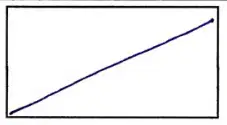
what is the graph referring to
a)
Exponential growth
b)
Linear growth
47.
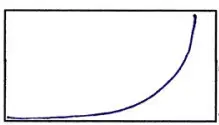
what is the graph referring to
a)
Exponential growth
b)
Linear growth
48.
the environment keeps populations from increasing forever with
a)
optimal conditions
b)
limiting factors
c)
biotic interactions
d)
reproductive potential
49.
what is carrying capacity
a)
# of organisms the environment can sustain / support over a long period of time
b)
the maximum potential growth rate of a species
c)
the reproductive capacity of a single individual in a population
d)
the total number of organisms in a specific ecosystem
50.
the definition of density - dependent is
a)
factors that remain constant regardless of population size
b)
factors affect all populations regardless of how large
c)
factors that cause a decrease in population size
d)
factors that have an increasing effect as the population increases
51.
the definition of density - independent is
a)
factors that remain constant regardless of population size
b)
factors affect all populations regardless of how large
c)
the reproductive capacity of a single individual in a population
d)
factors that have an increasing effect as the population increases
52.
examples of density-dependent are (click all that apply)
a)
predators
b)
drought
c)
disease
d)
floods
53.
examples of density-independent are (click all that apply)
a)
predators
b)
drought
c)
disease
d)
floods
54.
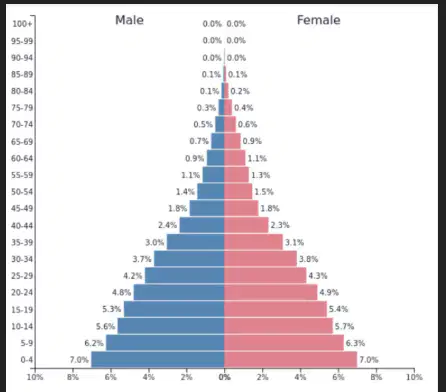
what does this population pyramid show
a)
an expanding population
b)
a decreasing population
c)
population that is stabilized
55.
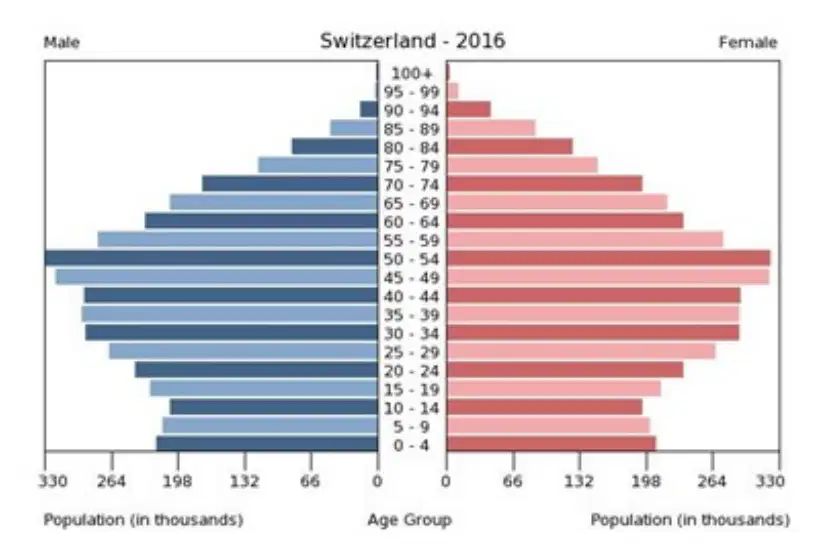
what does this population pyramid show
a)
an expanding population
b)
a decreasing population
c)
population that is stabilized
56.
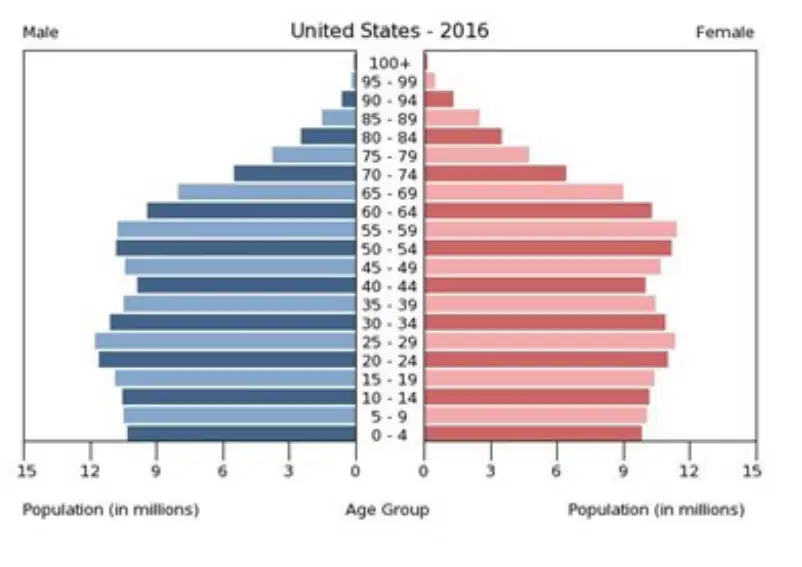
what does this population pyramid show
a)
an expanding population
b)
a decreasing population
c)
population that is stabilized
57.
What predictions can you make of a population's growth if the population has Natality > Mortality?
a)
Expanding
b)
Decreasing
c)
Stable
58.
What predictions can you make of a population's growth if the population has Natality < Mortality?
a)
Expanding
b)
Decreasing
c)
Stable
59.
What predictions can you make of a population's growth if the population has Natality = Mortality?
a)
Expanding
b)
Decreasing
c)
Stable
60.
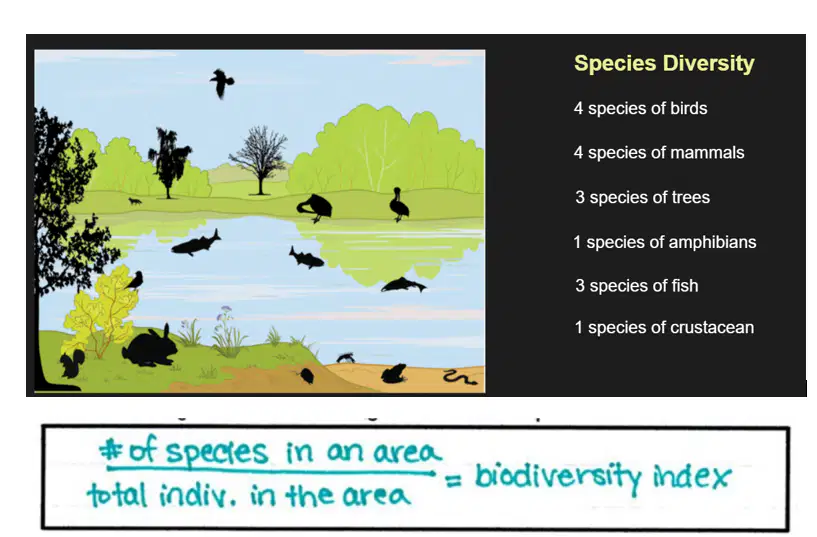
The biodiversity chart shows the number of species in each group:
Step 1: Add the species to find the total number of species in the habitat.
Step 2: Use the formula in the pic:
In this location, 200 total individual organisms live here.
What is the biodiversity index?
a)
0.064
b)
0.103
c)
0.080
d)
0.124
61.
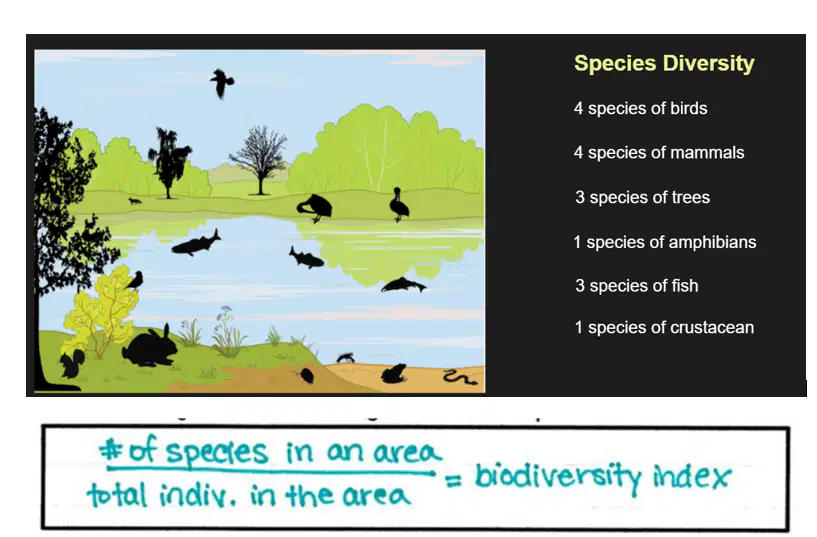
The biodiversity chart shows the number of species in each group:
Step 1: Add the species to find the total number of species in the habitat.
Step 2: Use the formula in the pic:
In this location, 250 total individual organisms live here.
What is the biodiversity index?
a)
0.043
b)
0.064
c)
0.080
d)
0.102
62.
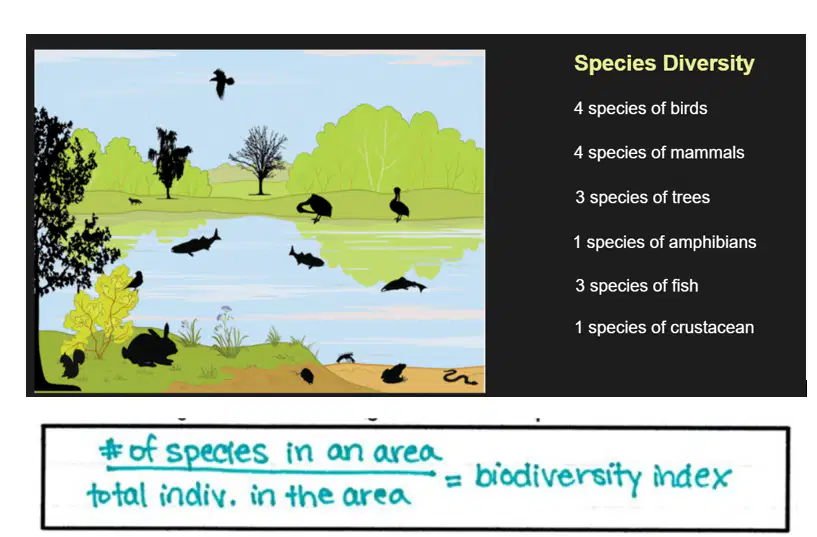
The biodiversity chart shows the number of species in each group:
Step 1: Add the species to find the total number of species in the habitat.
Step 2: Use the formula in the pic:
In this location, 40 total individual organisms live here.
What is the biodiversity index?
a)
0.204
b)
0.306
c)
0.400
d)
0.505
63.
blank is the daily fluctuation of temperature and precipitation
a)
Weather
b)
Climate
c)
Environment
d)
Atmospheric State
64.
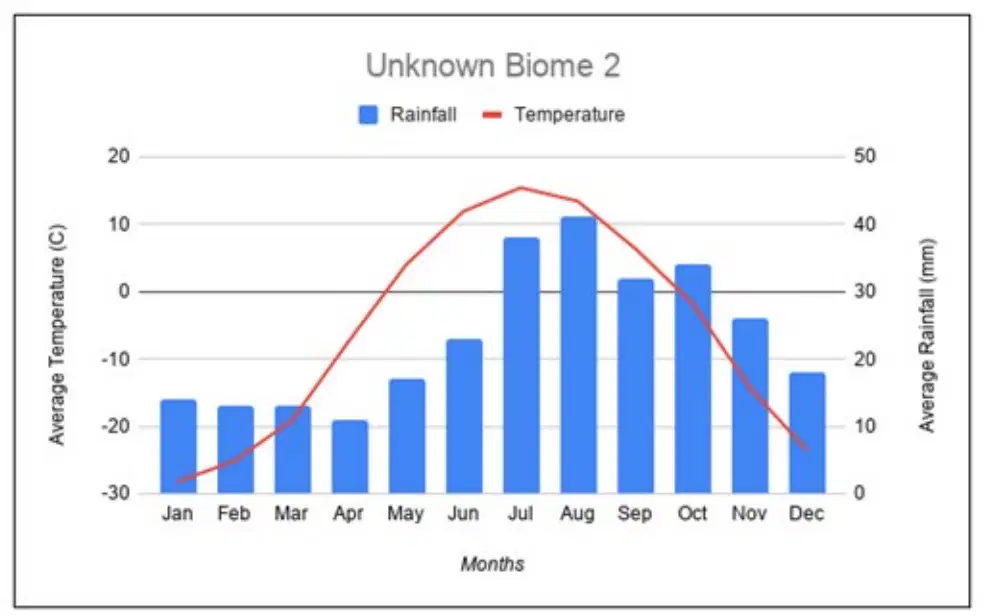
Determine the identities of the unknown biomes
a)
Temperate Forest: rainfall is fairly consistent and temperatures vary from cooler in winter to hotter in summer
b)
Taiga/Boreal Forest: the temperatures are very low and rainfall is moderate
c)
Desert: the rainfall is generally low and temperatures are high
d)
Tropical Rainforest: clear wet/dry seasons with vast amounts of rainfall. temperature is fairly consistent and warm
65.
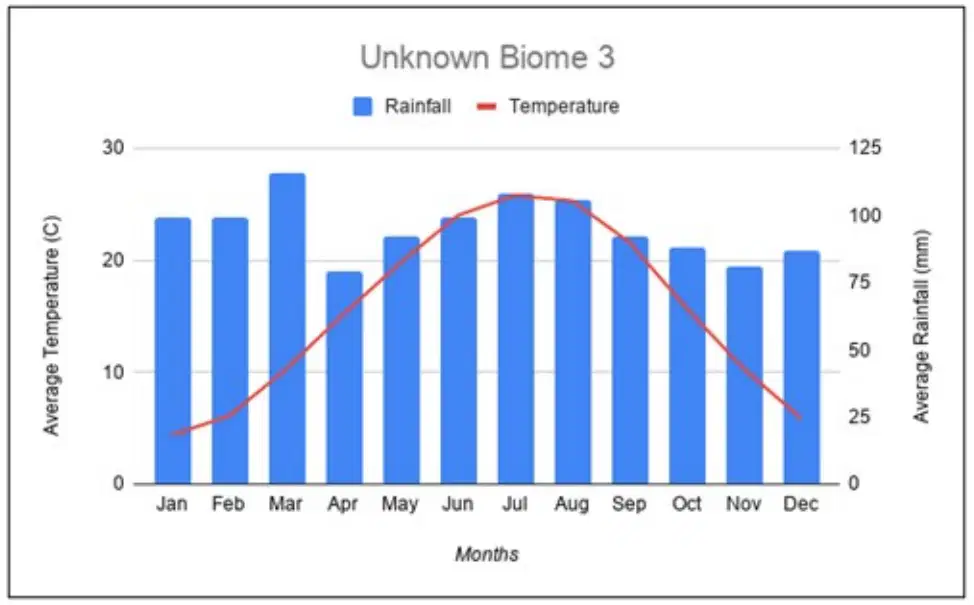
Determine the identities of the unknown biomes
a)
Temperate Forest: rainfall is fairly consistent and temperatures vary from cooler in winter to hotter in summer
b)
Taiga/Boreal Forest: the temperatures are very low and rainfall is moderate
c)
Desert: the rainfall is generally low and temperatures are high
d)
Tropical Rainforest: clear wet/dry seasons with vast amounts of rainfall. temperature is fairly consistent and warm
66.
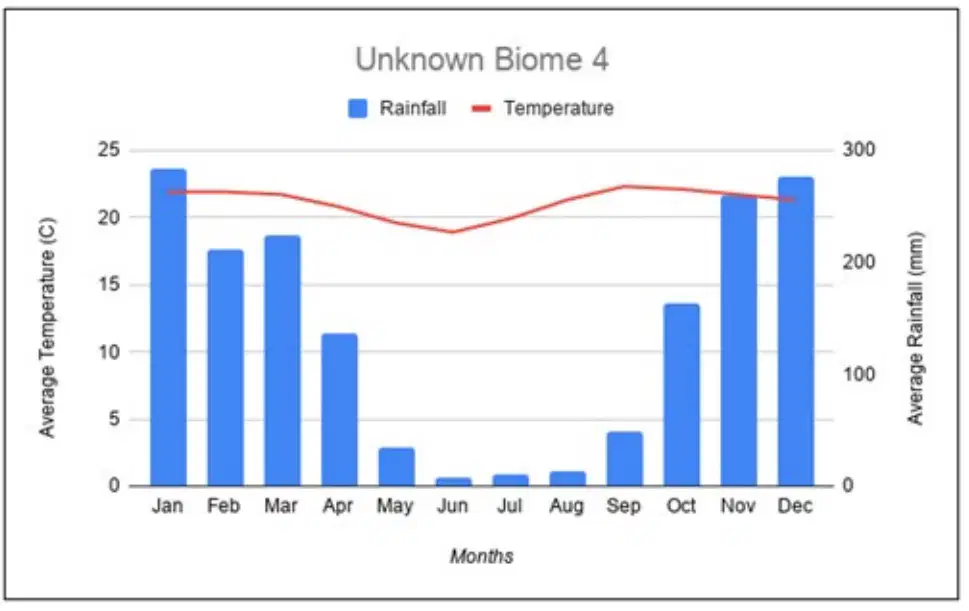
Determine the identities of the unknown biomes
a)
Temperate Forest: rainfall is fairly consistent and temperatures vary from cooler in winter to hotter in summer
b)
Taiga/Boreal Forest: the temperatures are very low and rainfall is moderate
c)
Desert: the rainfall is generally low and temperatures are high
d)
Tropical Rainforest: clear wet/dry seasons with vast amounts of rainfall. temperature is fairly consistent and warm
67.
What distinguishes keystone species in ecosystems?
a)
They are the most numerous species in their habitats
b)
They are primarily nocturnal and active during the night
c)
They have a specialized diet focusing on a single plant species
d)
They have a large impact on their habitats and affect many other species
68.
What characterizes indicator species in ecosystems?
a)
They are the top predators in their food chains
b)
They are known for their bright and colorful markings
c)
They have the ability to respond to environmental changes dramatically
d)
They have a symbiotic relationship with other species
69.
What distinguishes primary succession from secondary succession in ecological processes?
a)
Primary succession occurs in areas with existing soil, while secondary succession starts in areas with no soil.
b)
Secondary succession occurs on newly created volcanic islands, while primary succession occurs after events like floods or fires.
c)
Secondary succession is slower than primary succession, often taking centuries to unfold.
d)
Primary succession begins in areas where there is no soil, while secondary succession occurs in regions with established soil.
70.
In which scenario does secondary succession typically take place?
a)
On a newly created volcanic island
b)
After a flood or fire
c)
In areas where there is no existing soil
d)
In regions with a slow ecological recovery process
71.
What role do pioneer species play in ecological succession?
a)
They are the last organisms to establish in a stable community.
b)
Pioneer species primarily inhabit well-established and thriving environments.
c)
Pioneer species are responsible for preventing soil erosion in barren environments.
d)
Pioneer species are the first organisms to inhabit barren environments, breaking down rocks into soil.
72.
How would you define a climax community in ecological succession?
a)
A constantly changing and dynamic community in the early stages of succession.
b)
The first stage of ecological succession, characterized by pioneer species.
c)
The final stage of succession, representing a stable and relatively unchanged community.
d)
A community dominated by invasive species and rapid environmental changes.
73.
What does genetic biodiversity refer to?
a)
The variety of life in terms of different species within a habitat or region.
b)
The variation of DNA and genes within a species or population.
c)
The diversity of ecosystems and their interactions.
d)
The different ecological niches occupied by various species.
74.
Which type of biodiversity focuses on the variation in the network of species present in a certain location and their interactions?
a)
Ecological biodiversity
b)
Genetic biodiversity
c)
Species biodiversity
d)
Population biodiversity
75.
Which type of biodiversity focuses on the variety of species within a habitat or region?
a)
Ecological biodiversity
b)
Genetic biodiversity
c)
Species biodiversity
d)
Population biodiversity
76.
How does a line transect contribute to understanding biodiversity?
a)
By collecting DNA samples from various species.
b)
By measuring the atmospheric conditions in an area.
c)
By counting the number of species touching the line along a designated path.
d)
By analyzing the geological composition of the region.
77.
Why is it beneficial to complete several transects in a location?
a)
To create a visual map of the region.
b)
To measure the wind speed and direction.
c)
To gather more comprehensive data on the biodiversity in the area.
d)
To assess the pollution levels in the ecosystem.
78.
Why do invasive species often have a significant impact on ecosystems?
a)
Because they are easily controlled by natural predators.
b)
Because they spread slowly and have limited growth.
c)
Because they face more limiting factors than native species.
d)
Because predators may not recognize them as prey, allowing for quick and wide spread.
79.
What distinguishes the growth pattern of invasive species from native species?
a)
Invasive species have slower reproductive rates.
b)
Native species can reproduce faster than invasive species.
c)
Native species are less adaptable to new competition.
d)
Invasive species can reproduce faster than native species can adapt to the new competition.
100 %

