
 Worksheets
Grade 6 Science Review - Multiple Choice
Total questions: 47
Worksheet time: 24mins
Những lĩnh vực nào không thuộc về khoa học tự nhiên?
Vật lý
Hóa học
Sinh học
Lịch sử nhân loại
Trên thước kẻ, đơn vị nhỏ nhất là gì?
Giá trị cuối cùng được đánh dấu trên thước kẻ
Giá trị nhỏ nhất được in trên thước kẻ
Khoảng cách giữa hai dấu tick liên tiếp trên thước kẻ
Tất cả các câu trả lời đều sai
Choose the best sequence to complete the sentence: "Oxygen is needed for (1) of humans, animals, and plants, and for (2) in life and production."
respiration – oxidation
respiration – burning fuels
burning fuels – respiration
oxidation – respiration
Thiết bị được hiển thị được sử dụng để tách các thành phần của hỗn hợp nào?
Nước và rượu
Cát trộn trong nước
Bột trộn trong nước
Dầu ăn và nước
The sequence of images shows oil and water being combined, shaken, and then separating. What type of mixture formation is illustrated?
Suspension
Emulsion
Solution
Solvent
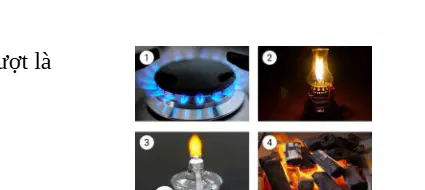
Look at the images: a gas stove flame, a kerosene lamp, an alcohol burner, and a coal fire. Which list correctly names the fuels used in order?
Gas, ethanol, kerosene, charcoal
Gas, kerosene, ethanol, coal
Gas, ethanol, kerosene, coal
Gas, kerosene, ethanol, charcoal
In many rural areas, people build biogas digesters to collect animal waste, which decomposes to produce a gas used for cooking or running generators. What is a main benefit of building such digesters?
They clean the environment and reduce pollution
They kill harmful pathogens
They provide biogas as a useful fuel
All of the above
Which material conducts electricity well?
Glass
Ceramic
Metal
Rubber
Which set includes materials that are available in nature?
Limestone, bamboo, sand, iron ore
Limestone, petroleum, coconut oil
Iron ore, plastic, petroleum
Sand, bamboo, coconut oil
Which material cannot be recycled?
Glass
Construction steel
Plastic
Cement
Fill in the blank in the statement: “A raw material is a material … that has not been processed and needs to be transformed to create a product.”
raw
synthetic
semi-synthetic
artificial
To maintain good health with a reasonable diet, what should we do?
Persist in running only
Eat nutrients continuously
Eat adequately and with variety
Focus more on studying
Which of the following is not a fuel?
Coal
Oil
Firewood
Soil
Coal is mined to supply thermal power plants to produce electricity. In this case, coal is called what?
a material
a fuel
a raw material
a material or a raw material
Which is an efficient, economical way to use fuels?
Adjust a gas stove to the smallest flame
Break coal into moderate pieces and split firewood small
Fan a wood stove while it is burning
Put a lot of coal or wood into the stove
Which group of foods below is a form of staple foods?
Rice, water spinach, sweet potatoes, pork
Potatoes, wheat, pumpkins, carrots
Beef, eggs, carp, cabbage
Rice, sweet potatoes, wheat, waxy corn
Which of the following is not a fossil fuel?
Coal
Petroleum
Natural gas
Ethanol
Among the foods below, which contains the most protein?
Rice
Green vegetables
Meat
Rice and green vegetables
Which type of raw material below is almost nonrenewable?
Wood
Cotton
Crude oil
Farm produce
Which type of fuel has a high heat output and burns completely most easily?
Gaseous fuels
Liquid fuels
Solid fuels
Fossil fuels
Using which form of energy causes the most air pollution?
Wind power
Solar power
Thermal power
Hydropower
Which of the following is considered a raw material?
Bricks
Clay
Cement
Roof tiles
Which crop below is not considered a staple food crop?
Rice
Maize
Sugarcane
Wheat
A mixture is formed from what?
Many atoms
A single substance
Many substances mixed together
Many substances kept separate
Which of the following is a homogeneous mixture?
Water mixed with alcohol
Water mixed with sand
Water mixed with cooking oil
Water mixed with condensed milk
Which of the following is an emulsion?
Vinaigrette
Salt water
Muddy river water
Water mixed with sand
Which of the following is a suspension?
Salt water
Milk
Tea with tea grounds in it
Water mixed with cooking oil
Which item below is made of cells?
A roly-poly toy
An eraser
A wooden pencil
A table
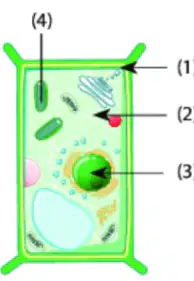
Look at the plant cell diagram where an arrow points to a part of the cell. Which part is indicated by the arrow?
Cytoplasm
Cell wall
Nucleus
Cell membrane
How do animal cells differ from plant cells?
Most animal cells do not have a cell wall
Most animal cells do not have mitochondria
Animal cells contain a main nucleus outside the cell
Animal cells contain chloroplasts
Fill in the blank: A cell is the unit of structure and ______ of all living organisms.
function
composition
basis
origin
Observe the bacterium diagram. The arrow is pointing to which component of the cell?
Cell membrane
Cytoplasm
Nucleus
Nucleoid region
Which statement is false?
Cells are very small in size.
Cells have many different shapes.
Both plant and animal cells are prokaryotic cells.
Cells are made up of three main parts.
What is the function of the cell membrane?
It contains genetic material and controls all life activities of the cell.
It protects and regulates substances entering and leaving the cell.
It contains organelles where the cell’s life activities occur.
It participates in photosynthesis.
Which component controls all of the cell’s activities?
Nucleus
Cytoplasm
Cell membrane
Chloroplast
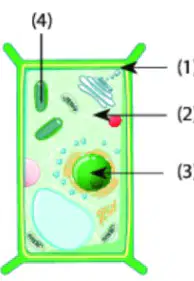
Refer to the labeled plant cell diagram. Which label indicates the cell membrane?
(1)
(2)
(3)
(4)
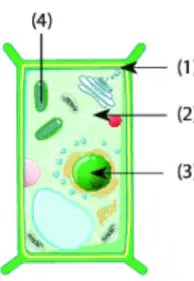
Refer to the labeled plant cell diagram. Which label indicates the component that controls all cell activities?
(1)
(2)
(3)
(4)
Based on the lifecycle diagram (cell → grows → mature cell → divides → two daughter cells), how many stages does cell reproduction go through?
2
3
4
5
What is the process called when a solid changes into a liquid?
Melting
Condensation
Evaporation
Freezing
Which process shows a chemical change?
Dissolving sugar in water
Heating white sugar until it burns and becomes a black solid
Mixing cooking oil with water
Which natural phenomenon is caused by the condensation of water vapor?
Forming clouds
Falling rain
Blowing wind
A tornado
A glowing matchstick is placed into a glass jar containing gas A, and the match bursts into flame. Identify gas A.
Nitrogen
Carbon dioxide
Argon
Oxygen
Which component of air is the main cause of the greenhouse effect?
Oxygen
Hydrogen
Carbon dioxide
Nitrogen
To separate sand from water, which method should be used?
Decantation
Evaporation to dryness
Filtration
Distillation
To separate cooking oil from water, which method should be used?
Decantation
Evaporation to dryness
Filtration
Distillation
Consider the statements about cells: (1) All living organisms are made of cells. (2) In organisms, cells vary widely in size and shape. (3) Plant and animal cells have the same structure. (4) Cells perform many life functions of an organism. (5) Cells cannot reproduce. How many statements are correct?
1
2
3
4
Fill in the blank to complete the sentence: "Natural science is the branch of science that studies ..., natural laws, and their effects on human life and the environment."
the natural world and nature
the natural world
objects and phenomena
the natural world and humankind

