
Font size
 Worksheets
Childcare and education provision excerpt (no questions present)
Total questions: 27
Worksheet time: 30mins
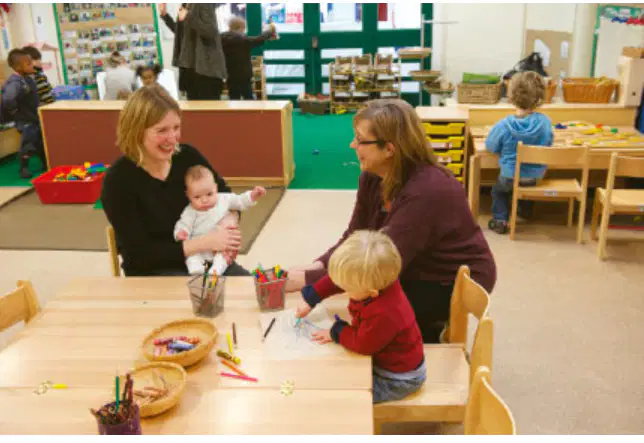
The worksheet asks: Can you think of different types of early years settings? Which option lists different types of early years settings?
Childminders, nannies, nurseries, pre-schools
Primary schools, hospitals, sports academies, public libraries
Museums, theatres, leisure centres, theme parks
After-school detention units, prisons, supermarkets, banks

Can you think of any learning benefits from collaborating with peers? Select all that apply.
Sharing diverse perspectives on tasks
Developing teamwork and communication skills
Reducing opportunities for feedback
Strengthening problem‑solving through joint work
Learning less effectively in groups
When researching three universities that offer undergraduate programmes in education and early years provision, which information should be gathered for each institution?
Entry requirements and the types of study programmes offered
Campus building plans and parking rules
Cafeteria menus and sports club fees
Historic alumni donations only
When identifying what roles within early years education and teaching assistant positions require, which categories should you focus on?
Knowledge, skills and behaviours
Starting salaries and holiday entitlement
Preferred classroom paint colours
Uniform sizes and logo placement
Andreas is 16 years of age and would like to be a primary school teacher. Which option best aligns with reaching his career goal?
Continue in education towards an undergraduate degree in primary education at a higher education institution
Leave education at 16 with no further study or training
Take a short course unrelated to education and seek immediate full‑time employment
Train only as a volunteer without recognised qualifications
Olivia is 16 years of age and wants to work as an early years educator for two years and then train to be a nursery teacher. Which option best fits her plan?
Begin in an early years educator role via a suitable qualification or apprenticeship, then progress to further training for nursery teaching
Stop studying entirely and apply for office work full‑time
Study only a subject unrelated to education and avoid work experience
Wait until age 21 and then decide without any training
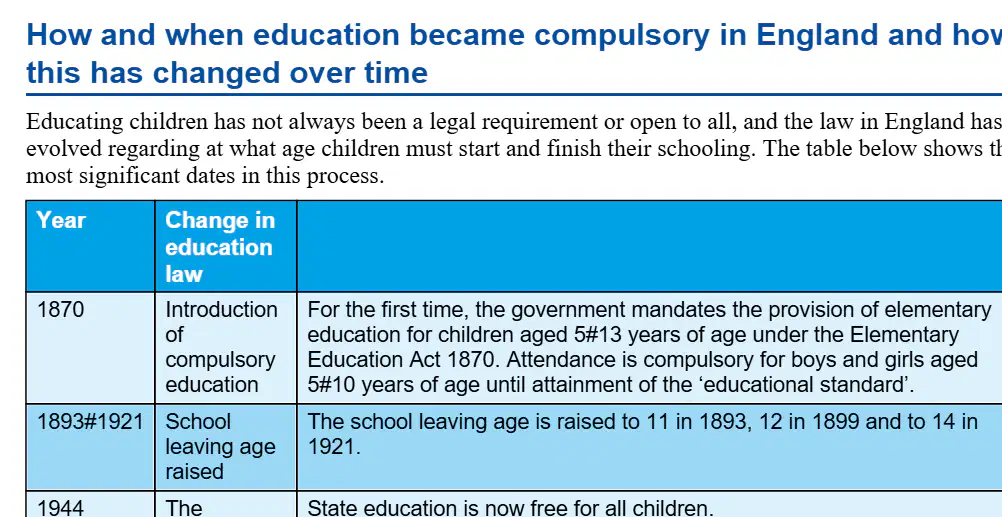
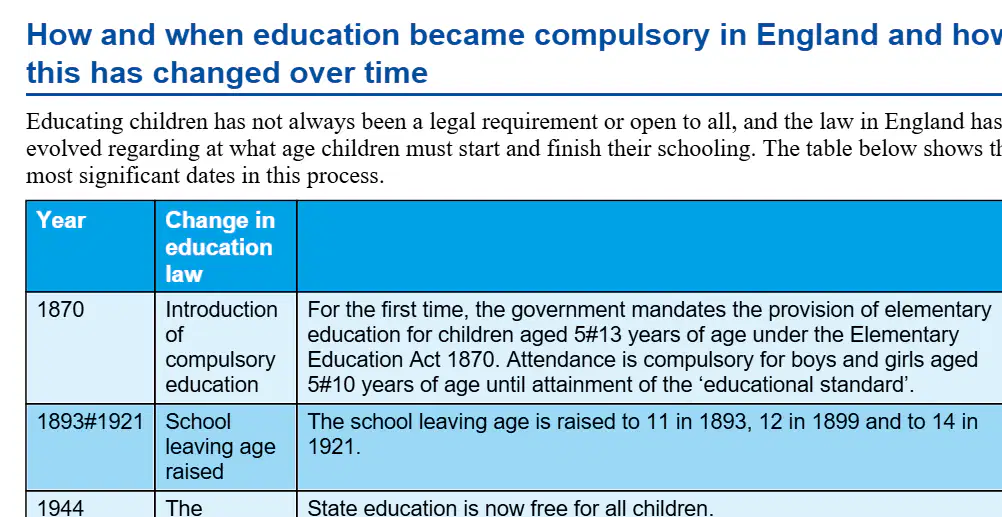
Which act first introduced compulsory elementary education in England?
Elementary Education Act 1870
Education Act 1944
Education Reform Act 1988
Education and Skills Act 2008
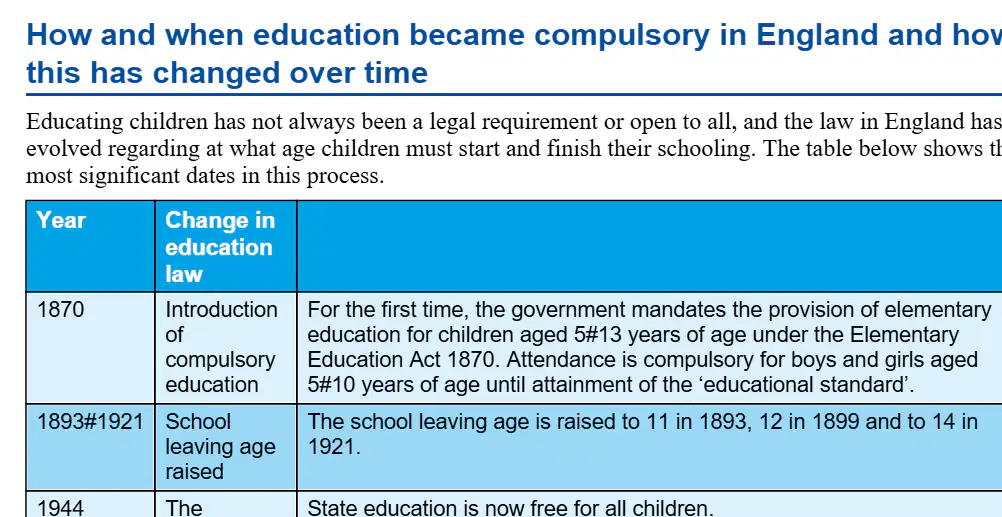
Under changes noted in the table, in which year was the school leaving age raised to 14?
1921
1899
1893
1870
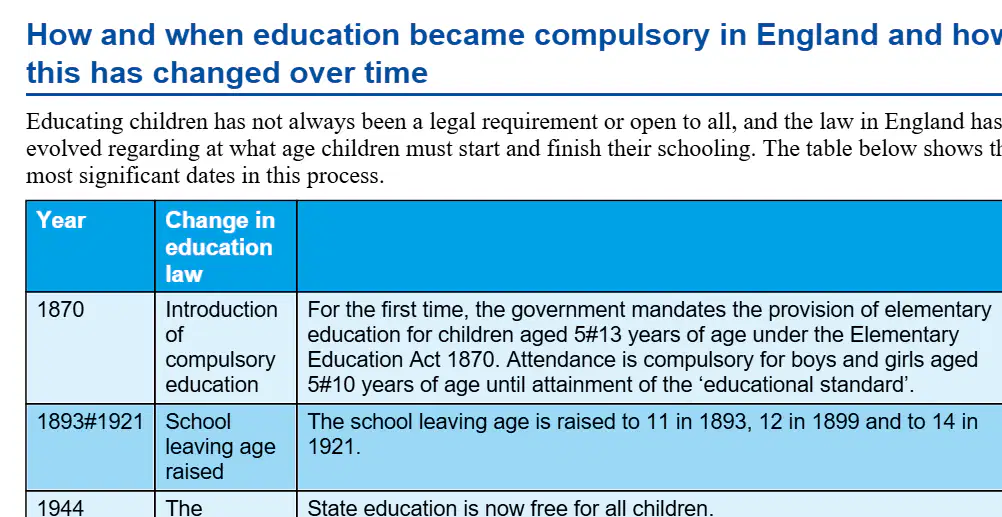
Which act made state education free for all children and created separate primary and secondary schools?
Education Act 1944
Elementary Education Act 1870
Education Reform Act 1988
Education and Skills Act 2008
What did the Education Reform Act 1988 introduce in schools in England?
A compulsory National Curriculum of 14 subjects and standardised assessments
Free school meals for every pupil regardless of need
The abolition of local education authorities
The end of all statutory testing at ages 7, 11, 14 and 16
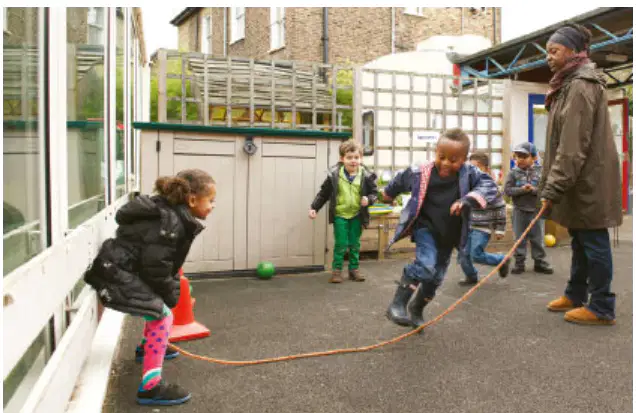
How is this adult enhancing the children’s experiences? In the photo, an adult stands in an outdoor play area with several young children who are using a long skipping rope; the adult is closely involved in organising and supervising the activity.
By facilitating cooperative outdoor play and turn-taking with a skipping-rope activity
By delivering a formal lesson focused on literacy skills at desks
By removing play equipment to minimise risk and limit physical activity
By directing the children to sit quietly and watch rather than participate
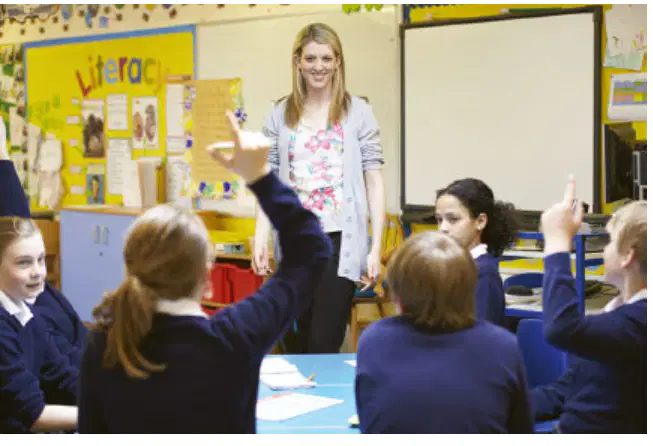
Study the classroom photo showing several pupils seated at tables with their hands raised while a teacher stands at the front of the room. What does this photo tell you about the level of engagement between the teacher and the children?
High engagement, with multiple students actively participating and seeking to respond
Low engagement, with only one student focused while most are distracted
Minimal engagement, as most students are turned away and chatting with peers
No engagement, because the teacher is not interacting with the students
Case study: Jayden is three years of age. He lives with his mum and younger sister, who is aged 14 months. Nursery staff are concerned about Jayden’s emotional wellbeing. During their observations, they have noticed how Jayden, usually a friendly and sociable young boy, has become withdrawn, even shying away from interaction with his key person. Jayden’s key person met with his mum at nursery. Jayden’s mum became very upset as she explained that Jayden’s dad was seriously ill and being cared for in a hospice. Choose the best summary of the situation and its potential impact on Jayden, his sister and his mum.
Jayden has become withdrawn at nursery as his dad is seriously ill; this may affect Jayden’s emotional wellbeing, his sister’s routines and attachment, and place significant stress on their mum.
Jayden’s behaviour has improved and he is more sociable; the family is likely to feel less stressed and his sister will benefit from more playtime.
Jayden has fallen behind academically due to a lack of homework support; the main impact is on his grades rather than emotions.
Jayden’s mum is upset about changes to nursery fees; the impact on Jayden and his sister is expected to be minimal.
Case study: Based on the situation described with Jayden and his family, what is the most appropriate way for the early years setting to support them?
Provide pastoral support through Jayden’s key person, maintain regular communication with his mum, and involve the setting’s mental health lead if needed.
Focus only on academic activities to distract Jayden from his feelings and avoid discussing home circumstances.
Avoid contacting the family so as not to upset them, and wait for behaviour to settle on its own.
Recommend immediate exclusion until the family situation changes to reduce disruption in the setting.
Case study: Which professionals may be able to offer support to Jayden and his family at this very sad time? Select all that apply.
Educational psychologist
Social worker
Children and Young People’s Mental Health Services (CYP MHS) counsellor
Physical activity and nutrition coordinator (PANCo)
Designated safeguarding lead (DSL)
Research box: Statutory guidance is updated regularly to ensure the best possible outcomes for babies, children and young people. According to this statement, what is the main purpose of regularly updating statutory guidance?
To ensure the best possible outcomes for babies, children and young people
To reduce paperwork for staff regardless of outcomes
To replace the need for staff training on safeguarding
To limit external partnerships with families and professionals
Research box: The Mental Health Foundation Association has produced useful documents to support an understanding of the importance of recognising mental health in children and young people, and the significance of intervention for a child’s holistic health and wellbeing. According to this statement, what do these documents primarily aim to support?
Understanding the importance of recognising mental health in children and young people and why timely intervention matters for holistic wellbeing
Training in sports nutrition for early years settings
Legal compliance with building and facilities regulations
Recruitment and appraisal procedures for school staff
Identify two features of maintained schools.
Funded by the state or local authority
Required to follow the National Curriculum
Charge tuition fees to parents
Operate independently of government oversight
List one similarity and one difference between academy schools and maintained schools.
Both are publicly funded; academies have greater autonomy over curriculum and finances
Both must follow the National Curriculum; maintained schools set their own pay and conditions
Both are privately funded; academies are run by local authorities
Both are inspected by Ofsted; academies are not accountable to the Department for Education
List three responsibilities held by an early years educator.
Safeguard children and promote their welfare
Plan and facilitate play-based learning aligned with the early years framework
Maintain the school budget
Observe, assess and record children’s progress
Conduct Ofsted inspections
Summarise the role of Ofqual in education and childcare.
Regulates qualifications, exams and assessments in England to maintain standards
Inspects early years settings and schools to report on quality and safeguarding
Sets the National Curriculum content for schools
Provides childcare places and family support services in the community
A local authority primary school is an example of:
a private service
a statutory service
a voluntary service
Which of the following do not need to follow the National Curriculum?
academy schools
voluntary aided schools
state primary schools
state secondary schools
Describe the role of the designated safeguarding lead in education and childcare.
Leads and coordinates safeguarding, receives concerns, makes referrals and supports staff training
Designs the curriculum and schemes of work for all subjects
Handles payroll and human resources for staff
Chairs the governing body and sets strategic priorities
Explain the role of Ofsted in education and childcare.
Inspects and regulates early years and education providers to promote quality and safety
Awards GCSE, AS and A level qualifications
Sets national teachers’ pay and conditions
Runs admissions for local authority schools
Compare the role of the childminder with that of the professional nanny.
Childminders are self‑employed and care for children in their own home; nannies are employed by families to work in the family home
Both roles are limited to registered nursery settings only
Childminders are employed by schools, while nannies must be Ofsted inspectors
Nannies must register as childcare settings with local authorities; childminders never need registration
Analyse the role of the physical activity and nutrition coordinator for children’s holistic health and wellbeing.
Leads whole‑setting approaches to healthy eating and physical activity, plans initiatives and supports staff and families
Teaches only competitive sports to selected pupils
Manages the canteen budget without influencing practice
Replaces classroom teachers for PE and health lessons

