
 Worksheets
Logical Database Design and the Relational Model
Total questions: 86
Worksheet time: 43mins
_______ database specification indicates all the parameters for data storage that are then input to database implementation.
Logical
Physical
Schematic
Conceptual
A form of database specification which maps conceptual requirements is called:
logical specifications
response specifications
security specifications
physical specifications
Data is represented in the form of:
data trees
tables
data notes
chairs
A two-dimensional table of data sometimes is called a:
group
set
declaration
relation
_______ is a component of the relational data model included to specify business rules to maintain the integrity of data when they are manipulated.
Business rule constraint
Data integrity
Business integrity
Data structure
An attribute (or attributes) that uniquely identifies each row in a relation is called a:
column
foreign field
primary key
duplicate key
An attribute in a relation of a database that serves as the primary key of another relation in the same database is called a:
link attribute
link key
foreign key
foreign attribute
A primary key whose value is unique across all relations is called a(n):
global primary key
inter-table primary key
enterprise key
foreign global key
A primary key that consists of more than one attribute is called a:
foreign key
composite key
multivalued key
cardinal key
In the SQL language, the ________ statement is used to make table definitions.
create session
create table
create index
select
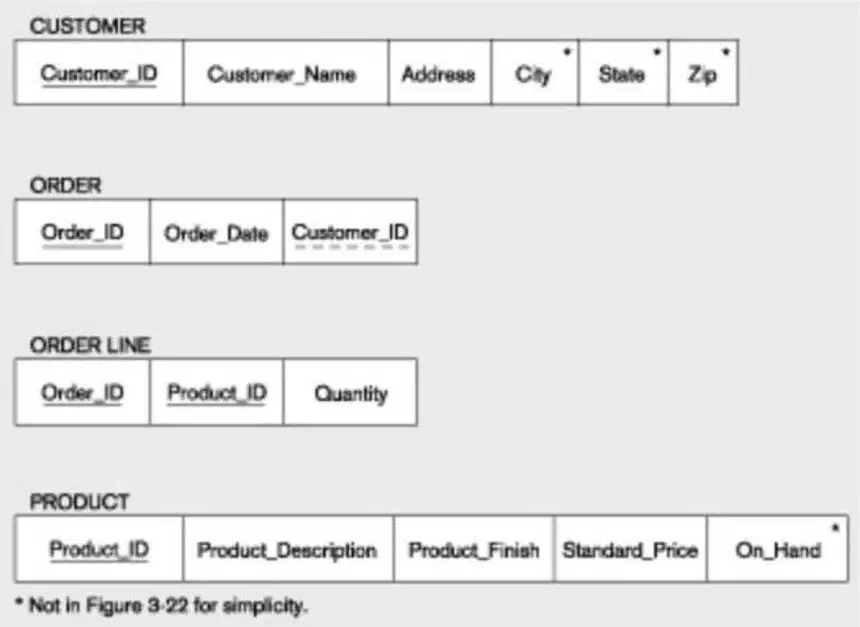
In the figure, the primary key for Order Line is which type of key?
Composite
Foreign
Standard
Grouped
Which of the following is NOT a reason to create an instance of a relational schema with sample data?
Sample data can be used to improve user communications.
Sample data can be used for prototype generation.
Sample data can reverse database implementation errors.
Sample data provide a convenient way to check the accuracy of your design.
A domain definition consists of all of the following components EXCEPT:
domain name.
data type.
integrity constraints.
size.
Which of the following are properties of relations?
Each attribute has the same name.
No two rows in a relation are identical.
There are multivalued attributes in a relation.
All columns are numeric.
Which of the following violates the atomic property of relations?
Sam
Hinz
Sam Hinz
Atomic
The entity integrity rule states that:
no primary key attribute can be null.
referential integrity must be maintained across all entities.
each entity must have a primary key.
a primary key must have only one attribute.
The ________ states that no primary key attribute may be null.
referential integrity constraint
entity integrity rule
partial specialization rule
range domain rule
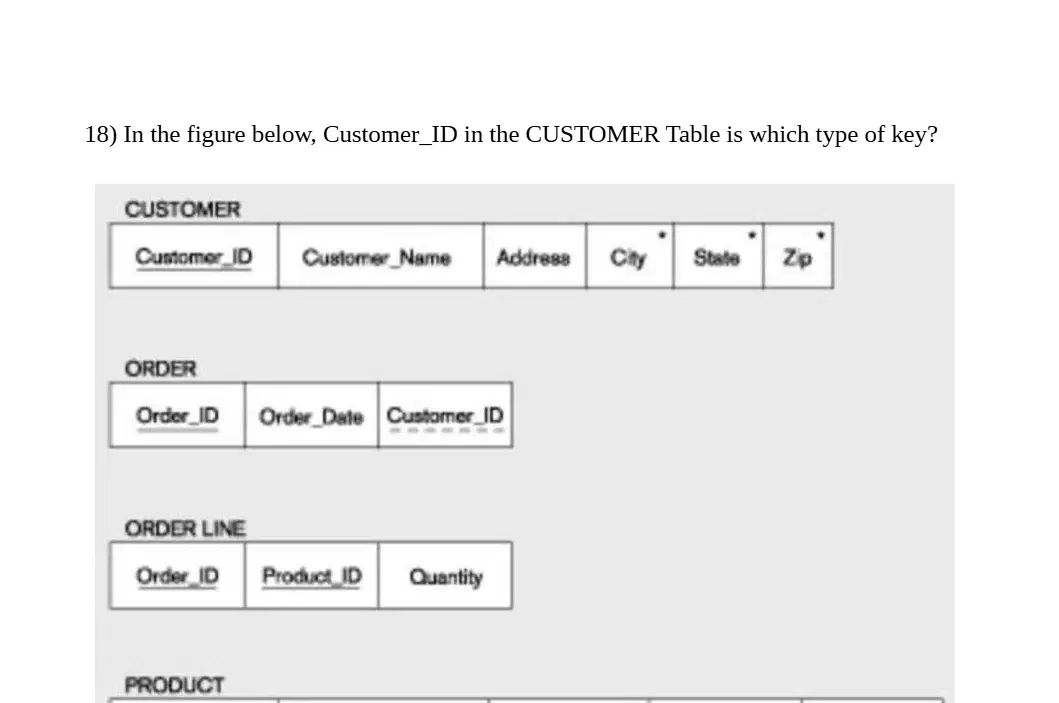
In the figure, Customer_ID in the CUSTOMER table is which type of key?
Composite
Candidate
Standard
Grouped
All of the following are the main goals of normalization EXCEPT:
minimize data redundancy
simplify the enforcement of referential integrity
maximize storage space
make it easier to maintain data
When all multivalued attributes have been removed from a relation, it is said to be in:
first normal form
second normal form
Boyce-Codd normal form
third normal form
The normal form which removes any remaining functional dependencies because there was more than one primary key for the same nonkeys is called:
fifth normal form.
fourth normal form.
Boyce-Codd normal form.
sixth normal form.
The normal form which deals with multivalued dependencies is called:
fifth normal form.
fourth normal form.
Boyce-Codd normal form.
sixth normal form.
A relation that contains no multivalued attributes and has nonkey attributes solely dependent on the primary key but contains transitive dependencies is in which normal form?
First
Second
Third
Fourth
A constraint between two attributes is called a(n):
functional relation.
attribute dependency.
functional dependency.
functional relation constraint.
A candidate key must satisfy all of the following conditions EXCEPT:
the key must uniquely identify the row.
the key must indicate the row's position in the table.
the key must be nonredundant.
each nonkey attribute is functionally dependent upon it.
The attribute on the left-hand side of the arrow in a functional dependency is the:
candidate key.
determinant.
foreign key.
primary key.
A functional dependency in which one or more nonkey attributes are functionally dependent on part, but not all, of the primary key is called a ________ dependency.
partial key-based
partial functional
cross key
merged relation
A functional dependency between two or more nonkey attributes is called a:
partial functional dependency.
partial nonkey dependency.
transitive dependency.
partial transitive dependency.
________ problems are encountered when removing data with transitive dependencies.
Insertion
Modification
Deletion
Merging
The need to ________ relations commonly occurs when different views need to be integrated.
metadata
system
drop
merge
Two or more attributes having different names but the same meaning are called:
homonyms.
aliases.
synonyms.
alternate attributes.
An attribute that may have more than one meaning is called a(n):
homonym.
alias.
double defined attribute.
synonym.
An alternative name for an attribute is called a(n):
synonym
alias
alternate attribute
related characteristic
Understanding the steps involved in transforming EER diagrams into relations is important because:
one must be able to check the output of a CASE tool
there are rarely legitimate alternatives from which to choose
CASE tools can model any situation
CASE tools model hypothetical business problems
A nonkey attribute is also called a(n):
column
unimportant datum
descriptor
address
When a regular entity type contains a multivalued attribute, one must:
create a single relation with multiple lines for each instance of the multivalued attribute
create two new relations, one containing the multivalued attribute
create two new relations, both containing the multivalued attribute
delete the relation and start over
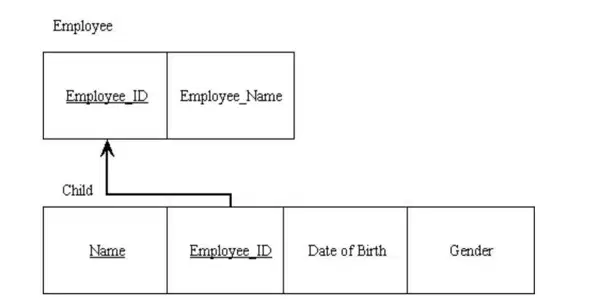
In the figure, what type of relationship do the relations depict?
Strong entity/weak entity
Multivalued
Composite foreign key
One-to-many
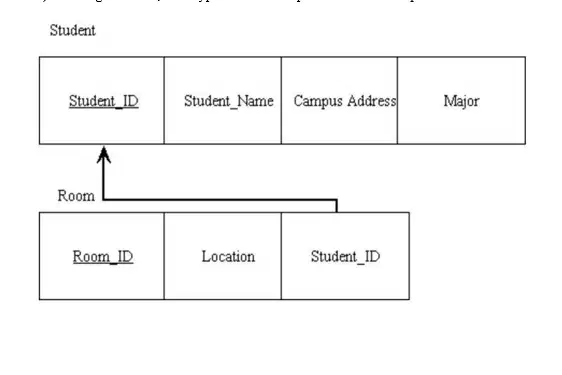
In the figure, what type of relationship do the relations depict?
Strong entity/weak entity
Multivalued
Composite foreign key
One-to-many
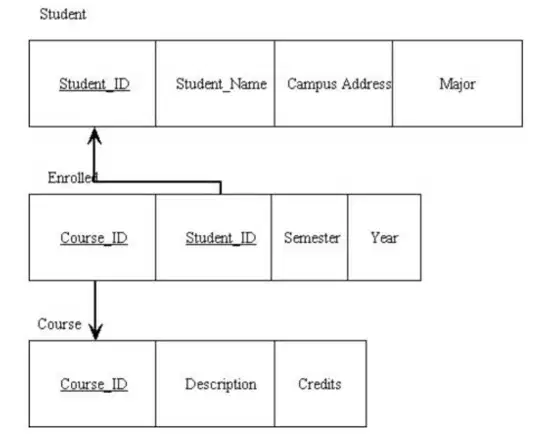
In the figure below, what is depicted?
A one-to-one relationship
A unary relationship
A one-to-many relationship
An associative entity
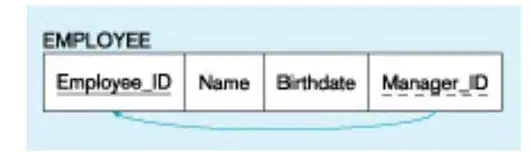
In the figure below, what type of key is depicted?
Primary
Recursive primary
Composite
Recursive foreign
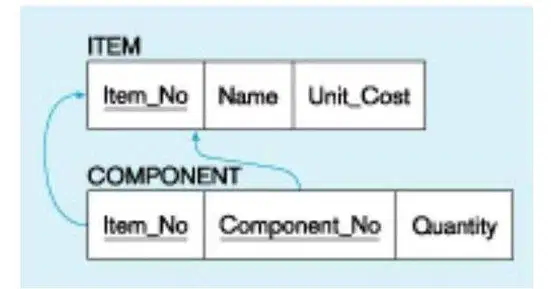
Referring to the figure below, which of the following is NOT true?
A component is part of an item.
A component is always used in only one item.
A component can be part of an item.
A component may be used in many items.
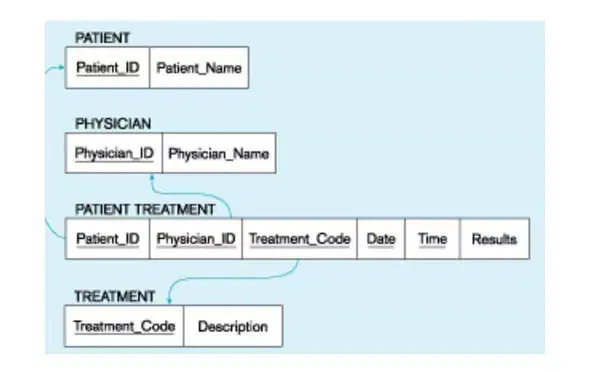
The figure below is an example of mapping which type of relationship?
First
Second
Unary
Ternary
A rule that states that each foreign key value must match a primary key value in the other relation is called the:
referential integrity constraint
key match rule
entity key group rule
foreign/primary match rule
_____ are anomalies that can be caused by editing data in tables.
Insertion
Deletion
Modification
Creation
A relation that contains minimal redundancy and allows easy use is considered to be:
clean
B) simple.
complex
B) well-structured.
Data structures include data organized in the form of tables with rows and columns.
True
False
A composite key consists of only one attribute.
True
False
A primary key is an attribute that uniquely identifies each row in a relation.
True
False
A foreign key is a primary key of a relation that also is a primary key in another relation.
True
False
Sample data are useful for developing prototype applications and for testing queries.
True
False
An enterprise key is a foreign key whose value is unique across all relations.
True
False
One property of a relation is that each attribute within a relation has a unique name.
True
False
There can be multivalued attributes in a relation.
True
False
The columns of a relation can be interchanged without changing the meaning or use of the relation.
True
False
Unlike columns, the rows of a relation may not be interchanged and must be stored in one sequence.
True
False
All values that appear in a column of a relation must be taken from the same domain.
True
False
View integration is the process of merging relations together.
True
False
A synonym is an attribute that may have more than one meaning.
True
False
When two or more attributes describe the same characteristic of an entity, they are synonyms.
TRUE
FALSE
CASE tools can model more complex data relationships, such as ternary relationships.
TRUE
FALSE
When a regular entity type contains a multivalued attribute, two new relations are created.
TRUE
FALSE
When transforming a weak entity, one should create one relation with both the attributes of the strong entity and the attributes of the weak entity.
TRUE
FALSE
The primary key of the many side migrates to the one side when transforming a one-to-many relationship.
TRUE
FALSE
When transforming a one-to-one relationship, a new relation is always created.
TRUE
FALSE
If an identifier is not assigned, the default primary key for an associative relation consists of the two primary key attributes from the other two relations.
TRUE
FALSE
An identifier assigned to an associative entity is also called a cross-relation key.
TRUE
FALSE
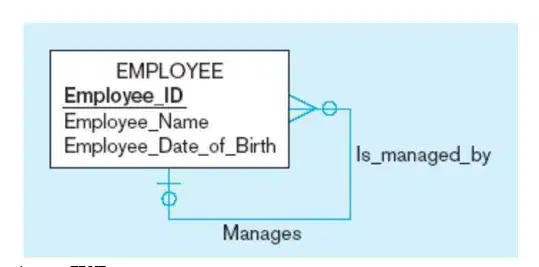
each employee has exactly one manager.
TRUE
FALSE
When transforming a unary many-to-many relationship to relations, a recursive foreign key is used.
TRUE
FALSE
The relational data model does, at this time, directly support subtype/supertype relationships.
TRUE
FALSE
Data integrity consists of powerful operations to manipulate data stored in relations.
TRUE
FALSE
The allowable range of values for a given attribute is part of the domain constraint.
TRUE
FALSE
The entity integrity rule states that a primary key attribute can be null.
TRUE
FALSE
In the relational data model, associations between tables are defined through the use of primary keys.
TRUE
FALSE
A referential integrity constraint is a rule that maintains consistency among the rows of two relations.
TRUE
FALSE
A cascading delete removes all records in other tables associated with the record to be deleted.
TRUE
FALSE
Select True or False: The truncate table statement in SQL creates a new table.
True
False
Select True or False: A well-structured relation contains minimal redundancy and allows users to manipulate the relation without errors or inconsistencies.
True
False
Select True or False: An anomaly is a type of flaw in the database server.
True
False
Select True or False: When normalizing, the goal is to decompose relations with anomalies to produce smaller, well-structured relations.
True
False
Select True or False: A relation in fifth normal form may not contain any anomalies.
True
False
Select True or False: A co-dependency is a constraint between two attributes or two sets of attributes.
True
False
Select True or False: A candidate key is an attribute, or combination of attributes, that uniquely identifies a row in a relation.
True
False
Select True or False: A relation is in first normal form if it has no more than one multivalued attribute.
True
False
Select True or False: A partial functional dependency is a functional dependency in which one or more nonkey attributes are functionally dependent on part (but not all) of the primary key.
True
False
Select True or False: A transversal dependency is a functional dependency between two or more nonkey attributes.
True
False
Select True or False: Anomalies do not generally arise out of transitive dependencies.
True
False

