
 Worksheets
Electricity Day 3
Total questions: 25
Worksheet time: 32mins
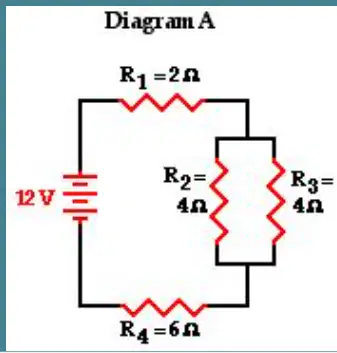
First solve the parallel circuit. What is R2 and R3 equal?
(a)
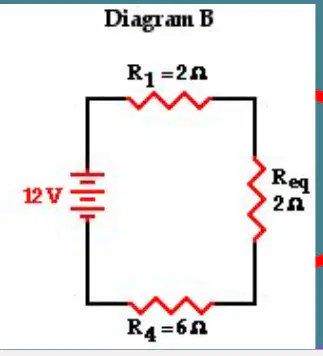
Second add any remaining resistors up. What is the total resistance?
(a)

The resistance from the parallel resistors is (a) ohms. The total resistance is (b) ohms.
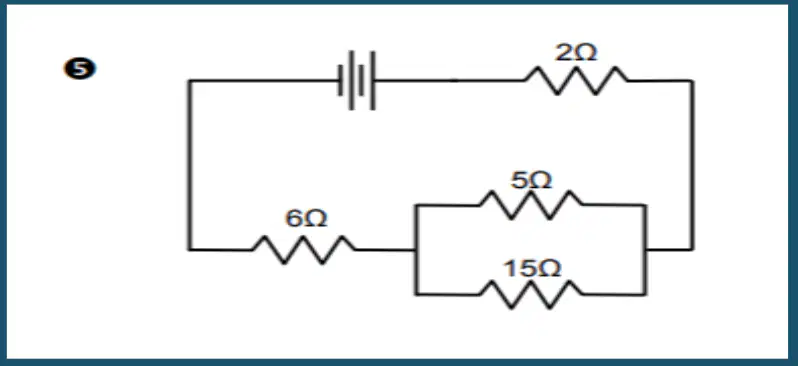
What is the total resistance?
(a)
What is power measured in?
Which is not an equation to find power?
R x I2
I x V
RV2
I x R
What is the current of a light bulb it is 70 watts and 120 volts?
What is the wattage of a light bulb if the ampere is 0.3 and the voltage is 150?
Which one of the following quantities is equivalent to 1 W?
1 V/A
1 Ω • m
1 V • A
1 V/Ω
When 5.00 A is flowing through an 10.0-Ω device, how much power is being dissipated in the device?
50.0 W
250 W
500 W
2.50 kW
A light bulb operating at a dc voltage of 100 V has a resistance of 200 Ω. How much power is dissipated in this bulb?
100 W
60 W
50 W
200 W
In a series circuit, if the total resistance is 10 ohms and the current flowing through the circuit is 2 amperes, what is the total power consumed by the circuit?
20 watts
40 watts
10 watts
5 watts

Categorize characteristics of Series vs Parallel Circuits
Individual Volts add up to TOTAL
Current remains the same throughout the circuit.
If one component fails, all components will stop working.
Only one path for the current to flow.
Individual Currents add up to TOTAL
If one component fails, other components will continue to work.
Multiple paths for the current to flow.
Components are connected side by side.
Same voltage across each component.
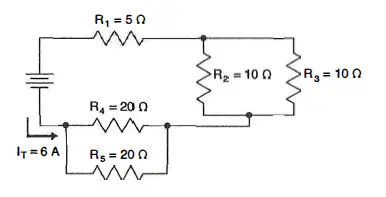
Drag the order of steps needed to simplify a combination circuit
Find Req for Parallel resistors
Find Req for entire circuit
Calculate total current (Itotal)
Apply Kirchoff's Laws by writing equations for V and I
Combine equations to find unknown variables

What current would flow?
0.36 A
1.04 A
0.021 A
0.82 A

What is the total resistance of the circuit in the figure?
24.17 ohms
70.41 ohms
15.32 ohms
120.12 ohms

The voltage drop across the parallel resistors shown in the figure is?
17.3 volts
62.1 volts
100 volts
20.7 volts

How many amps of current would flow through the circuit in the figure?
4.14
5.21
3.24
2

Calculate the current at the point E
6 A
7 A
8 A
9 A
Calculate the current at the point A
6 A
7 A
8 A
9 A
Calculate the current at the point B
6 A
7 A
8 A
9 A

Which of these circuits are parallel circuits?
X and Y only
X and Z only
Y and Z only
all of them

What is constant in a parallel circuit?
resistance (measured in ohms)
current (measured in amps)
voltage (measured in volts)
power (measured in watts)

The current in the resistor X is 2.0 A and the current in the 6.0 Ω resistor is 0.5 A. Calculate the current in resistor Y
0.5 A
1.5 A
2.5 A
3.5 A
The current in the resistor X is 2.0 A and the current in the 6.0 Ω resistor is 0.5 A. Calculate the resistance of resistor Y
6.0 Ω
2.0 Ω
4.0 Ω
3.0 Ω

