
Font size
 Worksheets
Diabetes Quiz
Total questions: 15
Worksheet time: 8mins
Diabetes is a disease related to the body’s inability to control blood sugar levels via insulin. Which type of diabetes is described as an autoimmune disorder where the body no longer produces insulin to control blood sugar and requires insulin injections to manage blood sugar?
Type 1 diabetes
Type 2 diabetes
Gestational diabetes
Which type of diabetes is lifestyle related, with the body producing insulin but not using it effectively to allow blood sugar into cells?
Type 1 diabetes
Type 2 diabetes
Gestational diabetes
Which statement best matches gestational diabetes as described?
It is an autoimmune condition that eliminates insulin production.
It is similar to Type 2 diabetes but occurs during pregnancy.
It results from a genetic mutation that increases insulin secretion.
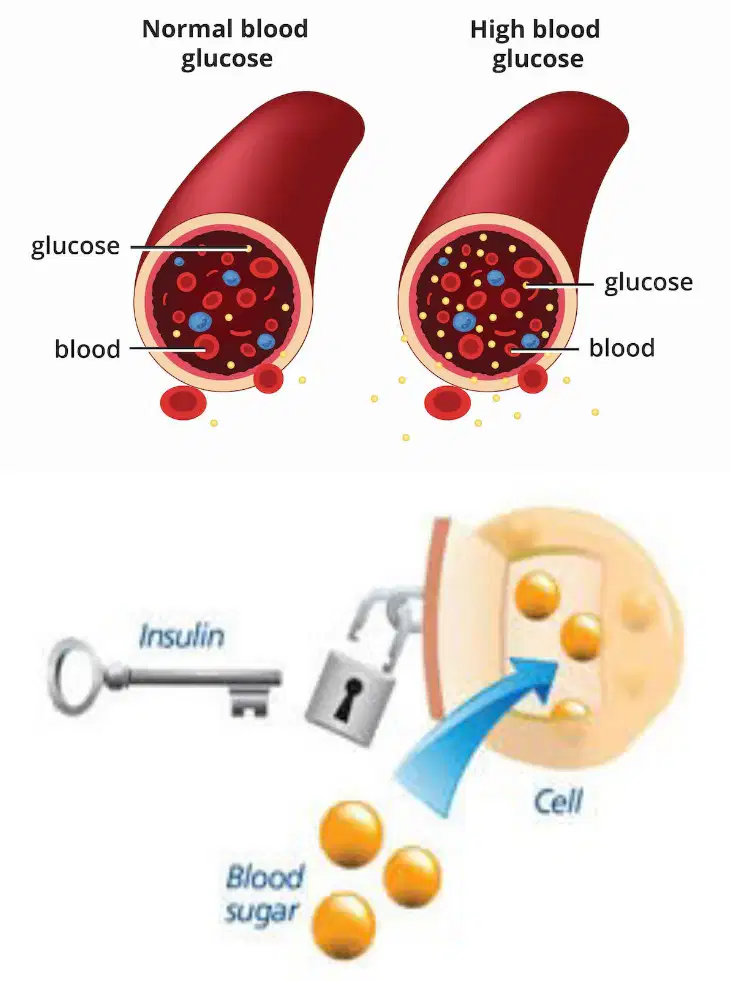
Based on the image showing insulin as a key allowing blood sugar into a cell, what is the primary role of insulin illustrated?
Insulin blocks glucose from entering cells.
Insulin enables glucose to enter cells.
Insulin converts glucose into amino acids.
In 2021 in Australia, about how many people were newly diagnosed with Type 2 diabetes?
About 45,700 people
About 12 per 100,000 people
About 3,000 people
Between 2000 and 2021, the age-standardised incidence rate for Type 2 diabetes changed. What was the approximate change over this period?
It increased by around 43%.
It fell by around 43%.
It remained unchanged.
For Type 1 diabetes, what best describes the incidence trend and the approximate number newly diagnosed in 2021 in Australia?
Incidence has remained fairly stable with around 3,000 people newly diagnosed.
Incidence has sharply declined with fewer than 500 people newly diagnosed.
Incidence has risen dramatically to over 60,000 people newly diagnosed.
Which pattern regarding diabetes prevalence is evident?
Prevalence increases with age.
Prevalence is highest in children and declines in older adults.
Prevalence has been decreasing steadily since 2000.
Which statement aligns with the diabetes trends?
Diabetes is less common in males than females.
Diabetes is higher in males.
Mortality rates have been rapidly increasing.
What has happened to the incidence of gestational diabetes over the past 20 years?
It doubled.
It decreased by half.
It remained unchanged.
Which statement about diabetes mortality in Australia is correct for 2022?
Diabetes was recorded as the underlying cause in around 6,000 deaths.
Diabetes contributed to roughly 1% of all deaths.
Mortality rates have been rising over the long term.
What do long-term trends indicate about age-standardised mortality rates for diabetes?
They have been declining, suggesting improvements in treatment, earlier detection, and better long-term disease management.
They have been increasing due to reduced access to care.
They have remained constant without notable change.
Given that death certificates often list “diabetes” without specifying type, which type is assumed to be responsible for the majority of diabetes-related deaths due to its higher prevalence?
Type 1 diabetes
Type 2 diabetes
Gestational diabetes
Which of the following are risk factors for Type 1 diabetes? Select all correct answers
Autoimmune conditions
Smoking
Family history
Physical inactivity
High blood pressure
Which groups are more at risk for diabetes? Select all correct responses
Aboriginal and Torres Strait Islander
Females
Young people
Rural and Remote
High socioeconomic status

