
Font size
 Worksheets
History Topic 3: The Industrial Revolution - 1700 to 1900
Total questions: 72
Worksheet time: 36mins
What was the Industrial Revolution characterized by?
The widespread adoption of industrial and mechanised processes in manufacturing, agriculture, and transportation
The decline of technology
The end of factory-based systems
The reduction of mass production
Where did the Industrial Revolution first begin?
United States
France
Great Britain
Germany
Fill in the blank: The Industrial Revolution was a historical period primarily occurring in the late ___ to early 19th centuries.
17th
15th
16th
18th
The Cottage Industry operated during the early 18th century in England by:
workers producing goods in their homes using hand tools
large factories employing hundreds of workers
goods being imported from overseas
production being controlled by the government
The concept of subcontracting in the cottage industry provided additional income for rural families.
True
False
Match the following terms with their correct descriptions:
New technology developed during the Industrial Revolution
Steam engine
Mechanised weaving device
Power loom
Rural household-based cloth production
Cottage Industry
The Voyages of Discovery had which impact on the Industrial Revolution in England?
They increased access to raw materials and markets, fueling industrial growth.
They led to the decline of trade and industry in England.
They caused England to become isolated from global commerce.
They had no significant impact on the Industrial Revolution.
What era is known as a period in which fundamental changes occurred in agriculture, textile and metal manufacture, transportation, economic policies and the social structure in England?
The Industrial Revolution
The Renaissance
The Victorian Era
The Enlightenment
Which phase of the Industrial Revolution introduced mass production using assembly lines, an idea pioneered by Henry Ford?
A) Industrial Revolution 1.0: Mechanization
B) Industrial Revolution 2.0: Electrification
C) Industrial Revolution 3.0: Automation
D) Industrial Revolution 4.0: Digitalization
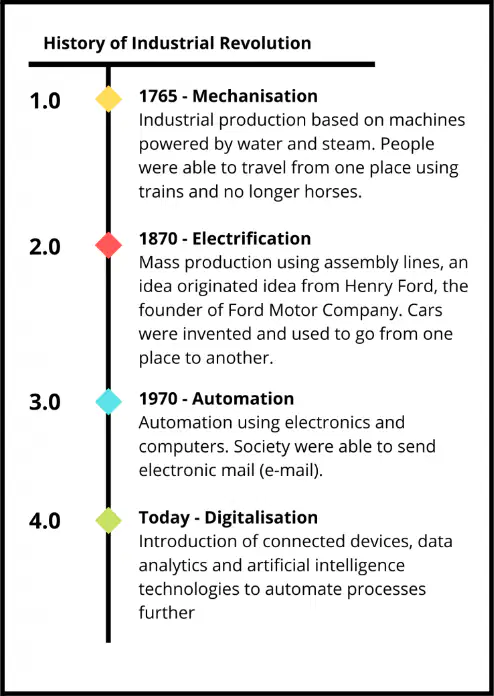
Match the phase of the Industrial Revolution with its main feature:
Use of connected devices, data analytics, and artificial intelligence
Use of water and steam-powered machines
Use of electronics and computers for automation
Use of assembly lines and electrification
Use of assembly lines and electrification
Use of electronics and computers for automation
Use of water and steam-powered machines
Use of connected devices, data analytics, and artificial intelligence
The Industrial Revolution lasted for over 100 years.
True
False
Fill in the blank: The first wave of the Industrial Revolution lasted from the late _______ to the mid-1800s.
1700s
1600s
1800s
1500s
Which innovation was important during the first wave of the Industrial Revolution?
Bessemer steel process
Steam power and cotton gin
Use of big data
Electronic mail (e-mail)
What is the current phase of the Industrial Revolution characterized by?
The integration of connected devices, data analytics, and artificial intelligence.
The widespread use of steam engines and mechanized manufacturing.
The dominance of manual labor and craft production.
The exclusive reliance on renewable energy sources.
Who was the founder of the Ford Motor Company, whose idea of assembly lines revolutionized mass production during the Industrial Revolution?
Henry Ford
Thomas Edison
Andrew Carnegie
John D. Rockefeller
The use of electronic mail (e-mail) was a feature of the Automation phase of the Industrial Revolution.
True
False
Why was England able to thrive during the Industrial Revolution?
England had an inexhaustible supply of coal
England had no access to raw materials
England was landlocked
England had no navy
Which of the following was NOT a reason for England's success in the Industrial Revolution?
Powerful navy
Lack of raw materials
Suitable climate for industries
Commercial empire
Fill in the blank: England imported raw cotton from _____ at very low prices and sold back cotton textile at high prices.
India
China
Brazil
Egypt
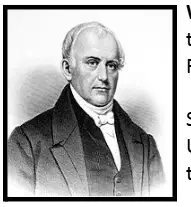
Who brought knowledge of textile mills from England to the United States?
Samuel Slater
Eli Whitney
Francis Cabot Lowell
Robert Fulton
Which countries were the first to be industrialised after England?
Belgium, France, the German states, and the United States in North America
Spain, Italy, Portugal, and Greece
Russia, China, India, and Brazil
Sweden, Norway, Denmark, and Finland
The industrial revolution spread to all parts of the world before 1850.
True
False
Match the following causes of the Industrial Revolution with their descriptions:
Capitalism
Laissez-faire system allowing people to carry out economic activities
European Imperialism
Provided funds and market for products through colonial powers
Cottage Industry
Small-scale production of goods in homes or farms
What does 'laissez-faire capitalism' mean during the Industrial Revolution?
It means the government was asked to stay out of the economy and allow people to carry out their economic activities.
It means the government strictly controlled all economic activities.
It means only the wealthy could participate in the economy.
It means the government provided subsidies to all businesses.
European Imperialism provided which two main benefits for industrialisation?
Access to raw materials and new markets
Technological advancements and improved education
Political stability and democratic reforms
Reduction in military conflicts and peace treaties
What is meant by 'cottage industry'?
A period in which goods for sale were produced on a very small scale, usually in homes or on farms, before the factory system.
A system where large factories produce goods using advanced machinery.
A type of industry that only produces luxury goods for export.
A government-run program to support small businesses in urban areas.
The textile industry was the first to use modern mass-production methods during the Industrial Revolution.
True
False
Who invented the spinning jenny, which drastically increased the pace of production during the Industrial Revolution?
James Hargreaves
Richard Arkwright
Samuel Crompton
Eli Whitney
Which invention did Richard Arkwright create that produced yarn harder and stronger than the initial spinning jenny?
Water-powered water frame
Spinning mule
Flying shuttle
Power loom
Who developed the steam engine that was more efficient and powerful than Thomas Newcomen's steam engine?
James Watt
Robert Fulton
George Stephenson
Richard Trevithick
Which of the following is NOT a notable invention of the Industrial Revolution?
Atmospheric steam engine
Cotton gin
Printing press
Airplane
Match the following inventors to their inventions:
Eli Whitney
Sewing machines
Samuel F.B. Morse
Cotton gin
Elias Howe
Telegraph
Alexander Graham Bell
Telephone
The Model T Ford and the large scale moving assembly line were invented by Henry Ford in 1908 and 1913.
True
False
During the Industrial Revolution, which country had significant political influence over India and its cotton industry?
Britain
France
Germany
Portugal
What percentage of an adult's wage did children often earn during the Industrial Revolution?
10 to 20 percent
50 to 60 percent
30 to 40 percent
70 to 80 percent
Which of the following jobs did children NOT typically perform during the Industrial Revolution?
Working in factories
Selling newspapers
Breaking up coal at coal mines
Practicing law
Child labour during the Industrial Revolution was eventually made illegal by new laws.
True
False
Why did some businesses hire children during the Industrial Revolution?
Because they were cheap, worked hard, and could do some jobs that adults couldn't do.
Because children were more educated than adults.
Because children were required to own businesses.
Because children were stronger than adults.
What were some dangers children faced while working during the Industrial Revolution?
Children lost limbs or fingers working on high powered machinery with little training, worked in mines with bad ventilation and developed lung diseases, and became sick from dangerous chemicals.
Children were given free education and healthy meals at work.
Children were allowed to work only for one hour a day under strict supervision.
Children were paid high wages and given weekends off.
What were the living conditions like in crowded cities during the Industrial Revolution?
Living conditions were dirty and unsanitary, with little medical care and diseases spread rapidly.
Living conditions were clean and spacious, with excellent medical care and little disease.
Living conditions were luxurious, with advanced technology and healthy environments.
Living conditions were peaceful and rural, with plenty of fresh air and open spaces.
Did a lot of children work during the Industrial Revolution?
True
False
What law was passed in the United States in 1938 to regulate child labor?
The Fair Labor Standards Act.
The Wagner Act.
The Social Security Act.
The Taft-Hartley Act.
Which of the following is a positive effect of the Industrial Revolution?
A. Expansion of Industries
B. Ruining of the Domestic system
C. Exploitation of people
D. Pollution
Which of the following is a negative effect of the Industrial Revolution?
Increase in commerce and trade
Growth of population
Unemployment
Better diets and housing
Fill in the blank: Child labour laws were introduced as a ______ effect of the Industrial Revolution.
positive
negative
neutral
temporary
Fill in the blank: Pollution is a ______ effect of the Industrial Revolution.
negative
positive
neutral
temporary
Which of the following is NOT a positive effect of the Industrial Revolution?
New inventions
Poor working conditions
Expanded educational opportunities
Better diets and housing
Which of the following is NOT a negative effect of the Industrial Revolution?
Overcrowding
Increase of wealth
New diseases
Pollution
What impact did the Industrial Revolution have on job opportunities?
It increased job opportunities and allowed more people to have jobs.
It eliminated all job opportunities and caused mass unemployment.
It had no effect on job opportunities.
It decreased job opportunities and forced people out of work.
How did the Industrial Revolution change the world from a rural culture to an urban culture?
People moved out of rural homes to be closer to factories and urban job opportunities.
People began farming more in rural areas.
People moved to rural areas to escape industrialization.
People stopped working and stayed at home.
Which of the following is an advantage of the industrial revolution?
It inspired innovation.
Working conditions became brutal.
It requires natural resources.
Local jobs got poached.
Fill in the blank: The industrial revolution allowed for groups of people to be more ________ than one person on their own, leading to increased production levels.
productive
isolated
fragile
confused
The industrial revolution created competition by allowing multiple products to be made in any industry or sector, leading to free market economies.
True
False
Which of the following is a disadvantage of the industrial revolution?
It improved processes in virtually any sector.
It reduced the influences of borders.
Financial disadvantages such as a wider gap between rich and poor.
It inspired innovation.
Fill in the blank: Before the industrial revolution, trade and commerce were restricted to the ________ level at best.
national
global
local
continental
The industrial revolution made it easier and cheaper to transport goods, allowing businesses to create an international presence.
True
False
Which of the following is NOT a disadvantage of the industrial revolution?
A) Working conditions can be brutal.
B) It requires natural resources.
C) It improved processes in virtually any sector.
D) Local jobs got poached.
Fill in the blank: Industrialization results in a wider gap between the ________ and ________ due to a division of labour and capital.
rich, poor
young, old
urban, rural
skilled, unskilled
Most of the processes developed during the industrial revolution require fossil fuels to operate, which are finite resources.
True
False
Which of the following statements is true about the global impact of the industrial revolution?
Every nation has experienced their own industrial revolution.
Not every nation has experienced their own industrial revolution, leading to a wealth gap between industrialized and non-industrialized nations.
The industrial revolution eliminated the wealth gap between nations.
All nations rely only on their own infrastructure.
Fill in the blank: Before unions were created, the working conditions in many of the first factories during the industrial revolution were ________.
horrible
excellent
comfortable
safe
The industrial revolution allowed for better products to be made or improved services to be given, improving quality of life over time.
True
False
The Industrial Revolution changed the way people viewed work and productivity by:
emphasizing efficiency and mass production over traditional craftsmanship
encouraging a return to agricultural lifestyles
reducing the importance of technology in daily life
making manual labor more valued than machine work
The Industrial Revolution set the stage for modern technological advancements in which of the following ways?
By introducing mass production and mechanization
By promoting feudal agricultural practices
By discouraging scientific research and innovation
By limiting global trade and communication
Entrepreneurship played a significant role in the success of the Industrial Revolution by:
Driving innovation and economic growth
Limiting technological advancements
Reducing the number of new businesses
Discouraging investment in new industries
My life would be different if the Industrial Revolution had never occurred because:
I would likely have less access to modern technology and conveniences.
I would have more advanced transportation systems.
I would live in a highly industrialized society.
I would rely heavily on digital communication.
Great Britain's geographical and political conditions contributed to it being the birthplace of the Industrial Revolution because:
It had abundant natural resources, stable government, and access to trade routes.
It was isolated from other countries and lacked natural resources.
Its political instability encouraged rapid industrial growth.
It had limited access to international markets and poor transportation.
The significance of the cottage industry before the rise of factories was:
It provided employment and income to rural families.
It led to the invention of steam engines.
It was the main source of urban pollution.
It replaced agriculture as the primary occupation.
Lessons learned from the Industrial Revolution can inform current discussions about automation and job displacement in which of the following ways?
By highlighting the importance of adapting workforce skills to new technologies
By suggesting that automation always leads to permanent job loss
By proving that technological change has no impact on employment
By showing that government intervention is unnecessary during technological shifts
Applying historical insights from this period can help improve working conditions today in which of the following ways?
By learning from past labor movements to advocate for fair wages and safer workplaces
By ignoring historical lessons and maintaining current practices
By reducing worker rights based on outdated methods
By focusing solely on technological advancements without considering worker welfare
Modern technological innovations might be viewed in a historical context similar to that of the Industrial Revolution as:
A period of rapid change and transformation in society and industry.
A time when technology had little impact on daily life.
An era marked by the decline of manufacturing.
A phase with minimal influence on global economies.
Match the following:
Colonisation
The act of moving from one place to another, driven by various factors
Mass Production
Efficient large-scale production of standardised products with automation
Migration
The employment of children in work that harms their development and well-being
Cottage Industries
Small-scale, decentralised production, often home-based, using traditional methods
Child Labour
Elements or materials found in the natural environment that have value and utility to humans

