
 Worksheets
Course Objectives Quiz
Total questions: 11
Worksheet time: 6mins
What does CMRR stand for in the context of operational amplifiers?
Common Mode Rejection Ratio
Current Mode Resistance Ratio
Circuit Modulation Response Rate
Capacitive Measurement Reference Ratio
The importance of slew rate in operational amplifiers lies in its effect on signal processing. What does slew rate determine?
Slew rate controls the input impedance of the amplifier, affecting signal attenuation.
Slew rate determines the maximum rate of change of the output voltage, affecting the amplifier's ability to accurately reproduce fast-changing signals.
Slew rate sets the power consumption of the amplifier, impacting efficiency.
Slew rate defines the bandwidth of the amplifier, limiting frequency response.
Compare the ideal characteristics of an OP-AMP with those of a practical OP-AMP. What are the key differences?
Ideal OP-AMPs have infinite gain, infinite input impedance, zero output impedance, and infinite bandwidth, while practical OP-AMPs have finite values for these parameters.
Ideal OP-AMPs have zero gain, zero input impedance, infinite output impedance, and zero bandwidth, while practical OP-AMPs have infinite values for these parameters.
Ideal OP-AMPs have finite gain, finite input impedance, zero output impedance, and zero bandwidth, while practical OP-AMPs have infinite values for these parameters.
Ideal OP-AMPs and practical OP-AMPs have identical characteristics.
Which material is most commonly used as the base for an Integrated Circuit (IC)?
Silicon
Copper
Plastic
Gold
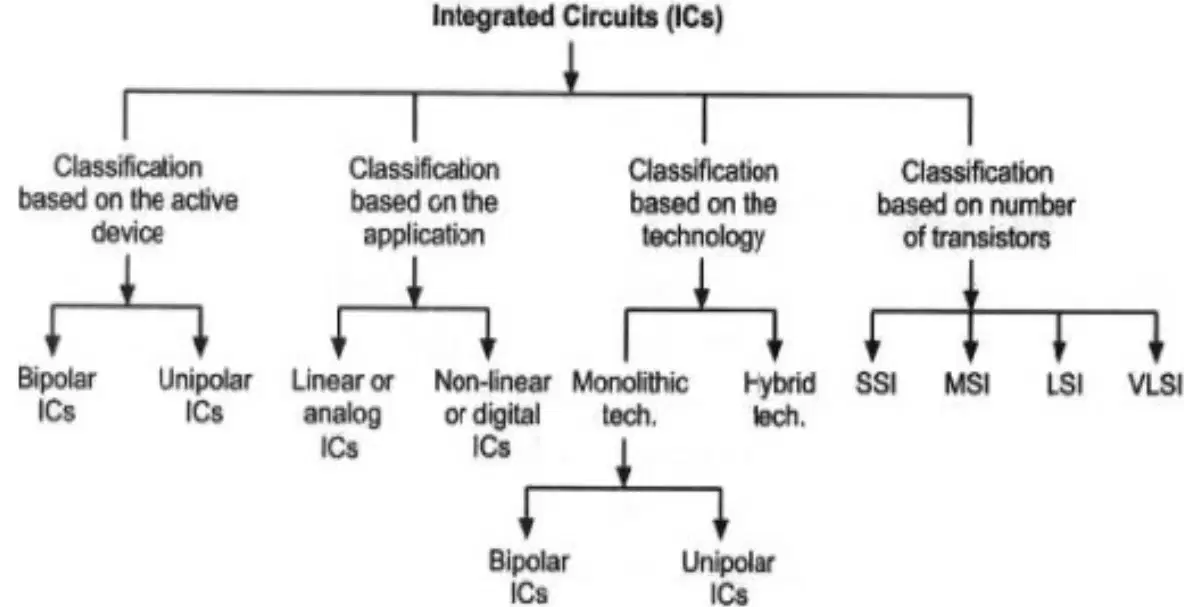
Explain how the classification of ICs based on technology differs from classification based on the number of transistors. Provide examples from each category.
Technology classification refers to how ICs are manufactured (e.g., monolithic or hybrid), while number of transistors classification refers to the scale of integration (e.g., SSI, MSI, LSI, VLSI).
Technology classification is about the application of ICs, while number of transistors classification is about the type of active device.
Technology classification is about the analog or digital nature, while number of transistors classification is about the manufacturing process.
Technology classification is about the number of transistors, while number of transistors classification is about the technology used.
What is the main characteristic of a digital integrated circuit?
It operates only in on-state or off-state, not in between.
It processes analog signals continuously.
It amplifies microwave signals.
It is used only in audio equipment.
A student is designing a circuit that requires the output to be either fully on or fully off, with no intermediate states. Which type of IC should they use?
Digital IC
Linear IC
Analog IC
Power amplifier IC
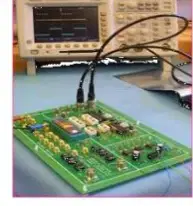
Which type of IC is most likely being tested in the image described above?
Digital IC
Linear IC
Analog IC
Microwave amplifier IC
Which of the following is NOT a benefit of using ICs?
Increased weight
High speed
Easy replacement and maintenance
Supports complex designs
What is the primary function of a linear integrated circuit?
To store data
To convert analog signals to digital
To amplify signals
To perform digital logic operations
In which application would you most likely use a power amplifier IC?
Microcontroller interfacing
Data storage in computers
Signal processing in audio systems
Digital signal processing

