
 Worksheets
Quiz: World War One Begins
Total questions: 22
Worksheet time: 11mins
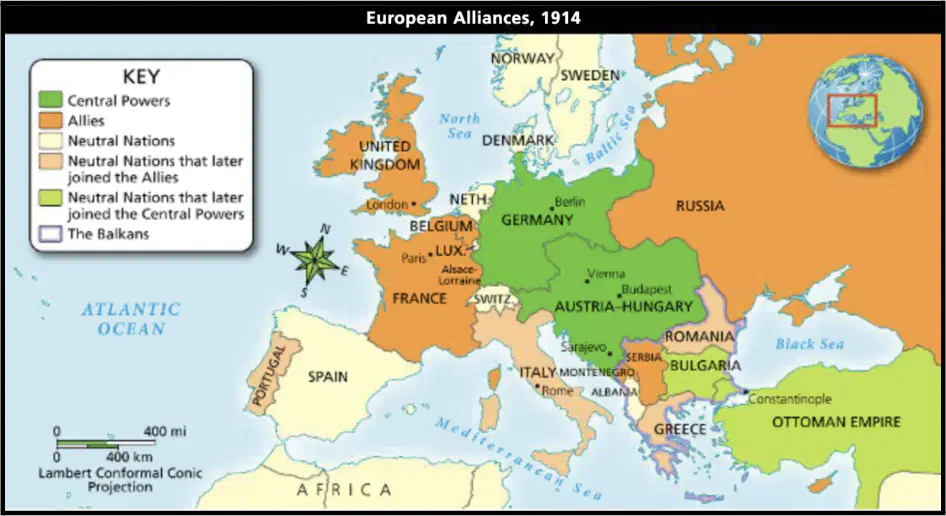
Using the map above, what three MAIN nations made up the alliance known as the Allied Powers?
Germany, Austria-Hungary, Ottoman Empire
Austria-Hungary, Russia, United Kingdom
Russia, Italy, Germany
United Kingdom, France, Russia
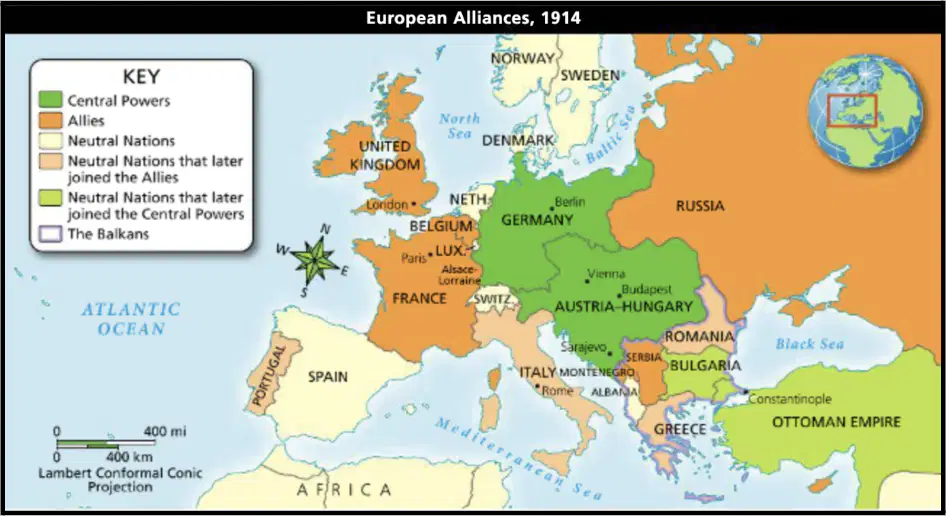
Using the map above, what three MAIN nations made up the alliance known as the Central Powers?
Germany, Russia, France
Austria-Hungary, Russia, United Kingdom
Germany, Austria-Hungary, Ottoman Empire
United Kingdom, France, Russia
What term was used to describe the glorification of the military and readiness for war?
Imperialism
Nationalism
Militarism
Industrialism
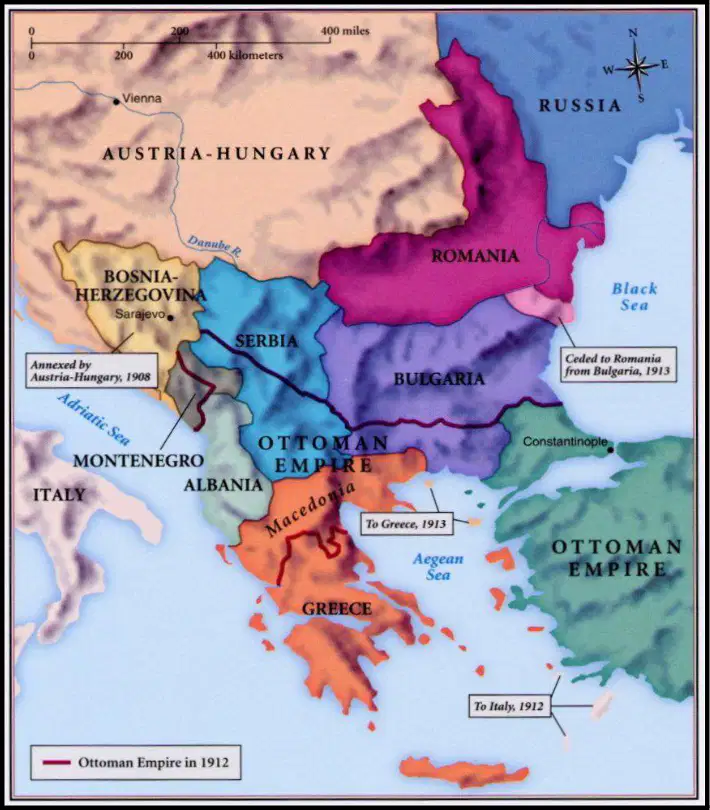
Use the map to help explain why the Balkan region of Europe was called the "powder keg of Europe" before World War I?
Because it was the center of arms manufacturing for the region
Because the empire of Germany had created a system of alliances to weaken the Ottoman Empire
Because it was the region was ripe with nationalist movements to overthrow the weakened Ottoman Empire
Because it was known as region full of resources needed by the big powers for their industrialization efforts
Before World War One, what was a major cause of tension between France and Germany?
Religious differences
Colonial disputes in Africa in North Africa
France's desire to recover Alsace and Lorraine lost in the Franco Prussian War in 1871
Competition for natural resources and colonies around the world
How did economic rivalries contribute to the start of World War I?
They led to increased cooperation between European nations
They caused nations to reduce their military spending and seek peaceful cooperation
They created competition and suspicion between major powers like Germany and Britain
They caused nations to seek economic partnerships to reduce the chance of war
Which nation sponsored Pan-Slavism and stood ready to support the newly created nation of Serbia against any threat?
Germany
France
Russia
Britain
What was the immediate event that sparked World War I?
The assassination of Archduke Francis Ferdinand
Austria-Hungary's declaration of war on Serbia
Russia's mobilization of troops
Germany's invasion of Belgium
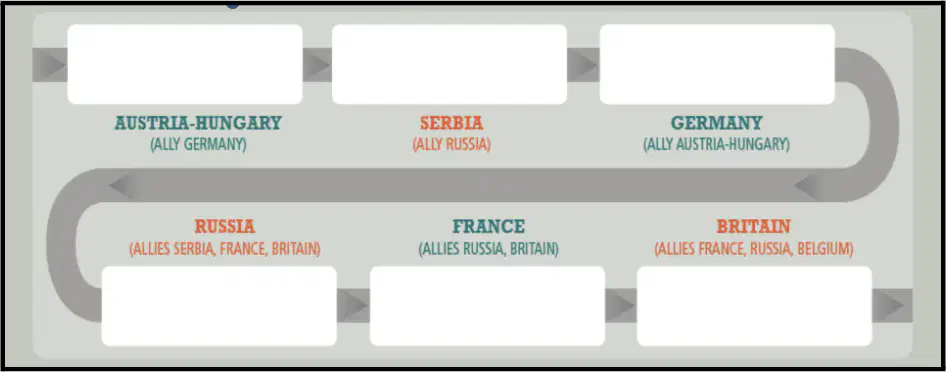
Select the correct grouping of numbers next to the statement to indicate the reasons for going to war below the correct country. 1. Declared war on Germany for invading Belgium 2. Wanted to defend fellow Slavic people in Serbia 3. Wanted to punish Serbia for encouraging terrorism 4. Rejected some terms of Austrian ultimatum 5. Stood by its one major ally, Austria-Hungary 6. Sought revenge for the Franco-Prussian War and honor its commitment to Russia
1, 5, 3, 4, 2, 6
2, 3, 4, 1, 5, 6
3, 4, 5, 2, 6, 1
6, 4, 5, 2, 1, 3
What did many people and governments believe about the war in the beginning?
It would be a long and bloody engagement
The war would be contained to the Balkans
The war would end with a negotiated peace and little bloodshed
The war would be quick and glorious
What was the Schlieffen Plan?
A peace proposal by Britain
A German strategy to avoid fighting a two-front war
A Russian mobilization plan
An Austrian diplomatic initiative
What battle ended Germany's hopes for a quick victory on the Western Front?
The Battle of Verdun
The Battle of the Somme
The Battle of the Marne
The Battle of Ypres
Which of the following statements BEST explains why trench warfare led to a stalemate on the Western Front?
Soldiers refused to follow orders to attack
Defensive technologies like machine guns made attacks extremely costly
Both sides had equal numbers of soldiers
Neither side had effective military leadership
What term was used to describe the area between opposing trenches?
The killing zone
The land between the trenches
No man's land
The neutral zone
What was a "stalemate" in the context of World War I?
A formal peace agreement
A deadlock in which neither side could defeat the other
A temporary ceasefire
A military strategy to conserve resources

According to the chart above, approximately how many casualties resulted from the Battle of the Somme?
100,000
500,000
750,000
1,000,000
Which weapon was responsible for up to 40 percent of battlefield deaths in World War I?
Artillery
Machine guns
Poison gas
Flamethrowers
Based on your previous learning, what was the greatest killer on World War I battlefields?
Machine guns
Artillery fire
Poison gas
Rifle fire

What new military technology was introduced by Britain in 1916 in an effort to break the stalemate by making “no man's land safer for attacks?”
Airplanes
Machine guns
Tanks
Poison gas
How were aircraft initially used in World War I?
To drop bombs on enemy trenches
To transport troops
To observe enemy troop movements
To evacuate wounded soldiers

What term was used for German submarines during World War I?
U-boats
Z-crafts
S-vessels
D-ships

What was the primary purpose of Germany's U-boat campaign?
To help establish further overseas colonies in Africa and Asia
To destroy ships supplying the United Kingdom, forcing their surrender
To prevent American entry into the war
To protect German coastal cities from attack by the United Kingdom

