
 Worksheets
12/9/25 PhET States of Matter: Basics Part 1 Quiz
Total questions: 20
Worksheet time: 30mins
Which statement best describes particle arrangement in a solid?
Particles are equally spaced and stationary
Particles are far apart and move randomly
Particles are loosely packed and slide past
Particles are tightly packed in fixed positions
Which state of matter takes the shape of its container but keeps a constant volume?
Solid with rigid shape and fixed volume
Plasma with charged particles and no volume
Liquid with flowing particles and fixed volume
Gas with spreading particles and changing volume
In a gas, how do particles typically move?
They slide past each other slowly
They vibrate in place in orderly arrangement or pattern
They rotate but remain touching
They move freely and spread out
What phase change occurs when a solid turns into a liquid?
Condensing as gas cools
Freezing as temperature decreases
Melting as temperature increases
Boiling as bubbles appear
What is the melting point?
Temperature where particles stop moving
Temperature where a gas forms bubbles
Temperature where a solid begins to melt
Temperature where a liquid begins to freeze
What is the boiling point of pure water at standard pressure?
50 degrees Celsius and 122 degrees Fahrenheit
273 degrees Celsius and 451 degrees Fahrenheit
0 degrees Celsius and 32 degrees Fahrenheit
100 degrees Celsius and 212 degrees Fahrenheit
When a gas is cooled, what most likely happens to particle motion and spacing?
Particles vibrate faster but stay apart
Particles move slower and get closer
Particles move faster and spread out
Particles stop moving and disappear
Which statement explains why water expands when it freezes?
Atoms of hydrogen become larger in size
Solid water forms an open crystal structure
Gas bubbles get trapped in liquid water
Liquid water compresses under cold pressure
During melting of a substance, what happens to temperature at the melting point while melting continues?
Temperature stays constant during the phase change
Temperature rises rapidly during the phase change
Temperature cycles up and down during change
Temperature falls steadily during the phase change
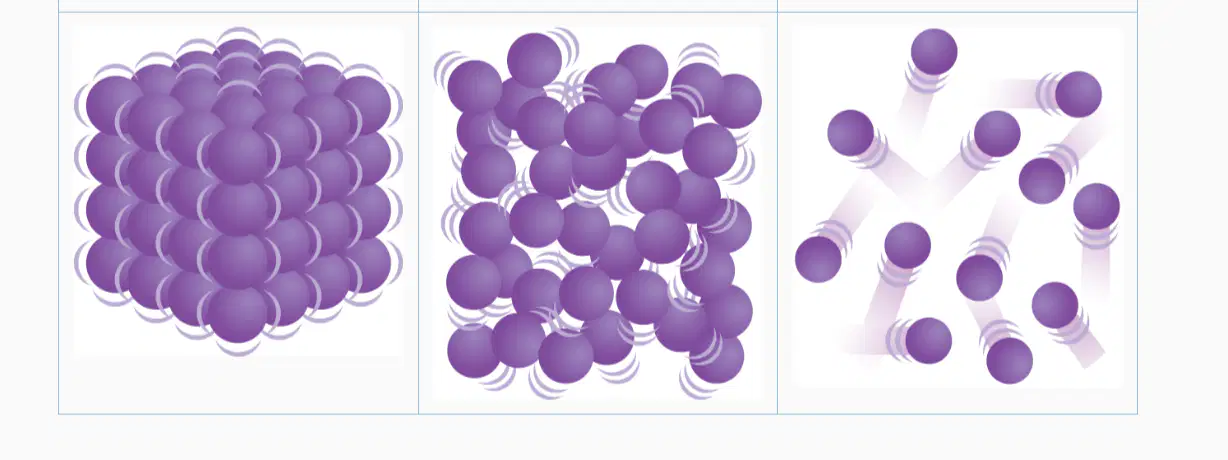
Which diagram best represents particles in a liquid?
Evenly spaced with no collisions
Widely spaced moving in straight lines
Locked in a rigid grid without motion
Close together with random sliding motion
What is the freezing point of water on the Celsius and Fahrenheit scales?
32 degrees Celsius and 0 degrees Fahrenheit
100 degrees Celsius and 212 degrees Fahrenheit
0 degrees Celsius and 32 degrees Fahrenheit
-10 degrees Celsius and 14 degrees Fahrenheit
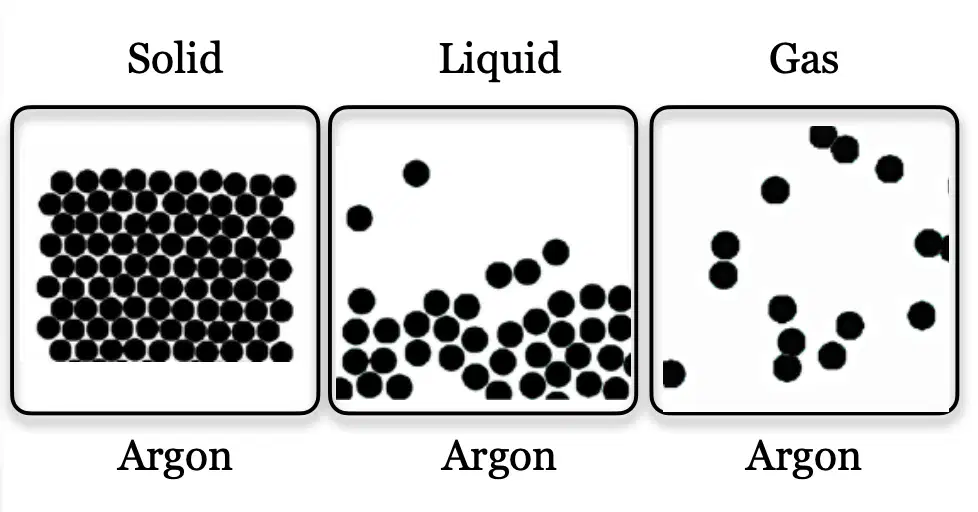
The state of matter in which the atoms are close together but not always touching.
liquid
solid
gas
The state in which atoms are loosely packed and tend to completely fill the container.
liquid
solid
gas
The state in which atoms are tightly packed and tend to keep their shape.
liquid
solid
gas

This is the element (a) and the state of matter is a (b)
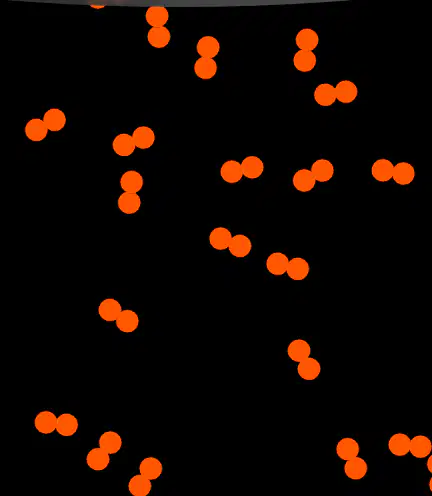
This is the element (a) and the state of matter is a (b) .
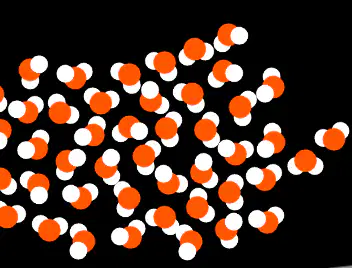
This is the molecule (a) and the state of matter is a (b) .

This is the element (a) and the state of matter is a (b) .

This is the molecule (a) and the state of matter is a . (b) .
Water is a substance which has particles that are farther apart as a solid than they are as a liquid. This explains why _____________________________.
Neon glows when energized with electricity.
Water expands when it freezes.
Argon is a gas at normal temperature and pressure.
Oxygen can be condensed into a liquid at very cold temperatures.

