
 Worksheets
Unit 4 Review Test
Total questions: 60
Worksheet time: 2hrs 49mins
Ionic bonds are between...
nonmetals and nonmetals
carbon and oxygen
metals and nonmentals
hydrogen and chlorine
Covalent bonds are between...
two or more nonmetals
sodium and chlorine
metals and metals
metals and nonmetals
Why do the noble gases not react with other elements?
They don't want to
They need many electrons
They have full outer energy levels
Their protons and electrons are balanced
What kind of bond is formed when a sodium and chlorine bond..
Covalent Bond
Ionic Bond
Metallic Bond
Treasury Bond
Chemical bond is ...
the physical mixing of two different atoms.
the force that holds two atoms together
the energy used up when two atoms combined.
the temperature that changes the phase of matter.
What kind of bond is formed when carbon and hydrogen bond..
Covalent Bond
Ionic Bond
Metallic Bond
Treasury Bond
Why do elements bond?
To be friends
To create a new element
To become stable
To get bigger

How many valence electrons does Oxygen (O) have?
6
8
15
16

What type of bonding does this picture show?
Ionic
Covalent

When electrons are lost by one atom and gained by another, so that they both get full outer shells.
Covalent bond
Ionic bond
Pairing
Compound
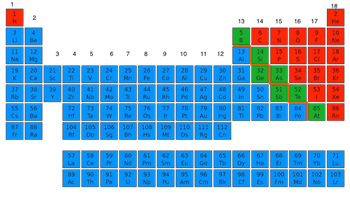


The 3 types of chemical bonds are ________, ________, and ______. (Choose 3)
ionic
valence
covalent
metallic
atomic
Which compound has high melting point?
Ionic
Covalent
The octet rules states that most elements want to have _____ valence electrons.
2
4
6
8

Which of the following is NOT an ionic bond?
NH3
KCl
K3N
NaCl

Which of the following is the correct Lewis dot between Rb and O?


What is the correct Lewis structure for BF3?

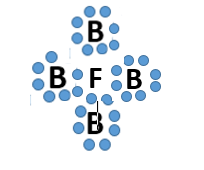

BF3 (The formula is the Lewis Structure)
What category of element usually forms a positive ion?
Metals
Nonmetals
metalloids
Noble gases
Which category of elements usually form negative ions?
metals
nonmetals
metalloids
noble gases
Why are metals malleable?
They are shiny
The electrons are held tightly within the lattice structure making it strong
The electrons are delocalized and able to move between the atoms
The electrons are shared between two metal ions and this holds the atoms together
Which of these are considered properties of metals? (choose ALL that apply)
brittleness
low melting point
luster (shininess)
malleability
ductility

Mg(NO3)2
magnesium nitrate
magnesium nitrite
magnesium nitride
magnesium nitrogen oxide
magnesium hydroxide
Mg(OH)2
MgOH2
MgOH
MgO
ammonium sulfide
(NH4)2S
NH4S
(NH4)2SO4
NH4(S)2
strontium dichromate
SrCr2O7
Sr2(Cr2O7)2
SrCrO4
Sr2(CrO4)2
What's the correct formula for titanium (II) nitrate?
Ti(NO3)2
Ti(NO3)
(NO3)Ti
none of the above
What's the formula for iron(II) sulfide?
FeS
Fe2S
SFe
S2Fe
What's the name of CdS?
Cadmium Sulfate
Cadmium (II) Sulfide
Cadmium Sulfur
None of the above
Metal ions are surrounded by a "sea" of POSITIVE charge
True
False
What are some benefits of alloys? (choose all that apply)
they can be stronger than pure metal
they may not rust/corrode as easily
they don't have electrons
they form covalent bonds
What is the sea of electrons model related to?
Covalent bonding
Hydrogen bonding
Ionic bonding
Metallic bonding
What are the properties of metallic bonding?
Good conductors of electricity, ductile, malleable, and arranged in crystal lattice structure
Poor conductors of electricity, not ductile, not malleable, and arranged in random structure
Good conductors of electricity, not ductile, not malleable, and arranged in random structure
Poor conductors of electricity, ductile, malleable, and arranged in crystal lattice structure
What is an alloy?
A compound with only one type of metal
Composed of two or more elements, at least one of which is a metal
A mixture of non-metallic elements
A pure metal
How many Lewis Dots should Sulfur have?
16
6
7
8
H2O is classified as a(n)
Metallic molecule
Covalent molecule
Ionic molecule
Lewis molecule
Check all element pairs that will form a covalent bond. (Nonmetal + Nonmetal)
S and O
C and F
H and Cl
Na and O
Mg and I

14. Using the image, identify what type of chemical bond would most likely be formed?
An ionic bond because there are positive and negative charges found between the aluminum atoms.
A covalent bond because the electrons are being shared.
A metallic bond because the electrons are being pooled and shared between metal atoms.
An ionic bond because a bond is formed between metal and nonmetal atoms.

