wayground logo

Free Printable Worksheets

Font size

S
M
L
XL
Worksheets

Semester 1 Review - Part Uno

Total questions: 55

Worksheet time: 1hrs 14mins

Name
Class
Date
1.
True or False:  The density of a specific type of material never changes.  
a)
True
b)
False
2.
In general what is the most dense form of matter?
a)
solid
b)
liquid
c)
gas
d)
plasmas
3.
If an object has a density of .6 g/cm^3 and you put it into water, will it sink or float?  
a)
sink
b)
float
4.
If an object has a density of 3.6 g/cm^3 and you put it into water, will it sink or float?  
a)
sink
b)
float
5.
What is the formula for density?
a)
density = mass x volume
b)
density = mass / volume
c)
density = mass + volume
d)
density = mass - volume
6.
Jack has a rock. The rock has a mass of 14 g and a volume of 2 cm3. What is the density of the rock?
a)
7 mL
b)
7 g/cm3
c)
28 g/cm3
d)
1/7 g/cm3
7.
Frank has an eraser. It has a mass of 4 g, and a volume of 2 cm3. What is its density?
a)
8 g/cm3
b)
2 g/cm3
c)
1/2 g/cm3
d)
24 g/cm3
8.
Frank has a liquid. It has a mass of 6 g and a volume of 9 mL. What is its density?
a)
3 g/mL
b)
.66 g/mL
c)
1.33 g/mL
d)
54 g/mL
9.
If this substance takes up 6 ml of space, what is its mass?
a)
 6 ml
b)
6 grams
c)
0 grams
d)
4 grams 
10.
Which substance is the MOST dense?  ** Use the key
a)
A
b)
B
c)
C
d)
Cannot be determined by the data provided.
11.
What is the volume of 150 grams of lead if it has a density of 11.3 g/cm3?
a)
13.3 g
b)
13.3 cm3
c)
.075 g
d)
1695 cm3
12.
An empty beaker has a mass of 60 grams.  When mercury is added to the beaker, it has a mass of 200 grams. What is the mass of the mercury?
a)
140 grams
b)
200 grams
c)
140 mL
d)
260 g
13.

The density of iron is 7.87 g/mL. If a 40 g block of iron is cut in half, what is true about the density of each half?

a)

It is twice the original density

b)

It is half the original density

c)

It is the same density as the whole block

d)

Cannot be determined without more data

14.
Which of the following temperatures is appropriate to convert 25oC into the Kelvin scale?
a)
373K
b)
272K
c)
372K
d)
273K
15.
What is the correct temperature on the Kelvin scale equal to 30oC?
a)
303K
b)
243K
c)
313K
d)
253K
16.
When the temperature is constant (k) inside a balloon, if you add pressure on it, the volume will ..... 
a)
Decrease
b)
Increase
c)
Not Change at all
d)
Particles will solidify 
17.
For example, if you increase the temperature of a gas inside a balloon, the balloon will....
[pressure is constant (k)]
a)
Expand (increase in volume)
b)
Deflate (decrease in volume
18.
Why does a car get low tire pressure in the COLD...what two variables are to blame? 
a)
Pressure and Temperature
b)
Temperature and Volume
c)
Volume and Pressure
d)
Temperature and Weight 
19.

How do you convert C to Kelvin (K)?

a)

C + 273

b)

C x 273

c)

C / 273

d)

C + 32 + 273

20.
Directly proportional means that as one value increases ....................
a)
the other stays the same 
b)
the other increases as well
c)
the other decereases
d)
the other goes to zero
21.
Inversely proportional means as one value increases the other............. 
a)
increases 
b)
decreases 
c)
stays the same 
d)
goes to zero
22.
Temperature describes  the ______________ of particles.
a)
volume
b)
mass
c)
motion
d)
conductivity
23.

What relationship does this graph represent?

a)

Pressure & Volume being inversely proportional

b)

Pressure & Volume being directly proportional

24.

Using the graph as support, if the volume of a gas was decreased, what should happen to the pressure?

a)

Pressure should increase

b)

Pressure should decrease

25.

Initially a balloon contains 30 particles at a pressure of 1 atmosphere. The particles in the balloon react and have now doubled to 60 particles total. What must be true about the pressure? Select all that apply. (Assuming temperature and volume are constant)

a)

The pressure will double

b)

The pressure will increase

c)

The pressure will half.

d)

The pressure will decrease

26.
What is 50 C in Kelvin?
a)
223
b)
323
c)
100
d)
50
27.
In order to solve gas law calculations, temperature must be measured in:
a)
Fahrenheit
b)
Celsius
c)
Kelvin
d)
It doesn't matter 
28.
If the temperature in a hot air balloon is doubled, what will happen to the volume?
a)
Double
b)
Decrease by half
c)
Remain the same
29.
If the pressure on a party balloon is doubled by dragging it down to the bottom of deep pool, what will happen to the volume?
a)
Double
b)
Decrease by half
c)
Remain the same
30.
A sample of a gas has a volume of 852 mL at 298 K. What temperature is necessary for the gas to have a volume of 945 mL?
a)
57.5⁰C
b)
57.5⁰K
c)
330.5⁰K
d)
330.5⁰C
31.
If 200 mL of a gas at 27°C is cooled to -33°C at a constant pressure, the volume will be
a)
250 mL
b)
204 mL
c)
196 mL
d)
160 mL
32.
4L of a gas is contained at 300 kPa and 200K. What will its volume be in L at 140 kPa and 100K?
a)
4.3L
b)
4.8L
c)
6.2L
d)
8.5L
33.

In this Equation "q" stands for

a)

Mass of Fuel

b)

energy change in joules

c)

change in temperature

d)

mass of substance being heated

34.

In an exothermic reaction …….

a)

heat energy is given out

b)

heat energy is taken in

c)

nothing happens

d)

don't know????

35.

In an Endothermic Reaction.....

a)

nothing happens

b)

I don't know!!!

c)

Heat Energy is given out

d)

Heat Energy is taken in

36.
What would be the effect on the particles if more heat is supplied to the system?
a)
They would slow down
b)
They would stop moving
c)
They would speed up
d)
There would be no effect
37.

If two objects have different temperatures when they come in contact, heat will flow from the warmer object to the cooler one UNTIL ____________

a)

one reaches a temperature of zero

b)

they both have an equal temperature

c)

one runs out of energy

38.

If the specific heat of water is 4.18 J/g∙°C, how much heat is required to increase the temperature of 1200 g of water from 23 °C to 39 °C? (show your work)

a)

-80,256 J

b)

80.256 J

c)

80,256 J

d)

-80.256 J

39.
The SI unit of heat and energy is the __________.
a)
calorie
b)
heat
c)
joule
d)
watt
40.

What does "ΔT" mean?

a)

A change in health

b)

A change in heat

c)

A change in height

d)

A change in temperature

41.

The specific heat of water is 4.18 J/g°C.

If 980. J of energy is added to 6.20 g of water at 18.0 °C, what is the final temperature of the water?

a)

37.8 °C

b)

-19.8 °C

c)

19.8 °C

d)

55.8 °C

42.
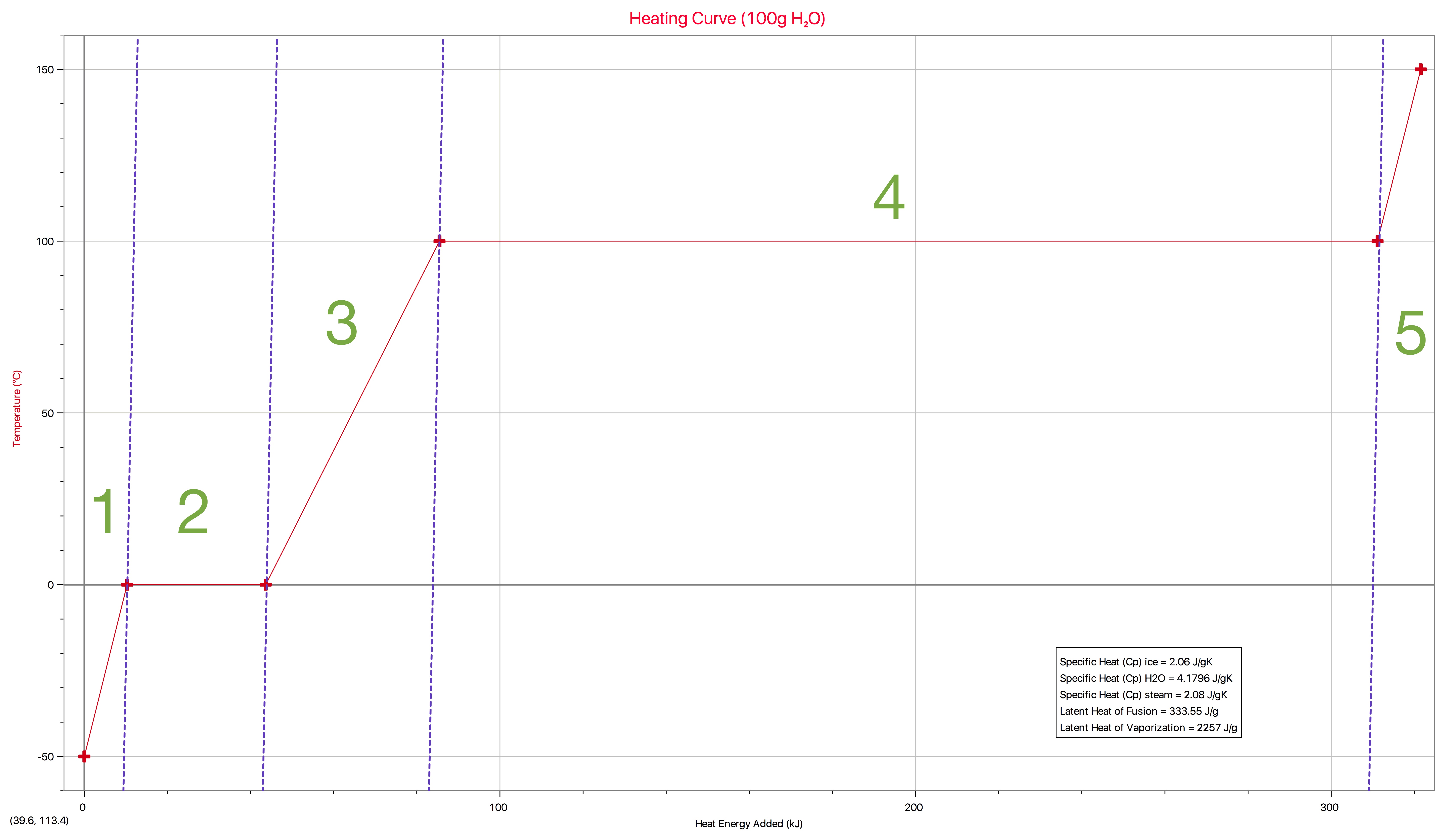
In which region(s) does temperature remain constant?
a)
Region 1, 3, & 5
b)
Region 2 & 4
c)
Region 1 only
d)
Region 1 & 2
43.
In which region(s) does temperature increase?
a)
Region 1, 3, & 5
b)
Region 2 & 4
c)
Region 1 only
d)
Region 1 & 2
44.
This curve indicates what about the heat energy?
a)
heat energy is being added or absorbed
b)
heat energy is being removed
45.
In which region(s) of the graph does a phase change occur?
a)
Region 1, 3, & 5
b)
Region 2 & 4
c)
Region 1 only
d)
Region 1 & 2
46.
In which region(s) of the graph would the substance be a solid only?
a)
Region 1
b)
Region 2
c)
Region 3
d)
Region 4
47.
In which region(s) of the graph would the substance be a solid and a liquid?
a)
Region 1
b)
Region 2
c)
Region 3
d)
Region 4
48.
In which region(s) of the graph would the substance be a liquid only?
a)
Region 1
b)
Region 2
c)
Region 3
d)
Region 4
49.
In which region(s) of the graph would the substance be a liquid and a gas?
a)
Region 2
b)
Region 3
c)
Region 4
d)
Region 5
50.
In which region(s) of the graph would we use a specific heat capacity(cp) to calculate heat energy?
a)
Region 1, 3, & 5
b)
Region 2 & 4
c)
Region 1 only
d)
Region 1 & 2
51.
In which region of the graph would use the latent heat of vaporization(ΔHvap) to calculate heat energy?
a)
Region 2
b)
Region 3
c)
Region 4
d)
Region 5
52.
In which region of the graph would use the latent heat of fusion(ΔHfus) to calculate heat energy?
a)
Region 2
b)
Region 3
c)
Region 4
d)
Region 5
53.
In which region of the graph would use the specific heat of the solid (cp solid) to calculate heat energy?
a)
Region 1
b)
Region 2
c)
Region 3
d)
Region 4
54.
In which region of the graph would use the specific heat of the liquid (cp liquid) to calculate heat energy?
a)
Region 1
b)
Region 2
c)
Region 3
d)
Region 4
55.
In which region of the graph would be used to find the melting of the substance?
a)
Region 2
b)
Region 3
c)
Region 4
d)
Region 5