
 Worksheets
Personal Finance Semester Review
Total questions: 55
Worksheet time: 28mins
Soft skills can best be described as...
Skills that are easy to demonstrate and measure
Skills that allow a person to work effectively with others
Skills that apply only to a specific position
Skills that are unimportant to employers
Your friend Nabila has a virtual interview tomorrow and is extremely nervous. Nabila should do all of the following to prepare for her virtual interview EXCEPT...
Test all of her technology, including internet connection and audio
Dress as comfortably as possible; since this is a virtual interview, professional dress is not necessary
Ensure she has a clutter-free background
Maintain positive body language during her interview, such as good posture and eye contact with the camera
Lilly is working on her first resume and has no previous work experience. What can she do to enhance her resume?
Emphasize her education and highlight her strong GPA
Create fictional positions she held in the past
Leave out volunteer experience since it's not paid work
Include a lengthy paragraph at the top of her resume explaining why she has no previous work experience
Grayson has a job interview tomorrow. Which of the following would be the BEST advice to give him?
Avoid asking questions during the interview, as it may show that he does not know something about the company.
Be sure to ask about things like vacation and sick leave, since he will want to know how many days he can take off.
Plan to arrive at least 60 minutes early for the interview.
Conduct research on the company ahead of time to understand how his values and beliefs align with the company's mission.
During an interview, if you have had a bad experience at a previous job, what should you do instead of speaking negatively about that organization?
Focus on what you learned from the experience.
Discuss the negative aspects in detail.
Blame your previous employer for your problems.
Avoid mentioning your previous job entirely.
When asked about your previous job in an interview, what is the best response?
Speak about what you learned in that role.
Avoid discussing your previous job altogether.
Make up a positive story about your previous job.
Speak negatively about your coworkers, but not your boss.
What is the purpose of a resume?
To list all your interests
To highlight your work experience and qualifications
To provide a list of references
To show your social media profiles
How should you handle your social media as it is connected to your job search?
Post about controversial topics to make yourself stand out.
Avoid posting on social media altogether.
Assume that your interviewers are monitoring your social media and post about relevant topics to your industry.
Post about anything you want, as long as it is not offensive.
To qualify for financial aid, which application must you submit?
FAFSA
PLUS
SAVE
SAI
Which of the formulas below correctly calculates the net price?
Sticker price - student loans = net price
Grants and scholarships + student loans = net price
Sticker price - grants and scholarships = net price
Sticker price + grants and scholarships = net price
What types of money are used to pay for college, and in what order should you use them?
Your money, borrowed money, free money
Borrowed money, your money, free money
Your money, free money, borrowed money
Free money, your money, borrowed money
Janelle's family earns about $60,000 per year. She has been accepted to College A and College B and is comparing their financial aid packages. College A has a sticker price of $28,000 and a net price of $12,000. College B has a sticker price of $60,000 and a net price of $9,000. Which statement below is FALSE?
College A has a lower net price than College B.
College B offers more financial aid than College A.
Janelle would pay less to attend College B than College A.
College A has a lower sticker price than College B.
Which of the following is a good strategy to use when paying for college?
Only report your own earnings and savings, not those of your parents, even if you live with them full-time.
See how much you can borrow in loans before applying for scholarships.
Spend the money that you earn from your summer job so you can get more financial advice.
Save your earnings from your summer job so that you can reduce the amount of loans you need to take.
Typically, when should you first file the FAFSA?
After you finish your freshman year of high school
October or November of your last year of high school
After you receive your Student Aid Index
Once you are ready to start repaying your student loans
Juan saved $1,000 from his summer job cleaning pools. Which of these account types would be best for him if he does not need access to the money for several years and wants to earn the highest interest rate?
Regular savings account
Money Market account
Checking account
Certificate of Deposit
Experts recommend that you accumulate enough to cover 3 to 6 ____________ of expenses in your emergency fund.
Days
Weeks
Months
Years
You overhear your Aunt Tina tell your mom that she, her husband, and their kids are "living paycheck to paycheck." What does Aunt Tina mean by that?
Aunt Tina gets a paycheck one month, and her husband gets a paycheck the next month; they alternate pay periods.
Aunt Tina and her family don't have any money saved, and they rely on each paycheck to cover their expenses until the next one arrives.
You are at the checkout counter at the local supermarket and use your debit card to pay for your groceries. Where does the money for this purchase come from?
Your credit card company covers the cost.
It is deducted directly from your checking account.
Your credit card company provides you with a cash advance to cover the cost.
It is deducted directly from your savings account.
You earn a salary of $40,000 per year and decide to save 20% of your gross pay. You set a goal of creating a $16,000 emergency fund. How long will it take for you to achieve your goal?
6 months
1 year
2 years
3 years
Which of these boxes of cereal has the lowest unit price?
Cereal A, which costs $3.20 for a 16 oz box
Cereal B, which costs $5.00 for a 32 oz box
Cereal C, which costs $2.50 for a 10 oz box
Cereal D, which costs $4.50 for an 8 oz box
Which description is most accurate for a zero-based budget?
You put every dollar of your net pay into a budget category each month.
You spend your checking account balance down to $0 every month.
You spend your savings account balance down to $0 every month.
You are considering moving into a 3-bedroom apartment with 2 roommates, instead of living on your own after college. Which of your expenses would likely decrease by having roommates?
Groceries and eating out
Rent
Cell phone bill
Bedroom furniture
Shira is trying to decide between getting a debit card, a prepaid debit card, and a credit card. Which statement is true?
All three cards are completely different.
Debit cards and prepaid debit cards are the same.
Debit cards and credit cards are the same.
All three cards are completely the same.
Which of the following statements comparing credit and debit cards is TRUE?
Far more businesses accept credit cards than debit cards.
Credit cards pull money directly from your bank account, while debit cards get their money from Visa or Mastercard.
Credit card companies provide you with a monthly statement, while debit cards do not.
With debit cards, you're spending your own money at the point of sale, but with credit cards, you're getting a loan that you need to pay back later.
Which of these credit payback strategies would result in the HIGHEST overall cost?
Paying off your credit card bill in full every month
Paying 20% of your credit card balance every month on time
What is an advantage of using a credit card?
It will not affect your credit score or credit history.
Since it is tied directly to your checking account, it prevents you from spending money you do not have.
If you need to carry a balance, the interest rates are generally quite low (less than 5%).
You can make an emergency purchase that you otherwise don’t have the money to pay for right now.
A loan with a shorter term length will have ________ monthly payments, and you will pay ________ in total interest.
higher, less
higher, more
lower, less
lower, more
An excellent credit score will help with which aspect of car financing?
Bargaining for a great sales price
Receiving a large down payment
Qualifying for a low interest rate
Having a wide selection of term lengths

28. Which of the following statements about credit scores does this bar graph support?
Credit scores tend to increase with age.
Credit scores are highest among teenagers.
Credit scores do not change over time.
Credit scores are lowest among middle-aged adults.

Refer to the bar graph titled 'Average Score by Age.' Which statement is TRUE?
Credit scores tend to drop as you grow older because you are more likely to miss a payment at some point.
It is more difficult for young people to borrow because they have less payment history for a lender to rely upon.
When young people borrow, they are likely to have lower interest rates because their credit scores are lower.
It is easier for young people to get loans at lower interest rates because they are likely to have never been late with a payment.
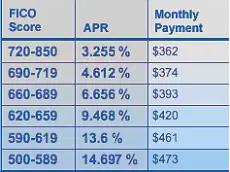
Frank and Jasmere are each shopping for a new car for themselves. Each will need a $20,000 loan that they will pay back over a five-year period. Frank has a credit score of 730, and Jasmere has a score of 600. Refer to the table showing FICO Score, APR, and Monthly Payment. Which of the following statements is TRUE?
Over the five-year period, Jasmere and Frank will pay the same amount for the car loan.
Frank's monthly payment on the auto loan will be about $100 more than Jasmere's payment.
Which of the following could have a NEGATIVE impact on your credit score if done in a short period of time?
Paying your bills on time
Paying down balances on your credit card accounts
Decreasing your credit utilization
Applying for multiple credit cards
Which best describes the Debt Snowball method for paying off debt?
Make payments on your smallest debt first, then move on to your second smallest debt, and so on.
Once your debt "snowballs" out of control, hire a certified credit counselor to help get your finances back on track.
Make the monthly minimum payments on all your debts, and then put any extra cash toward the debt with the highest balance.
Make the monthly minimum payments on all your debts, and then put any extra cash toward the debt with the lowest balance.
Which of the following is a potential consequence of failing to pay your federal student loans?
Wages or tax refunds can be garnished
Passport revocation
Driver’s license suspension
Termination from your job
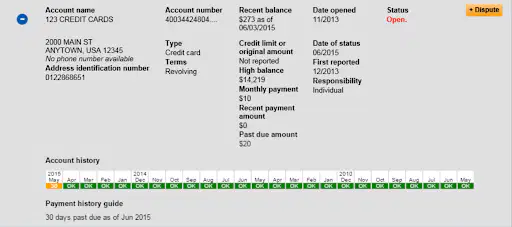
Refer to the account statement and payment history guide below:
The borrower paid a $30 fee in February 2015.
This borrower was never late with any of their credit payments.
This borrower's most recent payment was $30.
This borrower was 30 days late on their May 2015 payment.
Which free credit report service is authorized by federal law and only accessible once per year?
AnnualCreditReport.com
Credit Karma
Credit Wise
Wallet Hub
What is an insurance premium?
Your monthly payment to your insurer, regardless of whether you use any services.
A list of the procedures covered by your insurance carrier.
An added cost you pay in order to receive higher-quality services.
The amount you pay out-of-pocket for a specific procedure or service.
When setting your premium, your car insurance company may consider all of the following EXCEPT...
How many miles you drive per year
Your age
Your driving record
Your height
Insurance companies make money by...
Refusing to pay claims to policyholders
Collecting money from the government
Collecting more in premiums than they pay out each year
Keeping costs low with minimal advertising
Your renter's insurance policy costs $20/month and has a $1,000 deductible. A thief breaks into your apartment and steals your $800 TV set. How much would your insurance company pay?
$0
$200
$800
$1,000
Frank has an auto policy with a coverage limit of $30,000 and a deductible of $1,000. He gets into an accident and the damages to his car total $6,200. Fortunately, he has collision coverage. How much will Frank need to pay out-of-pocket?
$0
$1,000
$6,200
$30,000
Who is most likely to have the highest health insurance premiums?
Julian, who has three children and is eligible for Medicaid
Samantha, a widow who is eligible for Medicare
Patty, who works as an administrative assistant for an employer with a group plan
Robin, a high-earning business owner who buys a plan for their whole family on the Marketplace
What type of auto insurance are you required to carry in almost every state (49 out of 50)?
Insurance for damage to your own property
Insurance for causing injury to another person
Insurance in case you get into an accident with someone who does not have insurance
Insurance for causing injury to yourself
Your health insurance plan has a $20 copay for certain covered prescription medications. You arrive at the pharmacy and pick up your prescription (which is covered under your plan) and it has a list price of $75. How much would you pay the pharmacy?
$0 since health insurance plans waive the cost of prescription drugs
$20
$55
$75
When riding the highs and lows of the stock market, remember...
You can't go wrong when investing money in stocks.
The S&P isn't a reliable source when it comes to navigating the growth and decline of stocks.
It's unpredictable and risky. You should pull your money out and steer clear.
It will level out, so stick with it!
When you invest, your goal is to earn a negative rate of return on your investment.
True
False
How does investing in the stock market differ from putting money in a savings account at a bank?
Investing is always a less risky option than saving.
Investing is best for short-term situations like emergency funds; saving is best for the long-term.
Investing typically earns between 1-2%, while saving generally earns between 5-7%.
Investing allows you to accumulate wealth for retirement, while saving is best for short-term purchases or emergencies.
Why is diversification a recommended investment strategy?
Investing in a diversified portfolio guarantees that you won’t lose money on your investments.
If you tell your fund manager to use diversification, they will charge you lower fees.
Diversifying your portfolio helps reduce risk.
If you diversify your portfolio, you will definitely earn a high return.
Why is it important to track your expenses throughout the month?
It allows you to delete categories you don't like.
It gives you insight into whether you're sticking to the budget you set.
It helps you pull money from your savings to spend in other categories.
It really isn’t that important in the long run.
Your monthly rent payment is an example of a variable expense.
False
True
Sometimes
Only during holidays
When you buy with credit, you typically spend more than you would with cash or a debit card.
True
False
Insurance helps you transfer the _______ from your bank account to the insurance company.
Risk
Money
Insurance
Health
What is one way to improve your credit score over time?
Open several new credit cards at once
Pay your bills on time each month
Max out your credit cards regularly
Ignore your credit card statements
When preparing for a job interview, which action is most likely to leave a positive impression?
Bring a friend to the interview for support
Dress professionally and arrive on time
Answer questions with one-word responses
Refuse to make eye contact with the interviewer
Which budgeting strategy helps you avoid overspending each month?
Track your expenses and compare them to your budget regularly
Spend money without keeping receipts
Ignore your bank statements
Only budget for entertainment expenses

