
Font size
 Worksheets
PBS Midterm Test
Total questions: 60
Worksheet time: 57mins

What is the dependent variable in this graph?
the type of algae
the number of days
algal color
the ambient temperature

How are complimentary base pairs held together in DNA molecules?
by phosphate groups
by magnets
by the deoxyribose sugar
through the hydrogen bonding

Which patient has blood type AB?
patient 2
patient 4
patient 3
patient 1
Which of the following is not usually done at the crime scene?
blood testing
photograph
collect evidence
sketch

How do DNA fragments move in a gel?
from positive to negative
from negative to positive
from left to right
from right to left

Which suspect should the police interview for further information?
suspect 1
suspect 2
suspect 3
crime scene

Where would larger DNA fragments be found on a gel?
in lane 1
in lane 4
near the top of the gel
near the bottom of the gel

The scale in the figure above would be represented by
A
B
C
D

Who can donate to someone with AB- blood?
A-
B-
AB-
O-
A crime scene investigator is called to the scene of a mysterious death. Which of the following is NOT one of the initial steps used to process a crime scene?
Examine and observe the crime scene
Sketch a diagram of the crime scene
Interview witnesses to establish a theory of the case.
Mark and document evidence of the crime scene
What is the very FIRST thing that a police officer would need to do after arriving at a crime scene
Sketch the scene
Pick up pieces of evidence
Talk to witnesses
Secure the scene
A Forensic Investigator is called to the scene of a mysterious death. Which of the following things should be forensic investigator NOT do to process the crime scene and document the evidence at a crime scene?
Move the body to better view the crime scene.
Photograph evidence.
Examine the crime scene and mark any evidence
Which method is BEST for searching a crime scene that has easily definable areas/ sections such as houses or buildings
Link method
Grid method
Line method
Zone method
Which of the followings is correct:
Forensic scientists spend a significant amount of time completing a detailed sketch of possible crime scenes.
One strategy they use is to identify a point of origin from which they take all their measurements.
The origin can be any item or location within the scene perimeter
All of the above
In forensic investigations and medical cases, the person who has died is often referred to as the ________ .
plaintiff
victim
defendant
decedent

This laboratory procedure is known as
CLONING
gel electrophoresis
chromatography
use of a dichotomous key
In preparation for an electrophoresis procedure, enzymes are added to DNA in order to
convert the DNA into gel
cut the DNA into fragments
change the color of the DNA
produce longer sections of DNA

Once DNA has been extracted from the nucleus of a cell, it is exposed to ______ ______ that act like biochemical scissors to cut the DNA.
restriction enzymes
gel agarose
clotting factors
electric shock
Gel electrophoresis separates fragments of DNA by:
Size/weight
Genes
Base pairs
Electromagnetic charge

In a DNA fingerprint, lighter-weight fragments can be found at the:
Top
Bottom
Middle
Front
What are the proper complementary base-pairs?
A--T and G--C
A--G and C--T
G--T and A--C
A--C and T--G
If a strand of DNA has 39% Cytosine, it has...
39% Adenine
39% Guanine
39% Thymine
39% combined Cytosine and Guanine
If there is 22% Cytosine, how much of all the other bases are there?
22% C, 22% G, 28% A, and 28%T
22% C, 28% G, 22% A, and 28%T
28% C, 28% G, 28% A, and 28%T
22% C, 22% G, 22% A, and 22%T
Irregularly shaped cell fragments that help clot blood
Platelets
Lymph
Plasma
White Blood Cells
Contains hemoglobin, supplies body with oxygen
Plasma
Platelet
White Blood Cell
Red Blood Cell
Fight bacteria and viruses by entering infected tissue, destroying bacteria/viruses and absorb dead blood cells
White Blood Cells
Red Blood Cells
Platelets
Plasma
The liquid part of blood made of mostly water; nutrients, minerals and oxygen are dissolved
Marrow
Plasma
Proteins
Urea

Algor mortis refers to
a. the stiffening of muscles shortly after death
b. the clouding of the corneas after death
c. the cooling of the body after death
d. the pooling of blood after death

Identify what structure is outlined in the BLACK outline.
Base pair
deoxyribose sugar
phosphate group
hydrogen bonds
Nucleotide

This is diagram of a
nucleotide
double helix
protein
lipid
This occurs 2-4 hours after death, where the blood pools due to gravity. The area affected is a bluish-red color.
rigor mortis
algor mortis
livor mortis
The process that causes the muscles in the body to stiffen resulting in rigidity after death is called
algor mortis
rigor mortis
livor mortis
A body is found sitting upright in a chair, however the front of the body (chest, stomach, and thighs) are colored blue-purple. What does this indicate?
the victim died sitting in the chair
the victim died laying on their back
the victim was moved after death
the victim died from unusual circumstances
The body loses how many degrees per hour after death
1.5 °F
2 °F
3 °F
4 °F
Pallor mortis is defined as
when the skin turns reddish because it is receiving too much blood.
when the skin turns reddish because it is no longer receiving blood
when the skin turns pale because it is receiving too much blood.
when the skin turns pale because it is no longer receiving blood.
Which of these factors does not influence algor mortis?
age of deceased
the environment
whether the individual was wearing clothing or not
time since the individual died
What muscles are the first to contract and stiffen during rigor mortis?
legs
abdominals
arms
eyes and fingers
Why doesn't the body stay rigid forever?
Insects begin feeding on the muscles.
The blood drains out of the muscles.
The body is decomposing.
The bones are broken down.
Minutiae are
the general fingerprint patterns
small unique markings on fingerprints
the types of whorls
the lack of ridges
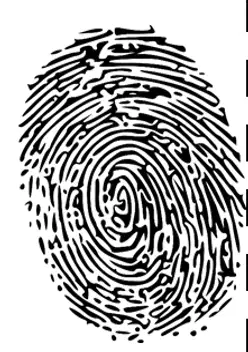
What fingerprint pattern is displayed in this picture?
Whorl
Loop
Arch
Double Arch
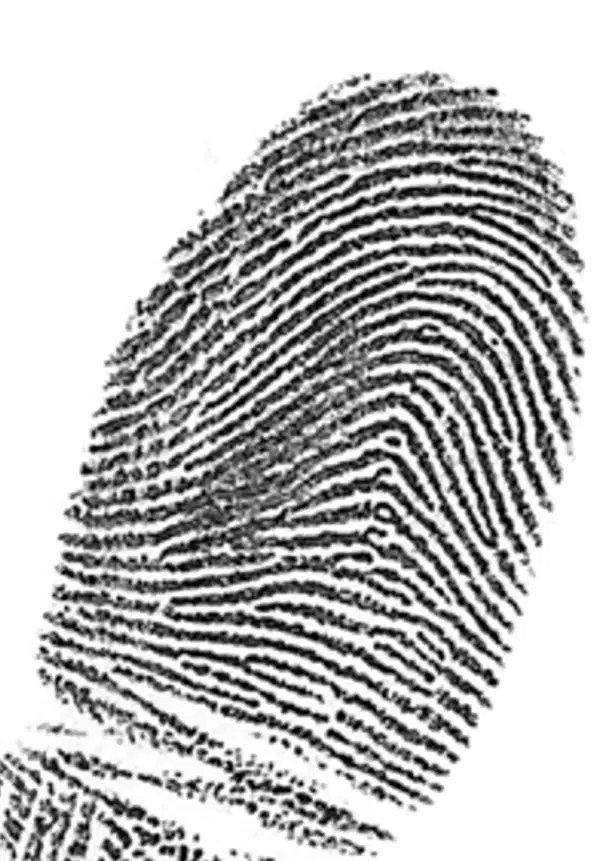
Which fingerprint pattern is shown in this picture?
Whorl
Loop
Arch
Double Loop
What is the name given to the person who examines a fingerprint and gives opinion as to the likelihood of a match?
FIngerprint Examiner
Print Matchmaker
FBI Criminologist with a subcertification in Figerprint Matching
RUVIS Technician

What type of fingerprint minutiae is represented by letter A
Eye
Bifurcation (Fork)
Ending ridge
Island (Short Ridge)
Core

What pattern is this? (Right Hand)
Tented Arch
Plain Arch
Ulnar Loop
Plain Whorl

What is the name of this minutiae?
Bridge
Junction
Connector
Zigzag

Name this minutiae type
Enclosure
Island
Bifurcation (fork)
Ridge ending
A surgical procedure performed by a pathologist on a dead body to ascertain—from the body, organs, and bodily fluids— the cause of death.
external examination
autopsy
postmortem interval
anatomical analysis
structural examination
What is the next step after the body is opened by the Y-incision?
The ribs are sawn off to expose the internal organs. Sternal plate or anterior chest wall is cut away to expose the organs underneath.
The sternum is sawn off to expose the internal organs. Sternal plate or posterior chest wall is cut away to expose the organs underneath.
The ribs are sawn off to expose the internal organs. Scapular plate or posterior chest wall is cut away to expose the organs underneath.
The ribs are broken to expose the internal organs. Scapular plate or anterior chest wall is cut away to expose the organs underneath.
The sternum is sawn off to expose the internal organs. Pelvic plate or lateral chest wall is cut away to expose the organs underneath.

Identify what structure is outlined in the BLACK outline.
Base pair
deoxyribose sugar
phosphate group
hydrogen bonds
Nucleotide

