
 Worksheets
Blood Components Overview
Total questions: 75
Worksheet time: 38mins
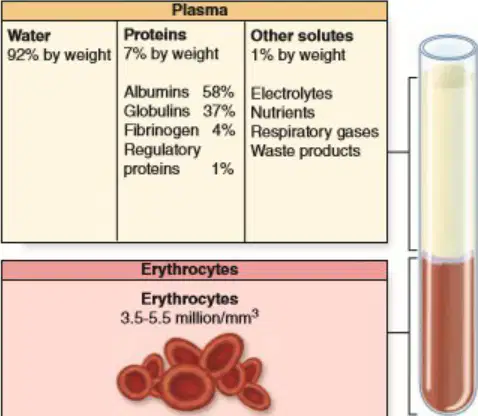
Which statement best describes the composition of blood shown in the diagram with plasma and formed elements?
Blood is only plasma without cellular components
Blood is solely formed elements without plasma
Blood consists of plasma and formed elements
Blood is plasma mixed with lymph fluid only

In the tube diagram separating layers after centrifugation, what does the buffy coat primarily contain?
Water and electrolytes only
Erythrocytes only
Leukocytes and platelets
Plasma proteins only
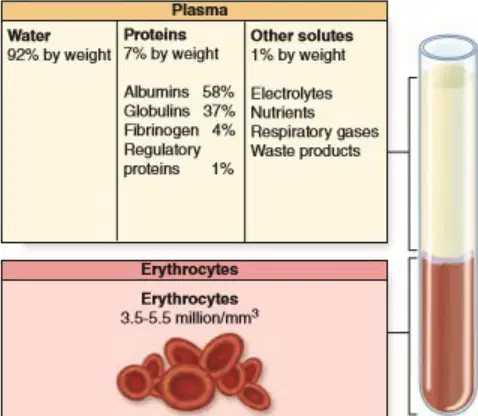
Which plasma protein is removed to produce serum?
Fibrinogen
Albumin
Regulatory proteins
Globulins
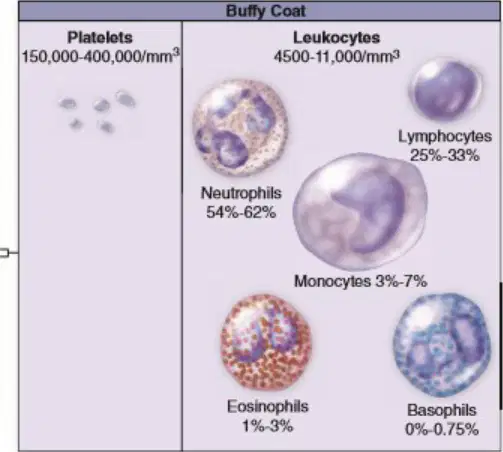
Based on the differential count ranges shown, which leukocyte type is most abundant in normal blood?
Neutrophils are the most abundant
Basophils are the most abundant
Lymphocytes are the most abundant
Monocytes are the most abundant
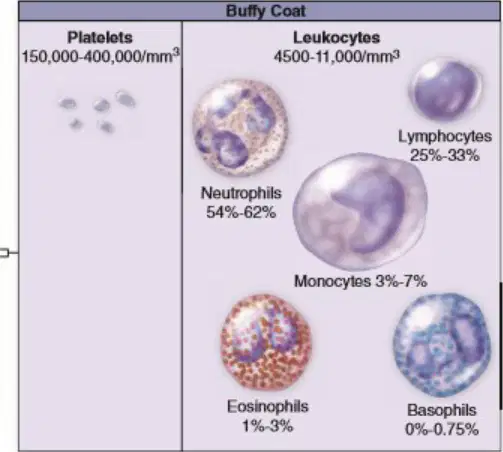
Which set correctly lists the formed elements of blood depicted in the diagram?
Erythrocytes, leukocytes, platelets
Albumins, globulins, fibrinogen
Water, electrolytes, nutrients
Neutrophils, lymphocytes, monocytes
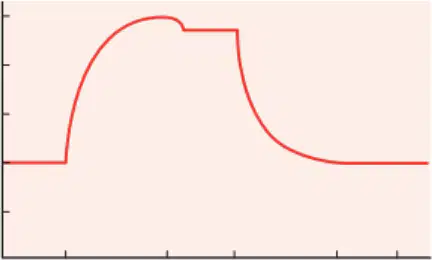
In the oxygen pressure graph, where is O2 pressure highest?
Arterial blood after lung capillaries
Venous blood before lungs
Systemic capillaries after tissues
Venous blood returning from tissues
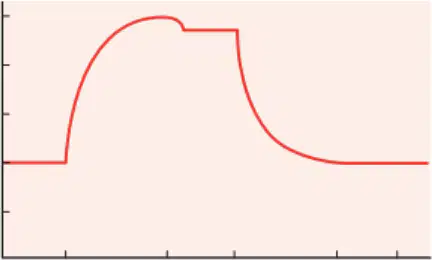
According to the O2 pressure curve, what happens to oxygen levels as blood passes through systemic capillaries?
O2 pressure decreases due to tissue exchange
O2 pressure oscillates without trend
O2 pressure increases sharply to peak
O2 pressure remains constant throughout
Which plasma protein primarily maintains blood’s osmotic pressure within the microvasculature?
Albumin produced by the liver
α-globulins transporting lipids
β-globulins carrying iron ions
Fibrinogen polymerizing to fibrin
Which statement best describes fibrinogen’s role during hemostasis?
Polymerizes to insoluble cross-linked fibrin
Transports iron and lipids systemically
Neutralizes bacterial toxins in plasma
Acts as the main osmotic regulator
Select the globulin types correctly paired with a chief function.
β-globulins—carry iron ions and lipids
α-globulins—polymerize into fibrin
α-globulins—transport some lipids and metal ions
γ-globulins—serve as immunoglobulins
Which component makes up the largest proportion of blood plasma by percentage?
Water at about ninety-two percent
Fibrinogen at nearly four percent
Albumin at around fifty-eight percent
Globulins at roughly thirty-seven percent
All plasma proteins share which general function listed below?
Convert carbon dioxide to bicarbonate
Buffer against pH changes
Catalyze aerobic respiration
Establish membrane potentials
Which set correctly matches solute category with its role in plasma homeostasis?
Electrolytes—regulate osmotic balance and pH
Wastes—enhance plasma viscosity
Nutrients—energy source and biosynthetic precursors
Respiratory gases—oxygen for respiration, CO₂ as waste
Which is TRUE of complement proteins in plasma?
Primary agents maintaining osmotic pressure
Major carriers of iron throughout bloodstream
Factors involved in inflammation and microbe destruction
Structural precursors of fibrin in clots
Which pairing of component and function is INCORRECT?
Albumin—retains fluid within microvasculature
γ-globulins—antibodies mediating immune responses
β-globulins—transport respiratory gases predominantly
Fibrinogen—participates in blood coagulation
During clotting, which direct transformation occurs to limit blood loss from small vessels?
Albumin to transport lipoproteins
Fibrinogen to cross-linked fibrin
γ-globulins to complement enzymes
β-globulins to prothrombin factors
Which statement accurately compares albumin and globulins in plasma?
Albumin carries iron; globulins buffer pH exclusively
Albumin forms fibrin; globulins maintain osmotic pressure
Albumin mediates inflammation; globulins are metabolic wastes
Albumin is most abundant; globulins include transporters and antibodies
In the stained blood smear diagram, which component is identified as the small, anucleate discs predominating the field?
Erythrocytes
Lymphocytes
Neutrophils
Platelets
During smear preparation shown in the diagram sequence, what is the purpose of using a second slide to pull the drop across the first slide?
Create a thin film
Increase stain uptake
Remove plasma proteins
Prevent hemolysis
Which labeled leukocyte in the diagram has a large kidney-shaped nucleus and abundant cytoplasm?
Lymphocyte
Monocyte
Basophil
Band neutrophil
Identify the feature of normal erythrocytes visible in the sectional view diagram:
Biconcave disc
Cylindrical tube
Spherical cell
Biconvex lens
According to the dimension labels on the erythrocyte diagram, what is the approximate thickness at the edge of a normal RBC?
0.75 micrometers
2.6 micrometers
15 micrometers
7.5 micrometers
In the micrograph illustrating rouleaux, what arrangement of RBCs is depicted?
Radial spokes
Parallel rows
Random clusters
Stacked coins
Which statements about erythrocyte morphology are correct based on the diagrams?
High surface-to-volume ratio
Flexible to pass capillaries
Central pallor due to thin center
Contains prominent nucleus
What is the typical red blood cell concentration in adult women per microliter?
6.5–8.0 million per microliter
4.1–6.0 million per microliter
3.9–5.5 million per microliter
2.0–3.0 million per microliter
Which best describes the plasma membrane composition of a red blood cell?
30% lipid, 20% carbohydrate, 50% protein
40% lipid, 10% carbohydrate, 50% protein
50% lipid, 10% carbohydrate, 40% protein
40% lipid, 20% carbohydrate, 40% protein
Which proteins are integral membrane components commonly found in red blood cells?
Band 3 protein
Ankyrin
Glycophorin A
Spectrin
Which cytoskeletal arrangement maintains red blood cell shape and flexibility?
Keratin filaments linked to desmin
Spectrin lattice bound to actin
Tubulin network connected to myosin
Collagen mesh anchored to integrins
What is the typical lifespan of a human red blood cell?
60 days
90 days
120 days
180 days

Which event initiates polymerization of HbS leading to sickling in capillaries?
Oxidation of heme iron by ROS
Phosphorylation of beta chains
Deoxygenation of hemoglobin S
Binding of CO to hemoglobin
Select the consequences of sickle cell disease at the microcirculatory level.
Greater blood viscosity
Improved capillary flexibility
Enhanced oxygen delivery to tissues
Poor microvascular circulation

In sickle cell disease, which specific missense change occurs in the beta-globin chain?
Glutamate to valine substitution
Valine to glutamate substitution
Glycine to proline substitution
Proline to glycine substitution
Which leukocyte is the most abundant in peripheral blood and primarily phagocytoses bacteria?
Eosinophil
Basophil
Neutrophil
Lymphocyte
Monocyte
Which leukocyte has a bilobed nucleus and combats helminthic parasites while modulating local inflammation?
Eosinophil
Neutrophil
Basophil
Lymphocyte
Which leukocyte releases histamine to modulate inflammation, especially during allergic reactions?
Neutrophil
Lymphocyte
Basophil
Monocyte
Which cell type serves as an effector and regulatory cell in adaptive immunity and can live from hours to many years?
Neutrophil
Basophil
Eosinophil
Lymphocyte
Which leukocyte differentiates into macrophages and other mononuclear phagocytic cells within tissues?
Eosinophil
Monocyte
Neutrophil
Basophil
Which of the following are granulocytes?
Neutrophils
Lymphocytes
Eosinophils
Basophils
Monocytes
What nuclear morphology best characterizes neutrophils on a blood smear?
Three to five lobes
Bilobed or S-shaped
Indented or C-shaped
Rather spherical
Which leukocyte typically shows red to dark pink specific granules on routine stains?
Eosinophil
Basophil
Neutrophil
Monocyte
Arrange the following leukocytes by typical differential count from highest to lowest: Basophils, Neutrophils, Eosinophils.
Neutrophils > Eosinophils > Basophils
Eosinophils > Basophils > Neutrophils
Eosinophils > Neutrophils > Basophils
Basophils > Neutrophils > Eosinophils
Which pair correctly matches a leukocyte with a principal function?
Monocyte—mediate immediate hypersensitivity
Basophil—release histamine in allergy
Lymphocyte—phagocytose bacteria rapidly
Neutrophil—kill helminths and parasites
Which leukocyte typically has dark blue to purple specific granules and may have a bilobed or S-shaped nucleus?
Eosinophil
Neutrophil
Basophil
Lymphocyte
Which statements about agranulocytes are correct?
They are always shorter lived than neutrophils
They function in adaptive and phagocytic roles
They lack specific cytoplasmic granules
They include lymphocytes and monocytes
Which statement best describes where leukocytes become functional after leaving circulation?
They act mainly inside venule lumens
They function in lymph node sinuses
They act within bone marrow niches
They become functional at tissue sites
Which pair correctly lists the two major divisions of leukocytes?
Granulocytes and agranulocytes
Erythrocytes and platelets
Neutrophils and eosinophils
Monocytes and lymphocytes
Upon entering connective tissue, what shape change and motility do leukocytes typically exhibit?
Spindle shape with flagella
Spherical and ameboid motility
Flattened and ciliated movement
Biconcave and passive drift
Which group is classified as granulocytes?
Megakaryocytes, platelets, erythrocytes
Lymphocytes, NK cells, plasma
Monocytes, macrophages, dendritic
Neutrophils, eosinophils, basophils
Granulocytes contain two granule types. Which pairing is accurate?
Peroxisomes and glycogen granules
Secretory granules and melanosomes
Azurophilic lysosomes and specific granules
Primary lysosomes and tertiary vesicles
Which statement about agranulocytes on the slide is correct?
They primarily stain with neutral dyes
They have abundant Golgi and ER
They include lymphocytes and monocytes
They lack azurophilic granules entirely
Healthy adult leukocyte count per microliter is approximately which range?
500–1,500 cells/µL
4,500–11,000 cells/µL
15,000–25,000 cells/µL
50,000–100,000 cells/µL
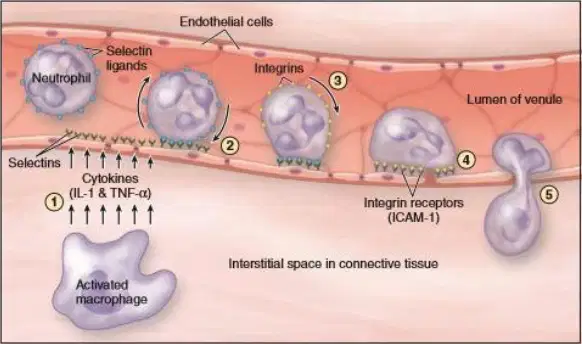
In the neutrophil migration diagram, which event is most directly mediated by selectins?
Firm adhesion to endothelium
Transendothelial diapedesis
Chemokine-driven motility
Slow rolling along endothelium
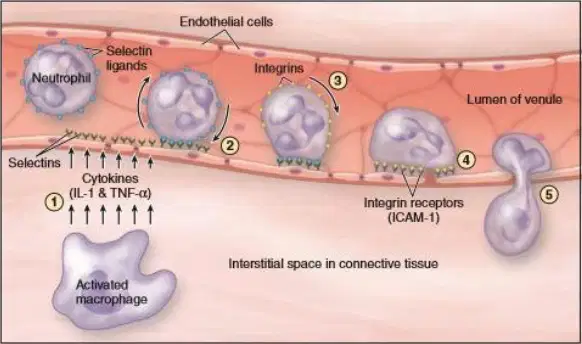
Which molecules on endothelial cells bind neutrophil integrins to achieve firm adhesion?
ICAM-1 receptors
TLR4 receptors
CD3 complexes
Fc gamma receptors
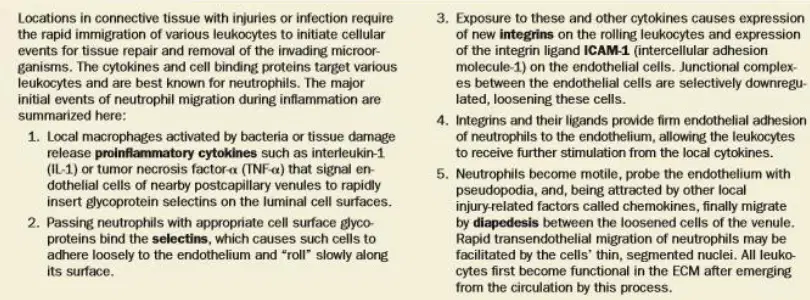
Which sequence correctly orders early steps of neutrophil recruitment shown?
Selectin-mediated rolling
Integrin activation and adhesion
Cytokine release by macrophages
Transendothelial migration
Which statement best describes the typical proportion of neutrophils among circulating leukocytes?
Approximately 54–62 percent in blood
Approximately 10–20 percent in blood
Approximately 30–40 percent in blood
Approximately 70–80 percent in blood
What is the usual nuclear morphology of a mature neutrophil?
Nucleus with 2–5 lobules
Bilobed nucleus only
Nucleus with 8–10 lobules
Single round nucleus
Which granule type in neutrophils plays the major role in killing and degrading engulfed microorganisms?
Secretory vesicle granules
Tertiary gelatinase granules
Azurophilic primary granules
Specific secondary granules
Select the functions correctly matched to the listed molecules found in neutrophil granules.
Myeloperoxidase generates hypochlorite toxic to bacteria
Lysozyme synthesizes bacterial cell walls
Defensins disrupt membranes of many bacteria
Myeloperoxidase degrades extracellular matrix proteins
Compared with azurophilic granules, which features characterize specific secondary granules in neutrophils?
Smaller and less dense than primary granules
Pink staining and pale cytoplasm appearance
Contain ECM-degrading enzymes
Major source of hypochlorite generation
Which finding would most likely indicate a female neutrophil in a blood smear?
Blue cytoplasm lacking any granules
Uniformly round nucleus with dense chromatin
A drumstick appendage from condensed X chromosome
Large azurophilic granules obscuring the nucleus
Neutrophils contribute to inflammation by releasing which mediators?
Cytokines
Chemokines
Lipid mediators
Antibodies
Which event directly follows a neutrophil engulfing bacteria into a phagosome?
Azurophilic granules fuse and acidify
Specific granules fuse and discharge
Mitochondria increase ATP production
Nucleus condenses and fragments
During the respiratory burst, which reactive species is first generated and contributes to microbial killing?
Hydrogen peroxide H2O2
Hypochlorite OCl−
Hydroxyl radical •OH
Superoxide anion O2−
Which combination forms a powerful microbial killing system inside neutrophils?
MPO with halide ions
Lysozyme with peptidoglycan
Superoxide with halide ions
Lactoferrin with iron
What is the role of lactoferrin in neutrophil-mediated bacterial killing?
Acts as a proton pump acidifier
Perforates bacterial membranes
Binds iron and starves bacteria
Neutralizes superoxide anions
Which outcome reflects the combined action of neutrophil enzymes and killing mechanisms on microbes and tissues?
Increase in mitochondrial density
Formation of viscous yellow pus
Expansion of rough endoplasmic reticulum
Generation of granular cytoplasm
A hereditary defect in NADPH oxidase most directly leads to which consequence in neutrophils?
Impaired actin polymerization and motility
Failure to produce H2O2 and hypochlorite
Excessive ECM digestion by proteases
Loss of lysosomal enzymes and granules
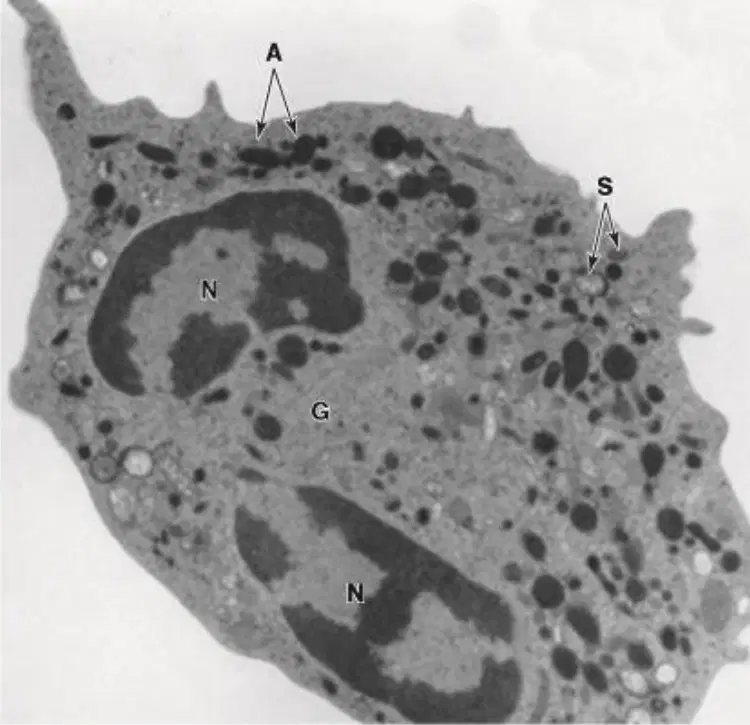
In the TEM image of a human neutrophil, what distinguishes azurophilic granules from specific granules?
Presence of abundant mitochondria nearby
Larger, electron-dense lysosomal nature
Smaller, pale variably stained content
Association with central Golgi apparatus
Which feature best characterizes the nucleus of eosinophils?
Multilobed irregular nucleus
Anucleate cytoplasm
Bilobed segmented nucleus
Single round nucleus
Eosinophil specific granules are described as large acidophilic and oval due to high content of which protein?
C-reactive protein content
Major basic protein content
Lysozyme protein content
Histamine binding protein
What percentage of circulating leukocytes are typically eosinophils?
Less than 1 percent
About 1 to 3 percent
Approximately 20 percent
Around 5 to 10 percent
Which combination of factors primarily enables eosinophils to kill parasitic worms (helminths)?
Cytotoxic T-cell perforin
Major basic protein in granules
Eosinophilic peroxidase enzyme
Other eosinophil toxins and enzymes
Complement C3 convertase
Which statement best explains why eosinophil granules stain acidophilic?
Dominance of heme-containing peroxidases
Presence of neutral mucopolysaccharides
Granules contain abundant acidic lipids
High arginine-rich MBP confers cationic charge
In allergic reactions, eosinophils primarily contribute by releasing which mediators?
Chemokines that recruit leukocytes
Cytokines that modulate inflammation
Interferons that inhibit parasites
Lipid mediators that amplify allergy
Beyond killing helminths, which function is attributed to eosinophils in tissues?
Removing antigen–antibody complexes
Presenting antigens to CD8 T cells
Synthesizing complement proteins
Producing antibodies against viruses

