
Font size
 Worksheets
Natural Texas and Its People Review
Total questions: 20
Worksheet time: 10mins
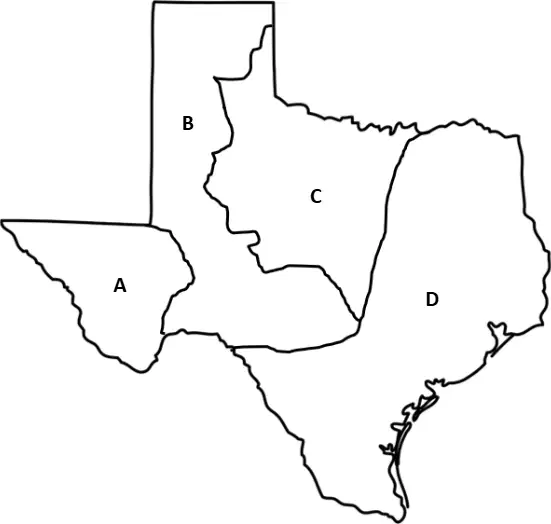
This is a map of Texas. Which region on the map includes the major cities of Houston, San Antonio, and Dallas? Select the correct answer.
A
B
C
D
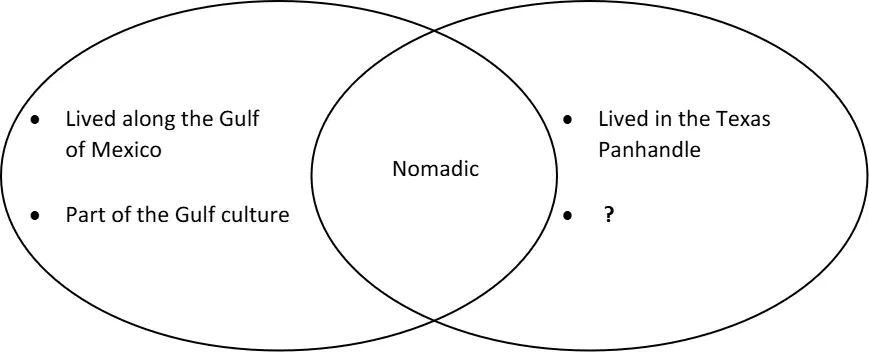
Refer to the Venn diagram comparing the Coahuiltecan and Apache peoples. Which of the following correctly replaces the question mark in the Apache circle?
Part of the Plains culture
Part of the Puebloan culture
Part of the Southeastern culture
Part of Shaman culture
The first people in Texas were primarily — Select the correct answer.
farmers
traders
hunter-gatherers
entrepreneurs
Determine whether each characteristic describes the culture of the Gulf Natives, the Plains Natives, or both groups. Match each characteristic to the correct group.
Were skilled horsemen and buffalo hunters
Gulf Natives
Built portable housing structures
Plains Natives
Used dugout canoes for fishing and transportation
Both
How did the Jumano modify their environment? Select the best answer.
By using alligator grease as bug repellant
By building irrigation systems for crops
By using dugout canoes for fishing
By hunting buffalo on horseback
This excerpt is about the first people in Texas. Excerpt: "Thousands of years ago, the Earth was experiencing an ice age. The lower sea levels revealed a land bridge that connected Asia to North America. This land bridge was called Beringia. The first people to come to North America walked across that land bridge. They were hunters following herds of migrating animals. Eventually, those first people migrated all the way to Texas." What claim is supported by the excerpt?
Early people could not leave Asia during the Ice Age.
Early people were nomadic.
Early people established Beringia.
Early people used boats to get to North America.
This excerpt is about the first people in Texas. Excerpt: "Thousands of years ago, the Earth was experiencing an ice age. The lower sea levels revealed a land bridge that connected Asia to North America. This land bridge was called Beringia. The first people to come to North America walked across that land bridge. They were hunters following herds of migrating animals. Eventually, those first people migrated all the way to Texas." Which statement BEST provides evidence for the answer to Part A?
"Thousands of years ago, the Earth was experiencing an ice age."
"The first people to come to North America walked across that land bridge."
"They were hunters following herds of migrating animals."
"Eventually, those first people migrated all the way to Texas."
How did learning to farm change life for early people? Select TWO correct answers.
By requiring them to stay in one place for longer periods of time
By allowing them to develop ways to travel faster than before
By giving them the opportunity to develop better tools for hunting
By providing them with a dependable source of food allowing societies to develop
By forcing them to divide into hunting tribes and farming tribes and causing friction
Which phrase correctly replaces the question mark in the table? Cultural Group: Group A — Main food source: hunted buffalo — Lifestyle: nomadic; Group B — Main food source: ? — Lifestyle: complex society.
Harvested crops
Used irrigation systems
Were hunter-gatherers
Were skilled swimmers
Historians learn about early cultures by -
studying drawings and artifacts
living like early Natives
reviewing tax documents
listening to recordings of Natives
Which statement describes a defining characteristic of the Natural Texas and Its People era?
Oil fields were discovered in both south and west Texas.
Native Americans lived in different regions of Texas.
Land in Texas was divided to build towns and railroads.
The Spanish converted Native Americans to Christianity.
Which phrase correctly replaces the question mark in the Venn diagram comparing the Caddo and Jumano? The Caddo lived in east Texas and were part of the Southeastern culture. The Jumano lived in the Mountains and Basins region and were part of the Puebloan culture. The center overlap is marked with a question mark.
Fished in the Gulf of Mexico
Were nomadic
Were strong swimmers
Lived in permanent villages
The Fort Worth Stockyards, AT&T Stadium, and Dinosaur Valley are all located in the -
North Central Plains region
Mountains and Basins region
Coastal Plains region
Great Plains region
How did the Karankawa differ from other Native tribes in Texas?
They hunted buffalo in the Mountains and Basins region.
They made dugout canoes for fishing in the Gulf of Mexico.
They developed irrigation systems for farming in the Great Plains.
They farmed using crop rotation in far east Texas.

Which region on the map includes Palo Duro Canyon and the Caprock Escarpment? Select the correct answer.
Coastal Plain s
North Central Plains
Great Plains
Mountains and Basins
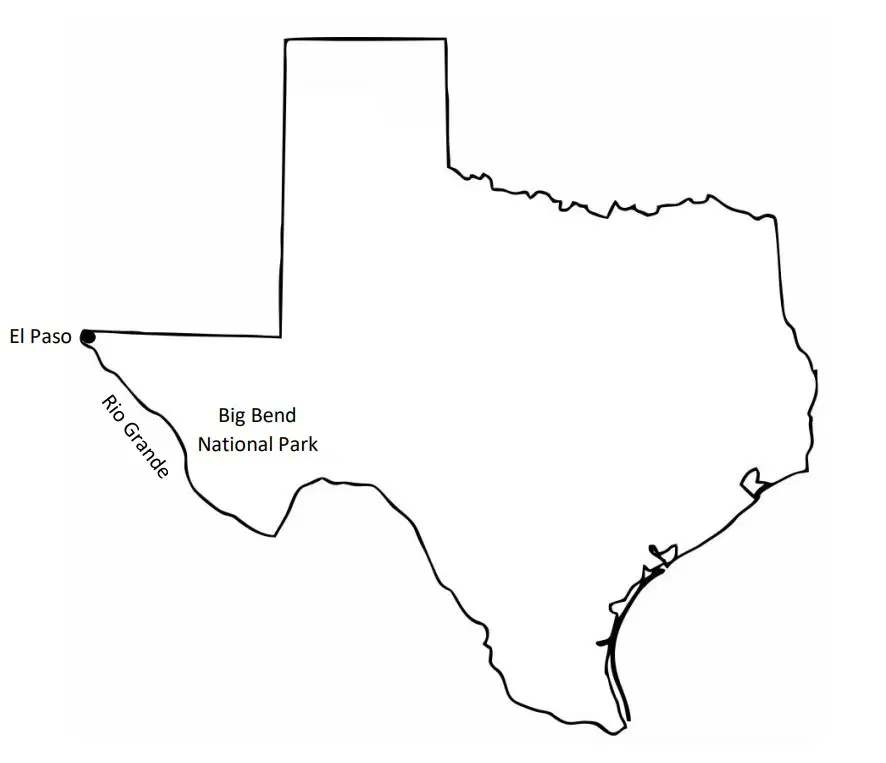
In which region would you find the locations labeled on the map?
Mountains and Basins
Great Plains
North Central Plains
Coastal Plains
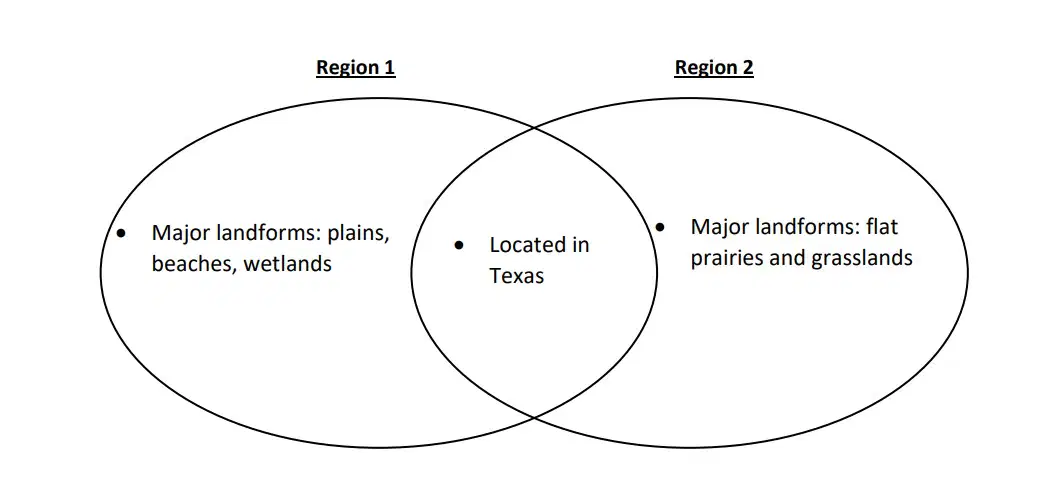
Which set of titles best replaces Regions 1 and 2?
Region 1: Great Plains; Region 2: North Central Plains
Region 1: Coastal Plains; Region 2: Great Plains
Region 1: North Central Plains; Region 2: Mountains and Basins
Region 1: Mountains and Basins; Region 2: Coastal Plains
The Alamo is located in the -
Coastal Plains region
North Central Plains region
Great Plains region
Mountains and Basins region
How did the Comanche differ from other Native tribes in Texas?
They built mounds to perform religious ceremonies.
They developed irrigation systems for farming.
They hunted buffalo in the Great Plains.
They were a matrilineal society along the Gulf of Mexico.
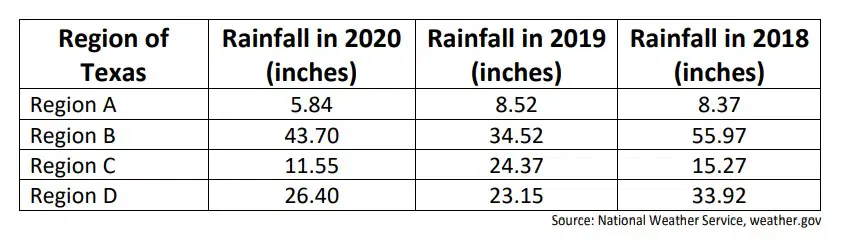
Based on the information in the table, which region represents the Coastal Plains?
A
B
C
D

