
 Worksheets
Constitutional Convention and U.S. Government Worksheet
Total questions: 65
Worksheet time: 33mins
_______ was the oldest delegate at the Constitutional Convention who helped large and small states agree to the Great Compromise.
Benjamin Franklin
George Washington
James Madison
Thomas Jefferson
What argument did the Three-Fifths Compromise settle at the Constitutional Convention?
how states would pass laws
representation in the Supreme Court
how enslaved people would be counted
how many rights would be in the Bill of Rights
“We the people” in the U.S. Constitution means that the government's power comes from ____________.
the citizens
the President
the government
the legislative branch
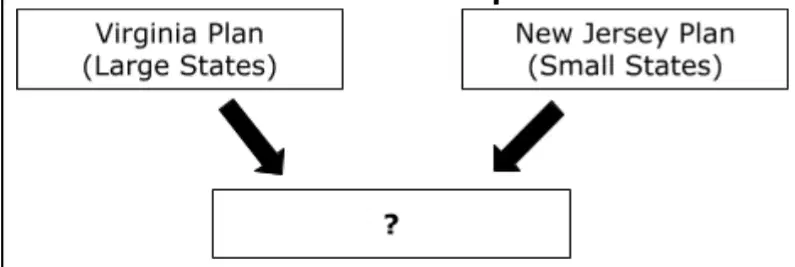
What is the name of the compromise between large and small states at the Constitutional Convention?
The Small Compromise
The Great Compromise
The Washington Compromise
The Articles of Confederation Confederation
In a representative democracy, leaders are elected by the ____________ to
people
government
army
judges
Who makes laws and decisions for the country?
citizens
governor
president
supreme court
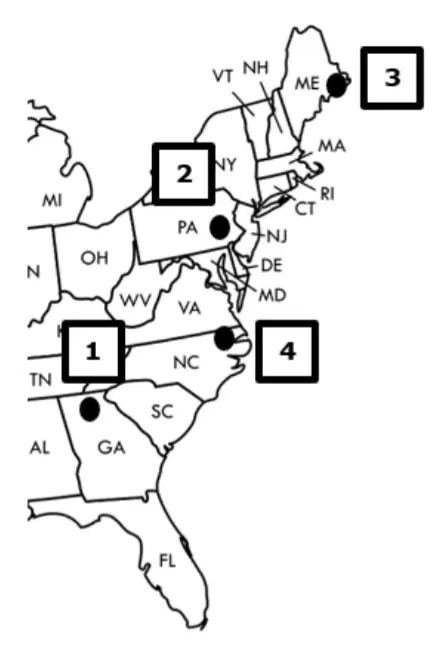
Which number represents the location of Philadelphia, Pennsylvania where the Constitutional Convention was held?
A. 1
B. 2
C. 3
D. 4
The words ____________________ mean that our government’s power comes from the people who live in it.
government rules
popular sovereignty
pursuit of happiness
legislative and judicial
One of the problems with the Articles of Confederation, is that it created a __________ national government.
weak
strong
centralized
powerful
Who is considered the “father of the Constitution” because he wrote most of it?
Benjamin Franklin
George Washington
James Madison
Thomas Jefferson
One weakness of the Articles of Confederation is that the national government could not ________________________ to pay for a military.
meet when they wanted
stop citizens from voting
write its own constitution
collect taxes from citizens
The ________________________ was the name of the first attempt at a government by the new United States.
Bill of Rights
U.S. Constitution
Articles of Confederation
Declaration of Independence
Why does the U.S. Constitution start with the words “We the People?”
to show that people have very few rights
to show that the government’s power comes from the people
to show that the government can take away the rights of the people
to show that all people can vote on each law passed by the government
Why was George Washington made the leader of the Constitutional Convention?
He was married to a princess from Great Britain.
He was trusted and respected by colonial leaders.
He was strongly opposed to slavery in the United States.
He was one of the authors of the Articles of Confederation.
How did Benjamin Franklin help get the Constitution written?
He wrote the Bill of Rights to protect the natural rights of the people.
He wrote the Preamble to describe the purpose of the new government.
He got the large states and small states to agree to the Great Compromise.
He got northern states and southern states to agree to the three-fifths compromise.
Which of the following was a reason the Articles of Confederation had to be revised?
The states no longer had any power.
More and more states wanted to join the new nation.
The federal government was collecting too many taxes.
The federal government had no power to raise an army.
Use the chart to answer the question. • No federal courts to settle disputes between states • To pass laws, each state had one vote, and all had to agree on it
Strengths of the U.S. Constitution
Weaknesses of the Articles of Confederation
Strengths from the Articles of Confederation
Weaknesses in the Declaration of Independence
Why were citizens of the new United States scared to have a strong national government?
They did not want to be free.
They did not want to unite as a nation.
They did not want another king telling them what to do.
They did not see the need for an army to defend themselves.

Use the image to answer the question. Which of the following BEST completes the chart?
The Great Compromise
Philadelphia Plan
Washington Plan
Three-fifths Plan
How was the issue of state representation solved in the new government?
Two houses were created: one just for the big states and another just for the smaller states.
Two houses were created: one based on population and another with two people from each state.
Checks and balances were put in place to stop the big states from using their power on the small states.
Three branches of government were created to include two representatives in each branch from each state.
What was the MAIN disagreement between the states at the Constitutional Convention?
the types of powers given to Congress
the number of branches of the federal government
the method for electing members of the two houses of Congress
the number of representatives each state would have in Congress
What disagreement between large and small states did The Great Compromise solve at the Constitutional Convention?
how states would be represented in the government
how states would count enslaved people
How states would elect the president
how states would collect taxes
Why did the delegates of the Constitutional Convention create different branches of government?
to limit the powers of the bigger states
to ensure a truly democratic system of government
to limit the power of any one branch of government
to allow the American people to directly elect their legislators
What argument did the Three-Fifths Compromise settle?
It settled representation in the Senate.
It settled how states should be represented.
It settled how many votes each state could submit.
It settled the issue on how enslaved people would be counted.
What argument did the Three-Fifths Compromise settle at the Constitutional Convention?
how states would pass laws
representation in the Supreme Court
how enslaved people would be counted
how many rights would be in the Bill of Rights
Why did southern states want each enslaved person to be counted in their populations?
to have more representation in the Senate
to have more money in their states’ budgets
to have more delegates to the Constitutional Convention
to have more representation in the House of Representatives

What city is labeled “1” on the map?
Washington, D.C.
Boston, Massachusetts
New York City, New York
Philadelphia, Pennsylvania
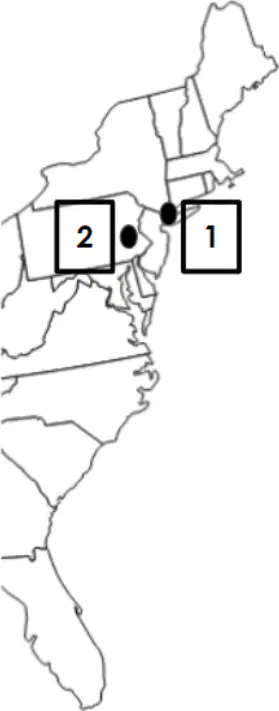
What city is labeled “2” on the map?
Washington, D.C.
Boston, Massachusetts
New York City, New York
Philadelphia, Pennsylvania
What is a representative democracy?
Voters elect only one leader that makes all laws and decisions.
All the voters come together in one place to make laws.
People elect leaders to speak for them and make the laws and decisions.
The government selects a few people to vote for the country’s laws and decisions.
In the United States, citizens elect other people to serve in government. Once in government, these people help pass laws and make decisions for their city, state, or country.
a direct democracy
a strong state government
a representative democracy
a weak national government
What power do citizens have in a representative democracy such as the United States?
Citizens are able to decide which taxes to pay.
Citizens vote directly on all laws for the country.
Citizens elect other people to run the government.
Citizens can choose which laws they want to follow.
Which of the following is the BEST reason Framers of the Constitution include this text in the document?
to show that all people in the country have the same rights
to show that the government’s power comes from the people
to show that the government can take away the rights of the people
to show that all people can vote on each law passed by the government
Which constitutional principle do the first three words of this text express?
federalism
individual rights
popular sovereignty
pursuit of happiness

Which of the following was President Roosevelt describing?
federalism
popular sovereignty
checks and balances
separation of powers
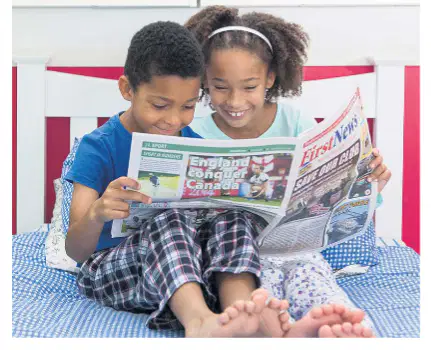
These kids are reading a newspaper. Which First Amendment right protects Americans’ right to print and read newspapers?
freedom of the press
freedom to assemble
freedom to petition
freedom of religion
Why do the 3 branches of the federal government have the power to check and balance each other?
to count votes
to give people more jobs
to help the government pass unfair laws
to keep one branch from becoming too powerful
Why did the framers of the U.S. Constitution promise to add the Bill of Rights?
to give states more power
to stop the Articles of Confederation
so states would ratify the Constitution
so the Executive Branch would have more power
Collecting taxes from citizens to pay for services like roads and schools is a power that belongs to _______________.
only state governments
only the federal government
both the federal and state governments
neither the federal or state governments
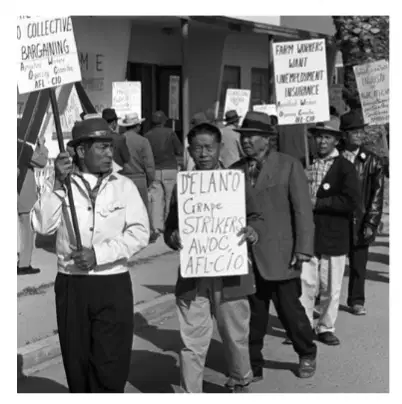
Which First Amendment right is this group of people exercising by peacefully marching together?
freedom to pay taxes
freedom to assemble
freedom of the press
freedom of religion
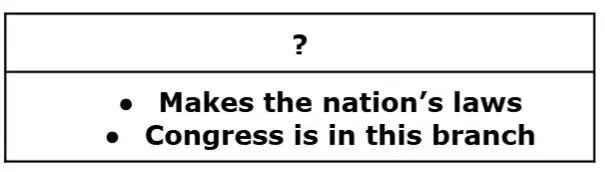
Which branch of the federal government should be the title of this list?
Executive Branch
Judicial Branch
Legislative Branch
State Branch
The First Amendment gives Americans the right to talk about their opinions. This right is called _____________________.
freedom of speech
freedom of religion
freedom to petition
freedom to assemble
What do the Bill of Rights protect?
the environment
the rights of citizens
the money people have
the rights of the government
Which of the following powers belongs ONLY to the federal government and NOT the states?
making laws
collecting taxes
declaring war on other countries
deciding how many days students go to school
Which of the following is one job of the Executive Branch of the federal government?
ignoring laws
enforcing laws
separating laws
making sure laws are fair
Which of the following are 2 examples of natural rights written in the Declaration of Independence?
A. life and liberty
B. money and safety
C. sadness and grumpy
D. good health and looks
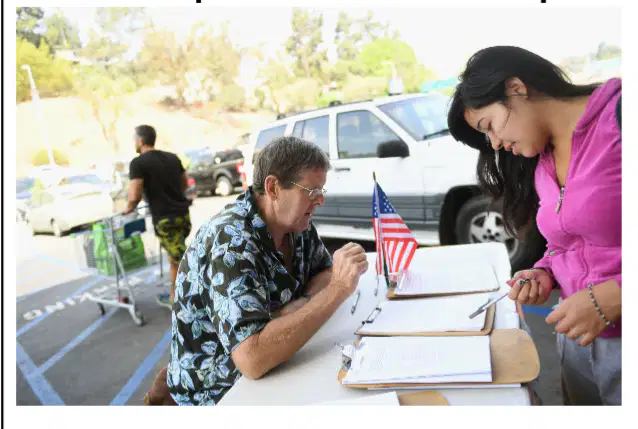
Which First Amendment right is this woman exercising by contacting government leaders to ask for a law to change?
freedom to assemble
freedom of religion
right of the press
right to petition
What is the goal of having three separate branches of government?
so one branch has all the power
so one branch can elect the president
so one branch can take over another branch
so one branch does not have too much power
Which of the following has the power to make laws?
the Senate and the President
the President and the Supreme Court
the House of Representatives and the Senate
the Supreme Court and the House of Representatives
Which of the following BEST explains the role of the executive branch of the federal government?
The executive branch is responsible for ending laws.
The executive branch is responsible for creating laws.
The executive branch is responsible for enforcing laws.
The executive branch is responsible for interpreting laws.
Why does the U.S. federal government have checks and balances?
to help the government enforce the law
to help the government pass laws quickly
to give states a voice in the federal government
to make sure no one branch has too much power
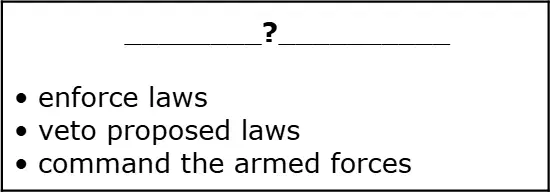
Use the table to answer the question.
Which of the following is the BEST title for the list?
Powers of the Legislative Branch
Powers of the Executive Branch
Powers of the Judicial Branch
Powers of the Senate
What is the purpose of the Bill of Rights?
to make passing laws easier
to limit the rights of all citizens
to protect basic rights of citizens
to give the president more power
Why did many people support adding the Bill of Rights to the Constitution?
They thought that the state governments were too strong under the Constitution.
They thought that the national government was too weak under the Constitution.
Living under the Articles of Confederation made them afraid of weak state governments.
Living under the rule of the British king made them afraid of strong national governments.
Which document written by Thomas Jefferson lists the natural rights of all people?
Articles of Confederation
Bill of Rights
Constitution
Declaration of Independence
What do the natural rights of life, liberty, and the pursuit of happiness have in common?
They are rights that all people are born with.
They are rights that people earn by paying taxes.
They are rights given to people by their government.
They are rights that people earn by being good citizens.
Which of the following are examples of natural rights found in the Declaration of Independence?
A. life and liberty
B. wealth and safety
C. health and property
D. prosperity and happiness
Which of the following is a power ONLY allowed by the federal government?
Tax citizens
Print money
Repair roads
Build schools
Rights not given to the federal government in the Constitution are shared with which of the following?
School governments
Church governments
All state governments
Some state governments
Which of the following powers belong ONLY to the states?
Increasing taxes on citizens
Declaring war on other countries
Printing more money for the country
Deciding how many days students go to school

Which of the following would BEST complete the “Shared” portion of the Venn Diagram?
Declaring war
Taxing citizens
Printing money
Fixing local roads
Which person's action would be protected by the first amendment?
Tina writes an article encouraging people to vote against her town’s mayor.
Louise steals her neighbor’s lawn mower because her neighbor owes her money.
Rudy rides her bike without her helmet even though state law says she has to wear it.
Gene spray-paints the windows of a newspaper office that printed an article she disliked.
Which of the following is a protected right of citizens under the First Amendment?
the right to refuse to follow laws
the right to complain about leaders
the right to encourage breaking the law
the right to threaten others with violence

Which right from the first amendment are the people exercising?
freedom of religion
freedom to petition
freedom to assemble
freedom of the press
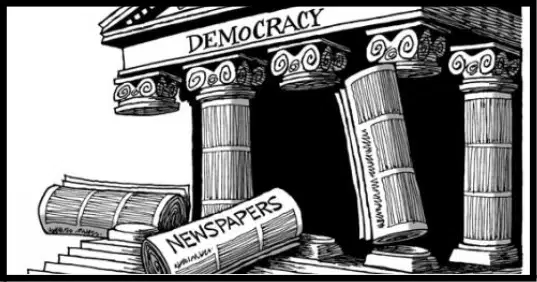
Which of the following rights from the first amendment is represented in this image?
freedom of speech
freedom to petition
freedom to assemble
freedom of the press
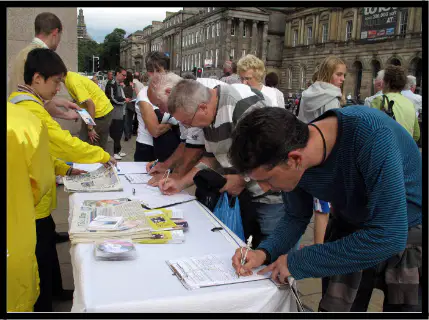
Which of the following rights from the first amendment are the people exercising?
freedom of speech
freedom to petition
freedom to religion
freedom of the press

