
 Worksheets
Mesopotamia Quiz
Total questions: 73
Worksheet time: 37mins
Which two rivers define the region of Mesopotamia?
Nile and Amazon
Euphrates and Tigris
Ganges and Indus
Danube and Rhine
Mesopotamia corresponds to which present-day country for the most part?
Egypt
Iran
Iraq
Turkey
Northern Mesopotamia is located in which present-day regions?
Northeastern Syria and northern Iraq
Southern Turkey and western Iran
Eastern Jordan and southern Iraq
Northern Saudi Arabia and eastern Syria
What is the name of the region shown in the map that lies between the Tigris and Euphrates rivers?
Mesopotamia
Indus Valley
Nile Valley
Yellow River Valley
Which two rivers are prominently shown flowing through Mesopotamia in the map?
Nile and Amazon
Tigris and Euphrates
Ganges and Indus
Yangtze and Yellow
Which ancient city located in Mesopotamia is marked near the Euphrates River in the map?
Babylon
Nineveh
Jerusalem
Damascus
What modern-day country contains most of the region of Mesopotamia as shown in the map?
Iraq
Syria
Iran
Turkey
What geographical feature is shown to have extended further inland until 5500 B.C. according to the map?
Mediterranean Sea
Persian Gulf
Caspian Sea
Red Sea
What does the term "Mesopotamia" mean?
Land of mountains
Land between the rivers
Land of deserts
Land of rainwater
Which two rivers bound Mesopotamia?
Nile and Amazon
Tigris and Euphrates
Ganges and Indus
Danube and Rhine
What was the northern region of Mesopotamia composed of?
Desert plains irrigated by rivers
Agricultural plateaus fed by rainwater
Mountain ranges
Dense forests
How was the southern part of Mesopotamia irrigated?
By rainwater
By underground wells
By water from the Tigris and Euphrates rivers
By artificial reservoirs
Which building material is present in abundance throughout Mesopotamia?
Wood
Stone
Clay
Metal
Why was clay significant as a building material in Mesopotamia?
It was the strongest material available.
It was abundant throughout the region.
It was imported from neighboring regions.
It was used only for decorative purposes.
Which river served as the main communication route between the different regions of Mesopotamia during historical periods?
Tigris
Euphrates
Nile
Amazon
Why was the Tigris river difficult to navigate?
It was too shallow.
It had violent floods.
It was surrounded by dense forests.
It was frozen most of the year.
What is one major difference between the Tigris and Euphrates rivers mentioned in the text?
The Euphrates was easier to navigate than the Tigris.
The Tigris was used for communication, while the Euphrates was not.
The Euphrates had violent floods, while the Tigris did not.
The Tigris was frozen, while the Euphrates was warm.
When does the historical period of Mesopotamia begin?
Around 3000 BC
Around 3400 BC
Around 2500 BC
Around 4000 BC
What significant development marked the beginning of the historical period of Mesopotamia?
The invention of the wheel
The perfection of writing
The construction of ziggurats
The discovery of agriculture
How is the historical period of Mesopotamia divided?
Into centuries
Into dynasties
Into several successive periods
Into kingdoms
What is the time period of the Sumerian civilization?
3400 - 2400 BCE
3000 - 2000 BCE
4000 - 3000 BCE
2500 - 1500 BCE
What was the result of the slow evolution of populations in lower Mesopotamia?
The rise of the Sumerian civilization
The fall of the Sumerian civilization
The creation of the Roman Empire
The development of the Egyptian civilization
Which period is referred to as "d’Uruk"?
3400 - 2900 BCE
2900 - 2340 BCE
3000 - 2500 BCE
4000 - 3500 BCE
What is the name of the second stage of the Sumerian civilization?
La période des dynasties archaïques
La période des dynasties modernes
La période des dynasties classiques
La période des dynasties anciennes
What is the time frame for "La période des dynasties archaïques"?
2900 - 2340 BCE
3400 - 2900 BCE
3000 - 2500 BCE
4000 - 3500 BCE
What was the "Uruk" period (c. 3400 - 2900 years BC) marked by?
The decline of agriculture and urbanization
Major innovations that laid the foundations of ancient Mesopotamian civilization
The disappearance of cities and states
The rise of nomadic lifestyles
Which phenomenon in Lower Mesopotamia contributed to the appearance of cities and states during the "Uruk" period?
The rise of agriculture
The invention of writing
The development of trade routes
The discovery of metal tools
What technical innovations were associated with the specialization of activities and functions during the "Uruk" period?
The creation of irrigation systems
Pottery, ceramics, and bricks of standardized formats
The invention of the wheel
The development of metal weapons
What is the term used to describe the emergence of cities and states during the "Uruk" period?
Agricultural revolution
Urban revolution
Industrial revolution
Technological revolution
When did the appearance of writing occur, as mentioned in the text?
Around 4000-3900 BCE
Around 3400-3300 BCE
Around 3000-2900 BCE
Around 2500-2400 BCE
What was the development of state institutions accompanied by during the appearance of writing?
The invention of new languages
The creation of artistic tools
The development of management instruments
The establishment of trade routes
What was the purpose of the management instruments developed during the appearance of writing?
To enhance communication between states
To supervise workers and other resources
To create historical records
To improve agricultural techniques
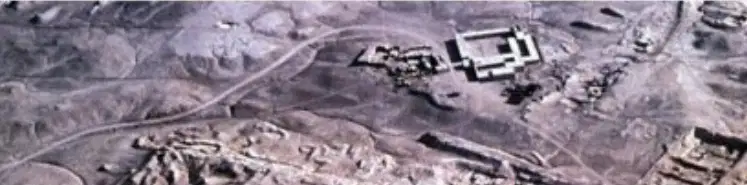
What does the image represent?
Aerial view of Babylon
Aerial view of URUK
Aerial view of Athens
Aerial view of Rome
What is another name for the Archaic Dynasties Period (2900-2340 BC)?
Protodynastic
Neolithic
Bronze Age
Akkadian
Which of the following city-states was located in the extreme south of Mesopotamia during the Archaic Dynasties Period?
Uruk
Babylon
Nineveh
Persepolis
What marked the end of the Archaic Dynasties Period?
The rise of the Akkadian Empire
The invention of writing
The fall of Uruk
The beginning of the Bronze Age
How were the political entities during the Archaic Dynasties Period described from a cultural point of view?
Relatively homogeneous
Highly diverse
Completely isolated
Extremely fragmented
Which of the following innovations is attributed to the Sumerian civilization?
Writing
Printing press
Steam engine
Electricity
What concept related to governance was introduced by the Sumerians?
Democracy
Concepts of law and government
Federalism
Monarchy
Which innovation by the Sumerians contributed to urban and commercial life?
The wheel
The compass
The printing press
The steam engine
Which field of study was advanced by the Sumerians?
Biology
Astronomy
Chemistry
Physics
What innovation by the Sumerians helped in agriculture?
Irrigation
Fertilizers
Crop rotation
Greenhouses
What mathematical system made it possible to divide time and space into degrees, leading to hours, minutes, and linear units of measurement?
The Sumerian system
The Roman numeral system
The Egyptian hieroglyphic system
The Mayan calendar system
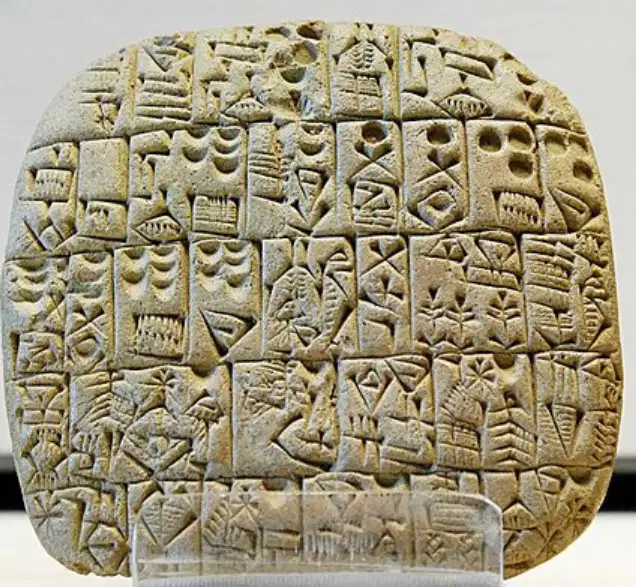
What is depicted on the Sumerian tablet shown in the image?
A contract of sale of a field and a house
A religious text
A mathematical equation
A historical map
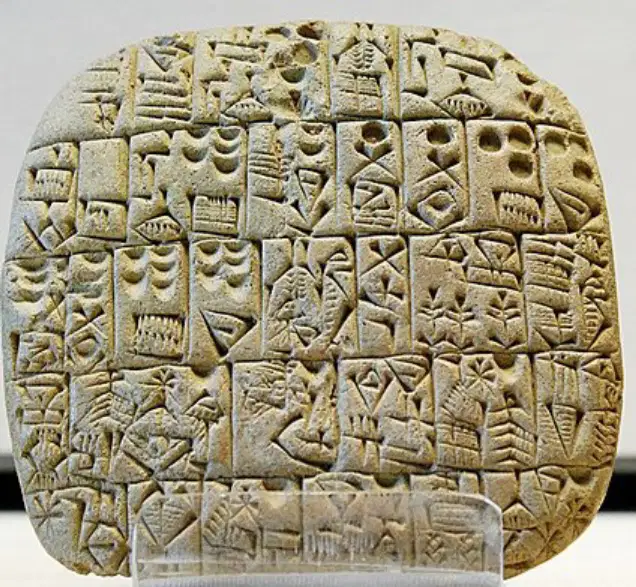
What writing system is used on the Sumerian tablet?
Cuneiform writing
Hieroglyphics
Latin script
Sanskrit
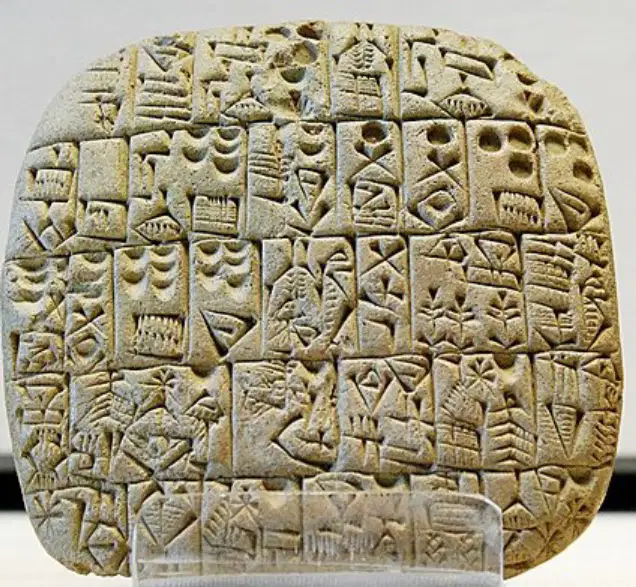
Since when has cuneiform writing on clay tablets been used?
Since the fourth millennium BC
Since the first millennium AD
Since the second millennium BC
Since the fifth millennium BC
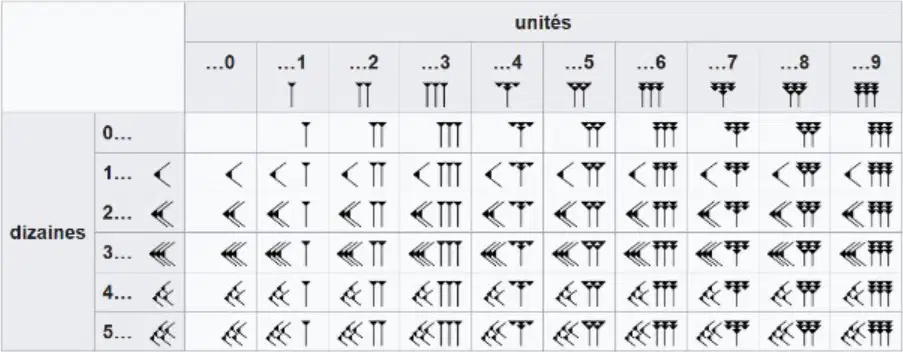
What does the table represent in the given image?
A multiplication table
A symbolic representation of numbers
A periodic table of elements
A calendar system
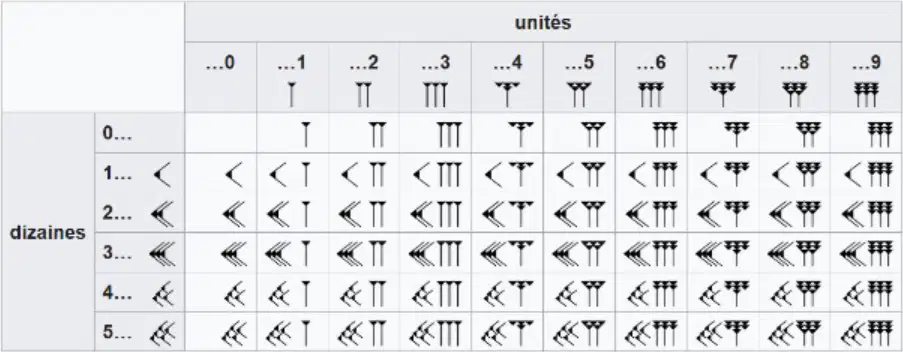
How is the number 12 represented in the symbolic system shown in the image?
Two vertical lines
A left-facing arrow and two vertical lines
Three vertical lines
A right-facing arrow and two vertical lines
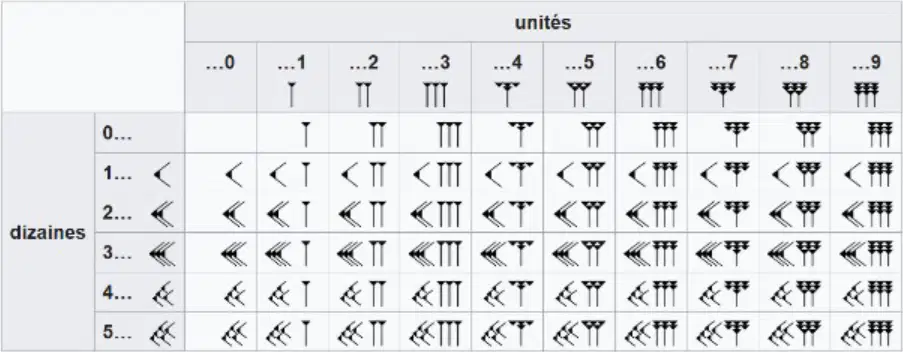
Which of the following numbers is represented by a combination of a left-facing arrow and three vertical lines in the symbolic system?
13
23
33
43
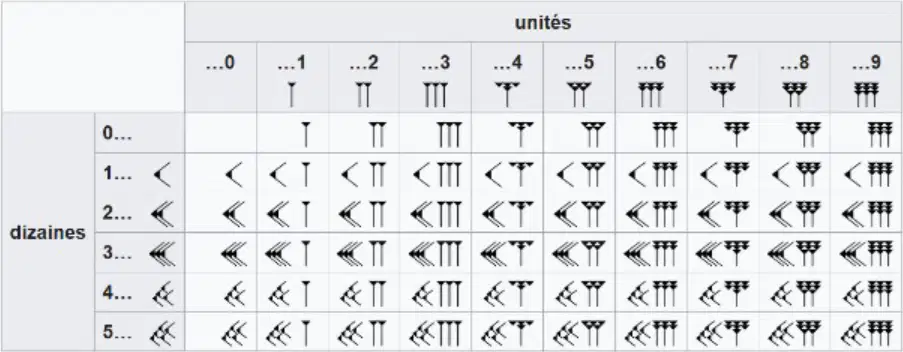
What is the symbolic representation of the number 30 in the given system?
Three left-facing arrows
Three vertical lines
A left-facing arrow and three vertical lines
Three left-facing arrows and no vertical lines
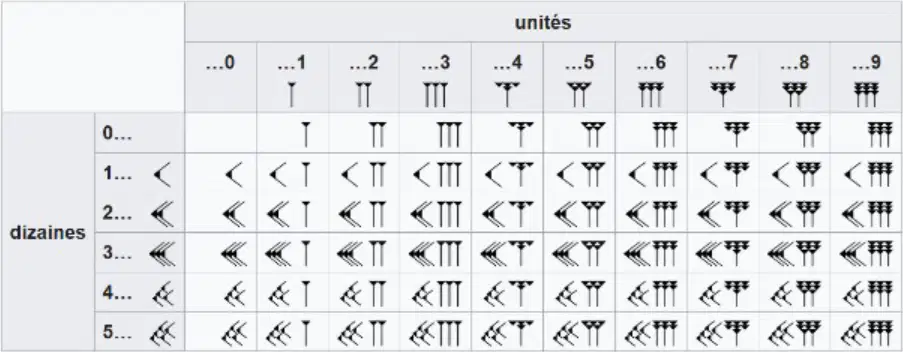
What is the symbolic representation of the number 58 in the given system?
Five left-facing arrows and eight vertical lines
Five left-facing arrows and three vertical lines
Five left-facing arrows and eight right-facing arrows
Five left-facing arrows and eight symbols resembling a "T"
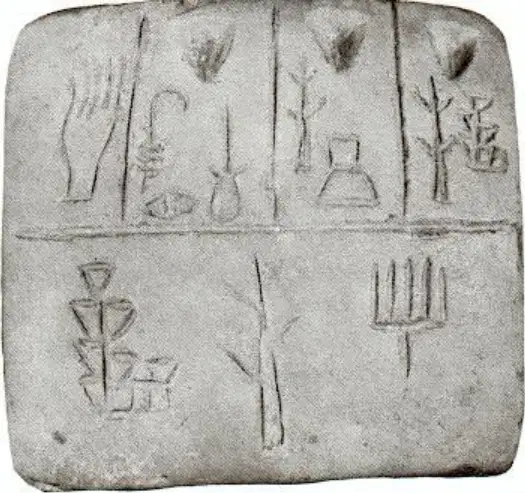
What were the first traces of writing inscribed on?
Papyrus scrolls
Clay tablets
Stone carvings
Animal skins
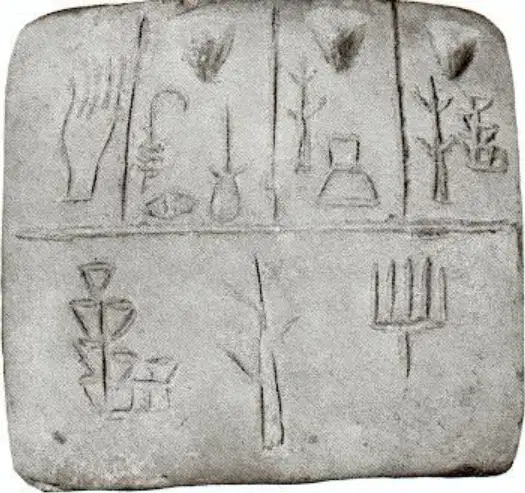
What was the primary purpose of the earliest writing?
Religious rituals
Economic needs
Storytelling
Scientific research
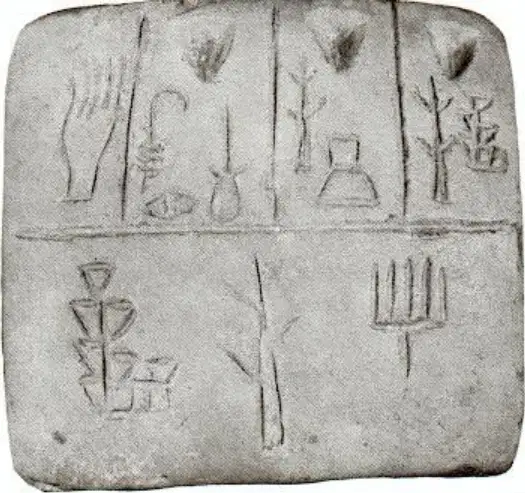
Where were the oldest clay tablets discovered?
The temple of Inanna in Uruk
The pyramids of Giza
The library of Alexandria
The city of Babylon
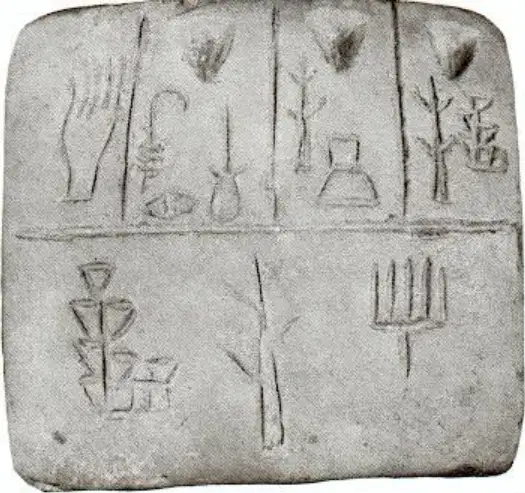
Around what year do the oldest clay tablets date back to?
2000 BC
3300 BC
1500 BC
4000 BC
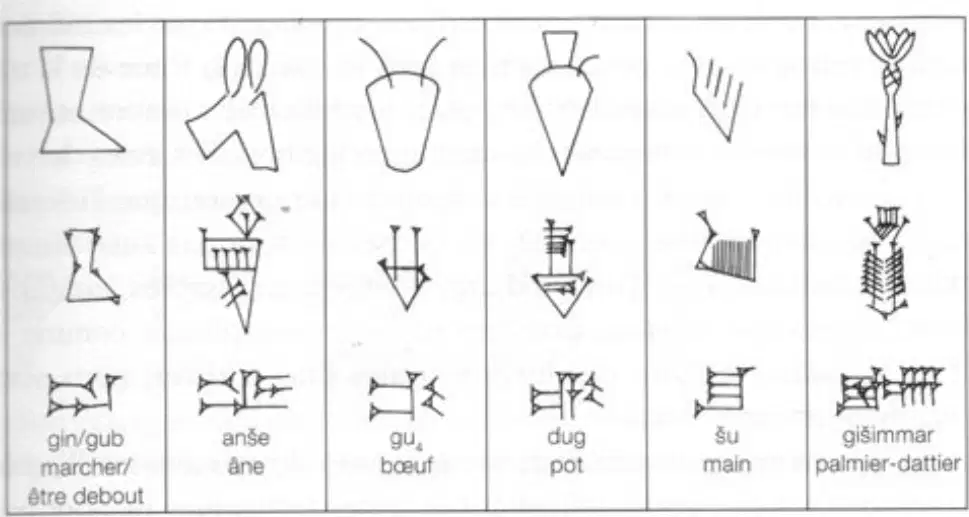
What is the process described in the text regarding the evolution of pictograms?
Pictograms became more realistic over time.
Pictograms evolved to become more stylized and abstract.
Pictograms retained their original appearances throughout history.
Pictograms were replaced by entirely new symbols without evolution.

Which of the following is an example of a pictogram that evolved into a stylized form, as shown in the diagram?
gu4 (ox)
dug (pot)
šu (hand)
gišimmar (date palm)
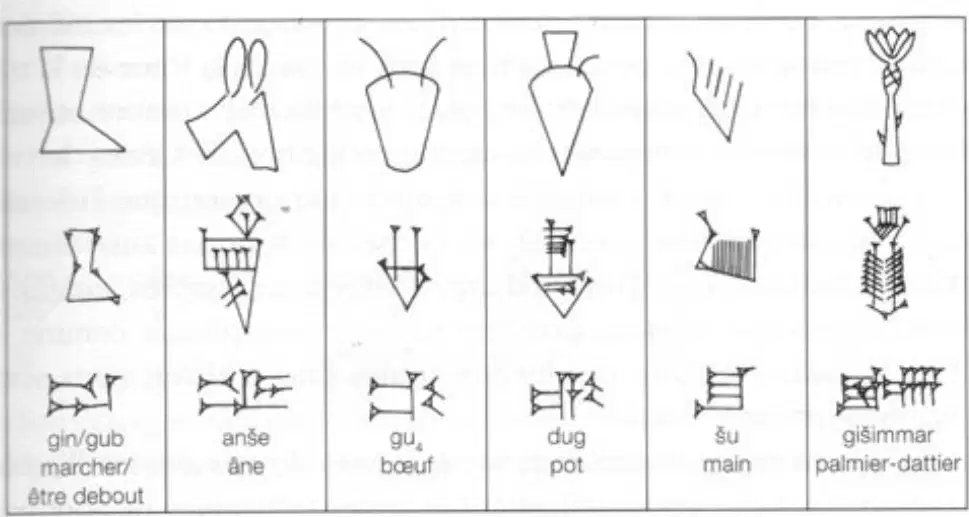
What does the pictogram "šu" represent in its stylized form, as shown in the diagram?
Ox
Hand
Pot
Date palm
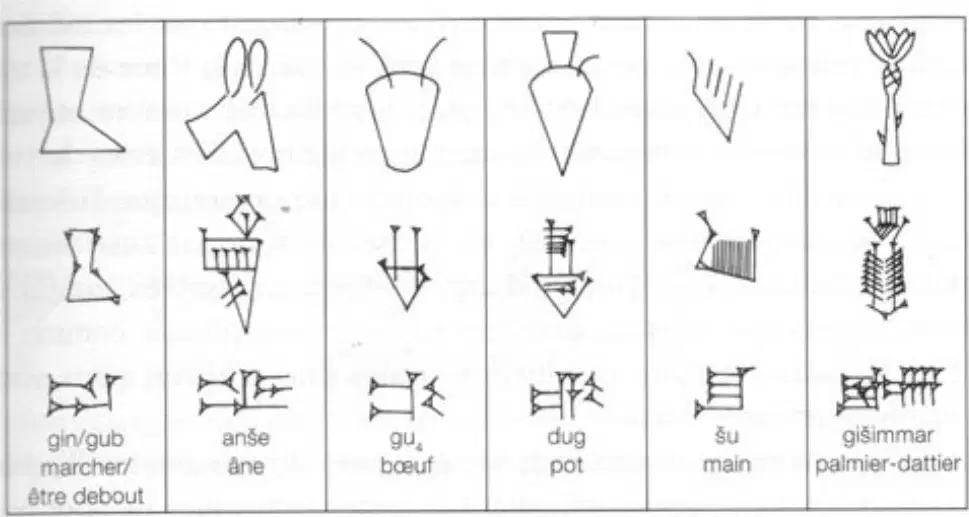
How did the shapes of objects in pictograms change over time according to the text?
They became more detailed and realistic.
They became more abstract and stylized.
They remained unchanged.
They were replaced by entirely new symbols.
What is the primary characteristic of pictographic writing?
It uses symbols to represent sounds.
It illustrates words through pictures.
It is entirely phonetic.
It uses abstract symbols without meaning.
What transition does the cuneiform script undergo over time?
From phonetic to pictographic.
From ideographic to phonetic.
From symbolic to abstract.
From phonetic to ideographic.
What happens to the symbols in cuneiform script as it becomes phonetic?
They lose their meaning entirely.
They are associated with sounds.
They become purely pictographic.
They are replaced by abstract shapes.
Where did the Akkadians live during the Akkadian period?
Southern Mesopotamia
Northern Mesopotamia
Eastern Mesopotamia
Western Mesopotamia
What was the main difference between the Akkadians and the Sumerians despite having similar government and culture?
The Akkadians lived in the south while the Sumerians lived in the north
The Akkadians spoke a different language
The Akkadians had a different religion
The Akkadians had a different form of government
Who came to power around 2300 BC during the Akkadian period?
Hammurabi
Sargon the Great
Gilgamesh
Nebuchadnezzar
What significant achievement is attributed to Sargon the Great during the Akkadian period?
He created the first written language
He federated the city-states to create a united empire
He established trade routes across Mesopotamia
He built the Hanging Gardens of Babylon
Who is depicted in the image provided?
Hammurabi
Sargon d'Akkad
Nebuchadnezzar II
Gilgamesh
What civilization is Sargon d'Akkad associated with?
Egyptian
Mesopotamian
Indus Valley
Greek
What was Sargon d'Akkad known for in history?
Building the Great Pyramid
Establishing one of the first empires
Writing the Code of Laws
Leading the Trojan War
Which of the following is a characteristic of Akkadian art, as seen in the image?
Use of hieroglyphs
Detailed beard and headdress design
Focus on abstract shapes
Lack of human representation
What was a significant technological advancement during the Sumerian civilization that improved agricultural productivity?
Seed drill
Fertilizer
Plow
Water wheel
Which ancient city is known as one of the first major urban centers in Mesopotamia?
Babylon
Ur
Lagash
Assur
What writing system was developed by the Sumerians for record-keeping and communication?
Hieroglyphics
Logographic script
Cuneiform
Alphabetic script

