
 Worksheets
Water Pollution and Natural Processes Quiz
Total questions: 15
Worksheet time: 8mins
What role did natural purification processes play in surface water quality?
They increased the amount of pollutants.
They removed or rendered impurities harmless.
They added new pollutants to the water.
They prevented human activity from affecting watercourses.
Which of the following is an example of human settlements contributing to water pollution?
Forests
Villages
Mountains
Deserts
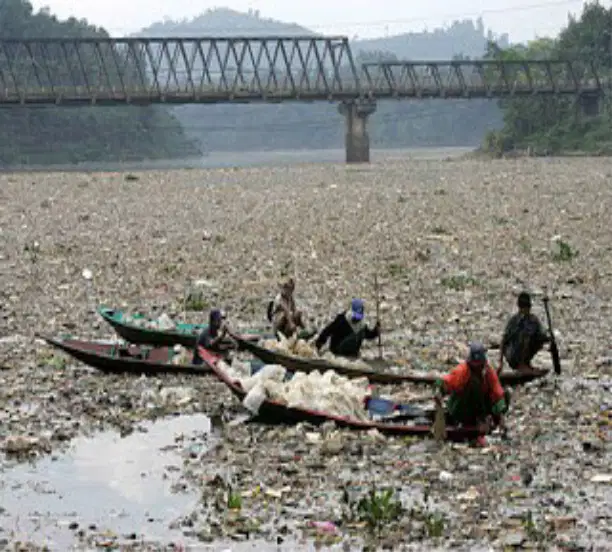
What is the primary cause of pollution in water bodies as mentioned in the text?
Excessive waste products exceeding the self-purification capacity.
Natural disasters affecting water bodies.
Lack of water flow in streams and lakes.
Overuse of water resources by humans.
What is the primary goal of pollution control programs initiated in recent decades?
To increase the amount of contaminants discharged into water bodies
To reduce contaminants discharged to a level that natural purification processes can assimilate
To eliminate all contaminants from water bodies
To replace natural purification processes with artificial ones
Diagram illustrating the self-purification mechanisms of natural water systems.
Diagram illustrating the self-purification mechanisms of natural water systems.
Diagram showing the industrial water treatment process.
Diagram of the water cycle without purification steps.
Diagram of a polluted water body with no purification.
How does temperature affect the natural purification process?
It has no effect on the process
It influences the speed and completeness of the process
It only affects the chemical nature of water
It impacts hydraulic characteristics exclusively
Why is a thorough knowledge of natural purification processes essential?
To understand the assimilative capacity of surface waters and the operations of engineered systems
To measure the temperature of water systems
To calculate the speed of water flow in rivers
To determine the color of water in lakes
What is a key factor for the success of dilution as a self-cleaning mechanism for surface water?
Discharging small quantities of waste into large bodies of water
Using advanced filtration systems
Increasing the population density
Treating wastewater with chemicals
Why does growth in population and industrial activity challenge the use of dilution for wastewater disposal?
It increases water demand and wastewater quantities
It reduces the availability of filtration systems
It eliminates the need for wastewater disposal
It improves the efficiency of dilution
What principle is used to calculate the dilution capacity of a stream?
Conservation of energy.
Mass balance.
Thermodynamics.
Fluid dynamics.
What does $ C $ represent in the formula $ CsQs + CwQw = CmQm $?
Volumetric flowrate (volume/time).
Concentration of selected material (mass/volume).
Dilution capacity.
Waste discharge rate.
What is one of the effects of suspended solids in water on aquatic plants?
Increase photosynthetic activity
Reduce light penetration
Enhance vision of aquatic animals
Improve feeding of aquatic animals
Which of the following is a consequence of suspended solids on aquatic animals that feed through filtration?
Improved feeding efficiency
Interference with feeding
Enhanced filtration process
Increased vision clarity
What is sedimentation in nature primarily used for?
Removing suspended particles from a watercourse
Increasing the flow rate of water
Enhancing the growth of aquatic organisms
Preventing flooding in harbors
What is a drawback of natural sedimentation?
It increases the oxygen levels in water
It creates anaerobic conditions in sediments, leading to decomposition of organics
It prevents the release of soluble compounds into the stream
It enhances the reproduction of aquatic organisms

