
 Worksheets
Revision Quiz 2: Investing
Total questions: 49
Worksheet time: 26mins
What is investing?
Putting money into assets like stocks and bonds to grow wealth over time
Saving money in a bank account for short-term goals
Spending money on daily expenses
Donating money to charity
Which of the following is TRUE about saving?
Riskier, long-term focus, higher potential returns
Safe, short-term, little risk, lower returns
Impacted by market fluctuations
Uses compound interest to build wealth faster
Fill in the blank: Investing is _______ than saving, with a long-term focus and higher potential returns, but is impacted by market fluctuations.
riskier
safer
slower
easier
Starting early with investing is a major advantage because compound interest allows investments to grow exponentially over time.
True
False
Investing is generally safer because the stock market tends to grow over the long-term averaging about 6% growth per year.
True
False
Fill in the blank: Stocks can be unpredictable over short periods, but historically, they grow over the _______.
long term
weekend
short run
holidays
midday
What does compound interest mean?
You earn interest only on your initial investment
You earn interest on your initial investment and on the interest it already earned
You do not earn any interest
You lose money over time
Even small, consistent investments can grow significantly over time because of compounding.
True
False
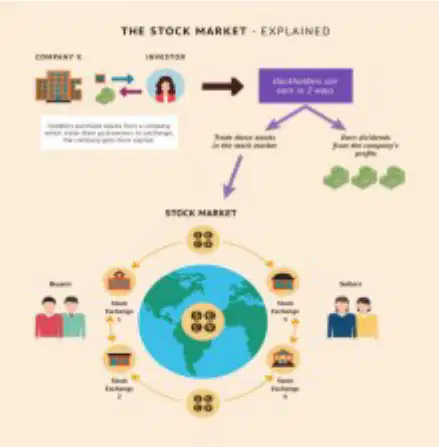
What is the stock market?
A place where people buy and sell goods
A system where people buy and sell ownership shares in companies
A bank where people save money
A government organization
Why do companies sell stock?
To lose money
To expand their business, create new products, hire more employees, or pay off debt
To close their business
To avoid paying taxes
Fill in the blank: Stocks are traded on stock exchanges like the ________ or the Nasdaq.
New York Stock Exchange (NYSE)
Chicago Mercantile Exchange (CME)
London Metal Exchange (LME)
Intercontinental Exchange (ICE)
One risk involved in investing in stocks is:
Potential loss of invested capital
Guaranteed profit
No market fluctuations
Fixed returns
What is the main difference between short-term and long-term financial goals according to the table?
A) Short-term goals are for emergencies and buying something important, while long-term goals are for retirement or big financial growth.
B) Short-term goals involve higher risk, while long-term goals involve lower risk.
C) Short-term goals are for over 10-60 years, while long-term goals are for 0-5 years.
D) Both are for the same duration.
Fill in the blank: Very low risk but low returns (small interest, around ___%) is associated with short-term financial safety.
1-2
5-6
10-12
15-20
Which type of investment involves higher risk but higher potential returns?
Saving money in a bank account
Investing in stocks and bonds
Buying groceries
Keeping cash at home
Saving money in a bank account is safe but grows very slowly.
True
False
Compound interest means when you invest:
You earn interest on both the initial amount and the interest previously earned.
You only earn interest on the initial amount invested.
You lose money over time due to fees.
Interest is paid only at the end of the investment period.
Fill in the blank: Over time, compound interest leads to ______ growth of your investment.
exponential
linear
cyclical
static
Which of the following is NOT a tip for successful investing?
Start early
Be patient
Diversify
Invest only in one company
Two benefits of starting to invest early are:
Compounding returns and more time to grow wealth.
Immediate high returns and guaranteed profits.
No risk and instant liquidity.
Tax-free income and no need for planning.
What is a market trend?
A trend is the general direction the stock market is moving over a period of time (up or down).
A market trend is a type of financial report released quarterly.
A market trend refers to the daily fluctuations in stock prices.
A market trend is the name given to a specific stock exchange.
Which market is associated with prices rising and investors feeling positive?
Bull Market
Bear Market
Which market is associated with prices falling and investors feeling negative?
Bull Market
Bear Market
A bull attacks upward with its horns. What does this mean for stock prices?
Prices going UP
Prices going DOWN
A bear swipes downward with its paws. What does this mean for stock prices?
Prices going UP
Prices going DOWN
In a bull market, investors are ________.
positive
negative
indifferent
confused
In a bear market, investors are ________.
negative
optimistic
indifferent
aggressive
Why is it hard to predict the market?
Trends are only clear after they’ve already happened.
It’s extremely difficult to time your investments perfectly with market changes.
Both A and B
What does diversification mean in investing?
Investing all your money in one company
Spreading your investments across different types of assets (like stocks, bonds, real estate, etc.) to reduce overall risk
Investing only in real estate
Avoiding investments altogether
What is dollar-cost averaging?
Investing a fixed amount of money at regular intervals, regardless of market conditions
Investing only when prices are low
Putting all your money in one stock
Avoiding the stock market
Fill in the blank: Diversification helps reduce overall ______ in your investment portfolio.
risk
return
growth
tax
Fill in the blank: Dollar-cost averaging helps you avoid trying to '______ the market' and lowers the risk of investing all your money when prices are high.
time
beat
predict
control
Which of the following is an example of diversification?
Investing all your money in one company's stock
Investing in several companies, bonds, and funds
Only buying real estate
Only buying stocks
Who decides what to buy and sell in a mutual fund?
The investor
A professional manager
No one
The government
Which investment type is known for flexibility to trade any time and usually low fees?
Mutual Fund
Index Fund
ETF (Exchange-Traded Fund)
TDF (Target Date Fund)
Fill in the blank: A TDF (Target Date Fund) automatically gets ______ as you age.
safer
riskier
more expensive
less diversified
What is a 401(k)?
A retirement savings plan offered by an employer
A type of robot advisor
A tax-free savings account
A personal nest egg you build yourself
Which of the following is true about Traditional IRAs?
Contributions are tax-deductible and you pay taxes later when you withdraw
You pay taxes now, but withdrawals in retirement are tax-free
It is managed by a robot advisor
It is only available through employers
Fill in the blank: A robo-advisor is an online investing service that uses ______ to pick and manage your investments automatically.
algorithms (robots)
human advisors
random selection
manual spreadsheets
Which retirement plan may offer a bonus where some employers match part of what you contribute?
401(k)
IRA
Roth IRA
SEP IRA
What is a catch of withdrawing money from a 401(k) before retirement age?
No penalties
You get less personal advice
There are penalties
Tax-free withdrawals
Which retirement option gives people a way to save for retirement on their own?
401(k)
IRA
Robo-advisor
None of the above
Fill in the blank: Think of a 401(k) as a retirement "______" that your job helps you fill up.
piggy bank
locker
basket
safe
Which of the following is a benefit of robo-advisors?
High cost
Easy to use and great for beginners
Only available through employers
No automation
How does diversification help in investment?
By allocating investments among various asset types to reduce risk
By focusing solely on bonds
By investing only in domestic markets
By guaranteeing profits
What is a mutual fund?
A type of savings account
A loan from the bank
A pool of money collected from many investors to invest in securities
A government bond
The benefits of diversifying your investments are:
Reduced tax liability
Reduced risk
Larger return
Larger risk
Abigail, James, and Isla join David, Aria, and Luna for a round of 'Investment Tycoon'. They are in a scenario where they have to decide on an investment strategy to safeguard their assets against market volatility. Which strategy would they choose that involves maintaining a diverse portfolio of investments?
Going all in with aggressive investment
Chasing the thrill with speculative stock
Playing it safe with asset allocation
Spreading their bets with diversification

