
 Worksheets
L23: Influences on Medieval Japan
Total questions: 21
Worksheet time: 11mins
Name
Class
Date
1.
What is one important way in which Empress Suiko and Prince Shotoku changed Japan?
a)
They turned it into an agricultural society.
b)
They divided power among the chiefs of clans.
c)
They increased contact with neighboring cultures.
d)
They introduced the craft of bronze and iron smithing.
2.
What was a characteristic of family life in Japan during this period?
a)
Fathers were the primary caregivers for children
b)
Women had relatively high status as heads of households
c)
Extended families always lived together in large compounds
d)
Children were primarily raised by community elders
3.
When Korean workers settled in Japan, how did they change the lives of the Japanese according to Lesson 23?
a)
They set up a new government over the country.
b)
They advised the emperor on government policy.
c)
They brought knowledge and skills from the mainland.
d)
They became the customers who bought Japanese crafts.
4.
Before the time of Empress Suiko and Prince Shotoku, the Japanese government _________________.
a)
ruled over Korea and China.
b)
depended on local leaders of clans.
c)
had a large bureaucracy of government officials.
d)
filled jobs based merit using civil service examinations.
5.
How did the Japanese incorporate mainland Asian cultural influences?
a)
They completely replaced their traditions with Chinese practices
b)
They rejected most foreign influences to preserve their identity
c)
They blended new ideas with their own traditions
d)
They adopted Korean culture but rejected Chinese influences
6.
What significant document did Prince Shotoku issue in 604?
a)
The Imperial Proclamation
b)
The Seventeen Article Constitution
c)
The Chinese Adaptation Act
d)
The Confucian Reform Decree
7.
What were "uji" in Japan?
a)
a type of building
b)
Shinto gods and goddesses
c)
a type of popular food
d)
clans that controlled the land
8.
Emperor Tenmu and Empress Jito made changes to strengthen their imperial power, including declaring all land as belonging to the emperor. Who would have been most upset by these changes?
a)
peasants
b)
merchants
c)
clan leaders
d)
military leaders
9.
By the 700s, how did Japan's imperial government compare to China's?
a)
It was completely different in structure and function
b)
It was strongly centralized with a large bureaucracy, similar to China's
c)
It was less centralized but had more efficient tax collection
d)
It was smaller but more powerful than China's government
10.
What key difference emerged between the Chinese and Japanese governments over time?
a)
Japan developed a powerful aristocracy that held high government positions
b)
Japan eliminated all government positions except for the emperor
c)
China adopted Japan's tax system
d)
Japan's government became more democratic than China's
11.
What major design feature did Chang'an have that Nara did not?
a)
A checkerboard pattern of streets
b)
A protective wall around the city
c)
Buddhist temples to the north
d)
A wide central boulevard
12.
Traditional Shinto temple design tends to reflect Shinto's _________.
a)
code of moral rules.
b)
worship of Buddha as a godlike figure
c)
belief in life and death as cycle of pain and suffering.
d)
respect for the beauty of nature
13.
In Shinto, what are the spirits called that exist in impressive natural objects?
a)
Bodhisattvas
b)
Kami
c)
Nirvana
d)
Eightfold Path
14.
A central teaching of Mahayana, the form of Buddhism that reached Japan, was that _______________.
a)
life on Earth is the only life.
b)
all people can reach nirvana.
c)
all buddhas hold false beliefs.
d)
only the material world is real.
15.
Why did the Japanese begin using Chinese characters?
a)
They were forced to by Chinese invaders
b)
To communicate with Chinese traders
c)
To keep written records and develop their own literature
d)
Because Chinese was considered more prestigious
16.
What challenge did the Japanese face when using Chinese characters for their language?
a)
Chinese characters were too complex to memorize
b)
Japanese and Chinese had different grammar, sounds, and pronunciations
c)
The Japanese government banned certain Chinese characters
d)
Paper was too expensive to use for writing
17.
How did the development of "kana" change Japanese writing?
a)
It completely replaced kanji in all Japanese writing
b)
B. It allowed the Japanese to spell out the sounds of their own language
c)
C. It made Japanese writing identical to Chinese
d)
D. It introduced punctuation marks to Japanese writing
18.
How can one tell whether a Japanese poem is a tanka?
a)
by counting the syllables in each line
b)
by identifying the social class described
c)
by analyzing the symbols described
d)
by checking whether pairs of lines rhyme
19.
After more contact with mainland Asia, how did this foreign influence affect Japanense sculptures?
a)
They started sculpting Shinto kami.
b)
The subject of sculptures included emperors.
c)
They started making sculptures of the Buddha.
d)
The subject of sculptures included armored warriors.
20.
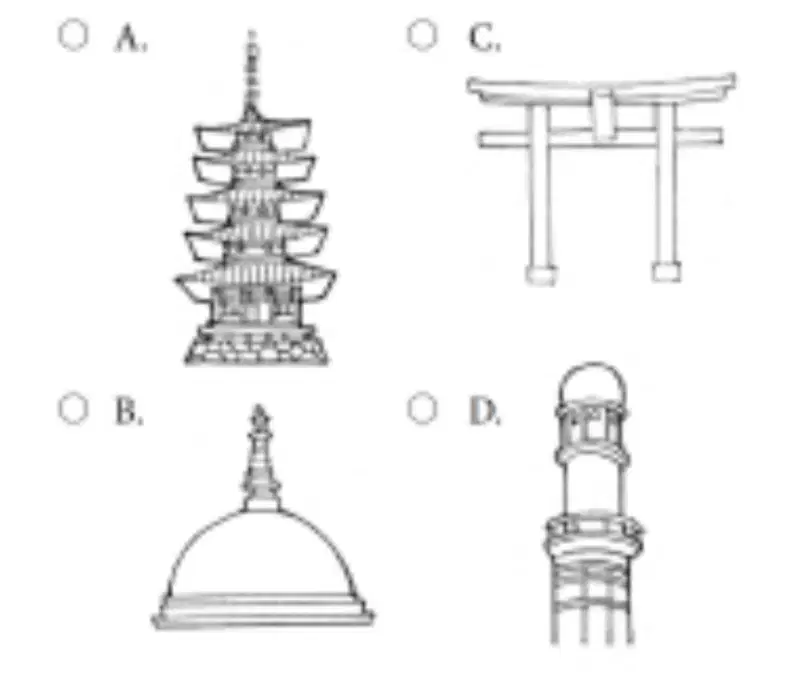
Which architectural style did Japanese Buddhists adopt for their temples?
a)
A
b)
B
c)
C
d)
D
21.
How did gagaku, a form of Chinese court music, influence music in Japan?
a)
The Japanese hired Chinese musicians.
b)
Japanese chants became more popular.
c)
New musical instruments were used.
d)
The Japanese sang only Chinese songs
100 %

