
 Worksheets
Sampling Methods (Unit 3a)
Total questions: 73
Worksheet time: 37mins
Which statement best describes a census compared to a sample?
A census studies the entire population
A census studies a small random group
A census studies a fixed-size subgroup
A census studies volunteers who respond
A school wants to know the favorite lunch of all students. Why might they use a sample instead of a census?
A sample guarantees perfect accuracy
A sample saves time and resources
A sample avoids any hidden bias
A sample includes every single student
A survey is run at the front gate right after a soccer game. Which judgment is most reasonable about this sampling method?
Always better than a full census
Guaranteed to match the population
Clearly unbiased and fully random
Likely biased due to event crowd
Which term describes the entire group that a study aims to understand?
Targeted subgroup
Whole population
Selected volunteers
Sample of participants
Which statement best defines a sample in a research study?
The unbiased portion of data
A random list of names
A relatively small group studied
The complete census of people
What is the main reason researchers use samples instead of a full census?
Volunteers are always available
Samples are more precise
Censuses are always biased
Studying everyone is costly
In a simple random sample, how is selection characterized?
Convenient access to members
Only volunteers are selected
Equal chance for each member
Systematic order of members
Which example shows a systematic random sample?
Choose every 10th person
Pick friends from class
Ask only volunteers
Divide by groups first
Which method involves selecting only those who choose to participate?
Census of residents
Voluntary response
Stratified random
Convenience sampling
Which sampling method divides the population into subgroups and randomly samples within each?
Systematic random sample
Convenience sample
Voluntary response sample
Stratified random sample
Proportional sampling ensures what about subgroups?
Equal numbers sampled
Proportions are maintained
Only volunteers included
Randomness is avoided
Which situation most likely produces a biased sample?
Simple random selection
Stratified by grade
Convenience at lunch
Systematic every 10th
Which situation most likely produces an unbiased sample?
Randomly select students
Ask your friends at recess
Stand near the library door
Only online survey volunteers
A census is best described as which action?
Dividing into subgroups first
Choosing every fifth person
Surveying the entire population
Measuring a small sample
Which is a key advantage of simple random sampling over non-random methods?
Faster to conduct
Guaranteed no bias
Less expensive always
Better representation
Which practice would create a convenience sample of students?
Using computer to randomize
Surveying students in gym
Selecting every 8th name
Randomly from each grade
Which choice shows voluntary response bias risk?
Divide by teams then random
Students who want to answer
Every 12th on a list
Computer picks 50 names
Which step makes a systematic sample systematic?
Only choosing volunteers
Balancing subgroups equally
Using a fixed interval
Starting with a census
To ensure gender balance in a sample, which method fits best?
Convenience at cafeteria
Systematic list interval
Simple random only
Stratified then random
Which statement about biased samples is accurate?
They represent population
One group favored over others
Always larger than samples
Always from volunteers only
Which statement about unbiased samples is accurate?
Exclude certain subgroups
Include volunteers only
Chosen only by convenience
Selected to represent population
Which method combines subgroup division with keeping subgroup proportions?
Convenience selection
Systematic sampling
Stratified proportional
Voluntary response
Which inference is most reasonable after drawing a well-designed random sample?
Only volunteers are represented
Only one subgroup is represented
Conclusions generalize to population
Conclusions apply to sample
Which statement best defines a population in a statistics study?
Only those who fill out surveys
People living in one classroom
A random subset of volunteers
The whole group being investigated
Which example correctly describes a population?
All seventh-graders in Cobb County
Seventh-graders from one school
Ten seventh-graders from a class
Students who like math surveys
What is a census?
An estimate using partial data
A survey measuring the entire population
A study of one neighborhood only
A small poll of interested people
How often does the United States conduct its national census?
Every five years
Every two years
Every year
Every ten years
Why do researchers often use samples instead of conducting a census?
Censuses are illegal in most countries
Censuses are tedious and time-consuming
Samples always give exact results
Populations are always tiny groups
What is a sample in a research study?
A relatively small group with data obtained
The entire group being investigated
The largest subgroup of participants
A list of questions for a survey
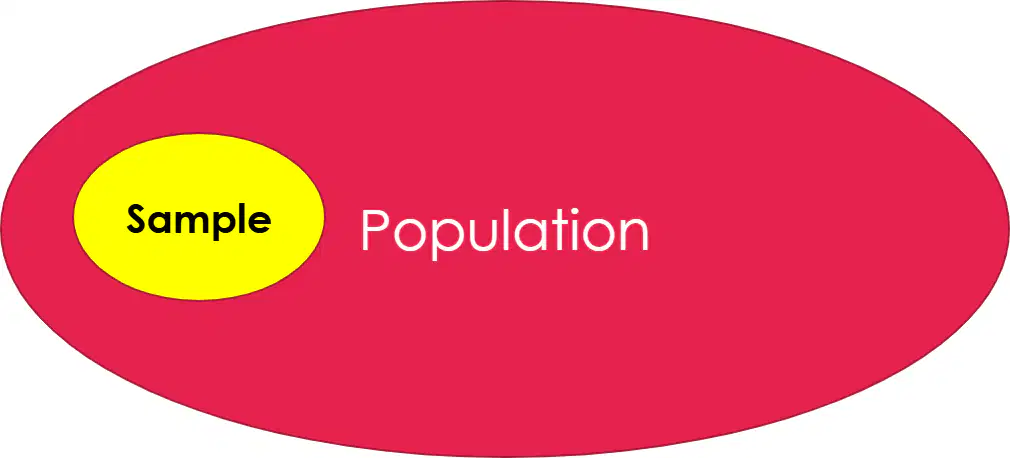
In the diagram showing a yellow oval inside a red oval, what do the shapes represent?
Yellow is population, red is sample
Yellow is sample, red is population
Both ovals are the population
Both ovals are the sample only
Which situation best illustrates making a generalization from a sample?
Asking every student in the district their opinion
Surveying 200 students to estimate all students’ opinions
Choosing friends only and reporting their views
Reading one article and forming an opinion
Which statement is true about a census compared to a sample?
Neither can be used to make inferences
A census measures fewer; a sample measures everyone
A census measures everyone; a sample measures fewer
Both measure only volunteers
Which group would be a sample of all seventh-graders in Cobb County?
Students from one advanced math class
Only seventh-graders who play soccer
Two hundred randomly selected seventh-graders
Every seventh-grader in Cobb County
What is the main purpose of using a sample?
To avoid collecting any data at all
To make inferences about the population
To count only the easiest cases
To replace the population permanently
Which choice shows a misconception about samples and populations?
A sample must represent the population
A sample’s results can be generalized carefully
A sample is always the entire population
A sample provides data from fewer individuals
Which statement best describes a random sample?
First names on a list automatically selected
Members chosen for convenient access
Every member has equal chance included
Only certain groups are intentionally targeted
Which method is nonrandom sampling?
Roll dice to pick participants
Ask only students with red hair
Survey every fifth name from roster
Use a computer to select ten students
What makes a sample unbiased?
It accurately represents entire population
It favors one specific subgroup
It uses volunteers from one class
It selects first available participants
Which sample is most likely biased?
Seventh-graders from honors English only
Every tenth student from full list
Randomly chosen names from district
Numbers drawn for student selection
A school wants opinions from all seventh-graders. Which plan is most representative?
Computer selects every tenth student
Survey students waiting after school
Ask the first thirty red-haired students
Use only students from math club
Why is random sampling preferred?
Ensures higher response rates
Faster than other methods
Better representation of population
Guaranteed perfect accuracy
Which scenario shows unbiased sampling?
Survey only students with top grades
Students chosen for similar hobbies
Names drawn at random districtwide
Participants selected from one classroom
A science teacher surveys only lab assistants about homework. What issue is most likely?
No subgroup is being favored
Sampling method is entirely random
Results reflect the entire school
Sample is biased toward assistants
Which statement best describes a simple random sample?
People volunteer to be included themselves
Only nearby members are chosen for ease
Members are chosen by fixed time schedule
Each member has equal independent chance
Which action is an example of a simple random sample?
Survey people who sign up online
Ask classmates because they are close
Choose every 10th person in line
Write all names, draw one at random
In a systematic random sample, how are people selected?
By who volunteers to respond
By who is easiest to reach
By equal independent chances
By item interval or specific time
Which procedure matches systematic random sampling?
Pick every 10th registered voter
Pull a name from a mixed hat
Ask your friends at lunch
Post a link for anyone to join
What defines a convenience sample?
Selection uses fixed intervals
Participants volunteer themselves
Every member has equal chance
Members are easily accessed
Why is a convenience sample often not representative?
It overuses nearby people
It requires complex intervals
It includes all subgroups evenly
It uses equal random chance
What is a voluntary response sample?
Selection follows time intervals
Researchers randomly select names
Participants choose to respond
Only easily reached members join
Which scenario shows voluntary response sampling?
Survey every 5th locker number
Interview students waiting nearby
Online poll where users opt in
Teacher draws a name from hat
What is the main idea of stratified random sampling?
Select by fixed time or interval
Divide into groups then sample each
Ask whoever is easiest to find
Let people sign up themselves
Which plan uses stratified random sampling for a school survey?
Share a link for anyone to respond
Survey students hanging in the lobby
Take every 12th name on the roster
Split by grade, randomly pick from each
What distinguishes proportional sampling from stratified random sampling?
Nearby people are chosen for convenience
Participants are entirely self-selected
Selections follow time-based intervals
Sample sizes match group proportions
A town has 60% adults and 40% teens. For 50 people, what fits proportional sampling?
Select 30 teens and 20 adults
Select 50 volunteers online
Select 25 adults and 25 teens
Select 20 teens and 30 adults
Which sampling method best reduces selection bias across the whole population?
Convenience sampling
Simple random sampling
Systematic random
Voluntary response
You want to estimate average shoe size at school quickly. Which method is fastest but weakest?
Convenience sampling near the gym
Simple random from all students
Systematic every 10th classroom seat
Stratified by grade then sample
A list of 1,000 names is alphabetized. You choose every 20th name. Which method is used?
Systematic random sampling
Simple random sampling
Convenience sampling
Voluntary response sampling
To ensure each grade is represented fairly, which method should you use?
Systematic random sampling
Voluntary response sampling
Convenience sampling
Stratified random sampling
Which issue most affects voluntary response samples?
Responses come from motivated people
Equal chance for all participants
Intervals control the selection process
Groups are balanced proportionally
Which change turns a stratified sample into a proportional one?
Let participants sign up themselves
Ask only people who are nearby
Switch to every 10th person rule
Match sample counts to group sizes
Which phrase best describes a representative sample of a population?
Includes varied subgroups proportionally
Includes only the most vocal members
Includes people who volunteer first
Includes anyone available that day
Why is it important to use a representative sample when studying a population?
It avoids using any numerical data
It guarantees perfect predictions
It makes data collection faster
It provides the most accurate portrayal
A school has 60% seventh graders and 40% eighth graders. Which sample is most representative?
15 seventh, 5 eighth students
18 seventh, 2 eighth students
12 seventh, 8 eighth students
10 seventh, 10 eighth students
Which statement about sample size is generally true?
Smaller samples are more precise
Tiny samples avoid all bias
Larger samples are more representative
Medium samples always guarantee accuracy
You survey 50 students and find 70% prefer recess outside. What inference can you make about the whole school?
Most students likely prefer outside recess
Exactly 70% of all students do
No students prefer inside recess
Preferences cannot be inferred
Which action helps ensure sub-groups are represented proportionally in a sample?
Choose students from one class
Use stratified selection by groups
Pick names until the list ends
Ask friends to participate first
Data from a representative sample are used to make predictions or generalizations about a population. Which example fits this idea?
Predicting school-wide trends from surveyed classes
Deciding only for the surveyed class itself
Ignoring survey percentages entirely
Guessing based on one student’s opinion
Which option best describes the relationship between a population and a sample in data collection?
A sample is the entire group being studied
A population is chosen using systematic random steps
A population is a subset selected from volunteers
A sample is a smaller group drawn from the population
Which method is classified as unbiased and valid for selecting a sample?
Only surveying highly active group members
Convenience sampling at the nearest location
Voluntary response from interested participants
Systematic random using a fixed interval list
A school wants grade-level representation in the survey by selecting random students from each grade. Which method fits this plan?
Voluntary response through an online poll
Convenience sampling near the cafeteria
Simple random without any subgroups
Stratified random with grade-based groups
Which choice is a biased (not valid) method according to the flowchart?
Simple random using equal chance selection
Convenience sampling at the easiest spot
Proportional sampling across subgroups
Systematic random from a numbered list
You number all students and pick every 10th student starting at a random point. What sampling method is this?
Systematic random with fixed intervals
Voluntary response by interested students
Convenience sampling after school hours
Proportional sampling by club membership

