
 Worksheets
Unit 4 Exit Ticket
Total questions: 35
Worksheet time: 18mins
1. In a futuristic bio-lab where scientists engineer life forms, where does the DNA replication process occur within the cell? (Hint: DNA never leaves the...)
cytoplasm
nucleus
ribosome
vacuole
2. In the year 2125, scientists are comparing RNA samples from a bioengineered chipmunk and a synthetic worm on a space station. Both of the RNA samples will contain _________. (Think about what sugar and base RNA has)
deoxyribose and thymine
deoxyribose and uracil
ribose and thymine
ribose and uracil

3. In the year 2125, a bioengineer aboard a space station is using advanced molecular scanners to identify genetic materials from samples collected on a distant planet. The table below shows the detected components of four unknown molecules.
Based on the futuristic molecular scan results, which of the four molecules is DNA?
(Hint: What sugar does DNA have?)
molecule 1
molecule 2
molecule 3
molecule 4
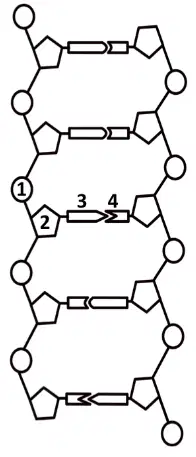
4. In the year 2124, scientists aboard the interstellar research vessel "Genome Explorer" are analyzing a sample of genetic material from a newly discovered life form on a distant planet. The diagram below represents a portion of its nucleic acid molecule.
Structures 3 and 4 on the molecule below could be
** HINT** this molecule is double stranded/double helix and think of base pair rules.
A U
A T
G U
T U
5. In the year 2125, scientists are engineering synthetic DNA for advanced bio-computers. A single DNA nucleotide in these futuristic systems could contain which of the following molecules?
deoxyribose, nitrogen base, and a lipid
deoxyribose, nitrogen base, and a phosphate group
ribose, nitrogen base, and thymine
6. In the year 2120, scientists use advanced nucleotide scanners to decode genetic information. The letters A, G, C, T, and U detected by these scanners represent
deoxyribose sugars
nitrogen bases
ribose sugars
9. In the year 2124, scientists aboard a space station are tasked with replicating a DNA strand to engineer crops that can survive on Mars. Provide the complementary DNA strand for the sequence below to ensure successful genetic modification. ATC TTG CAA
ATC TTG CAA
UAG AAC GUU
TAG AAC GTT
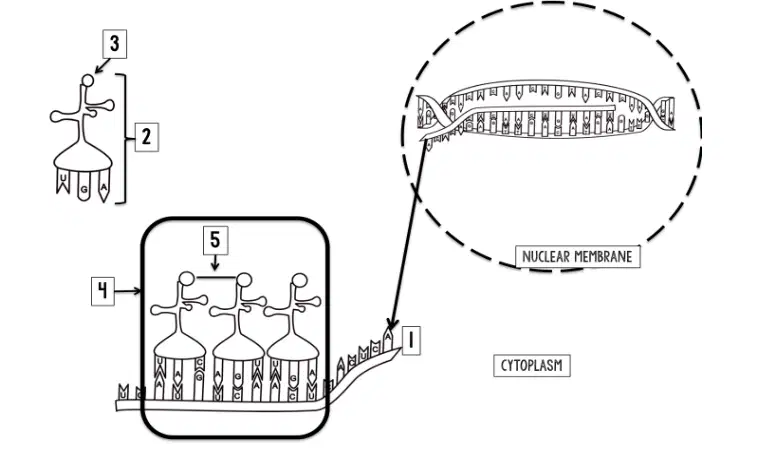
10. In the futuristic bio-lab, scientists use advanced nanomachines to replicate the process shown in the image below, synthesizing a _________ for medical and technological applications.
carbohydrate
lipid
protein
nucleic acid
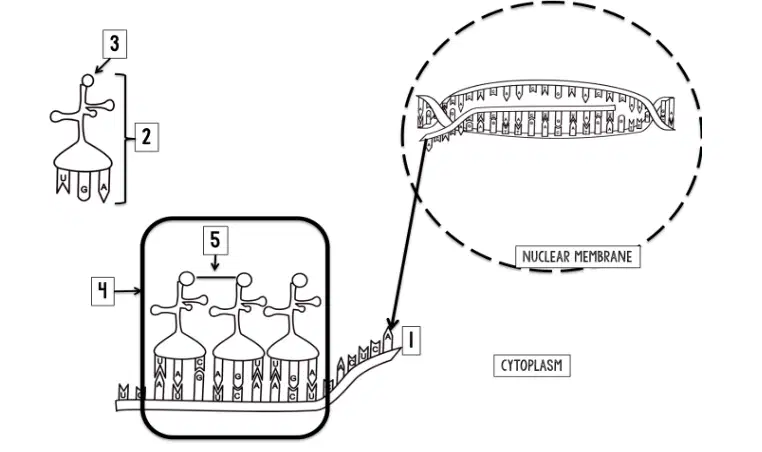
11. In a futuristic bioengineering lab, scientists are using advanced nanobots to decode genetic instructions. Structure number 1 represents a
mRNA
tRNA
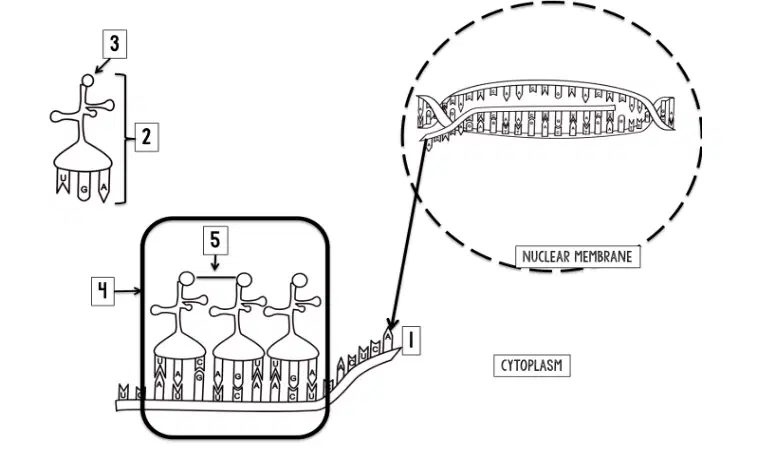
12. In a futuristic bioengineering lab, scientists are using advanced nanobots to synthesize proteins. Structure number 2 represents a
mRNA
tRNA

13. In a futuristic bioengineering lab, scientists are designing synthetic cells that assemble proteins using advanced nanobots. Identify structure 3, which represents a key component added by the nanobot during protein synthesis.
codon
anti codon
amino acid
14. In a futuristic bio-lab, scientists are programming nanobots to manufacture proteins using genetic instructions. Which is the correct sequence the nanobots should follow to make a protein? (Hint: The molecule that has the code goes first)
transcription, DNA replication, translation
translation, transcription, DNA replication
DNA replication, transcription, translation
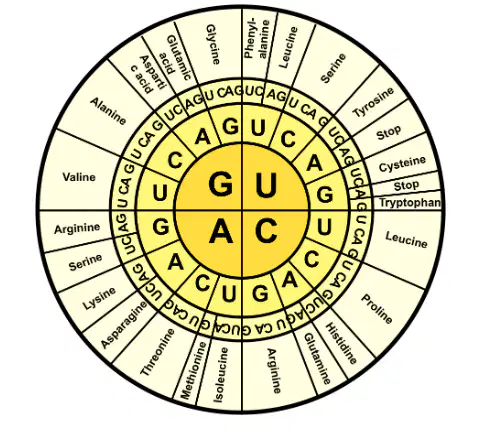
18. In the year 2124, scientists aboard the interstellar research vessel "Genoma" are engineering synthetic life forms to adapt to alien environments. They receive an mRNA sequence from a newly discovered microorganism on planet Xylon: AUG UAC CUA AAC GGA. Using the advanced codon wheel interface below, translate this mRNA sequence to determine the amino acid sequence that will help the crew understand the organism's protein synthesis.
Met - Tyr - Leu - Asp - Glu
Met - Tyr - Leu - Lys - Gly
Met - Tyr - Leu - Asp - Gly
Met - Tyr - Leu - Asp - Arg
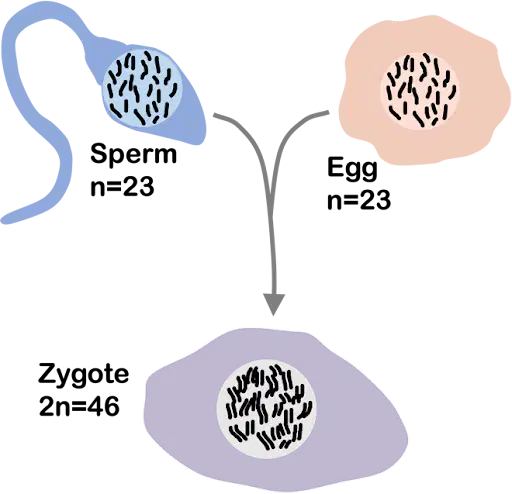
19. In the year 2125, advanced genetic screening reveals a mutation in the BRCA1 gene that increases cancer risk in humans. With futuristic reproductive technologies, this mutation can still be inherited by offspring even if only one parent carries it. Which statement best explains why this germ cell mutation has such significant consequences for families in this era?
Gene mutations in BRCA1 cannot be inherited because they occur after birth
Somatic mutations in BRCA1 are more dangerous because they spread through the bloodstream
Germ cell mutations only affect skin cells and are visible at birth
Germ cell mutations occur in reproductive cells and are passed to every offspring, affecting multiple generations

20. In the year 2050, a patient living in a smart city is diagnosed with cystic fibrosis due to a mutation in the CFTR gene, resulting in a misfolded protein. Advanced gene therapy drones are now able to deliver a functional copy of the gene directly to affected cells. Which statement best explains the advantage of this futuristic approach over treating only the symptoms?
Gene therapy is faster than symptom management but does not actually fix the underlying problem
Gene therapy addresses the root cause of the disease by providing functional protein, potentially preventing disease progression
Gene therapy only works for somatic mutations and cannot treat inherited disorders
Gene therapy eliminates the need for any other medical treatment permanently

21. In a futuristic biotech laboratory, scientists are engineering crops to thrive on Mars. They use restriction enzymes to cut DNA at specific recognition sequences. Why are these enzymes essential tools in this advanced genetic engineering process?
They prevent bacteria from accepting plasmids during transformation
They prevent all mutations from occurring in organisms
They allow scientists to precisely cut and isolate specific genes for insertion into other organisms or vectors
They repair damaged DNA by removing mutated sections
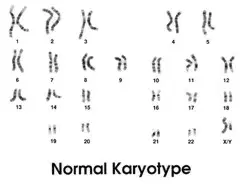
22. In the year 2125, a geneticist aboard a space colony analyzes a digital karyotype using advanced AI and observes 47 chromosomes with three copies of chromosome 21 in a newborn. Reviewing the child's medical records, she notes developmental delays and characteristic facial features. Based on this futuristic scenario, which conclusion is most scientifically justified?
The patient has Edwards syndrome, which involves trisomy of chromosome 18
The patient has Turner syndrome caused by nondisjunction during meiosis II only
The patient has Klinefelter syndrome, which always produces three sex chromosomes
The patient has Down syndrome resulting from nondisjunction during meiosis, likely in the maternal egg cell
23. In a futuristic bioengineering lab, scientists are programming synthetic organisms using advanced genetic codons. A silent mutation occurs in the third position of a codon that codes for leucine in one of these organisms. Which explanation best describes why this mutation does NOT result in a change to the organism's protein?
The genetic code is degenerate, meaning multiple codons code for the same amino acid, so the protein sequence remains unchanged
The mutation prevents transcription from occurring
The ribosome skips codons with mutations during translation
Silent mutations only occur in non-coding DNA regions
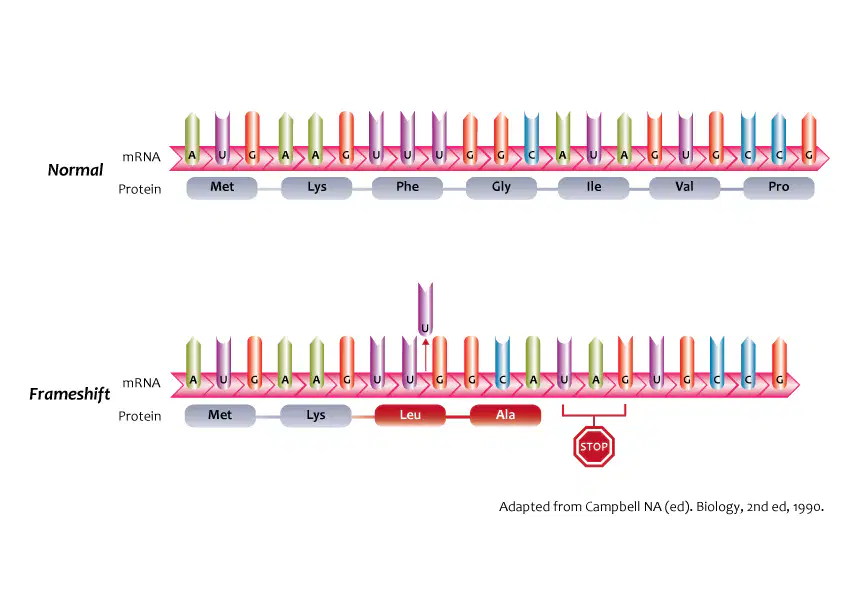
24. In a futuristic bioengineering lab, scientists are programming synthetic organisms using digital DNA sequences. During the process, a single nucleotide is accidentally inserted into the code. Why is this type of mutation typically more damaging to the organism's function than a point substitution?
Frameshift mutations only affect the first codon of a gene
Frameshift mutations shift the reading frame for all downstream codons, potentially changing many amino acids and creating nonfunctional proteins
Frameshift mutations always create stop codons immediately
Frameshift mutations are actually less damaging because they only change one amino acid

25. In the year 2085, a forensic scientist uses advanced DNA analysis at a crime scene to match genetic material to a suspect. Why is DNA fingerprinting still considered more reliable than comparing entire DNA sequences, even with futuristic technology?
DNA fingerprinting requires less time because it only looks at a few genes instead of all genes
DNA fingerprinting can identify mutations that other methods cannot detect
DNA fingerprinting is cheaper because it uses older technology
DNA fingerprinting analyzes only the most variable regions of DNA, making matches more distinctive between individuals

26. In the year 2125, advanced DNA identification is used at spaceports to verify travelers' identities. Even though two individuals share 99.9% of their DNA sequence, why can futuristic DNA fingerprinting technology still distinguish between them?
DNA fingerprinting focuses on repetitive sequences and short tandem repeats that vary greatly between individuals
DNA fingerprinting ignores the 99.9% similarity and only examines unique genes
The fingerprinting process amplifies mutations that occur in coding regions
The 0.1% difference is located in non-coding regions that are highly variable

27. In the year 2050, scientists introduce a synthetic plasmid into a colony of bacteria on a space station. This plasmid contains a gene for a futuristic medicine developed from human DNA. The bacteria then manufacture the medicine, which is harvested to treat astronauts' health conditions during long-term space missions. This process demonstrates which concept?
Somatic mutation in bacterial DNA
Creation of a transgenic organism that produces a protein from another species
Natural selection occurring in bacteria
Nondisjunction in prokaryotic cells

28. In a futuristic city where food is grown in climate-controlled skyscrapers, scientists have engineered a tomato plant with a gene from a fish that produces antifreeze protein. What is the primary advantage of this genetic modification?
The tomato will taste more like fish
The tomato will require less water from the soil
The tomato can survive in freezing temperatures without cell damage
The tomato will grow faster than normal tomatoes
In the year 2125, scientists are engineering a transgenic organism for interplanetary agriculture by inserting genes from multiple alien species. Why might this process be more challenging than inserting a single foreign gene?
Multiple genes require more DNA to be inserted, which is physically impossible
Multiple genes cannot be inserted into the same organism because they will reject each other
Different genes may interfere with each other or disrupt normal cellular processes, and their expression levels must be carefully balanced
Multiple genes will cause the organism to develop multiple new traits simultaneously

30. In the year 2125, a space explorer discovers a tiny sample of alien DNA on Mars and needs to produce large quantities of a specific sequence for analysis and potential bioengineering. Which futuristic technique would be most appropriate and why?
CRISPR, because it can cut and copy DNA sequences
Gel electrophoresis, because it separates DNA by size
DNA fingerprinting, because it can identify the sequence quickly
PCR (Polymerase Chain Reaction), because it exponentially amplifies specific DNA sequences through repeated cycles of heating and cooling
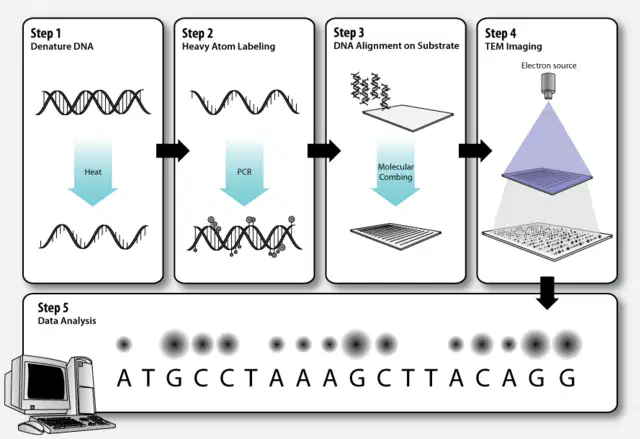
31. In a futuristic DNA analysis lab, scientists use advanced PCR machines to prepare genetic samples for rapid sequencing. During the initial step, the temperature is raised to 94-95°C. What is the purpose of this high temperature in the process?
To activate the DNA polymerase enzyme
To allow primers to bind to the target DNA
To denature (separate) the double-stranded DNA into single strands
To kill any bacteria that might contaminate the sample

32. In the year 2050, genetic engineers use CRISPR-Cas9 as a tool to edit human DNA to cure diseases and enhance abilities. CRISPR-Cas9 is often described as 'molecular scissors.' Why is this metaphor both accurate and incomplete in the context of futuristic gene editing clinics?
It is accurate for bacteria but not for human cells
It is accurate because CRISPR only cuts DNA, and that is all it does
It is incomplete because CRISPR cannot actually cut DNA precisely
It is accurate because CRISPR cuts DNA, but incomplete because CRISPR can also insert new genetic material at the cut site

33. In the year 2050, a doctor uses advanced CRISPR technology to edit a gene in a patient's somatic cells to cure a rare genetic disorder. Despite the futuristic treatment, why will the patient's children NOT inherit the edited gene?
Somatic cell edits are too powerful and would harm the children
The children's cells will automatically repair the CRISPR edits
CRISPR edits are always temporary and fade over time
Somatic cells are not involved in reproduction, so the edited genes are not present in sperm or egg cells
In the year 2124, humans have colonized Mars and rely on advanced DNA repair enzymes to survive the planet's intense UV radiation. A mutation occurs in a gene coding for one of these DNA repair enzymes. How might this mutation affect a Martian colonist's ability to survive exposure to UV radiation?
UV radiation would have no effect because the mutation is in a repair gene, not a structural gene
The colonist would develop a tan more quickly
The colonist would be more resistant to UV damage because the mutation creates a stronger enzyme
The colonist would be more vulnerable to UV damage because it cannot efficiently repair UV-induced DNA damage
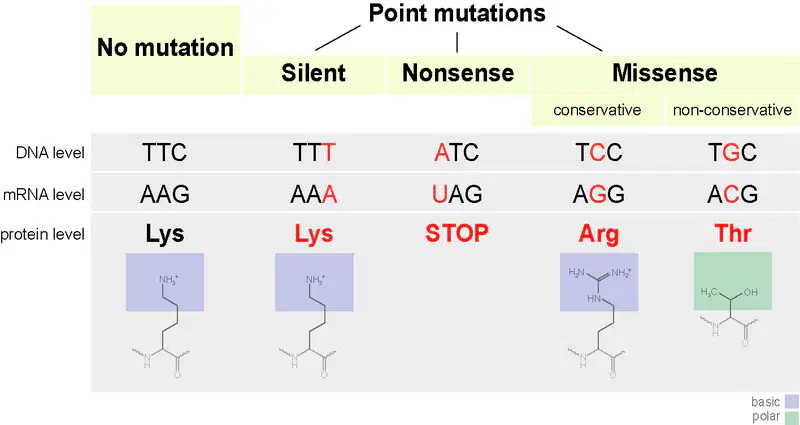
In the year 2125, scientists are engineering synthetic organisms to survive on Mars. During a routine genetic scan, a point mutation is detected: a codon in the organism's DNA changes from GAA to GUA, resulting in the replacement of glutamic acid with valine in a crucial protein. What type of mutation is this, and why might it be significant for the organism's survival in the Martian environment?
A nonsense mutation that creates a stop codon
A silent mutation that has no effect on the protein
A frameshift mutation that affects all downstream amino acids
A missense mutation that changes the amino acid; significance depends on the protein's function and the location of the change

36. In the year 2125, advanced genetic screening reveals a high frequency of a point mutation in the hemoglobin gene among inhabitants of Neo-Africa, a region where malaria outbreaks still occur despite futuristic medicine. What evolutionary explanation best accounts for the persistence of this mutation in the population?
The mutation is beneficial and has been selected for by natural selection
The mutation has no effect on fitness in Neo-African populations
Individuals heterozygous for the sickle cell mutation have increased resistance to malaria, providing a survival advantage in malaria-endemic regions
Neo-African populations have different DNA repair mechanisms that cause more mutations

37. In the year 2050, farmers are cultivating a new generation of transgenic crops that produce their own advanced pesticides to combat evolving insect threats. What is a potential ecological consequence of the widespread use of these futuristic crops?
The pesticide will only affect the target pest species and no other organisms
Insects will evolve resistance to the pesticide over time, reducing the crop's effectiveness
The crop will become more nutritious for human consumption
Soil bacteria will be unable to decompose the crop residue
In the year 2100, scientists on a lunar base use gene editing to create crops that can withstand extreme temperature fluctuations. Which genetic technique would most likely be used to insert a temperature-resistance gene into the plant genome?
Protein synthesis
Gel electrophoresis
Restriction enzyme digestion followed by ligation
DNA fingerprinting
In a futuristic hospital, doctors use personalized gene therapy to treat inherited disorders. If a mutation is found in a patient's somatic cells but not in their germ cells, what is the most likely outcome for the patient's future children?
The children will inherit the mutation
The mutation will be present in all cells of the children
The mutation will skip one generation
The children will not inherit the mutation
In the year 2150, researchers develop a new method to rapidly amplify alien DNA sequences for analysis. Which process is most similar to this technique in current biotechnology?
Transcription
PCR (Polymerase Chain Reaction)
Translation
DNA sequencing

