
 Worksheets
Honors Biology Midterm Review2025
Total questions: 100
Worksheet time: 50mins
Name
Class
Date
1.
Organisms that obtain food by consuming other living things are _________________
a)
autotroph
b)
heterotroph
c)
omnivore
d)
primary producer
2.
Requires oxygen and produces the most ATP
a)
Glycolysis
b)
Krebs Cycle
c)
Electron Transport Chain
d)
Fermentation
e)
NAD⁺
3.
Electron carrier that becomes NADH
a)
Glycolysis
b)
Krebs Cycle
c)
Electron Transport Chain
d)
Fermentation
e)
NAD⁺
4.
All of the following are problems that growth causes for cells EXCEPT
a)
more demands on DNA.
b)
excess oxygen.
c)
obtaining enough food.
d)
expelling wastes.
5.
An advantage of sexual reproduction over asexual reproduction is that sexual reproduction
a)
takes less time
b)
requires more time
c)
provides genetic diversity
d)
produces identical offspring
6.
Which is an advantage of having a cell’s DNA bundled into chromosomes.
a)
During DNA replication, the number of chromosomes is cut in half.
b)
During DNA replication, the number of chromosomes stays the same.
c)
During cell division, each daughter cell will get the same number of genes.
d)
During cell division, each daughter cell will get a random number of genes.
7.
Which of the following represents the phases of mitosis in their proper sequence?
a)
prophase, metaphase, anaphase, telophase
b)
interphase, prophase, metaphase, anaphase, telophase
c)
interphase, prophase, metaphase, telophase
d)
prophase, anaphase, metaphase, telophase
8.
During normal mitotic cell division, a parent cell that has four chromosomes will produce two daughter cells, each containing
a)
two chromosomes.
b)
four chromosomes.
c)
eight chromosomes.
d)
sixteen chromosomes.
9.
When cells are grown in a laboratory, which of the following is a factor that can stop normal cells from dividing?
a)
contact with other cells
b)
growth factors
c)
a cut in the skin
d)
injection of cyclin
10.
Which of the following explains why normal cells grown in a petri dish tend to stop growing once they have covered the bottom of the dish?
a)
The cells lack cyclin.
b)
The petri dish inhibits cell growth.
c)
Contact with other cells stops cell growth.
d)
Most cells grown in petri dishes have a defective p53.
11.
Cancer is a disorder in which some cells have lost the ability to control their
a)
size.
b)
spindle fibers.
c)
growth rate.
d)
surface area.
12.
Surface area tends to grow faster than volume.
a)
True
b)
False
13.
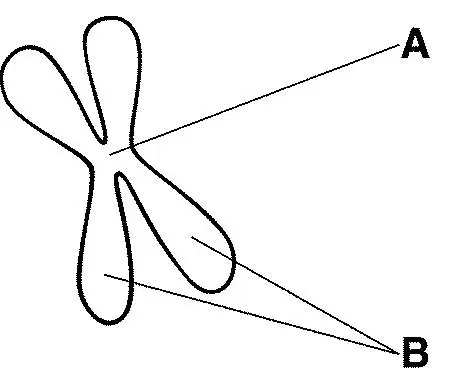
The structure shown in Figure 10–5 is a replicated chromosome.
a)
True
b)
False
14.
Typically, the longest phase of mitosis is metaphase.
a)
True
b)
False
15.
A single-celled organism would not be expected to undergo cell differentiation.
a)
True
b)
False
16.
Stem cells taken from embryos are totipotent.
a)
True
b)
False
17.
During ____________________ reproduction, cells can produce genetically different offspring.
a)
apoptosis
b)
differentiation
c)
sexual
d)
asexual
e)
embryonic
18.
During ____________________ reproduction, cells produce genetically identical offspring.
a)
differentiation
b)
sexual
c)
asexual
d)
embryonic
19.
Adult stem cells are referred to as ______________ and can only develop into limited types of cells.
a)
embryonic
b)
adult
c)
totipotent
d)
multipotent
20.
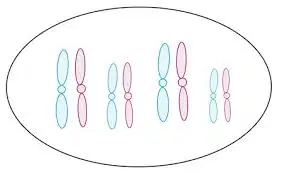
This is a somatic cell directly after cytokinesis, what is the diploid number of this organism.
a)
4
b)
8
c)
2
d)
16
21.
A zygote is referred to as _____________ because it has the ability to become any cell in the body.
a)
asexual
b)
embryonic
c)
totipotent
d)
multipotent
22.
First stage of cellular respiration, in cytoplasm
a)
Glycolysis
b)
Krebs Cycle
c)
Electron Transport Chain
d)
Fermentation
e)
NAD⁺
23.
Anaerobic pathway that allows glycolysis to continue
a)
Glycolysis
b)
Krebs Cycle
c)
Electron Transport Chain
d)
Fermentation
e)
NAD⁺
24.
Occurs in the mitochondrial matrix; produces CO₂ and NADH
a)
Glycolysis
b)
Krebs Cycle
c)
Electron Transport Chain
d)
Fermentation
e)
NAD⁺
25.
Which of the following correctly summarizes cellular respiration?
a)
CO₂ + H₂O → C₆H₁₂O₆ + O₂
b)
C₆H₁₂O₆ + O₂ → CO₂ + H₂O + energy (ATP)
c)
C₆H₁₂O₆ → lactic acid + ATP
d)
ADP + P → ATP + O₂
26.
One molecule of glucose produces a net total of approximately how many ATP after aerobic respiration?
a)
2
b)
18
c)
36
d)
90
27.
The final electron acceptor in the electron transport chain is:
a)
CO₂
b)
NAD⁺
c)
O₂
d)
FAD
28.
Which of the following is a product of glycolysis?
a)
Glucose
b)
Oxygen
c)
Pyruvic acid
d)
Citric acid
29.
The amount of energy needed to raise the temperature of 1 gram of water 1 degree Celsius.
a)
oxygen
b)
calorie
c)
energry
d)
aerobic
30.
Pathways of cellular respiration that REQUIRE oxygen are said to be _____________.
a)
anaerobic
b)
aerobic
c)
cardiovascular
d)
respiration
31.
During vigorous exercise, muscle cells switch to lactic acid fermentation because:
a)
They have too much oxygen.
b)
They lack glucose.
c)
Oxygen levels are low and glycolysis must continue.
d)
They need to produce CO₂.
32.
The first stage of Cellular Respiration is _________________.
a)
Electron Transport Chain
b)
Krebs Cycle
c)
Glycolysis
d)
Photosynthesis
33.
Refers to the process that releases energy from food in the presence of oxygen.
a)
cellular respiration
b)
calorie intake
c)
electron transport
d)
krebs cycle
34.
The bulk of energy comes from the final stage of cellular respiration called ________________.
a)
glycolysis
b)
krebs cycle
c)
electron transport chain
d)
aerobic
35.
Proteins and Carbs contain 4 calories per gram while Fats contains ____ calories per gram.
a)
4
b)
2
c)
15
d)
9
36.
Glycolysis occurs in the ____________________.
a)
mitochondria
b)
chloroplast
c)
cytoplasm
d)
nucleus
37.
Photosynthesis needs sunlight, water, and ______________.
a)
carbon dioxide
b)
oxygen
c)
glucose
d)
hydrogen
38.
Plants gather the sun’s energy with light-absorbing molecules called ______________
a)
pigments
b)
grana
c)
stroma
d)
chloroplasts
39.
_______________ is the fluid-like substance inside of the chloroplast.
a)
pigment
b)
grana
c)
stroma
d)
chloroplasts
40.
Thylakoids are arranged in stacks called ______________.
a)
pigment
b)
grana
c)
stroma
d)
chloroplasts
41.
________________ are saclike photosynthetic membranes inside chloroplasts.
a)
grana
b)
stroma
c)
thykloids
d)
pigment
42.
The overall equation for photosynthesis is _____________________.
a)
6 CO2 + 6 H2O = C6H12O6 + 6 O2
b)
CO2 + H2O = CHO + O2
c)
C6H12O6 + 6 O2 = 6 CO2 + 6 H2O
d)
H3CO2 + O2 + 6CO2 + H20
43.
Light ____________ reactions involve adding a hydrogen ion and 2 high-energy electrons to NADP.
a)
independent
b)
dependent
c)
oxygen
d)
water
44.
What is the principal pigment in plants?
a)
chloroplasts
b)
chlorophyll
c)
stroma
d)
thykaloids
45.
Cells keep only a __________ amount of ATP.
a)
moderate
b)
small
c)
large
d)
endless
46.
___________ refers to a stack of thylakoids
a)
grana
b)
chloroplasts
c)
ATP
d)
ADP
47.
During a light dependent reaction ____________ is released as a byproduct.
a)
carbon dioxide
b)
water
c)
oxygen
d)
pigments
48.
Why do plants look green?
a)
It's their favorite color
b)
Their leaves reflect green light.
c)
Their leaves absorb green light.
d)
Their leaves reflect orange light.
49.
How is ADP different from ATP?
a)
ADP is a compound that looks almost like ATP, except it has 2 phosphate groups instead of 3
b)
ADP is a compound that looks almost like ATP, except it has 3 phosphate groups instead of 2
c)
They both have the 3 phosphate groups
d)
ATP is a compound that looks almost like ADP, except it has 2 phosphate groups instead of 3
50.
__________ is converted from NADP when a hydrogen ion and 2 high-energy electrons are added.
a)
NADP
b)
oxygen
c)
NADPH
d)
glucose
51.
___________ is a carrier molecule that accepts and holds 2 high energy electrons, along with a hydrogen ion to convert into NADPH
a)
NADPH
b)
oxygen
c)
NADP
d)
glucose
52.
Which of these is NOT true of cells?
a)
They are much like empty rooms.
b)
They were first discovered in the 1600s.
c)
They can be found in pond water.
d)
They contain an array of working organelles.
53.
Which of the following enclose their DNA in a nucleus?
a)
prokaryotes
b)
bacteria
c)
eukaryotes
d)
viruses
54.
Not all cells are alike. Which of the following is NOT a true statement about differences between cells?
a)
Cells come in many different shapes.
b)
Different kinds of cells are different sizes.
c)
Some cells have a nucleus, but others do not.
d)
Most cells have a membrane, but some do not.
55.
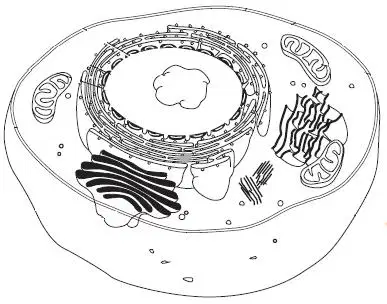
Which of the following conclusions could you draw about the cell shown in Figure 7–1?
a)
The cell is eukaryotic because it has a nucleus.
b)
The cell is prokaryotic because it has a nucleus.
c)
The cell is eukaryotic because it does not have a nucleus.
d)
The cell is prokaryotic because it does not have a nucleus.
56.
Which structure makes proteins using coded instructions that come from the nucleus?
a)
Golgi apparatus
b)
mitochondrion
c)
vacuole
d)
ribosome
57.
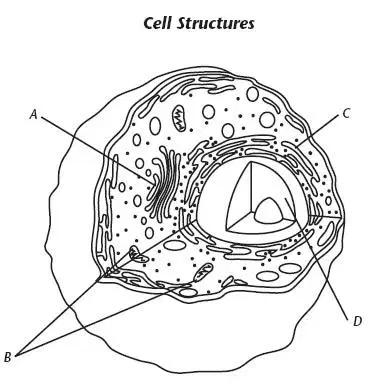
Which structure in the cell shown in Figure 7–3 above modifies, sorts, and packages proteins and other materials for storage or release from the cell?
a)
structure A
b)
structure B
c)
structure C
d)
structure D
58.
Which organelles are involved in energy conversion?
a)
mitochondria and chloroplasts
b)
mitochondria and ribosomes
c)
smooth and rough endoplasmic reticulum
d)
Golgi apparatus and chloroplasts
59.
An animal cell that is surrounded by fresh water will burst because the osmotic pressure causes
a)
water to move into the cell.
b)
water to move out of the cell.
c)
solutes to move into the cell.
d)
solutes to move out of the cell.
60.
Which means of particle transport requires input of energy from the cell?
a)
diffusion
b)
osmosis
c)
facilitated diffusion
d)
active transport
61.
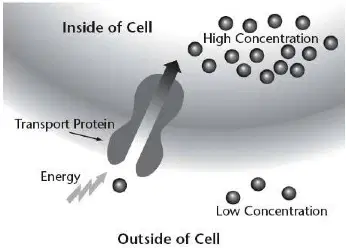
Which means of particle transport is shown in Figure 7–4 above?�
a)
diffusion
b)
osmosis
c)
facilitated diffusion
d)
active transport
62.
Plant cells have chloroplasts but not mitochondria.
a)
True
b)
False
63.
Which statement best describes the difference between passive and active transport?
a)
Passive transport moves molecules from low to high concentration without energy.
b)
Active transport moves molecules from high to low concentration using energy.
c)
Passive transport moves molecules from high to low concentration without energy.
d)
Active transport moves molecules from low to high concentration without energy.
64.
Facilitated diffusion differs from simple diffusion because it:
a)
Requires energy from ATP
b)
Uses protein channels to move molecules
c)
Moves molecules against the concentration gradient
d)
Occurs only in plant cells
65.
Why do hospitals give patients an isotonic saline IV solution instead of pure water?
a)
Pure water would cause red blood cells to shrink.
b)
Pure water would cause red blood cells to swell and burst.
c)
Isotonic saline provides extra nutrients.
d)
Isotonic saline is used to increase blood sugar levels.
66.
A cell placed in a hypertonic Solution will
a)
swell
b)
begin transcription
c)
shrink
d)
remain at equilibrium
67.
A cell placed in a hypotonic environment will
a)
Shrink
b)
Swell
c)
remain at equilibrium
d)
begin transcription
68.
A cell placed in a isotonic environment will
a)
shrink
b)
swell
c)
remain at equilibrium
d)
begin transcription
69.
Which of the following is NOT a goal of science?
a)
to investigate and understand the natural world
b)
to explain events in the natural world
c)
to establish a collection of unchanging truths
d)
to use derived explanations to make useful predictions
70.
Scientists will never know for sure why dinosaurs became extinct. Therefore, scientists should
a)
stop studying dinosaurs and study only living animals.
b)
work to raise live dinosaurs to study.
c)
continue to learn as much as they can about dinosaur extinction.
d)
accept the current theory about dinosaur extinction as the best possible theory.
71.
Science is best described as a
a)
set of facts.
b)
way of knowing.
c)
collection of beliefs.
d)
list of rules.
72.
The work of scientists usually begins with
a)
testing a hypothesis.
b)
careful observations.
c)
creating experiments.
d)
drawing conclusions.
73.
A scientific hypothesis
a)
can be based on personal beliefs or opinions.
b)
can be tested by experiments or observations.
c)
does not have to be tested to be accepted as correct.
d)
is a proven fact with much evidence to support it.
74.
During a controlled experiment, a scientist isolates and tests
a)
a conclusion.
b)
a mass of information.
c)
a control group.
d)
a single variable.
75.
Who reviews articles for peer-reviewed journals?
a)
friends of the scientists who wrote the articles
b)
anonymous and independent experts
c)
the scientists who did the experiments
d)
people who paid for the experiments
76.
A theory
a)
is always true.
b)
is the opening statement of an experiment.
c)
may be revised or replaced.
d)
is a problem to be solved.
77.
A personal preference or point of view is
a)
a bias.
b)
a theory.
c)
a hypothesis.
d)
an inference.
78.
Cells in multicellular organisms have many different sizes and shapes. These differences in cells is called cell specialization. Cell specialization allows cells to
a)
reproduce.
b)
perform different functions.
c)
respond to their environment.
d)
be less complex.
79.
The process by which organisms keep everything inside their bodies within certain limits is called
a)
homeostasis.
b)
evolution.
c)
metabolism.
d)
photosynthesis.
80.
A scientist working in which area of biology is MOST likely to study DNA?
a)
information and heredity
b)
cellular basis of life
c)
matter and energy
d)
interdependence in nature
81.
What are the smallest objects that biologists study?
a)
cells
b)
body organs
c)
molecules
d)
organisms
82.
How do scientific theories compare to hypotheses?
a)
Theories are the same as hypotheses.
b)
Theories unify a broad range of observations and hypotheses.
c)
Hypotheses combine the ideas of several theories to explain events.
d)
Hypotheses are the dominant view among scientists.
83.
An important goal of a scientist is to use evidence to learn about the natural world.
a)
True
b)
False
84.
Biologists study life on all levels from molecules to the entire planet.
a)
True
b)
False
85.
Which of the following is NOT one of the four main types of macromolecules?
a)
Proteins
b)
Lipids
c)
Water
d)
Carbohydrates
86.
Which process converts light energy into chemical energy?
a)
Respiration
b)
Chemosynthesis
c)
Biosynthesis
d)
photosynthesis
87.
Which macromolecule is used primarily for storing genetic information?
a)
Proteins
b)
Lipids
c)
Carbohydrates
d)
Nucleic acids
88.
ATP is known for its role in:
a)
Building proteins
b)
Storing genetic information
c)
Storing and releasing energy
d)
Insulating the body
89.
Which of the following is true about enzymes?
a)
They are made of lipids
b)
They speed up chemical reactions
c)
They are a type of carbohydrate
d)
They cannot be reused
90.
Which protein function is represented by hemoglobin?
a)
Storage
b)
Regulatory
c)
Transport
d)
Structural
91.
Which macromolecule is most important for building cell membranes and providing insulation?
a)
Proteins
b)
Lipids
c)
Carbohydrates
d)
Nucleic acids
92.
Which macromolecule helps maintain and build muscle tissue?
a)
Carbohydrates
b)
Proteins
c)
Lipids
d)
Nucleic acids
93.
The process of respiration primarily involves breaking down:
a)
Lipids
b)
Proteins
c)
Carbohydrates
d)
Nucleic acids
94.
Which type of feedback mechanism amplifies a change in the body?
a)
Positive feedback
b)
Negative feedback
c)
Neutral feedback
d)
Chemical feedback
95.
Which of the following proteins is involved in movement?
a)
Albumin
b)
Hemoglobin
c)
Myosin
d)
Amylase
96.
Most cells function best at a neutral pH (around 7)
a)
True
b)
False
97.
Enzymes lower the activation energy required for chemical reactions.
a)
True
b)
False
98.
Negative feedback counteracts changes to help maintain homeostasis
a)
True
b)
False
99.
Temperature can irreversibly change protein structure if it is too high.
a)
True
b)
False
100.
Biological catalysts
a)
Enzymes
b)
ATP
c)
Lipids
d)
Starch
e)
DNA
100 %

