
 Worksheets
US II Final
Total questions: 100
Worksheet time: 50mins
Name
Class
Date
1.
Republicans in the late 1800s argued that high tariffs (import taxes) would
a)
allow American Industries to grow because more people would buy American goods
b)
lead to a loss of manufacturing jobs
c)
increase the costs of consumer goods
d)
make it harder for farmers to sell products abroad
2.
Naturalist novels such as Upton Sinclair's "The Jungle"
a)
defended the efficiency of big business
b)
argued for the establishment of national parks and forests
c)
honestly portrayed human misery and the struggles of common people
d)
encouraged social reform based on the teachings of the Bible
3.
What social problem did Upton Sinclair’s novel The Jungle describe?
a)
the struggles of black Americans
b)
the living and working conditions in Chicago’s stockyards and meat packing plants
c)
the ruthless business methods of John D. Rockefeller and Standard Oil
d)
the conflict between California farmers and the Southern Pacific Railroad
4.
Which reform resulted from the fire at the Triangle Shirtwaist Factory?
a)
a ban on child labor
b)
antitrust legislation
c)
workers’ compensation laws and worker's safety regulations
d)
the spread of settlement houses
5.
Industrial workers in the late 1800s often labored
a)
for high wages.
b)
under ideal conditions.
c)
with unsafe machinery in dangerous factories.
d)
in well-ventilated factories with safe equipment.
6.
Which reform did the Nineteenth Amendment enact?
a)
temperance laws
b)
women’s suffrage
c)
a ban on child labor
d)
African American men’s suffrage
7.
The efforts of the Women’s Christian Temperance Union eventually led to which change?
a)
suffrage
b)
prohibition
c)
workplace reform
d)
minimum wage
8.
What was the name of John D. Rockefeller's Oil Monopoly?
a)
Big Oil
b)
Standard Oil
c)
Petrol King
d)
American Petroleum
9.
Which influential banker owned many massive companies including General Electric and US Steel?
a)
Cornelius Vanderbilt
b)
Andrew Carnegie
c)
John Rockefeller
d)
J.P. Morgan
10.
Why did United States Navy Commodore George Dewey lead an attack on ships in the Manila Bay during the Spanish-American War?
a)
Manila Bay was ruled by Spain, and the ships belonged to the Spanish.
b)
The United States used the war with Spain as an excuse to take over other territories.
c)
Dewey wanted to attack Spain and gain control over Cuba.
d)
The Philippines joined the war in support of Spain.
11.
The “Rough Riders” were
a)
Cuban revolutionaries who battled the Spanish for independence.
b)
a volunteer cavalry unit in the Spanish-American War.
c)
newspaper owners who influenced public opinion by exaggerating the truth.
d)
Spanish generals in Cuba who mistreated the civilian population.
12.
Unlike Britain, France, and Russia, the United States
a)
controlled large areas of China.
b)
wanted to keep trade in China open.
c)
had no interest in trade with China.
d)
broke China into distinct spheres of influence.
13.
President Teddy Roosevelt sent troops to support Panamanian rebels in the fight against Colombia so that
a)
the Colombians would grant the United States the right to build a canal.
b)
Panamanians could be free from Colombian imperialism.
c)
the United States could get the rights to build a canal in Panama at a lower price.
d)
the Panamanians could build a canal from the Atlantic Ocean to the Pacific Ocean.
14.
What new relationship with Hawaii did Congress approve in 1898?
a)
independence
b)
statehood
c)
secession
d)
annexation
15.
Social Darwinism is the theory that
a)
only countries with colonies can compete in the world market.
b)
life consists of competitive struggles in which only the strong survive.
c)
the American frontier stopped people from rebelling in the United States.
d)
the United States should expand its territory from the Atlantic and the Pacific oceans.
16.
The 1898 Treaty of Paris gave the US possession of which territories?
a)
Cuba
b)
Cuba and Puerto Rico
c)
Puerto Rico, the Philippines, and Guam
d)
Cuba, Puerto Rico, Hawaii, the Philippines, and other former Spanish territories
17.
Roosevelt’s “big stick” diplomacy
a)
depended on a strong military to achieve America’s goals.
b)
aimed to increase American investment in business and banks throughout Central America and the Caribbean.
c)
sought to conserve forests for lumber supplies for the military.
d)
worked to promote human rights, national integrity, and opportunity around the world.
18.
In 1914 the Central Power nations were
a)
France, Russia, and Great Britain.
b)
Great Britain, France, and the United States.
c)
Germany, and Austria-Hungary
d)
Russia, Germany, and Austria-Hungary.
19.
The sinking of the Lusitania was one reason the US entered WWI. What was the other major reason?
a)
Germany attempted to assassinated the US president
b)
Great Britain offered to pay the US
c)
Austria attacked the American fleet in the Pacific
d)
Germany sent a message called the Zimmerman Note to Mexica asking them to attack the US
20.
The League of Nations can best be described as a
a)
peace treaty.
b)
secret alliance.
c)
division of territory.
d)
a weak mutual defense agreement.
21.
What new weapons made WWI so deadly compared to previous wars?
a)
Machine Guns
b)
Poison Gas
c)
Tanks
d)
All of the above
22.
What did Wilson hope to accomplish with the League of Nations?
a)
He hoped to create a world organization where countries could gather and resolve their quarrels peacefully.
b)
He wanted the League of Nations to afford people the right to choose their own form of government.
c)
He proposed the League of Nations could insist that Germany pay reparations to the countries it damaged during the war.
d)
He believed the League of Nations could prevent freedom of the seas and free trade.
23.
What international event led to the first Red Scare?
a)
a murder in Italy
b)
an election in Britain
c)
a revolution in Russia
d)
an epidemic in Germany
24.
As the 1920s progressed, farm incomes
a)
declined.
b)
increased more rapidly than did incomes in urban areas.
c)
increased, but did so less rapidly than did urban incomes.
d)
remained steady.
25.
African Americans in the 1920s faced discrimination, especially in
a)
the North, where they were not allowed to work.
b)
the North, where the Jim Crow laws were in effect.
c)
the South, where the Jim Crow laws were in effect.
d)
the South, where they were not allowed to work.
26.
How did Prohibition contribute to the growth of organized crime?
a)
by forcing police to enforce anti-liquor laws
b)
by making it easier for bootleggers to branch into other types of illegal activity
c)
by forcing farmers to grow grain for the production of alcohol
d)
by strengthening respect for the law
27.
In 1933, Congress repealed Prohibition with the
a)
Eighteenth Amendment.
b)
Nineteenth Amendment.
c)
Twentieth Amendment.
d)
Twenty-first Amendment.
28.
What was a major result of Henry Ford’s innovative manufacturing techniques?
a)
The sale price of the average car increased.
b)
The sale price of cars went down.
c)
More Americans bought cars from overseas.
d)
Fewer Americans had jobs.
29.
The demand for automobiles in the 1920s
a)
stimulated growth in many other industries.
b)
led to a nationwide recession.
c)
closed down the steel industry.
d)
brought about the collapse of the suburbs.
30.
Buying stock on margin remained profitable as long as
a)
stock prices fell.
b)
buyers did not take out loans.
c)
stock prices rose.
d)
buyers did not acquire collateral.
31.
In the 1920s under President Coolidge, the national economy
a)
leveled off.
b)
declined slightly.
c)
stagnated.
d)
boomed.
32.
At its heart, the Scopes Trial was a clash between
a)
biology and science.
b)
education and science.
c)
evolution and science.
d)
religion and science.
33.
How was Henry Ford able to reduce the sale price of the Model T?
a)
The location of Ford’s plant gave him easy access to resources and allowed him to reduce the price.
b)
He studied the techniques of Chicago meatpacking houses and used their same processes.
c)
Ford kept his workers happy by paying them well and giving them a 40-hour work week.
d)
Ford put his cars on moving assembly lines and reduced the time it took to make a car.
34.
The American movie industry was controlled by a handful of huge studios in
a)
New York City.
b)
Washington, D.C.
c)
London, England.
d)
Hollywood, California.
35.
The literature of the Harlem Renaissance
a)
explored the origins of jazz.
b)
explored the pains and joys of being black in America.
c)
is largely forgotten today.
d)
argued for the separation of races.
36.
Who saved baseball in the 1920s?
a)
Lou Gegrig
b)
Babe Ruth
c)
Lefty Grove
d)
Joe Jackson
37.

Who is depicted in this photograph?
a)
women of the Victorian Age
b)
women entering the workforce during the 1920s
c)
New Women known as flappers
d)
none of the above
38.
In 1929, the stock market crashed because
a)
the Federal Reserve increased the money supply.
b)
Germany ceased reparation payments to the United States.
c)
investors lost confidence in the market and rushed to sell their shares.
d)
depositors lost their investments and tried to withdraw all of the savings from banks.
39.

What does this photograph show?
a)
bank closures
b)
a Hooverville
c)
the Dust Bowl
d)
the stock market crash
40.

People likely abandoned this place because
a)
the land could not be farmed.
b)
they had lost their investments.
c)
the banks and businesses had closed.
d)
too many homeless people had moved there.
41.
Which of these factors helped hide economic problems in the 1920s?
a)
Investors lost confidence in the market.
b)
Farmers sold crop surpluses to pay off their debts.
c)
Americans purchased many consumer goods on credit.
d)
Wages increased at the same pace as worker productivity.
42.
Why did the Bonus Army march on Washington, D.C.?
a)
The Federal Reserve refused to pay veterans their bonuses.
b)
General MacArthur attacked protestors demanding their bonuses.
c)
President Hoover vetoed a bill providing for early payment of bonuses.
d)
Congress passed a bill promising to pay veterans their bonuses in 1945.
43.
What did Franklin D. Roosevelt and Congress pass first after FDR’s inauguration?
a)
Federal Deposit Insurance Corporation
b)
Emergency Banking Act
c)
Federal Emergency Relief Act
d)
Agricultural Adjustment Act
44.
Franklin D. Roosevelt created the Securities Exchange Commission (SEC) to
a)
regulate the stock market.
b)
ensure bank deposits.
c)
give banks a chance to organize.
d)
pay farmers to destroy their livestock.
45.
What were the goals of the New Deal?
a)
reform the government and decrease spending
b)
create schools and protect farmers
c)
increase spending on defense and trade
d)
provide relief, recovery, and reform
46.
What did President FDR introduce to help retirees?
a)
Fair Labor Standards Act
b)
Works Progress Administration
c)
Second New Deal
d)
Social Security Act
47.
How many terms was FDR elected as president?
a)
1
b)
2
c)
3
d)
4
48.
What radio drama was so realistic that some people thought aliens were invading Earth?
a)
The Wizard of Oz
b)
The Grapes of Wrath
c)
“War of the Worlds”
d)
“Mr. Smith Goes to Washington”
49.
How did New Deal programs strengthen capitalism?
a)
The FDIC and SEC restored trust in banks and the stock market.
b)
Price supports were set firmly in place for farmers.
c)
A federal pension system gave retirees a way out of poverty.
d)
Unemployment insurance gave workers who lost jobs money to put into the system.
50.
How did the Great Depression eventually change Germany politically?
a)
Germans eventually believed that democracy would solve their economic problems.
b)
Germans eventually believed that Hitler would solve their economic problems.
c)
Thousands of Germans eventually emigrated to communist nations in search of jobs.
d)
It created a stronger German Economy
51.
Which of the following actions did Japan take in an attempt to recover from the Great Depression?
a)
Japan adopted democratic principles.
b)
Japan reduced military spending.
c)
Japan abandoned its constitutional monarchy.
d)
Japan seized control of land and resources in other nations.
52.
The Neutrality Act of 1939 establish "Cash and Carry, which allowed nations at war to buy arms and other supplies from the United States as long as those nations
a)
agreed to keep the United States out of the conflict.
b)
promised not to use the materials against the United States.
c)
paid cash and transported the materials themselves.
d)
adopted democratic policies in their own countries.
53.
What goal did President Roosevelt hope to achieve when he enacted the embargo on naval and aviation supplies such as oil and scrap metal in 1940?
a)
to provoke Japan into war
b)
to stop Japanese expansion
c)
to avoid war with Japan
d)
to appease Japan
54.
Italy and Japan were dissatisfied with the peace settlements provided in the Treaty of Versailles because both countries expected more
a)
financial assistance from the United States and Britain.
b)
guidance in establishing their own democratic governments.
c)
territory in exchange for their sacrifices during World War I.
d)
representation in the League of Nations.
55.
Which political party rose to power in Germany during the 1930s?
a)
the Communist Party
b)
the Nazi Party
c)
the Fascist Party
d)
the Socialist Party
56.
Who appeared to be winning the war in Europe at the end of 1940?
a)
Germany and Italy
b)
the Soviet Union
c)
Britain and France
d)
the United States
57.
The Japanese attacked Pearl Harbor because they wanted to
a)
gain control of the Hawaiian Islands.
b)
destroy ships and planes that threatened their expansion efforts.
c)
provoke the United States into declaring war.
d)
demonstrate their support for Germany and Italy.
58.
On which date was Pearl Harbor attacked?
a)
June 6, 1944
b)
September 11, 2001
c)
December 7, 1941
d)
May, 8 1945
59.
Which ships survived the attack on Pearl Harbor untouched?
a)
battleships
b)
destroyers
c)
light cruisers
d)
aircraft carriers
60.
After declaring war, the United States government
a)
repealed the Neutrality Act of 1939.
b)
enacted a draft because few Americans wanted to fight in the war.
c)
transformed peacetime industries into war industries.
d)
withdrew economic support from Britain because it was no longer needed.
61.
After the United States declared war in 1941, the nation’s economic situation
a)
improved.
b)
worsened.
c)
stalled.
d)
remained unchanged.
62.
How did Adolf Hitler explain the problems facing Germany in his book Mein Kampf?
a)
He stated that the problems were caused by a state-controlled press and state-controlled education system.
b)
He blamed the problems on the Jewish people and the great threat they caused Germany.
c)
He said the existing government caused the problems by forbidding citizens to read books that were “un-German.”
d)
He claimed the problems were caused by the country’s implementation of a secret police.
63.
The Allies adopted a “Europe First” strategy because
a)
Japan’s victory at the Battle of Coral Sea had frustrated Allied objectives.
b)
Germany, Italy, and Japan developed a coordinated strategy for victory.
c)
Italy threatened to conquer from the eastern Adriatic to East Africa.
d)
only Germany was considered a serious long-term threat.
64.
Why did Stalin want Britain and the United States to open a second front in France?
a)
He wanted Germany to divide its troops between two fronts.
b)
Soviet forces were losing ground in Eastern Europe and in the South.
c)
He recalled the slaughter of troops along the Western Front in World War I.
d)
His advisers told him the German U-boat presence in the English Channel was dangerous.
65.
President Truman’s chief priority in using the atomic bomb against Japan was to
a)
become a superpower.
b)
save American lives.
c)
prepare for a U.S. invasion of Japan.
d)
protect the lives of Japanese civilians.
66.
Following the battle of Stalingrad,
a)
German troops continued their blitzkrieg eastward.
b)
Hitler controlled the Caucasus oil fields.
c)
both German and Soviet troops refused to surrender.
d)
Hitler’s plans of dominating Europe had ended.
67.
Which of the following was a result of the Battle of Midway?
a)
Japan lost its powerful navy and fortified positions.
b)
The United States lost many aircraft carriers and aircraft.
c)
The United States was put on the defensive end of the war.
d)
Japan never again threatened Pacific domination and it proved to be the turning point of the war in the Pacific. .
68.
What was one effect of the D-Day invasion?
a)
Japan knew that Germany was out of the war.
b)
Germany could never again attack the Allies.
c)
The Allies took an important step toward reaching Berlin.
d)
Soviet troops stopped pushing toward Germany from the West.
69.
As American forces approached Japan, Japanese forces
a)
won an important victory in the Philippines.
b)
conquered every island the United States held.
c)
surrendered quickly and joined the Allied forces.
d)
fought to the end, preferring to kill themselves rather than surrender.
70.
Who made the decision to use the atomic bomb against Japan?
a)
Franklin D. Roosevelt
b)
Harry S. Truman
c)
Leslie Groves
d)
Enrico Fermi
71.
What was Hitler’s “final solution”?
a)
a plan to exterminate all Jews living in Third Reich-controlled regions
b)
a series of fake experiments conducted on topics such as oxygen deprivation
c)
the construction of walled ghettos in Polish cities to hold “undesirable” groups
d)
a plan to force all “undesirable” groups to become “useful members” of the Third Reich
72.
The largest Nazi death camp was located at
a)
Dachau.
b)
Ravensbruck.
c)
Treblinka.
d)
Auschwitz.
73.
During the 1945 conference in Potsdam,
a)
Churchill replaced Clement Atlee as prime minister of Britain.
b)
Stalin reneged on his pledge to enter the war against Japan in the Pacific.
c)
the Big Three decided that Poland, Bulgaria, and Romania would be independent.
d)
the Big Three formalized the plan to divide Germany into four zones of occupation.
74.
How did women play a major role in the War Effort during WWII?
a)
They fought alongside men
b)
They took many factory jobs building the weapons for war
c)
women played no role in the war
d)
Women were recruited to artillery units in the Pacific
75.
How did Nazis brainwash the German nation to accept complete annihilation of Jews?
a)
Nazis blamed the Jewish people for the rise of communism.
b)
Hitler barred Jews from holding jobs in the civil service and journalism.
c)
State institutions such as schools and newspapers dehumanized Jews.
d)
Hitler created a weekly television program humiliating Jewish people
76.

The United States stockpiled more than 10,000 weapons by 1971. When did the Soviet Union reach the same number of nuclear weapons?
a)
1957
b)
1970
c)
1977
d)
1990
77.

When did both the US and the USSR begin to decline in the weapon stockpiles?
a)
The mid 1950s
b)
the late 1970s
c)
the end of the 1960s
d)
the early 1990s
78.
Who first spoke of the “iron curtain”?
a)
George Kennan
b)
Winston Churchill
c)
Joseph Stalin
d)
Harry Truman
79.
One goal of the Marshall Plan was to
a)
make Germany pay costs for all the destruction it had caused in Europe.
b)
send troops to help European countries fight communism.
c)
make European countries strong enough to start buying American goods.
d)
give Europeans access to higher education in the United States
80.
How did the American public view General MacArthur after President Truman fired him as commander in Korea?
a)
They still saw him as a hero.
b)
They thought he was a traitor.
c)
They were angry that he had miscalculated in the war.
d)
They thought he was too old to still be on active duty.
81.
What happened on September 2, 1949, that caused a sudden change in U.S.-Soviet relations?
a)
North Korea invaded South Korea.
b)
The military alliance known as SEATO was formed.
c)
The Soviet Union set off an atomic bomb.
d)
The Soviet Union launched a satellite into space.
82.
What was one place on the globe where the Cold War was “hot” and U.S. soldiers fought and died?
a)
Hungary
b)
Egypt
c)
Korea
d)
China
83.
Julius and Ethel Rosenberg were charged, convicted, and executed specifically for
a)
being members of the communist party.
b)
violating the Smith Act.
c)
passing secrets about nuclear science to the Soviets.
d)
being subversive and disloyal Americans.
84.
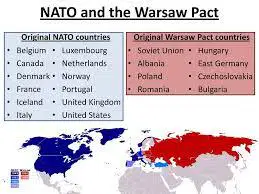
Which two countries were members of NATO?
a)
West Germany and East Germany
b)
Denmark and Hungary
c)
Italy and United Kingdom
d)
United States and Soviet Union
85.

In response to NATO, with whom did the Soviet Union form the Warsaw Pact?
a)
Western European nations
b)
Eastern European nations
c)
North American nations
d)
East Asian nations
86.

What was a result of the Hollywood Ten trial?
a)
Movie executives blacklisted entertainers with alleged communist ties after the hearings.
b)
During the hearings a variety of movies were released dealing with sensitive issues, especially communism.
c)
The Hollywood Ten answered questions regarding their political affiliations and were found innocent.
d)
Hearings were limited to the people in the entertainment industry.
87.
After World War II, the United States economy
a)
entered a severe depression.
b)
stagnated as wartime production fell.
c)
shifted to producing consumer goods.
d)
fluctuated as it withdrew from world markets.
88.
On which issue did President Truman make progress?
a)
civil rights
b)
labor rights
c)
national health insurance
d)
desegregation of the military
89.
Which of these African Americans is famous for breaking into major league baseball?
a)
Jackie Robinson
b)
Ralph Abernathy
c)
Thurgood Marshall
d)
Rosa Parks
90.
Why did Martin Luther King target Birmingham, Alabama for a civil rights campaign?
a)
because of its strong support for civil rights
b)
because it was considered the most segregated city in the South
c)
because President Kennedy had been born there
d)
because it was the only southern city that practiced segregation
91.
What were Jim Crow laws?
a)
They were laws that protected African Americans.
b)
They were laws that restricted African American voting rights in the North.
c)
They were laws that enforced the strict separation of the races.
d)
They were laws that restored equal rights to blacks.
92.
Kennedy prevented completion of missile bases in Cuba by approving a
a)
military invasion.
b)
trade boycott.
c)
diplomatic treaty.
d)
naval blockade.
93.
Which civil rights organization won a number of important court cases against segregation in the 1950s?
a)
SCLC
b)
CORE
c)
MIA
d)
NAACP
94.
To which city did President Eisenhower send federal troops to protect African American students?
a)
Montgomery, Alabama
b)
Little Rock, Arkansas
c)
Topeka, Kansas
d)
Baltimore, Maryland
95.
The Gulf of Tonkin Resolution allowed President Johnson to
a)
send economic aid to South Vietnam.
b)
declare war against North Vietnam without asking Congress.
c)
use the USS Maddox to control the seas around South Vietnam.
d)
take all necessary measures to defend against armed attacks on U.S. forces in Vietnam.
96.
What happened in hundreds of cities immediately after the assassination of Martin Luther King?
a)
Local civil rights demonstrators declared marital law.
b)
There was little reaction to King’s death.
c)
Riots broke out.
d)
Thousands of black citizens registered to vote.
97.
Who signed the Civil Rights Act of 1964?
a)
President Kennedy
b)
President Johnson
c)
President Nixon
d)
President Eisenhower
98.
One possible after effect of being exposed to agent orange was
a)
memory lose
b)
cancer
c)
trench foot
d)
paralysis
99.
In 1969 which NASA mission successfully brought Neil Armstrong and Buzz Aldrin to the moon?
a)
Mercury 7
b)
Friendship 7
c)
Apollo 11
d)
Challenger 1
100.
What event led to the resignation of Richard Nixon?
a)
The Pentagon papers
b)
Watergate
c)
napalm usage in Vietnam
d)
a secret relationship with Marilyn Monroe
100 %

