wayground logo

Free Printable Worksheets

Font size

S
M
L
XL
Worksheets

WWII Mastery Check Review US History 2025

Total questions: 76

Worksheet time: 45mins

Name
Class
Date
1.
The Neutrality Act of 1935
a)
sought to protect America's international trade agreements.
b)
prevented Americans from traveling on ships of warring nations.
c)
did not prevent the United States from intervening when Italy invaded Ethiopia.
d)
was passed by Congress with recent acts of Nazi aggression in mind.
e)
included a mandatory arms embargo of both sides during any military conflict.
2.
The Neutrality Act of 1937
a)
stripped the president of many of his powers as commander-in-chief.
b)
allowed warring nations to purchase nonmilitary goods in the United States if they paid cash
c)
loosened the trade policy for England, while tightening it for Germany and Japan.
d)
banned the sale of all goods from the United States to any nation at war.
3.
In 1929, a fascist-led government was in power in
a)
Germany.
b)
Spain.
c)
Italy.
d)
Japan.
e)
France
4.
Which battle is considered the turning point in the Pacific Theater, where the United States destroyed four Japanese aircraft carriers?
a)
A. Battle of Iwo Jima
b)
B. Battle of Midway
c)
C. Battle of Okinawa
d)
D. Battle of the Coral Sea
5.
The Allied invasion of Normandy, France on June 6, 1944, is commonly known as:
a)
A. V-E Day
b)
B. Operation Overlord
c)
C. D-Day
d)
D. The Battle of the Bulge
6.
What event brought the United States into World War II?
a)
A. The sinking of the Lusitania
b)
B. The German invasion of Poland
c)
C. The Japanese attack on Pearl Harbor
d)
D. The fall of France
7.
The America First Committee
a)
was a powerful lobby against U.S. involvement in the war.
b)
was strongly opposed by both major political parties.
c)
called for increased U.S. assistance to England without any actual intervention.
d)
was made up largely of Democrats who favored diplomacy to end the war.
8.
Which two Japanese cities were targeted by atomic bombs in August 1945?
a)
A. Tokyo and Kyoto
b)
B. Nagasaki and Tokyo
c)
C. Hiroshima and Nagasaki
d)
D. Osaka and Hiroshima
9.
In 1940, the "lend-lease" plan
a)
allowed the U.S. to loan weapons to England, to be returned or paid for when the war was over.
b)
saw England agree to allow jobless Americans to enlist in the British military.
c)
saw England allow the construction of American military bases in British territory.
d)
was extremely controversial and barely passed the Senate.
10.
V-E Day (Victory in Europe Day) marked:
a)
A. The surrender of Japan
b)
B. The Allied invasion of Italy
c)
C. Germany's unconditional surrender
d)
D. The liberation of Paris
11.
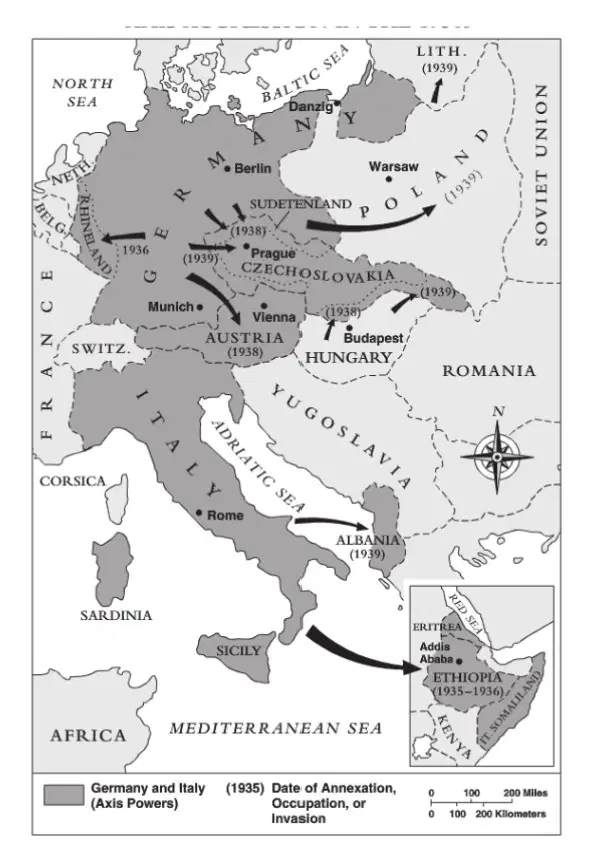
The Munich agreement of 1938
a)
it allowed Nazi Germany to annex part of Czechoslovakia's territory, in exchange for a promise of peace.
b)
ended further German aggression until World War II began by giving them Poland
c)
was signed by Joseph Stalin despite misgivings about German intent.
12.
Which general was Supreme Commander of Allied Forces in Europe and planned the D-Day invasion?
a)
A. George Patton
b)
B. Douglas MacArthur
c)
C. Dwight D. Eisenhower
d)
D. Omar Bradley
13.
President Franklin Roosevelt's decision in 1940 to give fifty American destroyers to England
a)
was in response to requests by the U.S. ambassador to London.
b)
was cancelled by Congress.
c)
circumvented the cash-and-carry provision of the Neutrality Acts.
d)
None of these answers is correct.
14.
In World War II, the main American strategy to fight Japan was to
a)
mount two offensive campaigns to attack the Japanese from two directions by island hopping
b)
concentrate U.S. forces into one large offensive moving west from the Marshall Islands
c)
quickly recapture the Midway Islands from the Japanese.
d)
establish a strong defensive position in the Solomon Islands to lure in the Japanese
15.
The 1943 "zoot-suit riots" in Los Angeles
a)
resulted from tensions between the African American and Mexican American communities.
b)
led the city to prohibit the wearing of zoot suits.
c)
began when off-duty Mexican American soldiers refused to wear their military uniforms.
d)
both began when off-duty Mexican American soldiers refused to wear their military uniforms, and led the city to prohibit the wearing of zoot suits.
16.
During World War II, American women who worked outside the home
a)
tended to be older than women who worked in the past.
b)
were barred from unions.
c)
were not allowed to have children under the age of three in their care
d)
None of these answers is correct.
17.
In 1942, when the United States interned Japanese Americans in "relocation centers,"
a)
all of the affected Japanese were American citizens.
b)
a powerful popular movement sprung up to protest the internments.
c)
all of those affected were first-generation Japanese immigrants.
d)
the move was protested by California Attorney General Earl Warren.
e)
there was no evidence that the Japanese Americans were a domestic security risk
18.
President Harry Truman made the controversial decision to:
a)
A. Enter World War II after Pearl Harbor
b)
B. Use atomic bombs against Japan
c)
C. Implement the Lend-Lease Act
d)
D. Create the Manhattan Project
19.
The Battle of Midway in 1942
a)
saw the United States suffer great losses.
b)
was a stunning defeat for the Japanese navy.
c)
lasted four days.
d)
both lasted four days and was a stunning defeat for the Japanese navy.
e)
All these answers are correct
20.
In 1943, the country that pressed for an immediate Allied invasion of France against Germany was
a)
the Soviet Union.
b)
China.
c)
Great Britain.
d)
the United States.
e)
Canada.
21.
The United States dropped a second atomic bomb on Japan in August 1945 after
a)
the Japanese failed to provide a response to the first bomb.
b)
the Soviet Union announced it would not enter into war against Japan.
c)
the Japanese government announced that the United States had only one atomic bomb.
d)
the emperor of Japan asked the United States for more time to consider surrendering.
22.
The Japanese surrender to the United States
a)
was announced a few days after a second atomic bomb had been dropped.
b)
was formally signed on the American battleship Missouri.
c)
occurred on September 2, 1945.
d)
All of these are correct
23.
General Douglas MacArthur was primarily responsible for:
a)
A. Leading forces in the Pacific Theater
b)
B. Commanding troops in North Africa
c)
C. Planning the D-Day invasion
d)
D. Liberating concentration camps in Europe
24.
During World War II, the first Axis country to be defeated was
a)
Germany.
b)
Spain.
c)
Austria.
d)
Japan.
e)
Italy.
25.
Prior to ordering the use of an atomic bomb against Japan, President Harry Truman
a)
sent evidence of a test explosion to the Japanese government.
b)
issued an ultimatum to Japan to surrender or face utter devastation.
c)
warned the Japanese about the atomic bomb but sent no evidence of its effect.
d)
told Japan to evacuate Hiroshima or face the consequences.
e)
did not send any kind of message to Japan
26.
. The Navajo Code Talkers made significant contributions to the war effort by:
a)
A. Flying combat missions in Europe
b)
B. Creating an unbreakable code based on their native language
c)
C. Serving in segregated combat units
d)
D. Working on the Manhattan Project
27.
The Tuskegee Airmen (Fighting Red Tails) were:
a)
A. The first African American military aviators
b)
B. Japanese-American soldiers who fought in Europe
c)
C. Native American code talkers
d)
D. Women pilots who transported aircraft
28.
Victory gardens during World War II were established to:
a)
A. Provide jobs for unemployed workers
b)
B. Help reduce pressure on the public food supply
c)
C. Train soldiers in agricultural techniques
d)
D. Raise money for war bonds
29.
"Rosie the Riveter" became a cultural icon representing:
a)
A. Women's suffrage movement
b)
B. Anti-war protests
c)
C. Women working in defense industries
d)
D. Rationing efforts on the home front
30.
The internment of Japanese Americans during World War II was:
a)
A. Declared unconstitutional immediately
b)
B. Upheld by the Supreme Court in Korematsu v. United States
c)
C. Limited only to immigrants, not American citizens
d)
D. Ended before the war concluded
31.
Which group made significant contributions to the war effort by working in factories, serving in auxiliary military roles, and taking on jobs traditionally held by men?
a)
A. Teenagers
b)
B. Elderly citizens
c)
C. Women
d)
D. Immigrants
32.
Rationing during World War II affected American civilians by:
a)
A. Eliminating all consumer goods
b)
B. Limiting access to items like sugar, gasoline, and meat
c)
C. Only restricting luxury items
d)
D. Applying only to cities, not rural areas
33.
The Manhattan Project was a top-secret government program that:
a)
A. Developed radar technology
b)
B. Created the atomic bomb
c)
C. Built aircraft carriers
d)
D. Established code-breaking operations
34.
Which of the following technological advances was NOT significant during World War II?
a)
A. Penicillin for treating infections
b)
B. Radar systems
c)
C. Internet communications
d)
D. Synthetic rubber
35.
The Office of Scientific Research and Development (OSRD) was created to:
a)
A. Coordinate scientific research for military purposes
b)
B. Regulate civilian industries
c)
C. Manage rationing programs
d)
D. Oversee propaganda efforts
36.
Which technology helped the Allies detect enemy aircraft and ships?
a)
A. Sonar only
b)
B. Satellites
c)
C. Radar
d)
D. Drones
37.
The Office of War Information was responsible for:
a)
A. Military intelligence operations
b)
B. Coordinating propaganda and promoting the war effort
c)
C. Rationing food supplies
d)
D. Managing Japanese internment camps
38.
Propaganda posters during World War II were used to:
a)
A. Discourage military enlistment
b)
B. Influence public opinion and encourage support for the war
c)
C. Promote isolationism
d)
D. Criticize government policies
39.
The 442nd Infantry Regiment was notable because:
a)
A. It was composed entirely of African American soldiers
b)
B. It was made up of Japanese American soldiers and became one of the most decorated units
c)
C. It was the first integrated military unit
d)
D. It consisted only of women volunteers
40.
Which battle was Germany's last major offensive on the Western Front?
a)
A. Battle of Stalingrad
b)
B. Battle of the Bulge
c)
C. D-Day
d)
D. Battle of Britain
41.
The battles of Iwo Jima and Okinawa were significant because they:
a)
A. Ended the war in Europe
b)
B. Were costly battles that influenced the decision to use atomic bombs
c)
C. Resulted in few American casualties
d)
D. Led to the surrender of Germany
42.
General George Patton was known for:
a)
A. Commanding naval forces in the Pacific
b)
B. His aggressive tank warfare tactics in Europe
c)
C. Leading the Manhattan Project
d)
D. Serving as Supreme Commander of Allied Forces
43.
According to President Roosevelt, what was his fervent desire after World War I?
a)
To increase military spending
b)
To seek peace and prevent future wars
c)
To expand American territory
d)
To form new alliances in Europe
44.
Which region did Japan annex in 1931, marking the beginning of its aggression in Asia during the 1930s?
a)
Manchuria
b)
Korea
c)
Burma
d)
Formosa
45.
Which of the following best describes the policy of appeasement?
a)
Allowing aggressive actions to go unchallenged to avoid conflict
b)
Building up military forces for war
c)
Imposing strict economic sanctions
d)
Forming alliances to oppose aggression
46.
What agreement did Hitler break in March 1939 by sending troops to occupy all of Czechoslovakia?
a)
The Munich agreement
b)
The Yalta agreement
c)
The Treaty of Versailles
d)
The Potsdam agreement
47.
What did the secret agreement between the Soviet and German dictators involve?
a)
Attacking Britain
b)
Forming the League of Nations
c)
Dividing Poland between them
d)
Invading France together
48.
What did the Selective Service Act of 1940 require?
a)
Registration of all American men between ages 21 and 35 for military service
b)
The drafting of women into the military
c)
Immediate deployment of U.S. troops to Europe
d)
The end of all military drafts in the U.S.
49.
Hitler's Final Solution aimed to do what?
a)
invade Poland
b)
annex all of Europe
c)
Exterminate ALL Jews living in Third Reich regions
d)
Removal of all "Undesirables"
50.
This Battle took 2 years to plan, occurred in 3 phases, and caused Germany to fight on 2 war fronts.
a)
Battle of Midway
b)
Operation Overlord "D-Day"
c)
Pearl Harbor
d)
Battle of Britain
51.
The Battle of Midway was a turning point of the war in the Pacific because....
a)
Japan had another successful attack on the U.S.
b)
Japan was now dominating the Pacific
c)
Japan now fighting on the defensive end & the U.S. now on the offense
d)
U.S. lost the battle
52.
The Korematsu legal team argued that Executive Order 9066 was a violation of Korematsu's
a)
13th Amendment rights
b)
14th Amendment rights
c)
15th Amendment rights
d)
16th Amendment rights
53.
What was Fred Korematsu arrested for?
a)
Staying in Oakland and not reporting to the internment camps
b)
Aiding the Japanese
c)
Giving intelligence to US enemy's
d)
Not giving his money and property to the US Government
54.
Define Nisei:
a)
a person born in Japan that immigrated to the United States
b)
a person born in the US whose parents were immigrants from Japan.
c)
a soldier that was fighting for Japan during WWII
d)
a soldier of Japanese descent fighting for the USA in WWII
55.

What event started World War II, setting off war in Europe?

a)

Battle of Britain

b)

Germany invaded Poland

c)

Japan bombed Pearl

d)

Japanese aggression in East Asia

56.
Which is a major reason that the outcome of World War I contributed to the outbreak of World War II?
a)
Germany resented losing territory and having to pay huge reparations after World War I.
b)
Germany demanded France allow Germans to settle in Alsace and Lorraine after World War I.
c)
The League of Nations tried to impose economic sanctions on Germany following World War I.
d)
The League of Nations demanded that Poland return to Germany territory lost following World War I
57.

What were the causes of World War II?

a)

The Treaty of Versailles stated that Germany must pay war reparations for WWI and they refused to accept financial responsibility for their debts.

b)

Adolf Hitler became the ruler of Germany and vowed to restore German wealth through communist means.

c)

Germany secretly began building up a military and stockpiling weapons. Hitler made alliances with Italy and Japan.

d)

Germany failed to appease- make agreements to foreign country's demands -in order to avoid intrnational conflicts.

58.

Which of the follow would NOT be considered a cause of WWII?

a)

Aggressive expansion by the Axis Powers

b)

Totalitarian Governments with Military dictatorships

c)

Harsh Conditions on Germany by the Treaty of Versailles

d)

The US desire to get rid of Soviet Communism

59.

This victory led to the liberation of France. ___________________

a)

Stalingrad

b)

Bulge

c)

Britain

d)

Normandy

60.

The Blitz ended in May 1941, so Hitler could turn his attention to the Soviets.

a)

Stalingrad

b)

Bulge

c)

Britain

d)

Normandy

61.

Why was the Battle of Britain important?

a)

It was another win for Germany and forced the British to surrender.

b)

It was the first failure for Germany and Britain remained in the war.

c)

It helped Great Britain get supplies from the United States.

d)

It involved an invasion of Great Britain, but it failed.

62.

After the island of Sicily fell, the Allies continued to mainland Italy and Italy surrendered. In response, Hitler sent troops.

a)

MAYBE SO

b)

TRUE

c)

FALSE

d)

MAYBE NOT

63.

What happened as a result of the Battle of Stalingrad?

a)

The Germans won, the Soviet forces surrendered and the Soviets began to retreat.

b)

The Soviets won, the German forces surrendered and German forces began to retreat.

c)

The Soviets won and Germany surrendered , ending World War II.

d)

The Germans won and the Soviet Union surrendered, ending World War II.

64.

Why did the Allies launch the D-Day invasion on June 6, 1944?

a)

to create a second front and liberate (free) France from Nazi control

b)

They wanted to use the Normandy beaches as a base to bomb Germany.

c)

They wanted to force a German surrender.

d)

They wanted to destroy Japanese defenses.

65.
The British Prime Minister at the time of WWII.
a)
President FDR
b)
Prince Harry
c)
Winston Churchill
d)
Charles de Gaulle
66.
Mein Kampf, the autobiographical book by Adolf Hitler, means:
a)
My Struggle
b)
My Life
c)
My Kettle
d)
My Story
67.

Which of the following was not a member of the Allies Big Three?

a)

Joseph Stalin - Soviet Union (Russia)

b)

Adolf Hitler - Germany

c)

Winston Churchill - Britain

d)

Franklin Roosevelt - USA

68.
Kristallnacht is also known as:
a)
The Night of Many Glasses
b)
The Night of Many Moons
c)
The Night of Broken Hearts
d)
The Night of Broken Glass
69.

During World War II, Italy, Germany, and Japan were part of which of the following alliance?

a)

Allied Forces

b)

Axis Powers

70.

Which was a characteristic of Germany under Adolf Hitler and the Soviet Union under Stalin?

a)

An official foreign policy of isolationism

b)

Governmental control of the media

c)

Public ownership of business and industry

d)

A written constitution containing individual rights and freedoms

71.

From 1939 to 1945, Hitler and the Nazis tried to get rid of all Jewish people. They forced Jews to live in concentration camps and killed at least 6 million people. This event in history is called the

a)

liberation

b)

the holocaust

c)

nationalism

d)

imperialism

72.

Which action illustrated the concept of genocide?

a)

The British negotiating peace with Adolf Hitler during the 1938 Munich Conference

b)

Adolf Hitler and Josef Stalin signed a nonaggression pact in 1939

c)

The Nazi armies eliminating the Jews and other groups as part of Hitler's Final Solution

d)

German generals plotting against Adolf Hitler

73.

In the 1920s and 1930s, the rise of fascist and totalitarian governments in Germany and Italy was largely the result of

a)

The success of the Communists in establishing a command economy in the Soviet Union.

b)

Severe economic and social problems that arose in Europe after WWI.

c)

The active support of the United States.

d)

Movements demanding the return of old monarchies.

74.

What new strategy allowed the Germans to achieve remarkable military success at the beginning of WWII?

a)

Blitzkrieg

b)

Counterattack

c)

Kamikazes

d)

Submarine warfare

75.

Truman ordered the bombing of Hiroshima and Nagasaki in order to

a)

persuade the Soviets to take part in the war against Japan.

b)

avenge American losses in the Pacific theater of the war.

c)

force an immediate Japanese surrender.

d)

test the capabilities of the atomic bomb.

76.

Japan surrendered in August 1945 because the United States

a)

Captured the islands of Iwo Jima and Okinawa.

b)

Dropped atomic bombs on Hiroshima and Nagasaki.

c)

Threatened to use the atomic bomb.

d)

Took Tokyo, the Japanese capital.