
 Worksheets
GS Chapter 5 Test: Building Blocks of Matter
Total questions: 34
Worksheet time: 17mins
Name
Class
Date
1.
Aristotle named atoms atoms.
a)
true
b)
false
2.
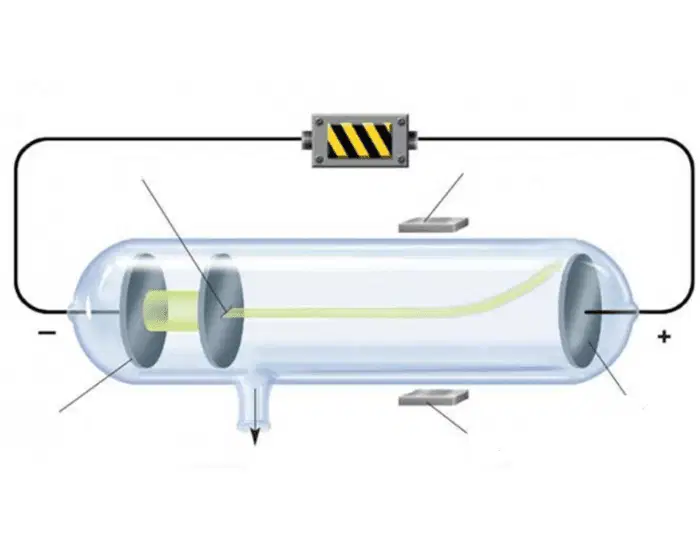
A cathode ray tube consists of a stream of protons.
a)
true
b)
false
3.
The Gold-foil experiment discovered the nucleus.
a)
true
b)
false
4.
In a neutral atom, the number of protons is always equal to the number of neutrons.
a)
true
b)
false
5.
Isotopes are forms of an element that have the same number of protons but a different number of electrons.
a)
true
b)
false
6.

Greek philosophers thought that matter was composed of four elements: air, earth, fire, and water.
a)
true
b)
false
7.
A theory is an explanation for a broad set of observations that is based upon proven hypotheses and is verified multiple times (and has never been shown to not be true!)
a)
true
b)
false
8.
The negative electrode in the cathode ray or in a battery is called the cathode.
a)
true
b)
false
9.
John Dalton used very precise scales to prove the Law of Conservation of Mass.
a)
true
b)
false
10.

In the notation below, 108 represents the atomic number and 47 represents the atomic mass of silver (Ag). (picture not on periodic table)
a)
true
b)
false
11.
The vertical columns on the periodic table are called periods.
a)
true
b)
false
12.
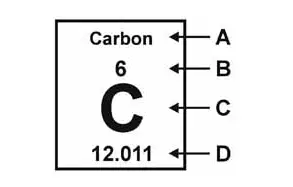
The box for an element from the periodic table is shown. Which is the atomic mass?
a)
a
b)
b
c)
c
d)
d
13.
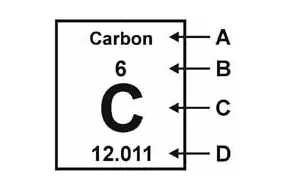
The box for an element from the periodic table is shown. Which is the atomic number?
a)
a
b)
b
c)
c
d)
d
14.
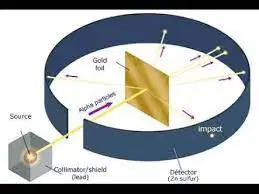
Which scientist described a positively charged core (“nucleus”) in the middle of a lot of empty space using a gold-foil experiment?
a)
Chadwick
b)
Thomson
c)
Rutherford
d)
Bohr
15.

Which of the following atomic models is shown in the picture?
a)
plum-pudding model
b)
nuclear model
c)
Bohr model (planetary model)
d)
Quantum mechanical model
16.
Which of the following is NOT part of Dalton's atomic theory?
a)
All matter is composed of tiny, indivisible particles called atoms.
b)
Atoms of a given element are identical in their chemical and physical properties.
c)
Atoms can be created or destroyed.
d)
A chemical reaction occurs when atoms are combined, separated, or rearranged.
17.
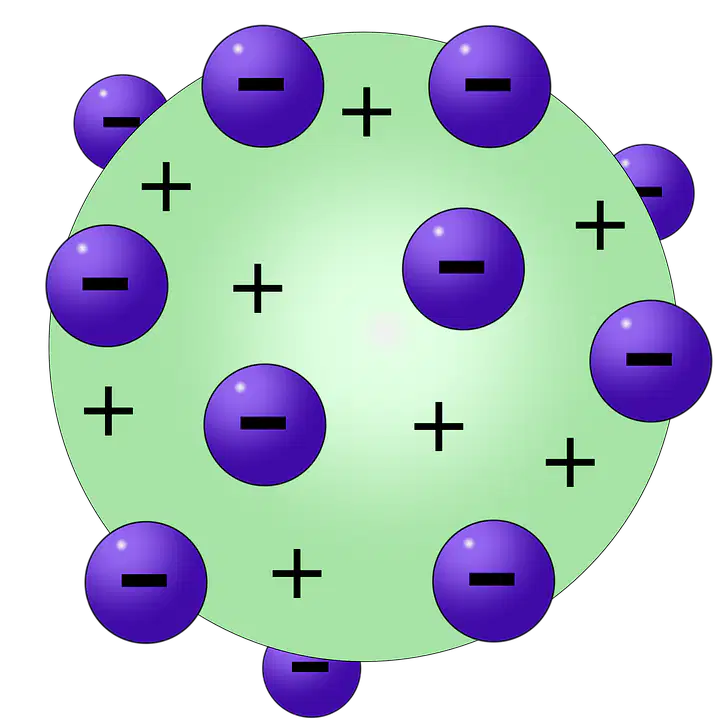
Which scientist developed the model of the atom shown?
a)
Chadwick
b)
Thomson
c)
Rutherford
d)
Bohr
18.
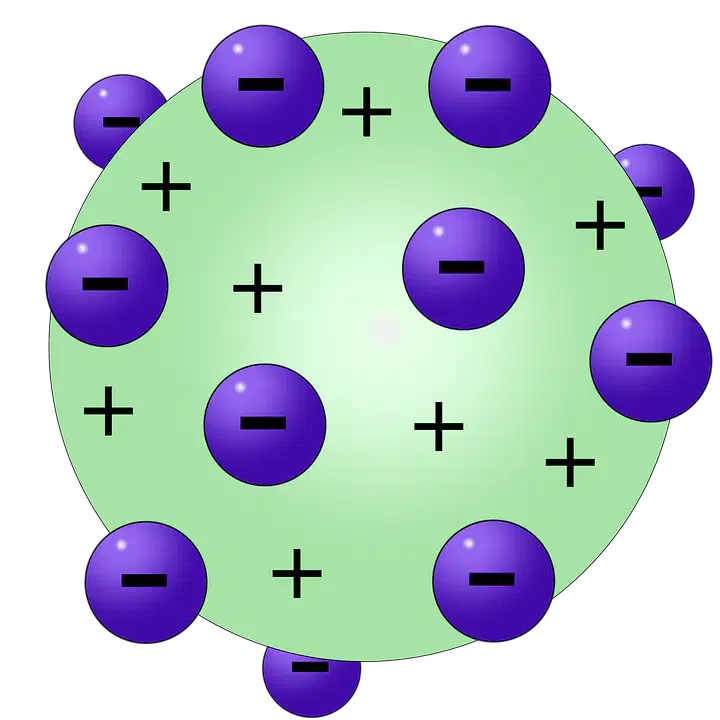
What is the name of the atomic model shown below?
a)
plum-pudding model
b)
nuclear model
c)
Bohr model
d)
Quantum mechanical model
19.
Which scientist described the existence of the neutron?
a)
Chadwick
b)
Thomson
c)
Rutherford
d)
Bohr
20.
What is a representation of an object or system?
a)
theory
b)
hypothesis
c)
model
d)
isotope
21.
Atoms that have the same number of protons, but different numbers of neutrons are called...?
a)
neutral
b)
isotopes
c)
charged
d)
amu's
22.
What is the sum of the protons and neutrons in the nucleus of an atom called?
a)
mass number
b)
average atomic mass
c)
atomic number
d)
electron number
23.
Which one is neutral?
a)
proton
b)
ion
c)
electron
d)
neutron
24.

Which has a charge of +1?
a)
proton
b)
atom
c)
electron
d)
neutron
25.

Which has a charge of 1-?
a)
proton
b)
atom
c)
electron
d)
neutron
26.
Which one(s) have a mass of 1 amu?
a)
electron
b)
proton
c)
proton and neutron
d)
electron and proton
27.

Which two are isotopes of one another?
a)
Atoms 1 & 2
b)
Atoms 2 & 3
c)
Atoms 1 & 3
d)
Atoms 1 & 4
28.

How many neutrons are in an atom of chlorine?
a)
17
b)
18
c)
34
d)
35
29.

How many electrons are in an neutral atom of sodium?
a)
22
b)
11
c)
12
d)
23
30.
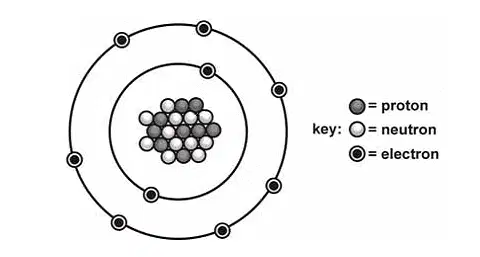
What is the mass number of the atom shown?
a)
9
b)
19
c)
20
d)
21
31.
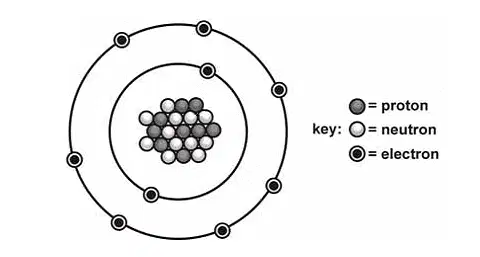
Which element does this atom represent?
a)
potassium
b)
neon
c)
fluorine
d)
sodium
32.

What is the number of neutrons in the following isotope? (picture not on periodic table)
a)
35
b)
45
c)
80
d)
115
33.
Which element has 14 protons?
a)
Nitrogen
b)
Silicon
c)
Aluminum
d)
Sulfur
34.
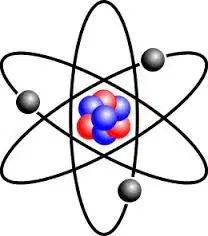
According to the modern concept of the atom, which are located in the nucleus of an atom?
a)
electrons and protons
b)
protons only
c)
neutrons and electrons
d)
protons and neutrons
100 %

