
 Worksheets
DNA, RNA, & Mutations Review
Total questions: 36
Worksheet time: 2hrs 48mins
When DNA replication occurs before meiosis, the original DNA strand CAG TGT TTA TAG is copied into complementary strand GTC ACA GGC ATC. What type of mutation has occurred?
deletion
inversion
substitution
When DNA replication occurs before meiosis, the original DNA strand GTC ACA GGC ATC is copied into complementary strand CAG CCG TAG. What type of mutation has occurred??
deletion
inversion
inversion
substitution
A gene on a strand of DNA has the following nucleotide sequence:
CCC-AAG-TGG
What are the mRNA triplets coded for from this gene?
Hint - DNA to mRNA
GGG UUC ACC
CCC AAG TGG
GGG TTC ACC
UUU CCC AGA

What is the sequence of amino acids formed from
GGG UUC ACC ?
Glycine - Leucine - Serine
Valine - Glycine - Arginine
Valine - Lysine - Tryptophan
Glycine - Phenylalanine - Threonine
What is the amino acids AAA?
Leucine
Glycine
Lysine
Threonine
What is the amino acids UCU?
Leucine
Glycine
Lysine
Serine
What is the amino acids GGG?
Leucine
Glycine
Lysine
Serine
What is the amino acids CCU?
Proline
Glycine
Lysine
Serine
Ribose Sugar
DNA
Both
RNA
Deoxyribose Sugar
DNA
Both
RNA
Throughout the Cell
DNA
Both
RNA
In the Nucleus
DNA
Both
RNA
Sugar, Phosphate, Nitrogen Base
DNA
Both
RNA

How might this model be revised to show a more accurate depiction of protein synthesis?
Between processes 1 and 2, the mRNA must leave the nucleus.
Prior to process 1, DNA should copy itself to allow the cell to divide.
After process 2, the completed protein should travel back to the nucleus.
During process 2, the ribosome should remove any mutated nucleotides from the mRNA.
Which statement best explains the process of transcription as it relates to protein synthesis and gene expression?
A ribosome is used to create a polypeptide.
A tRNA molecule is used to carry an amino acid to the ribosome.
A portion of a DNA molecule is read to produce an mRNA molecule.
A portion of an mRNA molecule is used to produce a chain of amino acids.
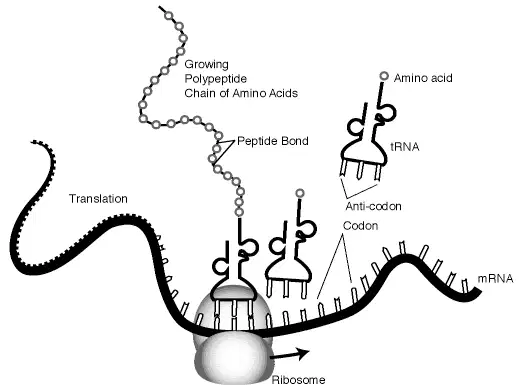
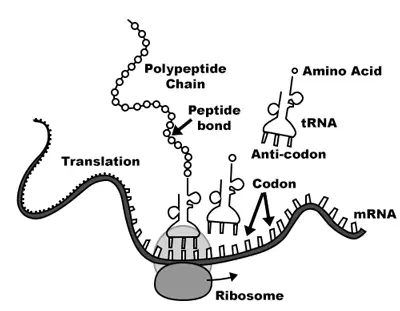
Consider the model of translation. Which statement could you use to best explain the purpose of translation to your lab partner?
In translation, tRNA carries the genetic code copied from DNA to the ribosome where mRNA is used to place amino acids in the correct sequence to form a protein.
In translation, DNA carries the genetic code to the ribosome where it is read and mRNA is used to place amino acids in the correct sequence to form a protein.
In translation, mRNA carries the genetic code copied from DNA to the ribosome where it is read and tRNA is used to place amino acids in the correct sequence to form a protein.
In translation, mRNA carries the genetic code copied from DNA to the nucleus where it is read and tRNA is used to place amino acids in the correct sequence to form a protein.
This is a genetic mutation caused by the replacement of a single base nucleotide with another nucleotide.
Point mutation
Deletion
Inversion
Frameshift mutation
A genetic mutation caused by the loss of a chromosomal segment.
Point mutation
Deletion
Inversion
Frameshift mutation
This reverses a segment within a chromosome.
Point mutation
Deletion
Inversion
Frameshift mutation
This is a genetic mutation caused by the insertion or deletion of one or more nucleotides that changes the amino acid sequence from the site of the mutation forward.
Point mutation
Deletion
Inversion
Frameshift mutation
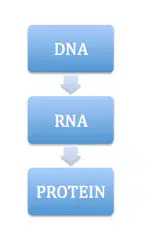
The central dogma of molecular biology is an explanation of the flow of genetic information within a biological system. It is a framework for understanding the transfer of genetic information between sequential information-carrying biopolymers. It traces the one-way flow from the nucleus out to the cell proper and the ribosome.
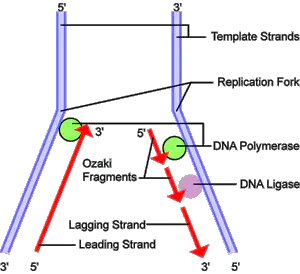
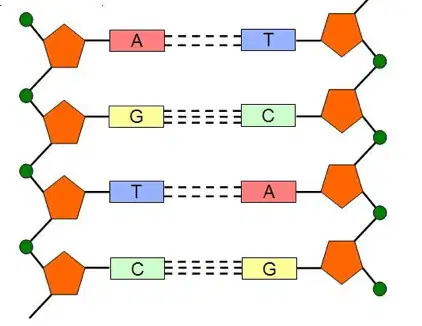
Josh is assigned a project in class to make a strand of m-RNA from DNA.The DNA code that he has been assigned is CGG TCG AGT GAT. What would be the correct code for Josh to use in his transcription?
GCC AGC TCA CTA
GCC AGG TGA CTA
GCC UGC TCA CTU
GCC AGC UCA CUA
A single strand of DNA contains the following nine nucleotides in this order: ACT TAT GGA. What sequence of bases will be present on the complementary strand of DNA?
UGA AUA CCT
ACU UAU GGA
ACU UAU GGA
TGA ATA CCT
A DNA molecule has the sequence GCATCCGA. What is the mRNA sequence resulting for this DNA code?
CCTAGGCT
CGTAGGCT
CGUAGGCU
GCATCCGA
Given the sequence of DNA nucleotide bases TAGTAGTAG, give the complementary strand of mRNA produced during transcription.
AAGGUAGUA
AAUCGGAAC
AUCAUCAUC
GAGGAGGAG

The codon chart shown here uses the three base sequence found on the mRNA molecule after the information is copied from DNA during transcription. Imagine that a protein is being assembled at the ribosome. What is the amino acid sequence for the codons GUU AAA?
valine - lysine
leucine - lysine
valine - arginine
leucine - arginine
The central dogma of molecular biology is centered upon the process of protein synthesis, in which the information from DNA is transcribed and translated, resulting in multiple amino acids being joined to form _______________.
lipids
proteins
carbohydrates
nucleic acids
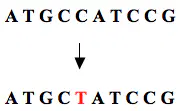
During replication, the DNA segment in a somatic cell undergoes the mutation seen here.
What type of mutation has occurred? If this DNA molecule proceeds to transcription and translation, explain the impact of this mutation on the production of a protein?
This is a point mutation, resulting from the addition of one nitrogen base. This strand can no longer be used for transcription or translation due to its mutation.
This is a frameshift mutation, resulting from the substitution of one nitrogen base. If this strand of DNA is used for transcription, it will result in all of the amino acids being placed incorrectly in the protein.
This is a frameshift mutation, resulting from the addition of one nitrogen base. This strand can no longer be used for transcription or translation due to its mutation. If this strand of DNA is used for transcription, it will affect the coding of multiple amino acids, causing an incorrect protein to be assembled.
This is a point mutation, resulting from the substitution of one nitrogen base. If this strand of DNA is used for transcription, it will affect the coding of ONE amino acid, resulting in placing the correct amino acid in the protein, placing the wrong amino acid in the protein, or coding for the protein to stop building.
This bonds to thymine (T) in DNA.
Adenine
Guanine
Uracil
Cytosine
This bonds to cytosine (C) in DNA.
Adenine
Guanine
Uracil
Cytosine
This is the nitrogenous base only found in RNA.
Adenine
Guanine
Uracil
Cytosine
A single stranded nucleic acid that plays a role in protein synthesis.
RNA
DNA
Replication
Transcription
This is the copying process by which a cell duplicates its DNA.
RNA
DNA
Replication
Transcription
This holds an organism's hereditary information.
RNA
DNA
Replication
Transcription
This is the process of copying DNA to RNA.
RNA
DNA
Replication
Transcription
Is this comparison of DNA replication, transcription, and translation
True or False
Replication - Purpose The process of synthesizing new strands of DNA
Transcription - The process of using DNA as a template to synthesize RNA.
Translation - The process of using mRNA to synthesize proteins.
True
False

