
Font size
S
M
L
XL
 Worksheets
2025 APUSH Semester 1 Exam
Total questions: 88
Worksheet time: 44mins
Name
Class
Date
1.
What crop helped "support economic development" of the civilizations of ancient Mexico and the American Southwest? Examples of these civilizations were the Aztec, Pueblo, and Anasazi.
a)
corn/maize
b)
squash and pumpkins
c)
cotton
d)
tobacco
2.
People groups of the American Southwest included the Hohokam, Anasazi, and Pueblo. What type of innovations were necessary for them to survive in their environment?
a)
mobile/nomadic lifestyles
b)
sedentary lifestyles, including sophisticated urbanization
c)
seafaring lifestyles
d)
development of irrigation and adobe/cave/cliff dwellings
3.
People groups of the Great Basin and Great Plains included the Lakota Sioux. What type of lifestyle did they have to adapt in order to survive in their environment, especially considering that the buffalo were so vital to their existence?
a)
mobile/nomadic lifestyles
b)
sedentary lifestyles, including sophisticated urbanization
c)
seafaring lifestyles
d)
an over-reliance on irrigation
4.
People groups of the Mississippi River Valley were are called collectively the Mississippian culture.
These peoples lived in environments that varied between rolling prairies and forests and riverside dwellings.
One unique aspect of this culture was that they built Cahokia near the confluence of the Mississippi and Missouri Rivers. This was most like the Aztec's Tenochtitlan than any other North American culture produced.
What was Cahokia? It is an example of how Mississippian culture favored THIS innovation in order to survive in their environments.
a)
modes of transportation for nomadic peoples
b)
sophisticated urban area/permanent urban settlements
c)
seafaring technology that rivaled that of the Chinese
d)
primitive hunting technology
5.
People groups of the Pacific Northwest included peoples that carved totem poles.
People groups like the Iroquois of modern-day New York created sophisticated government structures to rule their confederation of tribes.
Tribes from both regions, despite living on opposite sides of the continent, developed a similar mode of surviving in their environments.
How did these communal peoples adapt their housing in order to live in their environment and also maintain communal values?
a)
they created single-family cliff dwellings in order to escape the desert sun
b)
they lived in thatched longhouses
c)
they used gold in multiple ways in order to display their wealth
d)
they relied on human sacrifice to appease their sun god
6.
Europeans competed over colonies in the New World in the 16th and 17th centuries.
Which nation controlled most of eastern Canada in the 1600s?
a)
France
b)
Britain
c)
Portugal
d)
Spain
7.
Europeans competed over colonies in the New World in the 16th and 17th centuries.
Which nation controlled most of modern-day Latin America, with the exception of Brazil?
a)
France
b)
Britain
c)
Portugal
d)
Spain
8.
Europeans competed over colonies in the New World in the 16th and 17th centuries.
Which nation controlled began its plantation of colonies later in the imperialist game, after it defeated the Golden Armada in 1588?
a)
France
b)
Britain
c)
Portugal
d)
Spain
9.
Europeans competed over colonies in the New World in the 16th and 17th centuries.
The Reformation added a spiritual aspect to this imperialist race. Which of the colonial powers attempted to spread Protestant religious values to the New World?
a)
France
b)
Britain
c)
Portugal
d)
Spain
10.
Europeans competed over colonies in the New World in the 16th and 17th centuries.
This economic system encouraged competition, because its proponents believed that global wealth was finite, a zero-sum game, where one country gaining wealth must mean that another country was losing wealth...and European balance of power politics demanded that one's own country can NEVER lose wealth.
What was this economic system?
a)
capitalism
b)
mercantilism
c)
socialism
d)
feudalism
11.
The Columbian Exchange was:
a)
a deadly disease that decimated 90% of the New World population by the mid-16th century
b)
the transfer of plants, animals, germs, mineral resources, and humans from one side of the Atlantic to the other for the first time in world history
c)
business owned by a large number of investors in which investors had limited liability (did not have to pay the debts of the company)
d)
a medieval European social structure that saw vassals owe miltary service to the Lord, the serfs owe agricultural labor to the Lord, in exchange for the Lord protecting his subjects
12.
Europeans competed over colonies in the New World in the 16th and 17th centuries.
Besides its search for gold, which vastly enriched the Spanish when the conquered the Aztec and Incas, THIS was another new source of wealth that the New World added to Old World coffers:
a)
wheat
b)
sugarcane
c)
cattle
d)
horses
13.
England's joint-stock company was an innovation that aided in colonization of North America.
What was a joint-stock company?
a)
a deadly disease that decimated 90% of the New World population by the mid-16th century
b)
the transfer of plants, animals, germs, mineral resources, and humans from one side of the Atlantic to the other for the first time in world history
c)
business owned by a large number of investors in which investors had limited liability (did not have to pay the debts of the company)
d)
a medieval European social structure that saw vassals owe miltary service to the Lord, the serfs owe agricultural labor to the Lord, in exchange for the Lord protecting his subjects
14.
Smallpox was:
a)
a deadly disease that decimated 90% of the New World population by the mid-16th century
b)
the transfer of plants, animals, germs, mineral resources, and humans from one side of the Atlantic to the other for the first time in world history
c)
business owned by a large number of investors in which investors had limited liability (did not have to pay the debts of the company)
d)
a medieval European social structure that saw vassals owe miltary service to the Lord, the serfs owe agricultural labor to the Lord, in exchange for the Lord protecting his subjects
15.
The caravel, the astrolabe, and compass were all:
a)
a deadly disease that decimated 90% of the New World population by the mid-16th century
b)
the transfer of plants, animals, germs, mineral resources, and humans from one side of the Atlantic to the other for the first time in world history
c)
business owned by a large number of investors in which investors had limited liability (did not have to pay the debts of the company)
d)
a medieval European social structure that saw vassals owe miltary service to the Lord, the serfs owe agricultural labor to the Lord, in exchange for the Lord protecting his subjects
e)
improvements in maritime technology that enabled not only the exploration of Africa by Europeans but also the aided Europeans in the exploration of the Atlantic Ocean and the New World
16.
Encomienda was:
a)
a method Spanish colonial officials used to compel Native American labor for plantation agriculture and mining
b)
an abolition movement that resulted in a liberated Haiti
c)
a social organization system of England where the lord was at the top of the ladder, the vassal in the middle, and the serfs on the bottom
d)
a European-wide economic system where exports should always exceed imports and precious metals were highly valued
17.
West Africa was:
a)
the source of most of the enslaved populations brought to the New World, after the Native American population diminished
b)
the location of the Northwest Passage
c)
a mythical place where Spanish conquistadors searched for a lost city of gold
d)
the main source of smallpox that was inflicted upon Native Americans
18.
West Africans were brought to the Caribbean because:
a)
Spanish plantation owners wanted to use their knowledge of rice and sugar farming in the New World, not to mention that many of them had immuno-resistance to malaria
b)
they were to be used as warriors in the Spanish armies to defeat the Native American civilizations
c)
of their centuries of seafaring navigation skills
d)
their millennia-long adopted of the Catholic Church as their official religion
19.
The Spanish conquerors created a caste system in the New World. At the top of the caste system were Peninsulares, those Spaniards in the New World who were born in Spain, and the Criollos, the Spaniards in the New World born in the Western Hemisphere.
Near the bottom of the ladder were mestizos and mulattos.
Why were they on the bottom?
a)
they were mixed-race persons, being either the children of Spaniards and black slaves or Spaniards and Native Americans; they were not at the absolute bottom because of the Spanish heritiage, but they were denied many of the rights of full-blooded Spanish persons
b)
English settlers, because they were Protestants inside Catholic Spanish colonies
c)
Portuguese migrants, because of the rivalry between Spain and Portugal over the Pope's blessing for conquest
d)
French conquistadors, because they wanted to connect French Canada to French Argentina
20.
What happened to the population of Native Americans in the New World after contact with European colonizers?
a)
the Native American population decreased drastically; there was also intermarriage between Spanish men and Native American women
b)
Native American groups were largely successful at resisting European domination, causing Europeans to seek for a Northwest Passage to Asia
c)
Native Americans were mostly integrated into European society with a large degree of equality
d)
Native American leaders were able to negotiate strong peace treaties that treated Native groups fairly and protected Native lands from colonization
e)
Native American culture left no impact on later European colonies
21.
Matrilineal society was:
a)
more likely to be found among Native American tribes
b)
more likely to be found among Dutch colonies
c)
more likely to be found among English colonies, as it was Queen Elizabeth who began the push for colonization in earnest
d)
more likely to be found in Spanish colonies in South America
22.
French colonizers in Canada:
a)
more likely to live in peaceful coexistence with Native American people groups due to healthy trade relations and Jesuit sensibilities
b)
less likely to intermarry with Native Americans than the Spanish
c)
less likely to take sides in Native American intertribal wars
d)
more likely to clash with Spanish settlers in Florida than English settlers in New England
23.
Bartolomé de las Casas:
a)
was a Spanish priest that fought vigorously for the humane reform of the encomienda system
b)
was a conquistador who converted Native Americans by the sword
c)
advocated for Spain to leave the New World entirely
d)
successfully earned not just abolition of slavery, but full equal treatment by Spain of mestizo and mulatto peoples of the New World
24.
Important cultural contributions made by African peoples on the New World included:
a)
musical instruments like the banjo and knowledge of growing cash crops like sugarcane and rice
b)
the complex constitution of a confederacy of five tribes where each tribe had a check and balance on the others
c)
a sophisticated articulation of what would become the market economy and capitalism
d)
a powerful tribal alliance with the French against the English and their Iroquois allies
25.
One misunderstanding between English and Native American cultures regarded negotiations over exchanges of land.
Which is the most accurate representation of both sides of the cultural differences on this issue, in general?
a)
Europeans tended to use written contracts for permanent agreements; Native Americans viewed agreements as more temporary and community-oriented
b)
Europeans tended to use paper money for transactions; Native Americans wanted gold or silver bullion as payment
c)
Europeans never wanted to negotiate, they only wanted to take take take
d)
Europeans never wanted to pay; Native Americans always demanded exorbitant fees
26.
The Chesapeake region was:
a)
the first to develop cultivatable tobacco, a product that helped this colony thrive economically
b)
mainly a haven for Protestant escapees from Catholic France
c)
the breadbasket of the British North American colonial regions
d)
saw continual and persistent peace and coexistence with Native Americans
27.
Before using black enslaved Africans as their main source of manual labor, Chesapeake planters relied on this demographic group for manual labor:
a)
white, male indentured servants
b)
the first and second sons of English nobility
c)
Hessian mercenaries hired for their martial skill
d)
white, single, female skilled workers that demanded high wages
28.
Bacon's Rebellion:
a)
marked a shift from relying on white indentured labor to relying on black African labor
b)
successfully created a colony independent from Great Britain...the first American state, though it was short-lived
c)
was a mutiny by Islamic soldiers that refused to use British bullets because they were coated with pig grease
d)
was the first step toward national unity amongst all the British North American colonies
29.
The Middle Colonies region was:
a)
the first to develop cultivatable tobacco, a product that helped this colony thrive economically
b)
mainly a haven for Catholic escapees from Anglican England
c)
the breadbasket of the British North American colonial regions
d)
saw continual and persistent peace and coexistence with Native Americans
30.
The New England region was:
a)
the first to develop cultivatable tobacco, a product that helped this colony thrive economically
b)
mainly a haven for Puritan escapees from Anglican England
c)
the breadbasket of the British North American colonial regions
d)
saw continual and persistent peace and coexistence with Native Americans
31.
Which is the accurate European-Native American alliance?
a)
French and Algonquian Indians
b)
French and Iroquois Indians
c)
British and Powhatan Indians during the Powhatan Wars
d)
British and the Pequots during the Pequot War
32.
Metacom's War/King Philip's War:
a)
was a conflict in New England between the Wampanoag Indians and English settlers over land, resources, and political boundaries
b)
was a conflict between the Pueblo peoples and the Spanish colonizing efforts in New Mexico
c)
started when a British sailor named Philip Jenkins had his ear cut off by a Spanish ship captain on the high seas
d)
was a war only involved Native Americans, the Algonquians vs. the Iroquois, and the English let them fight it out, not taking sides in order to swoop in and take the land of both when each side was weakened in the aftermath
33.
The Pueblo Revolt:
a)
was a conflict between the Pueblo peoples and the Spanish colonizing efforts in New Mexico
b)
was a conflict in New England between the Wampanoag Indians and English settlers over land, resources, and political boundaries
c)
started when a British sailor named Philip Jenkins had his ear cut off by a Spanish ship captain on the high seas
d)
was a war only involved Native Americans, the Algonquians vs. the Iroquois, and the English let them fight it out, not taking sides in order to swoop in and take the land of both when each side was weakened in the aftermath
34.
The Catholic faith:
a)
was mainly adopted by Native Americans of the Spanish Southwest (modern day Texas, New Mexico, and Arizona)
b)
had no invovlement in the encomienda system; it fact, it was condemned universally by Spanish bishops in the New and Old World
c)
held a strong hold over New England during the years of the Puritan Great Migration
d)
helped create modern capitalism through the Dutch notion of "Protestant Work Ethic"
35.
King William's War, Queen Anne's War, and King George's War were all:
a)
examples of New World/American extensions of mercantilist conflicts between Britain and France
b)
lopsided victories for France, which expanded its influence into the Ohio Valley
c)
occurred between Catholic European nations over which would have the Pope's blessing for domination of the New World
d)
names for localized revolutions by American colonists against the Dominion of New England
36.
The headright system:
a)
offered 50 acres of land to each immigrant who paid for his own passage and to any plantation owner who paid for an immigrant’s passage
b)
facilitated runaway slaves to reach Spanish Florida safely
c)
demanded that Protestants of the Chesapeake convert to Catholicism if they wanted to vote
d)
abolished slavery in the Georgia colony
37.
Slave laws that developed over time into the mid-1600s included provisions that:
a)
forbid the intermarriage of white and black residents of the colonies
b)
forbid the enslavement of any person who had been baptized, regardless of race
c)
no child would automatically be enslaved just because their mother had been a slave
d)
worked to create equality for freed Africans living in the colonies
38.
Ways that enslaved Africans resisted slavery even while living in the American colonies included:
a)
hunger strikes, breaking plantation tools, and running away
b)
most of them refusing to convert to Christianity
c)
nothing...slavery was not resisted by African laborers in the colonies
d)
earning more money for their own bank accounts than their masters
39.
Which region used the fewest slaves, relatively speaking, in the British North American colonies?
a)
New England
b)
the Middle Colonies
c)
the Chesapeake
d)
the Deep Southern colonies
40.
The great majority of West African slaves that were brought to the New World ended up in:
a)
the West Indies and Brazil
b)
the North American British colonies
c)
French Canada
d)
the Spanish Southwest (Texas, New Mexico, Arizona, California)
41.
The Scots-Irish:
a)
were immigrants to the British North American colonies that settled in the backcountry and in the Appalachian Mountains
b)
held deep respect for the English monarchy and were main supporters of the Crown during the Revolution
c)
came over in whole community groups, brining the Germanic language with them
d)
were mainly Catholic migrants that represented the majority of New England's population
42.
The existence of a colonial governor in each colony and a bicameral assembly almost every colony was an indication that:
a)
English governmental systems had a strong hold on American institutions
b)
American colonists resisted anything related to British institutions
c)
French institutions dominated the political landscape of British America
d)
the Enlightenment had not yet reached British North America
43.
The First Great Awakening was:
a)
a Protestant revival movement that affected all of the American colonies
b)
consolidated American Christianity into only a few denominations, allowing for less choice for the average churchgoer
c)
a unification movement for American Catholics in the post-Revolution years
d)
dominated by preachers who demanded respect for traditional authority as their sermons came from Romans 13
44.
The First Great Awakening included the following effects, EXCEPT for:
a)
an increased desire for the representatives of the King to have more control over religious affairs in the colonies
b)
families reading the Bible more at home or in private study groups
c)
New Light believers splitting off from Old Light churches
d)
increased emotionalism in areas impacted by revival
45.
The John Peter Zenger Trial demonstrated the American precedent that:
a)
the freedom of the press would be protected even if the press printed embarrassing information about those in power, if what was printed was in fact the truth
b)
New England was moving closer to identifying with the Mother Country
c)
the American press was decreasing in influence
d)
newspaper circulation had fallen from its early colonial heights
46.
The relationship between Britain and France:
a)
grew more antagonistic in the mid-1700s, after decades of war between the two nations
b)
experienced a rapprochement (becoming better friends) in the 1750s, after decades of war had worn them out
c)
in the mid-1700s could be characterized as a frigid Cold War
d)
was an uneasy alliance in the mid-1700s, as they did not trust each other but joined sides often against Spain
47.
The Seven Years' War:
a)
was fought between Britain and France and began over the Ohio Valley territories that were east of the Appalachian Mountains
b)
actually lasted 11 years and began over India
c)
resulted in a victorious France
d)
helped solve Britain's debt problem
48.
The Seven Years' War:
a)
resulted in Britain dominating the North American continent
b)
had nothing to do with George Washington
c)
was exactly like the previous three great conflicts between Britain and France, in that territorial gains were nullified by treaties that restored the status quo antebellum
d)
brought the Americans and British closer together ideologically
49.
The Seven Years' War:
a)
resulted in regulations placed on American colonists that theoretically would prevent them from moving west passed the Appalachians
b)
solved Britain's debt problems effectively solved
c)
prompted Britain to want to attack Native American tribes more frequently in order to expand all the way to the Mississippi River
d)
reinforced the American's love for Parliament and the British army's officers
50.
Pontiac's Rebellion led to the:
a)
Proclamation of 1763
b)
Stamp Act
c)
Albany Plan of Union
d)
Declaration of Independence
51.

The Point of View of this document would be:
a)
an American colonist who believed that American interests would be best served through intercolonial cooperation
b)
an American during the French and Indian War that did not believe in American colonial unity
c)
a Catholic American who wanted to combine all the colonies into one papal regency
d)
an American Loyalist that supported the Boston Massacre
52.

The Point of View of this document would be:
a)
an American Loyalist or pro-King British citizen that ridiculed American women's role in enforcing American boycotts on British goods
b)
an American Patriot that was proud of the efforts by Patriot women to produce homespun cloth
c)
an anti-slavery abolitionist who challenged racial norms of the era
d)
an Old Light propagandist that was critical of the emotionalism of the New Light movement
53.

The Purpose of this document would be:
a)
to rally support for the Patriot cause in the aftermath of the shooting of American colonists in Boston
b)
to show how the crowd was violent and unruly and that British soldiers acted in self-defense
c)
to persuade the Parliament and King George III that increased restrictions be placed on the American colonists
d)
to show Americans that Parliament and the King really did have their best interests in mind
54.
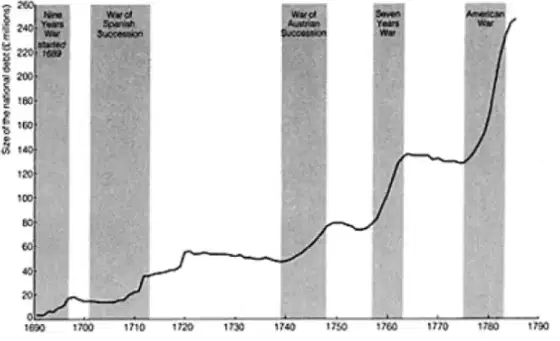
A thesis that this document could be used to support would be:
(the note on the side says "Size of the National Debt [of Britain] in the millions)
a)
"The British increased their attempts to tax the American colonists after 1763 in order to help pay off war debt."
b)
"British imperialist policy consistently produced a stable economic atmosphere."
c)
"Funding of the British war machine slowly declined prior to the Napoleonic Wars."
d)
"The British government enforced a balanced budget rule throughout the 1700s."
55.
The Enlightenment:
a)
was an intellectual movement on both sides of the Atlantic that demanded the natural rights of the people be secured by governments
b)
was a pamphlet written by Thomas Paine that helped sever the American colonists' love of their monarch, calling King George III a "royal brute"
c)
was a Protestant religious revival that gave American colonists a taste for resisting traditional authority
d)
a document created by a committee of Americans representing each region of the former colonies, stating that reasons why the Americans were justified in revolution
e)
an ideology that prizes individual talent over hereditary privilege
56.
Common Sense:
a)
was an intellectual movement on both sides of the Atlantic that demanded the natural rights of the people be secured by governments
b)
was a pamphlet written by Thomas Paine that helped sever the American colonists' love of their monarch, calling King George III a "royal brute"
c)
was a Protestant religious revival that gave American colonists a taste for resisting traditional authority
d)
a document created by a committee of Americans representing each region of the former colonies, stating that reasons why the Americans were justified in revolution
e)
an ideology that prizes individual talent over hereditary privilege
57.
The First Great Awakening:
a)
was an intellectual movement on both sides of the Atlantic that demanded the natural rights of the people be secured by governments
b)
was a pamphlet written by Thomas Paine that helped sever the American colonists' love of their monarch, calling King George III a "royal brute"
c)
was a Protestant religious revival that gave American colonists a taste for resisting traditional authority
d)
a document created by a committee of Americans representing each region of the former colonies, stating that reasons why the Americans were justified in revolution
e)
an ideology that prizes individual talent over hereditary privilege
58.
The Declaration of Independence was:
a)
was an intellectual movement on both sides of the Atlantic that demanded the natural rights of the people be secured by governments
b)
was a pamphlet written by Thomas Paine that helped sever the American colonists' love of their monarch, calling King George III a "royal brute"
c)
was a Protestant religious revival that gave American colonists a taste for resisting traditional authority
d)
a document created by a committee of Americans representing each region of the former colonies, stating that reasons why the Americans were justified in revolution
e)
an ideology that prizes individual talent over hereditary privilege
59.
Meritocracy was:
a)
was an intellectual movement on both sides of the Atlantic that demanded the natural rights of the people be secured by governments
b)
was a pamphlet written by Thomas Paine that helped sever the American colonists' love of their monarch, calling King George III a "royal brute"
c)
was a Protestant religious revival that gave American colonists a taste for resisting traditional authority
d)
a document created by a committee of Americans representing each region of the former colonies, stating that reasons why the Americans were justified in revolution
e)
an ideology that prized individual talent over hereditary privilege, popular among American colonists
60.
American advantages during the Revolutionary War included:
a)
a commitment to securing freedom and their way of life, "homefield advantage", and possible assistance from European allies
b)
a well-trained military, the world's most powerful navy, a government that could raise funds, Loyalists on their side
c)
a better ability to supply their military, holding all of the most important cities in America at some point in the war (NYC for the entirety almost), professional soldiers
61.
American disadvantages during the Revolutionary War included:
a)
a homefront with deep divisions, no government that was able to raise sufficient funds, soldiers serving only one year at a time, supply shortages
b)
public opinion that wearied of a distant, prolonged war; lack of knowledge of the terrain
62.
The Battle of Saratoga:
a)
helped secure the Americans a foreign ally in France
b)
represented the lowest point for American military leaders during the war
c)
was the first battle where the Americans won
d)
was where Washington's armies re-crossed the Delaware River to meet a force of Hessian mercenaries...and they won!
63.
George Washington's leadership genius was seen in his:
a)
ability to keep the Continental Army from being pinned down and captured by the British...which would have effective ended the Revolution
b)
ability to many consecutive decisive victories in a row
c)
ability to inspire confidence in the Continental Congress, so that there was never doubt that he was the best man for the job
d)
personally financing the entirety of the war, so that Congress could focus on diplomatic matters
64.
In the Treaty of Paris of 1783:
a)
Britain recognized American independence
b)
Britain denied the Northwest Territories to the American government
c)
America agreed to pay all of Britain's previous war debt from its four wars against France
d)
Britain emerged victorious
65.
The American Revolution and the ideals set forth in the Declaration of Independence reverberated in France, Haiti, and Latin America, inspiring future independence movements.
a)
True
b)
False
66.
The Quakers:
a)
called for the end of slavery before and during the Revolution, even going as far to manumit their own slaves in the process
b)
generally were pro-war jingoists and expansionists in the Revolutionary Era
c)
called for an end to the temperance movement
d)
stood in the way of educating women, as they believed that men should be the only ones to teach republican values to the next generation
67.
Republican Motherhood:
a)
believed that women should be empowered, through higher education, to teach republican values to the next generation
b)
claimed that women were under the legal covering of their husbands and could not inherit property while married
c)
demanded women have access to industrial jobs that were gaining in great numbers during the French and Indian War
d)
was primarily an anti-slavery movement
68.
The abolition of primogeniture and entail in the new American states:
a)
tended to promote greater economic equality
b)
reinforced old British notions that heredity was the most important factor in determining self-worth
c)
created an immediate redistribution of wealth when the Loyalists exited the new American nation after independence was secured
d)
prevented movement west passed the Appalachian Mountains
69.
American citizens of the immediate post-war era possibly had more freedoms than any other nation on the planet, at that time.
But this atmosphere of equality had its limits. Which of the following is true?
a)
there was no widespread movement across the USA to grant citizenship to Native Americans nor to protect their lands from white encroachment
b)
there was no movement to abolish slavery, especially from white religious groups, after the Revolutionary War
c)
few women desired to pursue higher education and there were literally zero institutions of higher learning founded for them in the post-Revolutionary period
d)
social upward mobility was impossible, as there was little economic opportunity in America, compared to Russia, China, or India
70.
The newly formed US state governments tended to put more power into which state institution, due to fears remaining of British monarchical overreach?
a)
state legislatures
b)
state executive officers, like a governor
c)
state judicial branches
d)
state armies and militias
71.
The Articles of Confederation:
a)
helped secure America's independence diplomatically and created processes of organized westward expansion
b)
created a strong central government
c)
created an executive branch with the ability to veto Congressional and state laws
d)
saw increased peace and economic conditions in the mid-1780s
72.
The Articles of Confederation:
a)
created a weak central government that only had one branch (legislature)
b)
gave Congress too great a power to tax citizens
c)
had the power to regulate interstate commerce, but not the will to regulate interstate commerce
d)
had been ratified immediately upon America declaring independence, with no states, not even Rogue's Island, holding out
73.
The Northwest Ordinance did NOT:
a)
admit Vermont, Kentucky, or Tennessee into the Union
b)
ban slavery in the Northwest Territories
c)
promote public education in the Northwest Territories
d)
protect private property in the Northwest Territories
74.
Shays' Rebellion:
a)
sparked fears in American leaders, so much so that they convened in Philadelphia in 1787 in order to create a new government that would provide more stability
b)
is grammatically and punctuationally incorrect, as the apostrophe should be placed BEFORE the second "s"
c)
was primarily a religious conflict between Protestants and Catholics
d)
prompted the veto of the Northwest Ordinance, due to the controversial banning of slavery clause therein
75.
The Constitutional Convention included:
a)
representatives from all 13 states, even Rogue's Island
b)
mostly poor and uneducated representatives of the people, as Americans wanted the common man to make a new form of government
c)
all abolitionists and no slave owners
d)
only representatives from the large, powerful states
76.
The Three-Fifths Clause was:
a)
a compromise over slavery that gave Southern states some increased power in the selection of president and the House, but also slightly increased their taxation proportions
b)
the effective banning of slavery throughout all the territories (but not the states)
c)
a compromise between the states with large populations and the states with small populations over the matter of representation in the House
d)
set a limit on how long the US would allow slaves to be imported from foreign nations
77.
Anti-Federalists:
a)
demanded a Bill of Rights to limit the power of the new national government
b)
desired the ability of the national government to raise taxes on more items than British Parliament had been able to do
c)
believed that it was dangerous to list protected rights in a constitution, as only the ones written down would ever be protected
d)
tended to represent the merchant class and Southern elite landowning planters
78.
Federalists:
a)
supported the ratification of the US Constitution
b)
feared standing armies more than Anti-Federalists
c)
never did support amendments to the US Constitution
d)
feared central government powers
79.
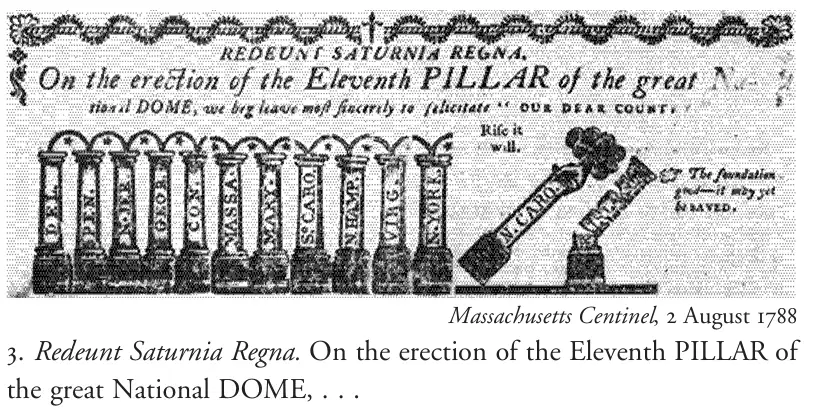
The image below is a primary source document that could be used to support which of the following statements best?
a)
"The ratification of the US Constitution was encouraged by the publication of the Federalist Papers and by the promise of Federalists to ratify a bill of rights."
b)
"Anti-Federalists won the debate, since the Constitution was not ratified by all the states."
c)
"There was little interest in the young United States to increase the strength of the national government."
d)
"Rhode Island joined the ratification team early on, in order to secure its place as a leader in public policy."
80.
The U.S. Constitution:
a)
strengthened the national government, making it stronger than the Articles of Confederation Congress, but still provided for government that was limited in power
b)
distanced the United States from ideas like separation of powers, checks and balances, and federalism
c)
denied Congress the power to tax, the power to ratify treaties, and the power to impeach executive officers...all in the name of "limited government"
d)
contained few compromises, instead favoring only wealthy, elite small-state, slaveholding interests
81.
Jay's Treaty:
a)
ensured that the British would withdraw their troops from the Northwestern forts (even though they should have already done so with the Treaty of Paris of 1783)
b)
ensured the right of deposit for American farmers in New Orleans
c)
ceded the Louisiana Purchase to France
d)
initiated the War of 1812 with Great Britain
82.
Pinckney's Treaty:
a)
ensured that the British would withdraw their troops from the Northwestern forts (even though they should have already done so with the Treaty of Paris of 1783)
b)
ensured the right of deposit for American farmers in New Orleans
c)
ceded the Louisiana Purchase to France
d)
initiated the War of 1812 with Great Britain
83.
The Jeffersonian POV on the French Revolution was:
a)
that it was an assault on law and order, Christianity, even civilization itself
b)
something that the United States government should support, given the alliance that the US had with France and given that the French were resisting monarchy, just like the US had done to Britain
c)
neutrality
d)
supporting Citizen Genet in his quest for soldiers and supplies from the US
84.
The official position that Washington took on the French Revolution was:
a)
that it was an assault on law and order, Christianity, even civilization itself
b)
something that the United States government should support, given the alliance that the US had with France and given that the French were resisting monarchy, just like the US had done to Britain
c)
neutrality
d)
supporting Citizen Genet in his quest for soldiers and supplies from the US
85.
Which was true of American relations with Indian tribes during the first 30 years of the American government?
a)
the Battle of Fallen Timbers helped secure peace in the Northwest Territories and give Washington some political credibility among Congress
b)
Native Americans were granted American citizenship in the Indian Intercourse Act
c)
surprisingly there we no Native tribes that began to attempt inter-tribal cooperation
d)
the American policy officially was to steal as much land from Native tribes as possible
86.
Washington's Farewell Address (click two, no partial credit)
a)
cautioned against the strife caused by political factions
b)
cautioned against entangling American in European affairs
c)
welcomed the Two Party System as a necessary force in ensuring that two sides will be heard on every issue
d)
championed the idea of alliances with European powers, so that Americans could reap the economic benefits of such agreements
87.
The Quasi-War with France:
a)
saw Federalists attempt to undermine the freedom of press and speech of their Jeffersonian rivals
b)
saw John Adams' popularity never get above a 20% approval rating
c)
bankrupted the French government, allowing Britain to win the Napoleonic Wars
d)
was started by Americans impressing French naval troops on the high seas
88.
The Virginia and Kentucky Resolutions:
a)
were a source of the intellectual roots of interposition, nullification, and secession
b)
approved of the Alien and Sedition Acts
c)
were written by Hamilton and Burr together in a rare moment of unity
d)
supported the actions of Federalists under John Adams
Reset

