
 Worksheets
Immunology Quiz
Total questions: 99
Worksheet time: 50mins
Which scientist is credited with the development of the smallpox vaccine?
Edward Jenner
Louis Pasteur
Robert Koch
Alexander Fleming
What is the main focus of Germ theory as proposed by Louis Pasteur?
Microorganisms are the cause of disease
Vaccines are made from plants
Diseases are caused by bad air
Immunity is inherited
Which of the following is NOT listed as a main content area in Immunology?
Cytokin
Miễn dịch dịch thể
Photosynthesis
Hệ thống bổ thể
During which period were the structures of antibodies and the roles of Lympho B and T cells discovered?
1940-1960
1822-1895
1980-2000
1975
Which of the following is a goal of studying immunology according to the document?
To explain the basic concepts of immunology
To learn about plant biology
To study chemical reactions
To understand the solar system
Which scientist is associated with the development of vaccines for rabies and anthrax?
Louis Pasteur
Edward Jenner
Jonas Salk
Albert Sabin
What major advancement in immunology occurred between 1980 and 2000?
Discovery of cytokine, MHC, receptor, and vaccine DNA
Invention of the microscope
Discovery of penicillin
Development of X-ray technology
Which of the following is a technique used in basic immunological testing?
Các kỹ thuật xét nghiệm miễn dịch cơ bản
Photosynthesis
DNA replication
Protein synthesis
What does the term "miễn dịch đặc hiệu" refer to?
Specific immunity
General health
Cell division
Blood circulation
Which era is known for the development of monoclonal antibodies and diagnostic immunology?
1975
1822-1895
1940-1960
1980-2000
Which of the following best describes the focus of immunology?
The study of plant growth and development
The study of mechanisms of resistance, both specific and non-specific, against foreign invasion
The study of chemical reactions in the body
The study of animal behavior
What is the main difference between innate and adaptive immunity?
Innate immunity is slower than adaptive immunity
Adaptive immunity is non-specific, while innate immunity is specific
Innate immunity provides immediate response, while adaptive immunity develops over time
Both provide immediate response
How soon does the innate immune response occur after infection?
After 24 hours
After 1 week
Immediately and within the first few hours (0 to 12 hours)
After 1 month
Which of the following is NOT a main component of innate immunity?
Epithelial barriers
Phagocytes
B lymphocytes
NK cells
What is the primary function of phagocytes in the innate immune system?
Produce antibodies
Swallow and destroy pathogens
Block physical entry of pathogens
Activate T cells

Which type of immunity develops more slowly and is highly specific to pathogens?
Innate immunity
Adaptive immunity
Humoral immunity
Cell-mediated immunity
Which cells are responsible for producing antibodies in the adaptive immune system?
T lymphocytes
B lymphocytes
NK cells
Phagocytes
What is the main difference in the evolutionary process between innate and adaptive immunity?
Innate immunity evolves in vertebrates only
Adaptive immunity is present from birth
Innate immunity develops early from cells
Adaptive immunity develops automatically in vertebrates with bones
Which of the following best describes the role of Effector T cells in cell-mediated immunity?
They produce antibodies to neutralize pathogens
They directly destroy infected cells
They act as physical barriers to infection
They help phagocytes engulf pathogens
(DoK Level 2) How do humoral and cell-mediated immunity differ in their approach to fighting pathogens?
Humoral immunity uses antibodies, while cell-mediated immunity uses effector T cells to directly kill infected cells.
Both use antibodies to neutralize pathogens.
Cell-mediated immunity produces antibodies, while humoral immunity destroys infected cells.
Both rely solely on phagocytes for pathogen destruction.
(DoK Level 3) In a scenario where a person is exposed to a virus for the first time, which immune response acts first and which provides long-term protection?
Innate immunity acts first due to its rapid, non-specific response; adaptive immunity provides long-term, specific protection.
Adaptive immunity acts first because it is highly specific; innate immunity provides long-term protection.
Both innate and adaptive immunity act simultaneously and provide equal long-term protection.
Only adaptive immunity acts, as innate immunity does not respond to viruses.
Which of the following is a component of innate (bẩm sinh) immunity?
Lysozyme
Antibodies (Kháng thể)
Lymphocytes (Lymphô bào)
Memory cells
What type of immune cell is primarily involved in adaptive (thích nghi) immunity?
Lymphocytes (Lymphô bào)
Mast cells (Tế bào mast)
Macrophages (Đại nhân thực bào)
Neutrophils (Bạch cầu hạt)
Which of the following best describes the response time of innate immunity compared to adaptive immunity?
Innate immunity responds immediately, while adaptive immunity takes time.
Both respond immediately.
Adaptive immunity responds immediately, while innate immunity takes time.
Both take time to respond.
In the case study, why does Bé Nam not need to worry about getting chickenpox (Thủy đậu) again after recovering?
Because his immune system has formed memory cells that provide long-term protection.
Because chickenpox virus cannot infect the same person twice.
Because he will receive a vaccine after recovery.
Because his mother will protect him from future infections.
Analyze why the immunity provided to Bé Bông (3 months old) through breast milk is considered "natural passive immunity."
Because the antibodies are transferred naturally from mother to child without the child’s immune system producing them.
Because the child is vaccinated.
Because the child produces its own antibodies.
Because the child is exposed to the virus directly.
Compare and contrast the effectiveness of the secondary immune response in adaptive immunity with the primary response.
The secondary response is faster, stronger, and more effective than the primary response.
The secondary response is slower and less effective than the primary response.
Both responses are equally effective.
The primary response is faster and more effective than the secondary response.
Which type of immunity involves the baby receiving antibodies that are already made, such as through breast milk?
Passive immunity
Active immunity
Artificial immunity
Cellular immunity
What is the main characteristic of natural immunity in newborns?
It is acquired through medical intervention
It is passed through natural biological processes like breast milk or placenta
It is permanent and lasts a lifetime
It is only present in adults
Which immunoglobulins are mainly involved in temporary immunity passed from mother to child?
IgA and IgG
IgM and IgE
IgD and IgM
IgE and IgD
What happens to the temporary immunity in babies after 3-6 months?
It becomes stronger
It remains unchanged
It gradually declines as the antibodies degrade
It transforms into active immunity
Which cells and products are involved in adaptive (specific) immunity?
Lymphocytes and antibodies
Red blood cells and platelets
Neutrophils and macrophages
Plasma and hormones
Which of the following is NOT a characteristic of adaptive immunity (MDĐH)?
Specificity for self and non-self structures
Effectiveness
Diversity
Lack of immune memory
What is the function of immune memory in adaptive immunity?
To forget previous infections
To remember and respond more effectively to previously encountered antigens
To produce red blood cells
To destroy all cells indiscriminately
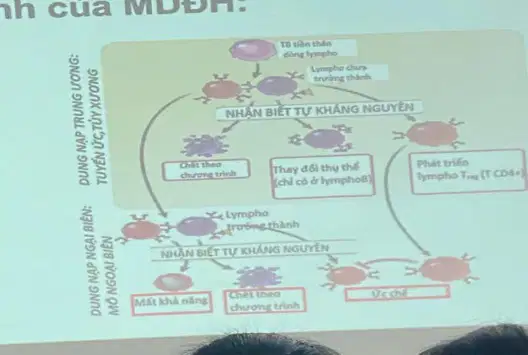
Which organ is mentioned as being involved in central tolerance (immune education)?
Thymus and bone marrow
Liver and spleen
Kidney and pancreas
Heart and lungs
Which of the following is NOT a possible outcome for a cell after it recognizes a self-antigen?
Programmed cell death
Change in receptor (only in B lymphocytes)
Uncontrolled cell division
Lymphocyte development
What happens to mature lymphocytes in peripheral tissues after they recognize a self-antigen?
They gain new abilities
They lose their function
They divide rapidly
They produce antibodies
Which process describes the ability of each B and T lymphocyte clone to respond to a specific antigen?
Clonal selection
Programmed cell death
Antigen presentation
Phagocytosis
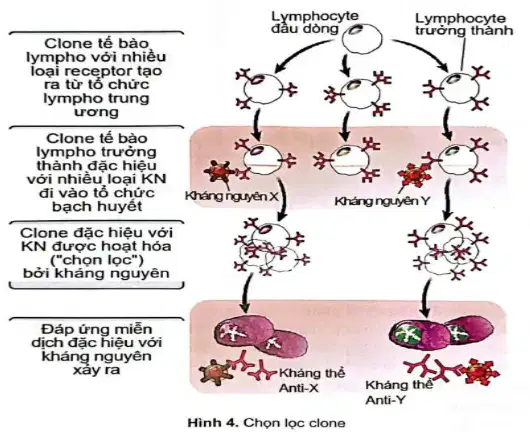
Which concept explains the body's ability to produce millions of different specific immune cells after exposure to an antigen?
Immune tolerance
Clonal diversity
Antigenic drift
Passive immunity
Why is it important for lymphocytes to undergo programmed cell death after recognizing self-antigens?
To prevent autoimmune reactions
To increase antibody production
To promote inflammation
To enhance phagocytosis
Which type of cell creates multiple different clones of mature lymphocytes?
Red blood cells
TB precursor lymphocyte cells
Platelets
Macrophages
What is the main function of a mature lymphocyte clone that has been programmed for a specific antigen?
It produces hormones
It reacts with a specific antigen and produces a corresponding antibody
It digests food particles
It transports oxygen
Which antibody is primarily produced during the initial immune response (first exposure to an antigen)?
IgA
IgE
IgM
IgD
What is the main difference between the first and second immune response to the same antigen?
The first response is faster and stronger
The second response is slower and weaker
The second response is faster and more effective
Both responses are identical
Which immunoglobulin is produced after IgM in the primary immune response?
IgA
IgE
IgG
IgD
What is the application of optimizing the cellular immune response mentioned in the text?
Treating diabetes
Vaccine development
Enhancing digestion
Improving vision
Which type of cell is responsible for producing antibodies during the primary immune response?
Lympho B chưa hoạt hóa
Tương bào có đời sống ngắn
Lympho B trí nhớ
Lympho T
What is the main type of antibody produced during the secondary immune response?
IgA
IgM
IgG
IgE
During the secondary immune response, which cell is quickly activated due to previous exposure to the antigen?
Lympho B chưa hoạt hóa
Tương bào có đời sống ngắn
Lympho B trí nhớ
Lympho T
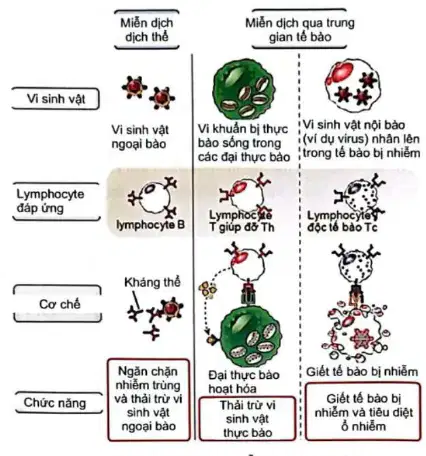
Which immune response is characterized by the secretion of antibodies and is effective against extracellular microorganisms?
ĐƯMD qua trung gian tế bào
ĐƯMD dịch thể
Đáp ứng miễn dịch lần hai
Đáp ứng miễn dịch lần đầu
Which type of immune response involves many types of lympho T and is effective against intracellular microorganisms?
ĐƯMD dịch thể
Đáp ứng miễn dịch lần hai
ĐƯMD qua trung gian tế bào
Đáp ứng miễn dịch lần đầu
Why is the secondary immune response faster than the primary immune response?
Because more antibodies are produced
Because Lympho B trí nhớ cells are already present
Because the antigen is weaker
Because Tương bào có đời sống ngắn are more active
Which cell type has a long lifespan and is found in the bone marrow, producing antibodies at high concentrations for a long duration?
Tương bào có đời sống ngắn
Lympho B chưa hoạt hóa
Lympho B trí nhớ
Lympho T
Which type of immunity protects a newborn baby from diseases such as measles?
Passive immunity
Active immunity
Acquired immunity
Artificial immunity
What is the main function of innate (non-specific) immunity in the body?
Always present and blocks invasion and eliminates pathogens
Produces antibodies against specific pathogens
Remembers previous infections for faster response
Only works after vaccination
Which immunoglobulin (Ig) is responsible for passive immunity transferred from mother to baby?
IgG
IgA
IgM
IgE
Why did the 4-month-old baby not get measles after exposure, while the 5-year-old sibling did?
The baby received passive immunity from the mother
The baby was vaccinated
The baby had a stronger immune system
The baby was not exposed to the virus
How does maternal IgG provide protection to the newborn?
It crosses the placenta into the fetal blood
It is produced by the baby after birth
It is transferred through breast milk only
It is activated by vaccination
Which of the following is NOT a function of innate immunity?
Producing specific antibodies
Blocking invasion of pathogens
Eliminating pathogens
Creating conditions for adaptive immune response
Passive immunity is temporary and does not last a lifetime because:
the antibodies are not produced by the baby's own immune system
the antibodies are destroyed by the body immediately
the antibodies mutate quickly
the baby’s immune system rejects them
Which type of antibody is primarily transferred from mother to child through the placenta?
IgA
IgM
IgE
IgG
Why is the measles vaccine recommended for children at 9 months old rather than earlier?
Because the child’s immune system is fully developed at 9 months
Because maternal IgG antibodies may still be present before 9 months, reducing vaccine effectiveness
Because the vaccine is only available for children older than 9 months
Because children younger than 9 months cannot tolerate vaccines
Does the protection provided by maternal IgG antibodies last for a lifetime?
Yes, it lasts for a lifetime
No, it is only temporary and decreases over time
Yes, but only for certain diseases
No, it disappears immediately after birth
What is the main reason why person B does not get chickenpox again after having it at age 10?
He avoids contact with infected individuals
He has active natural immunity from previous infection
He takes regular medication
He receives annual vaccinations
Which cells are responsible for quickly recognizing the chickenpox virus upon re-exposure?
Red blood cells and platelets
Memory B cells and Memory T cells
Neutrophils and macrophages
Plasma cells and dendritic cells
What is the function of Memory B cells when re-exposed to the chickenpox virus?
They produce non-specific antibodies
They quickly recognize the virus and produce specific IgG antibodies
They destroy infected cells directly
They activate platelets
How does the immune system respond upon re-exposure to the chickenpox virus in someone who has had the disease before?
The immune system fails to respond
Memory cells activate quickly, producing specific antibodies to prevent symptoms
The immune system produces a general inflammatory response
The immune system requires several weeks to respond
Which type of immune response is mainly responsible for a rapid and strong reaction upon re-exposure to an antigen?
Primary Immune Response
Secondary Immune Response
Innate Immune Response
Passive Immune Response
What does the abbreviation SAT stand for in the context of tetanus treatment?
Serum Anti-Tetanique
Serum Anti-Tuberculosis
Serum Anti-Thrombosis
Serum Anti-Typhoid
Why is SAT/TIG administered immediately after a deep and dirty wound instead of a vaccine?
SAT/TIG provides direct antibodies to neutralize tetanus toxin immediately
SAT/TIG helps the body produce its own antibodies over time
SAT/TIG is less expensive than vaccines
SAT/TIG prevents all types of infections
If a person receives SAT/TIG after a wound, will they still be protected against tetanus one year later?
No, the protection is short-term and does not last for a year
Yes, SAT/TIG provides lifelong immunity
Yes, SAT/TIG stimulates memory cells for long-term protection
No, SAT/TIG only works for viral infections
What is the main function of specificity in the immune response?
Ensures that different antigens trigger distinct immune reactions
Increases the speed of immune response
Reduces the effectiveness of antibodies
Prevents the formation of memory cells
A tetanus vaccine is not used for immediate treatment of a deep, dirty wound because:
The vaccine takes time to stimulate the body to produce antibodies
The vaccine instantly neutralizes toxins
The vaccine is only for viral infections
The vaccine is more expensive than SAT/TIG
Which characteristic of the immune system allows it to respond to many different types of antigens?
A) Diversity
B) Memory
C) Specialization
D) Self-limitation
What is the functional significance of "Memory" in the immune system?
A) It leads to a stronger response upon repeated exposure to the same antigen.
B) It prevents the immune system from attacking self-antigens.
C) It allows the immune system to respond to new antigens.
D) It creates optimal responses against different microorganisms.
Which type of cell is classified as a Myeloid cell and participates in phagocytosis?
A) MAC (Macrophage)
B) NK cell
C) Mast cell
D) PMN (Polymorphonuclear neutrophil)
Which process is involved in the innate immune response to tissue damage?
A) Healing or Chronic inflammation
B) Antibody production
C) Cell division
D) Hormone secretion
Which of the following is NOT a function of innate immunity?
A) Production of interferons
B) Block and lysis of pathogens
C) Antigen-specific antibody production
D) Chronic inflammation
The characteristic of "Nonreactivity to self" benefits the immune system by:
It prevents damage to the body's own tissues during immune responses.
It allows the immune system to attack all antigens, including self.
It enhances the production of antibodies against self-antigens.
It increases the diversity of immune responses.
Which cells are involved in the process of phagocytosis in innate immunity?
A) Myeloid cells
B) Epithelial cells
C) Red blood cells
D) Platelets
The role of interferons in innate immunity is:
They help in the production of antibodies.
They are produced to help block and destroy pathogens.
They increase the number of red blood cells.
They are responsible for tissue repair.
Which type of cell is classified as a lymphocyte and is responsible for supporting specific immunity against all bacteria and viruses?
B cell
Red blood cell
Platelet
Macrophage
What is the main function of T cells in the immune system?
Oxygen transport
Activation and cytotoxicity
Blood clotting
Hormone production
Which immune cells are involved in the presentation of antigens to T cells?
Dendritic cells and MAC
Platelets and B cells
Red blood cells and NK cells
Neutrophils and eosinophils
What is the role of NK cells in the immune response?
Supporting cytotoxicity of T cells
Producing antibodies
Neutralizing toxins
Presenting antigens
Which process is described as blocking entry and neutralizing toxins in adaptive immunity?
Entry block and neutralization
Cytotoxicity
Activation
Presentation
B cells and T cells interact to produce a specific immune response by:
B cells activate T cells to produce antibodies
T cells help B cells to produce specific immunity against pathogens
B cells and T cells both produce toxins to kill pathogens
T cells and B cells do not interact in the immune response
Analyze the importance of antigen presentation in the activation of T cells.
It allows T cells to recognize and respond to specific pathogens
It helps B cells produce antibodies
It neutralizes toxins directly
It blocks the entry of pathogens
Both MAC and dendritic cells are involved in which function in the immune system?
Antigen presentation to T cells
Production of antibodies
Cytotoxicity
Neutralization of toxins
Evaluate the significance of cytotoxicity in the immune response.
It produces antibodies to neutralize pathogens
It helps eliminate infected or abnormal cells with the support of NK cells
It presents antigens to B cells
It blocks the entry of toxins
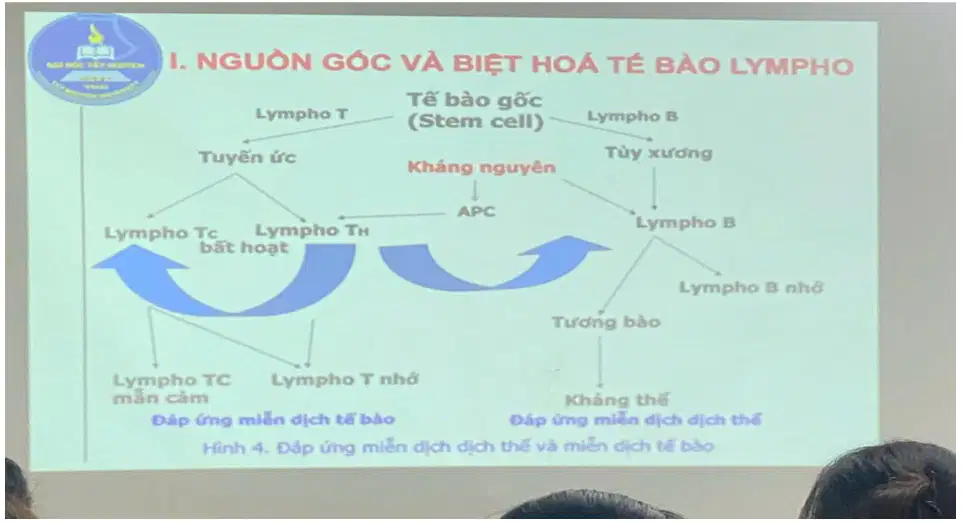
Where do Lympho T cells differentiate?
Thymus
Bone marrow
Spleen
Liver
Which type of cell is the origin for both Lympho T and Lympho B cells?
Stem cell
Red blood cell
Platelet
Macrophage
What is the role of Lympho TC mẫn cảm (sensitive cytotoxic T cell)?
Participates in cellular immune response
Produces antibodies
Transports oxygen
Stores fat
After differentiation in the bone marrow, what two types of cells can Lympho B become?
Lympho B and Lympho B memory
Lympho T and Lympho TC
Lympho TH and Lympho T memory
Macrophage and Neutrophil
Which cell type produces antibodies in the immune response?
Plasma cell (Tương bào)
Lympho TC
Lympho TH
Stem cell
The difference between the immune responses mediated by Lympho T cells and Lympho B cells is:
Both mediate humoral immunity.
Lympho T cells mediate cellular immunity, while Lympho B cells mediate humoral immunity.
Lympho T cells produce antibodies, Lympho B cells destroy infected cells directly.
Both mediate cellular immunity.
The process by which Lympho B cells become plasma cells and their role in the immune response is best described as:
Lympho B cells differentiate into plasma cells, which produce antibodies for humoral immune response.
Lympho B cells become macrophages and engulf pathogens.
Lympho B cells produce cytokines for cellular immunity.
Lympho B cells differentiate into red blood cells for oxygen transport.
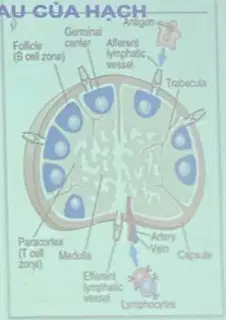
Which type of lymphocyte is primarily located in the B Cell Zone (Lymphoid Follicle) of a lymph node?
T cell
Dendritic cell
B cell
Macrophage
What are the main regions into which a lymph node is divided?
Cortex, paracortex, and medulla
Follicle, germinal center, and capsule
Cortex, follicle, and capsule
Paracortex, germinal center, and capsule

