
 Worksheets
Final Exam Study Guide MA 2415 Calculus 1
Total questions: 35
Worksheet time: 50mins

A) (-1, ∞)
B) [-1, ∞)
C) (-∞, ∞)
D) (0, ∞)
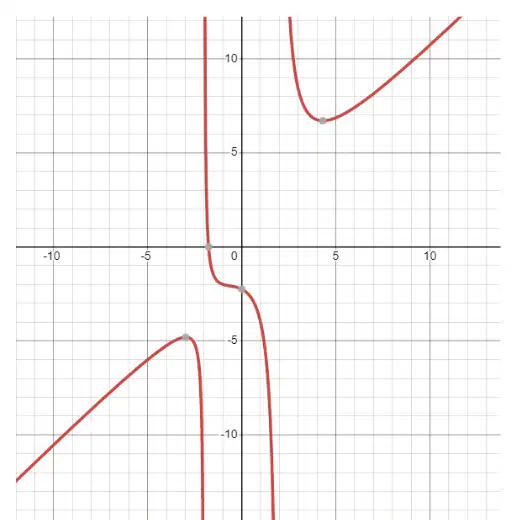
Determine the correct equation of the graph shown in the picture. (Hint: look for asymptotes)
f(x)=x2−4x3+2x+9
x2−4x2+2x+9
f(x)=x2−4x+9
f(x)=x−4x3+2x+9
Evaluate the left side limit: x→3−limx2−x−6x2−2
∞
-∞
3
0
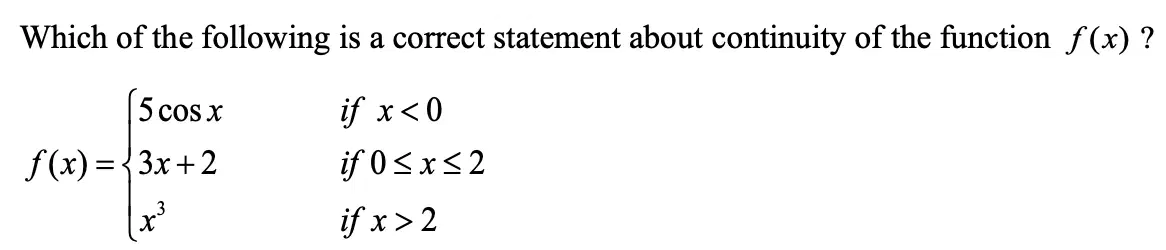
Which of the following is a correct statement about continuity of the function f(x)?
f(x) is continuous on (-∞, 2) ∪ (2, ∞)
f(x) is continuous on (-∞, 0) ∪ (0, ∞)
f(x) is continuous on (-∞, 0) ∪(0,2)∪(2, ∞)
f(x) is continuous on (-∞, ∞)
Find the slope of the tangent line at the given point: f(x) = (5x+1)e(x−2) at x = 2
16
21
11
5
Suppose that g(x) = f(-x + 1), for all x, and limx→1+f(x)=4 and limx→1−f(x)=6 . Find limx→0+g(x)
6
4
-4
-6
Evaluate the limit at infinity: limx→∞(e3x+e−3x)/2
-∞
1/2
∞
-1/2
Integrate: ∫ (4 + √x)/√x dx
8/√x + 1 + c
2√x + x + c
4/√x + x + c
8√x + x + c
Find the Linear Approximation L(x) of the function f(x) = tan(x) for values near π, and use it to approximate tan(3).
L(x) = x - 4π, tan(3) ≈ -9.5664
L(x) = x - π, tan(3) ≈ -0.1416
L(x) = 4x - π, tan(3) ≈ 8.8584
L(x) = x + π, tan(3) ≈ 6.1416
Use Newton’s method to calculate the zero of the function h(x) = cos(x) - 4x, until your answers converge to 3 decimal places. Use x₀ = 1.
0.250
0.243
0.087
-0.306
Calculate d/dx ∫4x2tln(t)dt
ln(x²)/x² - ln(16)/16
ln(16)/16
ln(x²)/(16x)
4 ln x/x
Suppose that the daily cost function for manufacturing air conditioners is c(x) = x3−6x2+12x . A factory currently produces 10 units per day. Use the marginal cost to find the extra cost to produce one more AC unit per day.
52 Yuan
192 Yuan
243 Yuan
520 Yuan
Find the derivative of the function f(x) = ln(cos(2x3))
f′(x)=−6x2/sin(2x3)
f′(x)=−6x2tan(2x3)
f′(x)=−6tan(2x3)
f′(x)=−sin(2x3)/cos(2x3)
Evaluate the definite integral ∫−4π4πsin5(x)dx :
0
2
1/24
1/(4√2)
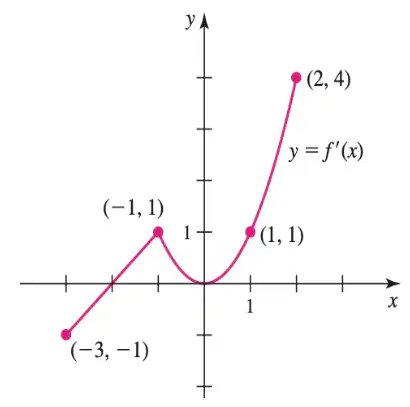
Consider the function f(x) depicted in the graph. Which two answers are correct?
f(x) is increasing on [-3, 1]
The critical points of f(x) are x = -1 and x = 0
The critical points of f(x) are x = -3, x = -1, x = 0 and x = 2
x = 0 is the absolute minimum and x = 2 is the absolute maximum
x = 0 is a local minimum and x = 2 is the absolute maximum
16. Given h(x) = 1/(x-4) on the interval [0, 3]. (a) The average rate of change of the function on the interval is: ______
-1/7
1/7
-1/4
1/4
16. Given h(x) = 1/(x-4) on the interval [0, 3]. (b) According to the mean value theorem, at which c-value(s) does the instantaneous rate of change of the function equal the average rate of change?
There is no such c-value in the interval [0, 3]
c = 2
c = 1
c = 2.5
16. Given h(x) = 1/(x-4) on the interval [0, 3]. (c) Using integration to calculate the average value of the function on the interval is:
-ln(4/7)
ln(4/7)
1/4
−31ln4
Consider the following function: f(x) = e(2/x) a) Find the domain of f(x): ________
x ≠ 0 (all real numbers except 0)
x > 0 (all positive real numbers)
x < 0 (all negative real numbers)
x ∈ ℝ (all real numbers)
Does the function f(x)=ex2 have any symmetry? If yes, which kind?
No symmetry
Even symmetry
Odd symmetry
Both even and odd symmetry
Consider the following function: f(x) = e(2/x) c) f'(x) = ?
f′(x)=−2e(2/x)/x2
f′(x)=2e(2/x)/x2
f′(x)=e(2/x)/x2
f′(x)=−e(2/x)/x
Consider the following function: f(x)=e(2/x)
f′′(x)=(4e(2/x)/x4)+(4e(2/x)/x3)
f′′(x)=(2e(2/x)/x3)−(4e(2/x)/x4)
f′′(x)=(4e(2/x)/x2)−(2e(2/x)/x3)
f′′(x)=(2e(2/x)/x2)+(2e(2/x)/x3)
Identify the possible critical points and inflection points for the function f(x) = e2/x .
Critical point at x = 0; inflection point at x = -1
Critical point at x = -1; inflection point at x = -2
No critical points; inflection point at x = -1
No critical points; inflection point at x = -2
Identify the open intervals on which the function f(x) = e2/x is increasing and decreasing.
f(x) is increasing on (-∞, 0) and decreasing on (0, ∞)
f(x) is increasing on (0, ∞) and decreasing on (-∞, 0)
f(x) is increasing on (-∞, 0)u(0, ∞)
f(x) is decreasing on (-∞, 0)u(0, ∞)
Identify any local maximum/local minimum points for the function f(x) = e2/x :
No local maximum or minimum points exist.
There is a local maximum at x = 1.
There is a local minimum at x = 0.
There are both a local maximum and minimum at x = 2.
On which open interval(s) is the graph concave up and concave down: _________________
Concave up on (-∞, 0), concave down on (0, ∞)
Concave up on (0, ∞), concave down on (-∞, 0)
Concave up on (-∞, -1), concave down on (-1,0)u(0, ∞)
Concave up on (-1,0)u(0, ∞), concave down on (-∞, -1)
Consider the following function: f(x) = e(2/x) i) f(x) has a Vertical Asymptote at: ________ and a Horizontal Asymptote at: _______
Vertical asymptote at x = 0; no horizontal asymptote
Vertical asymptote at x = 2; horizontal asymptote at y = 0
Vertical asymptote at x = 0; horizontal asymptote at y = 1
Vertical asymptote at x = 1; horizontal asymptote at y = 0
Consider the following function: f(x) = e(2/x) Calculate: limx→0−e(2/x) = _____ and limx→0+e(2/x) = _____
(x→0−)lime(2/x)=0 , (x→0+)lime(2/x)=∞
(x→0−)lime(2/x)=∞ , (x→0+)lime(2/x)=0
(x→0−)lime(2/x)=∞ , (x→0+)lime(2/x)=∞
(x→0−)lime(2/x)=0 , (x→0+)lime(2/x)=0
The graph of the function f(x) = ex2 includes which of the following features?
An asymptote at x = 0
A maximum at x = 0
A minimum at x = 2
A zero at x = 1
Given the function f(x)=x4−3x2 , what is the Net Area between the x-axis and the function between x = -1 and x = 1?
4/5
-8/5
8/5
-4/5
Given the function f(x)=x4−3x2 , find the Total Area between the x-axis and the function between x = -1 and x = 1.
4/5
-8/5
5/8
-5/8
Integrate the given function ∫03125−9x21dx and round your answer to 2 decimal places
The integral is 5.67
The integral is 3.14
The integral is 2.71
The integral is 1.66
Evaluate the following integral: ∫etcsc2(et−7)dt
Let u = et−7 , then du/dt=et , so dt=du/et . Substitute: ∫ etcsc2(u) dt = ∫ csc2(u) du = −cot(u)+C = −cot(et−7)+C
Let u = et−7 , then du/dt=et , so dt=du/et . Substitute: ∫ etcsc2(u) dt = ∫ csc2(u) du = tan(u)+C = tan(et−7)+C
Let u = e^t - 7, then du/dt = e^t, so dt = du/e^t. Substitute: ∫ etcsc2(u) dt = ∫ sec2(u) du = tan(u)+C = tan(et−7)+C
Let u = et−7 , then du/dt=et , so dt=du/et . Substitute: ∫ etcsc2(u) dt = ∫ csc2(u) du = cot(u)+C = cot(et−7)+C
Evaluate the following definite integral ∫011+x2tan−1x dx
π2/32
π2/8
π2/4
π2/16
The solutions for the Exam 2 Practice Problems will be posted on Sunday at 2 PM, and attendance for next Monday’s class is optional. For next Monday, what format would you prefer?
I prefer to self-study and will not attend class.
I prefer an in-class review and will attend class.
I prefer an in-class review plus office hours (with selected questions for me to go over).

