
 Worksheets
NFPA 14 (4th Quarter 2025)
Total questions: 24
Worksheet time: 12mins
During a school fire safety inspection, Arthur and Jorge notice that someone is responsible for enforcing the requirements of the NFPA standards. In this context, what does the term "Authority Having Jurisdiction (AHJ)" refer to?
A government agency responsible for fire safety
An organization or individual responsible for enforcing requirements of a code or standard
A committee that drafts NFPA standards
A private company that inspects fire safety equipment
Martin and David are reviewing NFPA standards for a safety project. They come across the term "Shall" in the document. What does the term "Shall" indicate in NFPA standards?
A recommendation
A mandatory requirement
A suggestion
A guideline
Jorge and David are selecting steel pipes for a school project that will operate at pressures up to 300 psi (20.7 bar). According to Section 4.2.4, what is the minimum nominal wall thickness they should choose?
Schedule 10
Schedule 20
Schedule 30
Schedule 40
Before David and Jeremy begin any welding on fittings referenced in section 4.4.2.3.1 at their workshop, what is required?
A qualified welding procedure prepared and qualified by the contractor or fabricator
A full penetration groove weld
A circumferential butt joint
A reducing fitting
Martin and Jorge are installing a semiautomatic fire suppression system in their school's science lab. What standard must all wiring for actuation of semiautomatic systems comply with?
NFPA 72
NFPA 13
NFPA 25
NFPA 101
During a fire safety drill at their school, Jorge and Arthur are learning about the semiautomatic standpipe system. What is the purpose of the automatic water control valve in this system?
To regulate water temperature
To provide hydraulic or mechanical means for operation
To monitor water pressure
To prevent water leakage
Jeremy and Arthur are inspecting a building's fire safety equipment. What is the required hose connection size for a Class I standpipe system?
1 in. (25.4 mm)
1½ in. (40 mm)
2 in. (50 mm)
2½ in. (65 mm)
During a fire safety workshop, Timmie and Jorge are discussing building requirements. What type of standpipe system is required in buildings classified as high-rise?
Manual only
Automatic or semiautomatic
Non-interlock systems only
Double interlock systems only
Jorge and Arthur are helping to install a dry pipe sprinkler system in their school's science lab. As per section 5.2.1.4.3.2, what is the purpose of a check valve in the air filling connection?
To prevent backflow of water
To increase air pressure
To reduce system maintenance
To allow faster water flow
During a fire safety inspection at their school, Jorge and David are asked what is required for system water supply valves, isolation control valves, and other valves in feed mains to be supervised. What should they answer?
A listed indicating-type valve and check valve
A local signaling service that initiates an audible signal at a constantly attended location
Valves plainly marked to indicate the service they control
A sign indicating the portion of the system controlled by the valve
Martin and Jorge are inspecting a building's fire pump installation. As per section 6.7, what is the purpose of the sign provided in the vicinity of the pump?
To indicate the location of the fire department connection
To indicate the minimum pressure and flow required at the pump discharge flange
To indicate the type of sprinkler system installed
To indicate the water supply source
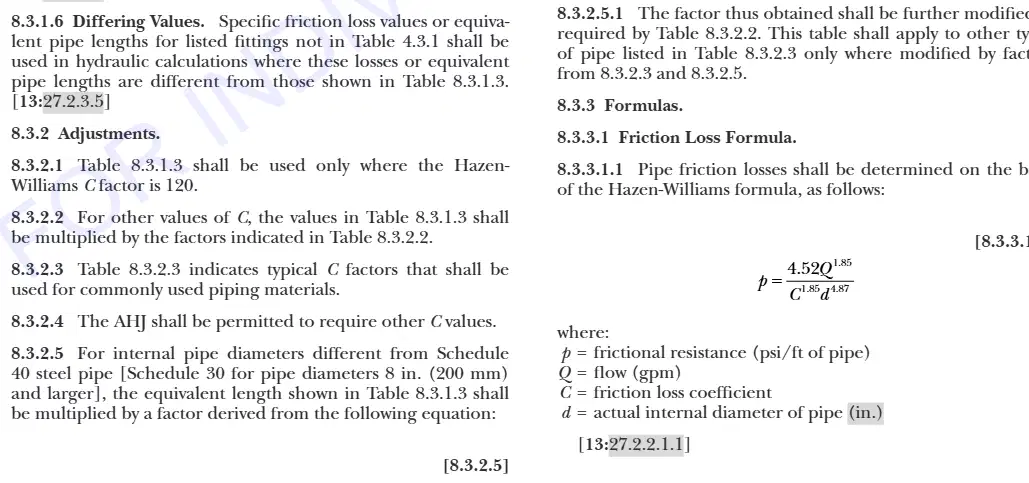
Martin and Jeremy are working together to design a water supply system for their school. They need to calculate the pipe friction losses using the Hazen-Williams formula. What is the formula they should use?
p = C1.85d4.874.52Q1.85
p = C1.85d2.874.52Q1.85
p = C1.85d3.874.52Q1.85
p = C1.85d5.874.52Q1.85
David and Jorge are installing fire hoses in their school's new science building. What is required to verify hose threads for compliance?
Approval from the contractor's personnel
Verification with local fire department
Inspection by the owner's representative
Certification from NFPA
Jorge and Martin are inspecting underground piping at their school and need to perform a hydrostatic test according to NFPA standards. What is the required pressure for this test?
100 psi
200 psi
50 psi
300 psi
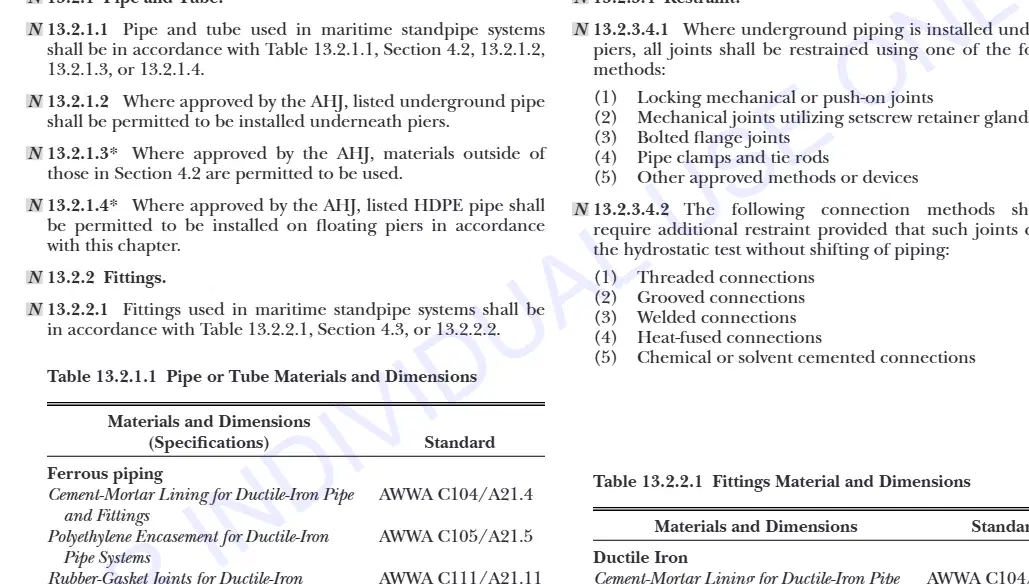
Jeremy and Martin are helping to install safety equipment at a local marina. What is the primary application of maritime standpipes and hose systems as described in Chapter 13?
Installation of underground water pipes in residential areas
Installation of standpipes and hose systems at marinas, boatyards, marine terminals, piers, docks, and wharves
Installation of fire suppression systems in commercial buildings
Installation of irrigation systems in agricultural fields
David and Jorge are inspecting a building's fire safety system. When a standpipe system supplies three or more hose connections, what is the minimum flow rate for the hydraulically most demanding horizontal standpipe?
250 gpm (946 L/min)
500 gpm (1893 L/min)
750 gpm (2840 L/min)
1000 gpm (3785 L/min)
During a fire safety inspection, David and Martin are checking the signage near the fire department connection. What information must be included on the sign according to NFPA standards?
The type of standpipe system and required pressure
The building's address and owner name
The minimum flow rate and pressure required at the fire department connection
The installation date of the standpipe system
Jorge and Martin are inspecting a Class II standpipe system in a commercial building. What is the required hose connection size for a Class II standpipe system?
1½ in. (40 mm)
2½ in. (65 mm)
1 in. (25.4 mm)
2 in. (50 mm)
Martin and Jorge are checking the installation of a fire department connection at their school. According to NFPA standards, what is the minimum diameter required for the piping serving the fire department connection?
2½ in. (65 mm)
4 in. (102 mm)
3 in. (76 mm)
2 in. (50 mm)
During a fire safety inspection, David and Jeremy notice that the pressure gauge on a standpipe system is missing. What is the primary reason for installing a pressure gauge at the top of a standpipe riser?
To monitor water temperature
To indicate the type of standpipe system
To verify system pressure during testing and operation
To measure flow rate
Jorge and Arthur are reviewing the requirements for fire hose cabinets in their school's science building. According to NFPA standards, what must be provided inside a Class II hose cabinet?
A 1½ in. (40 mm) hose and nozzle
A sprinkler head
A fire extinguisher
A 2½ in. (65 mm) hose and nozzle
Timmie is ready to retire, as a matter of fact, he is already one foot out the door. At what age can Timmie retire without losing any benefits?
61 years old
Timmie anxiously awaits being able to sit at the deer blind and/or fishing hole everyday. At what age can Timmie take early retirement with losing some benefits?
55
Jorge and Arthur are both apprentices for 669. How long is the apprenticeship and how many lessons must be completed?
5 years, 212 lessons
5 years, 210 lessons
5 years, 213 lessons
5 years, 220 lessons

