
 Worksheets
U.S. Government: Constitutional Principles and Rights
Total questions: 43
Worksheet time: 22mins
Which of the following statements best reflects the deeper significance of due process protections in a constitutional democracy?
Due process grants elected officials the discretion to interpret laws in ways that support public order.
Due process limits arbitrary government actions by requiring fair procedures before laws are enforced against individuals.
Due process ensures all citizens receive the same economic opportunities from the government.
Which right is protected by the First Amendment to the U.S. Constitution?
The right to a trial by jury in civil cases
The right to free speech and freedom of religion
The right to own property without government interference
Based on the flyer, how is the Green Forward Party attempting to influence public policy?
By raising awareness about environmental issues through candidate messaging
By creating environmental laws without going through Congress
By funding clean energy projects directly
Select TWO statements that demonstrate how the U.S. Constitution might protect individual rights through limited government and the rule of law.
A police officer is fired for violating a suspect's Fourth Amendment rights
The Supreme Court declares a government surveillance program unconstitutional
How does the principle of limited government protect individual rights?
By restricting the powers of government through a written constitution
By dividing all power between the executive and legislative branches
Why is the Supreme Court’s power of judicial review important to the U.S. constitutional system?
It ensures that laws and executive actions comply with the Constitution
It allows the Court to create new laws when necessary
It enables the president to overrule federal court decisions
It prevents Congress from passing any new legislation
Which situations represent examples of a violation of due process rights? Select TWO correct answers.
Police obtain a warrant before entering a suspect’s home to collect evidence
A state court provides a public defender to someone who cannot afford a lawyer
A student is suspended from school without being told the reason or given a chance to respond
A suspect is arrested and immediately brought to trial without access to a lawyer
A city council holds a public hearing before passing a new zoning ordinance
Which principle ensures that government officials must follow the same laws as all citizens?
Rule of law
Checks and balances
Popular sovereignty
Separation of powers
Which scenario best demonstrates how an interest group can influence political change today?
A student voting in a national election
A mayor vetoing a city council bill
A business coalition lobbying for environmental deregulation
A celebrity running for public office
A person is arrested and held without being told the charges against them. Which constitutional principle is being violated?
Federalism
Judicial review
Due process
Equal protection
Which constitutional principle did the Supreme Court rely on in its decision in Miranda v. Arizona, and how did this reshape law enforcement practices?
The Fifth Amendment protection against self-incrimination; it required police to inform suspects of their rights before interrogation
The First Amendment freedom of speech; it protected suspects from being forced to answer questions
The Sixth Amendment right to a speedy trial; it required police to complete interrogations within 48 hours
The Eighth Amendment ban on cruel and unusual punishment; it outlawed psychological pressure during questioning
Based on Montesquieu’s ideas in The Spirit of the Laws, how did his views influence the structure of the U.S. Constitution?
Congress has supreme authority over judicial and executive powers
Each branch of government operates independently to protect liberty
The Supreme Court writes laws to balance its authority
The President leads all three branches of government to ensure unity
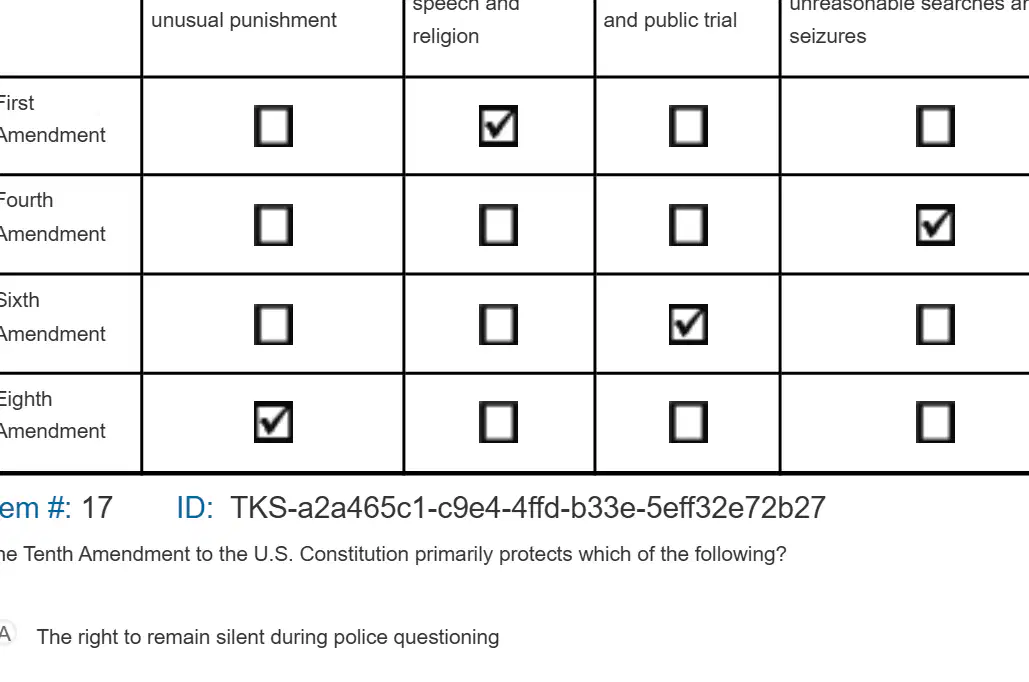
Match each right to the correct amendment in the Bill of Rights.
First Amendment — right to bear arms; Sixth Amendment — freedom of the press; Fourth Amendment — cruel and unusual punishment; Eighth Amendment — speedy trial
First Amendment — quartering of soldiers; Sixth Amendment — due process of law; Fourth Amendment — trial by jury; Eighth Amendment — freedom of religion
First Amendment — protection against unreasonable searches; Sixth Amendment — freedom of speech and religion; Fourth Amendment — speedy and public trial; Eighth Amendment — right to bear arms
First Amendment — freedom of speech and religion; Sixth Amendment — speedy and public trial; Fourth Amendment — protection against unreasonable searches; Eighth Amendment — protection from cruel and unusual punishment
The Tenth Amendment primarily states which principle?
Soldiers cannot be quartered in homes during peacetime
Freedom of the press is fully protected in all cases
Rights to remain silent during police questioning are guaranteed
Powers not delegated to the federal government are reserved to the states or the people
Unalienable rights in the Declaration of Independence are best described as rights that are given to all people and cannot be taken away by government.
given to all people and unable to be taken away
created by government and protected during peace
earned through citizenship and subject to majority rule
granted by courts and limited by elections
Which example shows an individual’s impact on political change in the United States?
A newspaper endorsing a presidential candidate
A political party holding a national convention
Martin Luther King Jr. leading the civil rights movement
A lobbying group buying television advertisements
Which is considered an unalienable right according to the Declaration of Independence?
The right to own property without restriction
The right to free public education
The right to life, liberty, and the pursuit of happiness
The right to vote in all elections
Which option correctly describes the structure of the U.S. federal court system?
One unified national court for all legal matters
A three-tiered system of district courts, courts of appeals, and the Supreme Court
A two-branch system of civil and criminal courts only
Independent state courts operating outside federal law
Select the three rights protected by the Fifth Amendment to the U.S. Constitution.
Right to remain silent; Protection from double jeopardy; Right to due process of law
Right to bear arms; Right to speedy trial; Right to remain silent
Protection against unreasonable searches; Freedom of speech; Protection from double jeopardy
Freedom of the press; Right to counsel in criminal cases; Due process of law
Which amendment protects against cruel and unusual punishment?
First Amendment protects speech and religion
Eighth Amendment prohibits cruel and unusual punishment
Fourth Amendment guards against unreasonable searches
Sixth Amendment ensures a speedy and public trial
A police search without a warrant or probable cause most directly raises issues under which amendment?
Sixth Amendment on public and speedy trials
Fourth Amendment on searches and seizures
Eighth Amendment on bail and punishments
First Amendment on speech and religion
Why is the federal judiciary described as three-tiered?
It alternates elected and appointed judges
It separates civil and criminal matters only
It divides courts by state population size
It includes trial, appellate, and supreme levels
How does the Fifth Amendment’s protection against double jeopardy operate?
A person is guaranteed a public jury trial
A person must always have a court-appointed lawyer
A person cannot be tried twice for the same offense
A person cannot be searched without a warrant
Which right is most closely connected to the concept of unalienable rights described in the Declaration?
Right to a government-provided attorney
Right to life that cannot be surrendered
Right to refuse quartering of soldiers
Right to vote for any office
Which of the following best explains why the United States has developed a two-party system?
Third parties are banned from appearing on presidential ballots.
Voters are only allowed to register as Democrat or Republican.
Winner-take-all electoral rules discourage the success of smaller parties.
The Constitution requires only two parties to exist at a time.
Supporters of judicial activism and judicial restraint often disagree on the role of the judiciary. Which of the following best describes a core argument made by supporters of judicial activism?
Courts should defer to state legislatures in all matters.
The Constitution should only be interpreted based on original intent.
The judiciary has a responsibility to correct injustices and expand rights when other branches fail to act.
Judges should avoid making any decision that could have broad social consequences.
Which statement best reflects the philosophy of judicial restraint?
Judges should make decisions based on personal political beliefs.
Judges should actively reinterpret the Constitution to address modern social issues.
Courts should avoid overturning laws unless they clearly violate the Constitution.
The judiciary should serve as the most powerful branch of government.
Complete the sentence: The principle of due process serves as a constitutional safeguard by requiring the government to __________ legal procedures before depriving individuals of rights and by __________ the potential for abuse of power.
ignore; expanding
ensure; limiting
circumvent; justifying
expedite; amplifying
Read the analysis: Throughout U.S. history, political changes have often resulted from the influence of key groups and institutions. During the 1960s, coverage of protests and violent responses in the South helped shift national opinion in favor of __________, showing the powerful role of __________ in shaping public perception and policy.
the Civil Rights Movement; the media
the #MeToo Movement; interest groups
the Civil Rights Movement; interest groups
the Tea Party Movement; political parties
Analyze how the media can influence public opinion during a major election and explain how that influence can affect public policy decisions.
By hiring campaign staff to directly change laws
By reporting only on one candidate’s platform to ensure their victory
By airing entertainment programs to reduce political stress
By shaping voter perceptions through coverage of candidates and issues
Which of the following is a significant way third parties have influenced U.S. politics?
They frequently replace one of the two major parties.
They control most state legislatures across the country.
They have consistently won a majority of seats in Congress.
They introduce new ideas and issues that are later adopted by major parties.
Which of the following best illustrates how due process both protects individual rights and limits government power?
A state passes a law increasing the minimum wage after a public referendum.
A court rules that a law allowing evidence obtained without a warrant is unconstitutional.
A city requires residents to obtain a permit before holding a parade on public property.
Congress holds a hearing to approve a presidential appointment to the Supreme Court.
Which effect of winner-take-all electoral rules most directly contributes to the persistence of the two-party system?
They mandate equal media coverage for all certified parties.
They require parties to register with federal agencies every election cycle.
They discourage voters from supporting candidates perceived as unlikely to win.
They guarantee proportional representation for minor parties.
Which argument would a proponent of judicial restraint most likely use when considering a law that is unpopular but constitutional?
Judges should defer to the legislature unless constitutional rights are clearly violated.
Courts should overturn the law to address public demands.
Judges should prioritize outcomes over adherence to precedent.
The judiciary should expand rights by broadly interpreting vague clauses.
Which statement best characterizes the two-party system in the United States since the mid-1800s?
It has prevented partisan shifts in Congress
It has permanently controlled state legislatures
It has eliminated regional party differences
It has alternated control of national institutions
Which feature commonly limits third parties’ electoral competitiveness in national races?
Control over primary election rules
Restricted ballot access across many states
Guaranteed spots in televised debates
Excessive public funding for campaigns
A presidential election is very close. A minor party candidate attracts votes from supporters who might otherwise back a major party. What is the most likely effect?
The Supreme Court appoints an interim president
Both major parties merge into one coalition
The Electoral College is automatically disbanded
The election outcome shifts by drawing votes away
Which reform is an example of an issue championed by third parties and later adopted nationally?
Direct election of U.S. senators through the Seventeenth Amendment
Abolition of the bicameral structure of Congress
Lifetime term limits for House representatives
Appointment of governors by the federal courts
Which TWO scenarios fall under federal court jurisdiction? Select the best answer.
A speeding citation on a county highway
A challenge to a city ordinance by local residents
A dispute between two states regarding water rights
A lawsuit between citizens of different states over $100,000
A robbery prosecuted under state criminal code
Which dispute would most clearly be heard in federal court due to diversity jurisdiction?
A contract suit between citizens of different states
A burglary charge against a local defendant
A zoning appeal for a city neighborhood
A noise complaint against a nearby stadium
In response to an environmental bill, which actor is most likely to meet privately with lawmakers to argue economic concerns?
A political party hosting a rally downtown
A national media outlet covering breaking news
An individual voter writing personal letters
An organized interest group representing industry
A media organization runs investigative pieces highlighting pollution impacts, increasing public attention to a bill. What policy role is the media demonstrating?
Setting the public agenda through issue framing
Appointing members to congressional caucuses
Enforcing statutory penalties on polluters
Negotiating floor amendments in committee
Which TWO statements describe ways third parties have influenced U.S. politics? Select the best answer.
They often determine election outcomes by drawing votes
They write most federal statutes passed by Congress
They elevate issues the major parties previously ignored
They nominate and confirm Supreme Court justices
They consistently win presidential elections nationwide

