
 Worksheets
Introduction to Automatic Control and PLCs
Total questions: 15
Worksheet time: 5mins
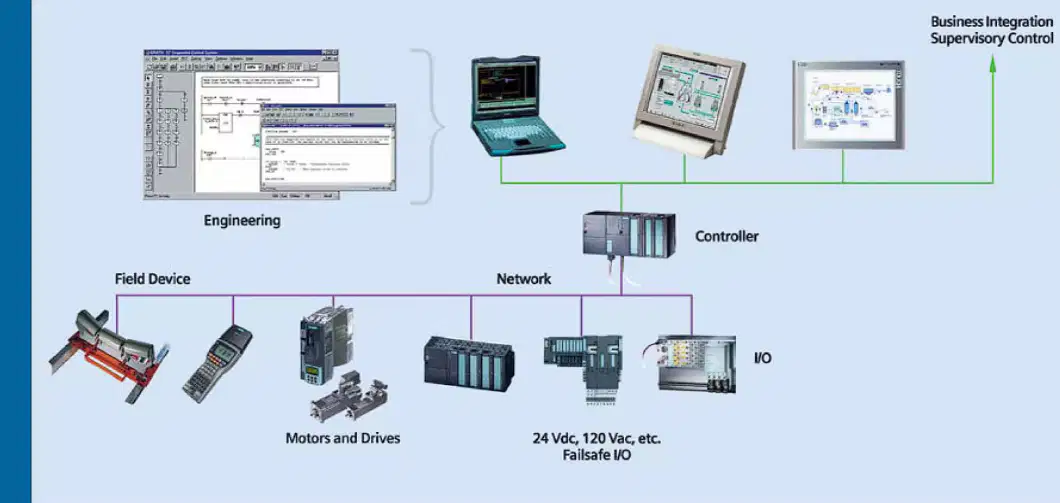
Which advantage of automatic control most directly increases production consistency in industrial systems?
Complete removal of supervisory software components
Guaranteed zero maintenance across the equipment lifetime
Eliminated need for sensors and actuators entirely
Reduced human decision variability across cycles
In a modular PLC, what is the primary role of the backplane bus?
Provide high-speed motion control signals
Store the ladder logic and retentive memory
Convert AC mains to regulated DC voltages
Distribute power and exchange data between modules
You add a new output module to a PLC rack. Which subsystem enables the CPU to communicate with this module without rewiring each signal to the CPU?
Ethernet switch for external devices
Dedicated CPU expansion cable
Isolated power rails on the chassis
Backplane bus across the rack
Looking at the slide with PLC disadvantages, which limitation can affect integrating modules from different vendors on the same backplane bus?
Closed architectures prevent third-party programming
Fixed circuit operations reduce runtime changes
Limited design and cost option increases budget
Proprietary devices restrict cross-compatibility
When a PLC transitions from logic solve to output scan, what is the expected effect on actuators?
Actuators change state to match computed results
Actuators reset due to bus synchronization
Actuators remain unchanged until next input scan
Actuators feed back inputs for next cycle

Which scenario best illustrates a PLC application in manufacturing and industrial automation?
Scheduling staff shifts using HR timekeeping software
Archiving maintenance manuals in a document server
Streaming training videos to operator tablets
Coordinating conveyor belts and robotic assembly lines
In a DCS, what does distributed functionality primarily achieve?
Moves all computation to a single historian server
Lower controller scan time across all loops
Segregates tasks among nodes to enhance reliability
Eliminates field wiring by using wireless sensors
What is the primary cabling used to interconnect LCN nodes, as depicted?
Twisted pair through RJ45 connectors
Fiber pairs with LC connectors
Coaxial segments via TEE connectors
Shielded CAT7 with PoE injectors
Which Honeywell platform forms the hybrid DCS used in the ethylene plant?
Standalone TPS without Experion
Only Experion PKS, no TPS parts
Legacy LCN without Experion bridge
TPS with Experion PKS integration
What is the primary role of the Operator's Console in the ethylene plant DCS?
Network routing configuration
Field device calibration tasks
Loop tuning only activities
Supervisory monitoring and control
In a hybrid Honeywell DCS, which two systems typically interact?
TPS subsystems and Experion servers
Profibus and Foundation Fieldbus
SCADA and PLC networks
MES and ERP platforms
Which server includes TPS components and communicates to TPS via Bridge?
Standalone GUS server station
LCN-native server module
Standard Experion server only
ESVT specialized Experion server
What capability does an ESVT node provide beyond standard Experion?
Native OPC UA historian exclusively
Wireless sensor commissioning
Advanced PID auto-tuning only
Initial Experion configuration support
HPM cabinet in Honeywell TPS typically houses which component?
High Performance Process Manager
Human Performance Monitor module
Hybrid Protocol Multiplexer unit
Hardware Protection Module device
What best describes data flow on an LCN under normal operation?
Strict token passing rings
Deterministic scheduled frames
Random contention like Ethernet CSMA/CD
Broadcast-only status messages

