
 Worksheets
SCI 330 Core Review
Total questions: 37
Worksheet time: 20mins
The amount of energy required to remove or lose an electron.
atomic radius
ionization energy
electronegativity
periodic trend

Which is the trend of ionization energy?
Up and Left
Down and Left
Up and Right
Down and Right
Order the following elements in order of increasing ionization energy:
Fr, F, S, Mg
F> S> Mg> Fr
Fr> Mg> S> F
Mg> S> F> Fr
Fr> Mg> S> F
Describes the size of an atom.
Electronegativity
Ionization Energy
Atomic Circumference
Atomic Radius
Describe the trend of atomic radius
Up and Left
Down and Left
Up and Right
Down and Left
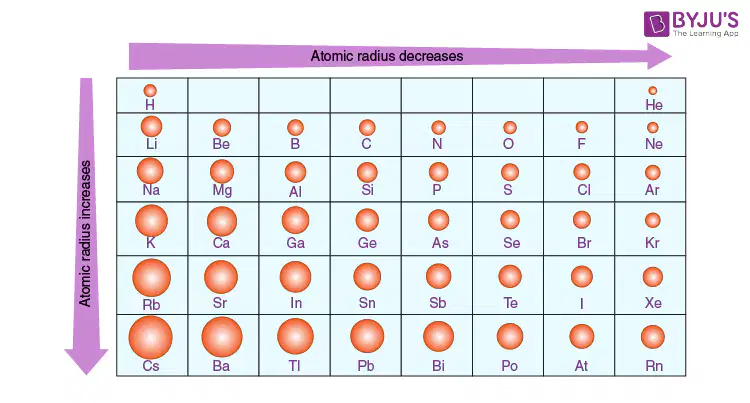
Based on the table pictured, who has the largest atomic radius?
Halogens (group 17)
Noble Gases (Group 18)
Non-metals (right side)
Group 1

What are valence electrons?
Electrons in the outermost shell
Electrons in the innermost shell
Subatomic particles in the nucleus
subatomic particles with a positive charge

How many valence electrons does Boron have?
1
2
3
8
Define electronegativity
The energy required to lose electrons
The size of an atom
Increases as you move left and down.
The ability attract electrons.

Which of the following describes the trend of electronegativity?
Up and Left
Down and Left
Up and Right
Down and Right

Which of the following elements has the largest electronegativity?
Li
Ca
Ge
O
Why are noble gases unreactive?
They all have 8 valence electrons
They all require 1 more valence electron
They all have a full outer shell
They react with each other in the same group
Characteristics of an ion include (select all that apply)
can be negatively charged
Can be positively charged
anion
cation

Which element has the highest electronegativity?


Elements in the same group or column have the same ...
# of valence electrons
# of shells
# of protons
Mass Number
What tells you the number of energy shells (levels)?
Group number
Atomic Number
Atomic Mass
Period Number

Where are the noble gases located?
Group 1
Group 8
Group 17
Group 18

Identify where the protons are located in an atom.
Outer shells
Nucleus
Identify where the electrons are located in an atom.
Outer shells
Nucleus
Which subatomic particles have a positive (+) charge?
Protons
Neutrons
Electrons
Valence Electrons
Which subatomic particles have no charge?
Protons
Neutrons
Electrons
Valence Electrons
Which subatomic particles have a negative (-) charge?
Protons
Neutrons
Electrons
Define the atomic mass number
The number of protons and neutrons in an atom
The charge of an atom
The size of the atom
The total sum of the protons and neutrons of an atom
The building blocks of a molecule
ions
protons
compounds
atoms
Which of the following are characteristics of metals?
Low luster
Poor conductors
High Luster
High Conductors
When a metal can be pulled into wires
Ductile
Malleable
Brittle
Luster
When a metal can be hammered out into thin sheets
Ductile
Malleable
Brittle
Luster
Which are the characteristics of metalloids? (select all that apply)
Somewhat conducts electricity
brittle
Shiny
Ductile
What is a compound?
Contains one type of atom
A combination of atoms and molecules
can be broken down into simpler substances (physically)
Can be broken down into simpler substances (chemically)
What is an element?
Contains one type of atom
A combination of atoms and molecules
can be broken down into simpler substances (physically)
Can be broken down into simpler substances (chemically)
What is a mixture?
Contains one type of atom
A combination of atoms and molecules
can be broken down into simpler substances (physically)
Can be broken down into simpler substances (chemically)
What happens after a chemical change?
Different physical and chemical properties are displayed
Substances are changed to another phase
Substances are separated or combined
The identity is unchanged.
What happens after a physical change?
Two substances interact to form another
Different physical and chemical properties are displayed
Substances changed from one phase to another
Atoms are rearranged
Which of the following are not an example of a physical property?
Boiling point
electricity
solubility
Reactivity to water
Which of the following are not a chemical property?
Flammability
Luster
Rust
Radioactivity

