
 Worksheets
Study Guide for Final Exam Fall Semester 2025
Total questions: 64
Worksheet time: 33mins
What is the difference between Qualitative and Quantitative data?
Qualitative is description and quantitative is about numbers and facts. Independent variable does not change meanwhile the dependent variable is dependent on the independent variable.
Qualitative data is always numerical, while quantitative data is always descriptive.
Quantitative data cannot be measured, but qualitative data can be counted.
Qualitative data is only used in mathematics, while quantitative data is only used in literature.
A scientist proposes an answer to a scientific question. This is known as?
A hypothesis
A theory
An experiment
A conclusion
List the different steps of the scientific method.
Observation/question, hypothesis, experiment, data, conclusion
Conclusion, experiment, observation, hypothesis, data
Hypothesis, data, observation, experiment, conclusion
Data, observation, experiment, hypothesis, conclusion
What are the four types of carbon-based molecules (macromolecules)?
Carbohydrates, lipids, proteins and nucleic acids
Carbohydrates, vitamins, minerals and water
Lipids, enzymes, hormones and starches
Proteins, nucleic acids, minerals and glucose
Glucose is in which category of carbon-based molecules?
Carbohydrates
Lipids
Proteins
Nucleic acids
What occurs during the process of nitrogen fixation?
Nitrogen gets converted into ammonia by nitrogen fixing bacteria
Nitrogen gets converted into oxygen by plants
Nitrogen gets broken down into carbon dioxide by animals
Nitrogen gets converted into glucose by photosynthesis
Why do all living things depend on the recycling of matter?
Finite amount of elements available so they have to be reused
To increase the number of elements on Earth
Because recycling creates new elements
Because living things do not use elements
All macromolecules have these three main elements?
Hydrogen, oxygen and carbon
Nitrogen, sulfur and phosphorus
Sodium, potassium and calcium
Iron, magnesium and zinc
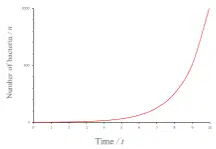
The above graph shows what type of population growth?
Exponential
Logistic
Linear
Cyclic
What are 2 non-living (ABIOTIC) and 2 living (BIOTIC) things you would find in a forest ecosystem?
Sun, rocks (abiotic) and fungi, trees (biotic)
Water, soil (abiotic) and birds, cars (biotic)
Air, plastic (abiotic) and mushrooms, benches (biotic)
Light, sand (abiotic) and squirrels, paper (biotic)
What are the two things that make up an ecosystem?
Abiotic and biotic factors
Producers and consumers
Plants and animals
Water and sunlight
Define succession.
A process of an ecosystem developing over time
A method of plant reproduction
A type of animal migration
A way to measure rainfall
What organisms provide the basis for an ecosystem’s energy?
Producers
Consumers
Decomposers
Predators
The number of individuals of a single species per unit area is known as?
Population density
Biomass
Species richness
Carrying capacity
Secondary succession occurs when?
A natural disaster destroys an ecosystem which causes the ecosystem to be rebuilt from the soil.
A new ecosystem forms on bare rock where no soil exists.
A population of animals migrates to a new area.
A forest is planted by humans in a previously empty field.
A rabbit moves into a new meadow to eat plants is an example of what type of population behavior?
Immigration
Emigration
Predation
Extinction
Lichens and mosses that first inhabit an area, are examples of?
Primary succession
Secondary succession
Climax community
Deforestation
Define a Biome and give an example.
A piece of land defined by plants, animals and temp. An example of a biome is a tundra.
A biome is a type of weather pattern found only in deserts. An example is a rainstorm.
A biome is a mountain range with no living organisms. An example is the Himalayas.
A biome is a body of water with only fish. An example is the Pacific Ocean.
Ecology is the study of?
Interactions between organisms and their environment
The structure of atoms
The history of ancient civilizations
The laws of motion
An ecosystem is made up of?
Abiotic and biotic factors
Only plants and animals
Only water and soil
Only living organisms
Limiting factor that depends on population size is called a?
Density dependent
Abiotic factor
Density independent
Limiting nutrient
What term describes a group of different species in a given area?
A community
A population
An organism
A habitat
Where does the Krebs cycle take place?
The matrix
The cytoplasm
The nucleus
The intermembrane space
What organelle is responsible for making ATP?
Mitochondria
Nucleus
Ribosome
Chloroplast
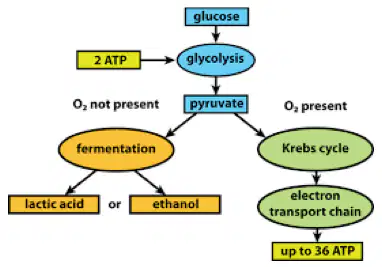
Circle the processes that are part of cellular respiration, box for photosynthesis?
Krebs cycle
glycolysis
electron transport chain
Calvin cycle
An active cell might contain large numbers of this organelle?
Mitochondria
Ribosome
Lysosome
Golgi apparatus
The energy all cells need to perform most cell functions?
Mitochondria
Nucleus
Ribosome
Cell wall
The process shown in the equation above begins in the cytoplasm of a cell and ends where?
Cellular membrane
Nucleus
Mitochondria
Endoplasmic reticulum
When cells break down molecules, energy is released as?
ATP
Glucose
Oxygen
DNA
The aerobic stages of cellular respiration take place where?
The mitochondria
The cytoplasm
The nucleus
The ribosome
When muscles do not receive enough oxygen during workouts, the muscle begins to make?
Lactic acid
Glucose
Oxygen
Adenosine triphosphate (ATP)
What is the primary source of energy for life on planet earth?
The Sun
The Moon
Wind Energy
Geothermal Energy
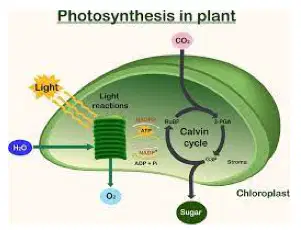
What is the food source that is produced during photosynthesis?
Glucose (or sugar)
Oxygen
Carbon dioxide
Water
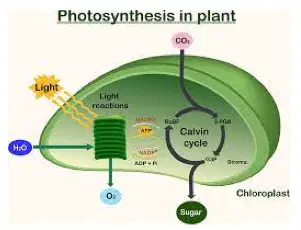
What gas does photosynthesis take out of the atmosphere?
Carbon dioxide (CO2)
Oxygen (O2)
Nitrogen (N2)
Methane (CH4)
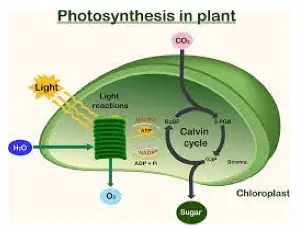
Photosynthesis is the process by which plants:
Convert sunlight into chemical energy
Absorb oxygen from the air
Release carbon dioxide during the day
Produce energy without sunlight
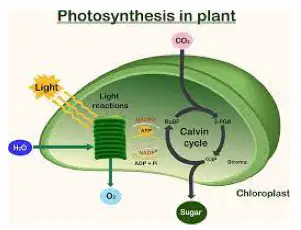
The opening in the leaf where gas is exchanged is called?
Stomata
Phloem
Cuticle
Xylem
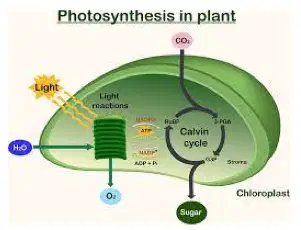
The organelle where photosynthesis takes place in is?
Chloroplast
Mitochondria
Nucleus
Ribosome

The pigment within the thylakoid is called?
Chlorophyll
Carotene
Xanthophyll
Anthocyanin
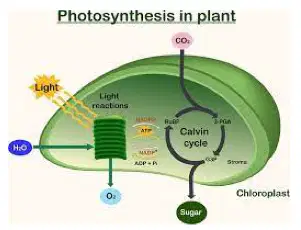
Select the correct chemical equation for photosynthesis.
6CO₂ + 6H₂O → C₆H₁₂O₆ + 6O₂
C₆H₁₂O₆ + 6O₂ → 6CO₂ + 6H₂O
6CO₂ + 6O₂ → C₆H₁₂O₆ + 6H₂O
C₆H₁₂O₆ + 6H₂O → 6CO₂ + 6O₂
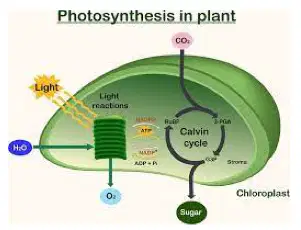
What gasses go in and out of the chloroplast?
Carbon dioxide goes in, oxygen comes out.
Oxygen goes in, carbon dioxide comes out.
Nitrogen goes in, hydrogen comes out.
Methane goes in, ammonia comes out.
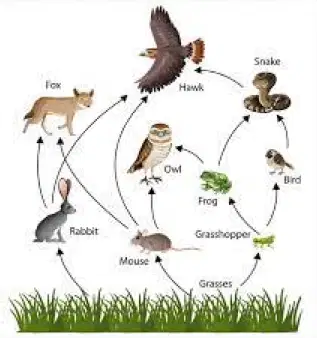
In the above food web name one producer, one primary consumer, one secondary consumer and one tertiary consumer.
Producer: Grass; Primary consumer: Grasshopper; Secondary consumer: Frog; Tertiary consumer: Hawk
Producer: Grasshopper; Primary consumer: Frog; Secondary consumer: Hawk; Tertiary consumer: Grass
Producer: Frog; Primary consumer: Hawk; Secondary consumer: Grass; Tertiary consumer: Grasshopper
Producer: Hawk; Primary consumer: Grass; Secondary consumer: Grasshopper; Tertiary consumer: Frog
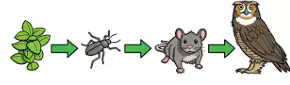
Tell what role an organism has in the above food chain.
Producer
Decomposer
Consumer
Scavenger
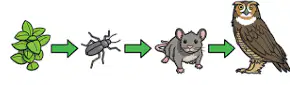
Organisms that break down dead plants and animals are?
Decomposers
Producers
Consumers
Herbivores
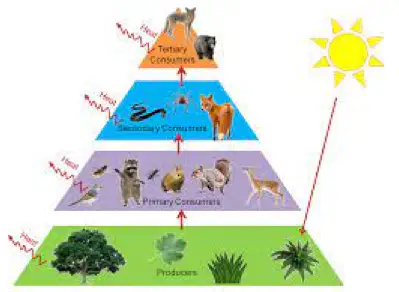
Refer to the diagram of the trophic pyramid. Starting at the lowest trophic level, the amount of energy generally _____________ as you go up in levels.
decreases
increases
stays the same
doubles
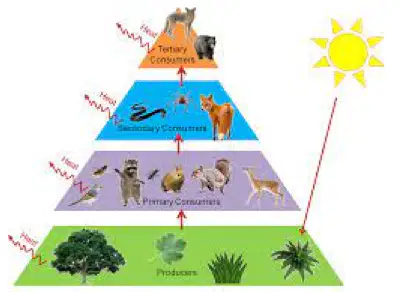
Energy in an ecosystem flows from producers to consumers through different trophic levels.
From producers to consumers through different trophic levels
From consumers to producers through different trophic levels
From decomposers to producers directly
From consumers to decomposers only
An organism is said to be autotroph if it can produce its own food, and heterotroph if it relies on other organisms for food. Which of the following best describes autotrophs and heterotrophs?
Autotrophs produce their own food; heterotrophs rely on other organisms for food.
Autotrophs eat only plants; heterotrophs eat only animals.
Autotrophs rely on other organisms for food; heterotrophs produce their own food.
Autotrophs and heterotrophs both produce their own food.
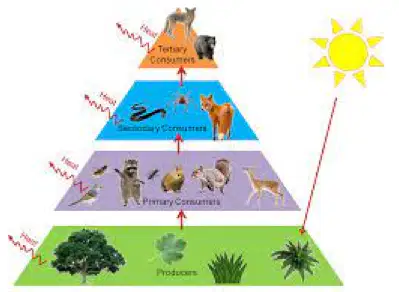
Refer to the diagram of the trophic pyramid. In most food chains, all of the energy originally comes from where?
The Sun
Plants
Animals
Soil
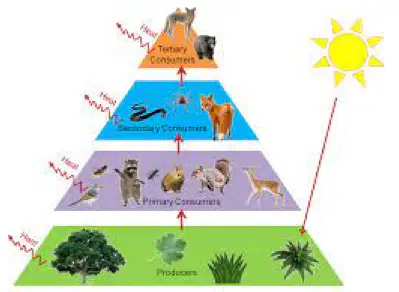
Primary consumers in the trophic pyramid mainly eat which of the following organisms?
Producers
Secondary consumers
Tertiary consumers
Decomposers
Deer only eat plants. Deer are considered what type of consumer?
Herbivore
Carnivore
Omnivore
Decomposer
Lions only eat animals. Lions are considered what type of consumer?
Herbivore
Carnivore
Omnivore
Producer
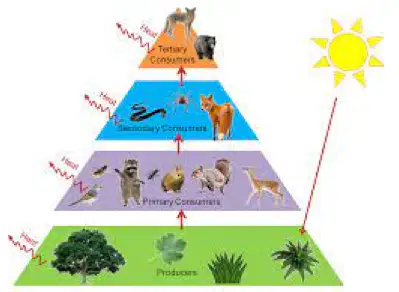
The diagram of the trophic pyramid shows that the basis for an ecosystem’s energy is provided by which kind of organism?
Producers
Herbivores
Carnivores
Decomposers
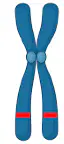
Identify the correct definitions for telomere, centromere, and sister chromatid.
Telomere: end of chromosome; Centromere: region joining sister chromatids; Sister chromatid: identical copy of a chromosome
Telomere: center of chromosome; Centromere: end of chromosome; Sister chromatid: non-identical chromosome
Telomere: region joining chromatids; Centromere: end of chromosome; Sister chromatid: unrelated DNA segment
Telomere: identical copy of a chromosome; Centromere: unrelated DNA segment; Sister chromatid: end of chromosome
The difference between malignant and benign tumors is:
Malignant tumors can invade nearby tissues and spread to other parts of the body, while benign tumors do not.
Benign tumors are always cancerous, while malignant tumors are not.
Malignant tumors are smaller than benign tumors.
Benign tumors grow faster than malignant tumors.
Review the different steps of the cell cycle and mitosis.
Interphase, prophase, metaphase, anaphase, telophase, cytokinesis
Prophase, metaphase, telophase, interphase, meiosis
Interphase, meiosis, cytokinesis, telophase, anaphase
Metaphase, anaphase, telophase, interphase, apoptosis
The cell cycle is controlled by which of the following?
Cyclins and cyclin-dependent kinases (CDKs)
Mitochondria and ribosomes
DNA polymerase and RNA polymerase
Lysosomes and peroxisomes
All cells have the following in common:
A cell membrane, cytoplasm, and genetic material
A nucleus and mitochondria
A cell wall and chloroplasts
A large central vacuole
Apoptosis is defined as:
A process of programmed cell death.
A type of cell division.
A method of cell growth.
A form of cell fusion.
Which of the following correctly represents the levels of organization for multicellular organisms?
Cell → Tissue → Organ → Organ System → Organism
Organism → Organ System → Organ → Tissue → Cell
Tissue → Cell → Organ → Organ System → Organism
Organ System → Organism → Organ → Tissue → Cell
Cells are different because:
they have different functions and structures.
they are all the same size.
they contain no genetic material.
they do not interact with their environment.
The two main types of cells we studied this year are:
Prokaryotic and Eukaryotic
Animal and Plant
Red and White
Bacterial and Fungal
Why does ice float?
water expands when it freezes, making ice less dense than water
water compacts when it freezes, making ice more dense than water
hydrogen bonds in water push the ice to the surface
ice is afraid of water, and avoids it
Water dissolves all substances because it is the universal solvent.
True
False

A water strider can skate along the top of a pond because:
covalent bonds result in water cohesion (surface tension)
hydrogen bonds result in water cohesion (surface tension)
water striders have adapted to take advantage of water cohesion
water striders are afraid of water and avoid it

