
 Worksheets
What is Selling? Assisting the Customer
Total questions: 126
Worksheet time: 1hrs 3mins
Which statement best defines selling in a business context?
Explaining how offerings create benefits for customers
Persuading buyers using pressure and urgency tactics
Lowering prices to outperform competing businesses
Advertising products through mass media promotions
What is the most important job of a salesperson during a sales interaction?
Assisting the customer in making a wise buying decision
Collecting personal data for future email marketing
Closing the sale as quickly as possible
Upselling add-ons regardless of customer needs
Which activity most directly helps a salesperson learn customer needs?
Demonstrating product features loudly
Offering extended warranties immediately
Handing out promotional brochures
Asking targeted questions and listening carefully
Why are selling skills crucial for business survival and growth?
Sales generate revenue that keeps operations running
They reduce the need for trained customer service
They eliminate competition in free enterprise markets
They allow businesses to avoid product innovation
Customers typically decide to purchase when which condition is met?
They are convinced they will receive buyer benefits
They see the lowest price on any comparable item
They receive a limited-time discount coupon
They encounter aggressive sales closing techniques
Which practice shows the salesperson assisting customers to their advantage?
Ignoring objections to maintain conversation pace
Pushing inventory that needs to be cleared
Focusing on product features without relevance
Explaining benefits linked to customer objectives
What are buyer benefits in the context of selling?
Gains or personal advantages received from purchases
The salesperson’s commissions after closing deals
The list price reductions applied at point of sale
The warranties offered by the manufacturer
In a competitive market with similar products, which strategy best builds repeat business?
Offering one-time promotions and flash sales
Matching every competitor’s price immediately
Limiting customer questions to control time
Providing courteous, capable assistance consistently
Which phase involves the physical creation of goods and services?
Selling phase of retail operations
Consumption phase of user benefits
Marketing phase of distribution channels
Production phase of economic activity
What is the primary purpose of marketing in the economy?
Create goods and physical services
Move goods from producer to consumer
Use goods and services in society
Increase wages and employment
Which statement best defines consumption?
Distributing goods via wholesalers
Using goods and services by consumers
Producing goods in factories and farms
Promoting goods through advertising
A company’s sales decline for several months. What is the most likely immediate impact on employment?
Employment rises due to more production
Employment stays unchanged for months
Employment moves from retail to wholesale
Employment usually decreases for the company
How do salespeople most directly support consumers during the purchase process?
Set industry-wide pricing standards
Handle manufacturing quality inspections
Negotiate lower taxes for the transaction
Provide product information to save time and money
Which outcome is most closely linked to strong selling throughout the economy?
Higher standard of living for society
Lower production costs in mining
Reduced consumer needs and wants
Elimination of wholesalers entirely
A retailer wants to raise living standards in its community. Which strategy aligns with selling’s role in society?
Remove salespeople from customer contact
Limit product information to create scarcity
Focus solely on production efficiency
Identify needs and help customers purchase
Which factor most directly drives repeat business in retail selling?
Low prices and constant discounts
Large inventory and floor space
Friendly, courteous salespeople
Aggressive upselling techniques
What is identified as a major reason customers do not return to a store?
Lack of courtesy or help
Complex checkout technology
Lack of parking facilities
Limited product advertising
Which statement best captures the idea that 'Customer is King'?
Businesses exist to serve customers
Customers are dependent on businesses
Managers are more important than buyers
Salespeople should win arguments
A customer-oriented business is primarily defined by which focus?
Expanding product lines constantly
Cutting internal operating costs
Maximizing sales quotas monthly
Satisfying customer needs and wants
Which attitude-related outcome is highlighted for job success in selling?
Positive attitude eliminates price complaints
Poor attitude improves negotiation power
Positive attitude reduces product defects
Poor attitude leads to job loss risk
Select the best action when a customer calls with a need.
Redirect them to statistics
Consider it the purpose of work
View it as doing them a favor
Treat it as an interruption
A salesperson wants to build long-term relationships. Which plan is most effective?
Rely solely on promotional pricing
Develop positive human relations skills
Compete with customers’ opinions
Limit time spent on assistance
Which principle from the Eleven Commandments is most aligned with respectful service?
Dependence of customers on us
Treat customers as cold statistics
Argue or match wits with people
Provide courteous, attentive treatment
Which classification groups selling jobs by who employs the salesperson?
By customer relationship length
By employer type category
By product tangibility level
By territory size focus
Which is an example of a tangible product in selling roles?
Insurance policies coverage
Advertising consulting plans
Banking services packages
Automobiles and computers
Which employer type sells primarily to other businesses rather than final consumers?
Consulting agency group
Retailer organization unit
Wholesaler distribution firm
Manufacturer service branch

A role selling investment services best fits which product classification?
Durable tangible goods
Perishable tangible goods
Intangible services offerings
Seasonal tangible goods
Which statement best explains a typical career path for successful salespeople?
They usually switch to retail cashiering
They rarely move into management
They commonly avoid leadership positions
They often advance to supervisory roles
Which term best describes businesses that prioritize meeting customer needs and satisfaction?
Retailers
Repeat customers
Customer-oriented businesses
Wholesalers
Which phrase refers to benefits the purchaser receives from a product or service?
Consumption
Buyer benefits
Tangible products
Intangible services
Which term refers to physical goods that can be touched?
Marketing
Tangible products
Intangible services
Consumption
Which role buys goods in bulk and sells to retailers?
Consumers
Wholesalers
Production
Repeat customers
Which activity describes using goods and services to satisfy needs?
Consumption
Selling
Marketing
Production
Which responsibility is most important for a salesperson when assisting a customer in a wise buying decision?
Help the customer and ensure buyer benefits
Use high-pressure tactics to close deals
Focus only on company sales quotas
Prioritize complex product features
Why are buyer benefits important in selling?
They justify the purchase for the customer
They eliminate marketing costs
They guarantee higher profit margins
They reduce need for customer service
Which option best explains the difference between tangible products and intangible products or services?
Tangibles are physical; intangibles are nonphysical
Tangibles are trendy; intangibles are timeless
Tangibles are branded; intangibles are generic
Tangibles are cheaper; intangibles are expensive
How can selling contribute to the overall economy?
Stimulates production and consumption
Eliminates competition entirely
Replaces marketing functions
Reduces consumer choice significantly
Which statement reflects a customer-oriented philosophy?
High-pressure tactics close more deals
Product features matter more than needs
Sales quotas are the primary objective
The customer is most important in any business
Why are human relations important in selling?
Eliminate the need for retailers
Reduce distribution channel steps
Increase product manufacturing speed
Build trust and repeat business
Which outcome is most closely linked to positive selling attitudes?
Fewer buyers in the market
Greater customer satisfaction and loyalty
Higher inventory carrying costs
More complex product designs
Which practice aligns with helping customers rather than tricking them?
Provide guidance and clear benefits
Overemphasize minor product features
Apply pressure to force decisions
Use confusing pricing tactics
Which concept describes people who purchase goods for personal use?
Wholesalers
Consumers
Marketers
Retailers
Which term refers to activities that promote and sell goods to consumers?
Marketing
Production
Consumption
Wholesale
Which business role sells directly to end users?
Repeat customers
Producers
Wholesalers
Retailers
Which result of effective selling most benefits a business in the long term?
Repeat customers and sustained revenue
Immediate one-time large orders
Complete removal of competition
Reduced need for product quality
Which statement best distinguishes a salesperson from an order-taker?
An order-taker designs new product lines
A salesperson guides wise buying decisions
An order-taker oversees supplier negotiations
A salesperson manages store accounting records
What is the salesperson’s most important function in retail settings?
Monitoring inventory behind the scenes only
Providing assistance beyond simple transactions
Setting prices without customer interaction
Completing sales tickets without discussion
A customer says, “I’ll take this, please.” What role are you performing if you only ring up the sale?
Advisor demonstrating product features
Salesperson conducting needs analysis
Consultant providing tailored guidance
Order-taker handling a transaction
Which action directly helps customers make wise buying decisions?
Scheduling employee shift rotations
Explaining benefits of the product or service
Counting daily cash drawer totals
Designing store window displays
Select the best sequence to assist undecided customers effectively.
Ask questions, determine needs, recommend products
Set price, finalize payment, print receipt
Open conversation, close immediately, upsell warranty
Show features, avoid objections, skip reassurances
Which method is part of responsible assistance listed for salespeople?
Suggest additional related merchandise
Ignore customer objections entirely
Avoid explaining product benefits
Discourage questions about features
Why must salespeople develop human relations skills in addition to selling techniques?
To understand and help customers effectively
To reduce taxes on store operations
To replace marketing campaigns completely
To eliminate the need for product training
Which statement reflects customer-oriented selling emphasized in Chapter 2?
Functions are performed with the customer in mind
Objections should be avoided, not answered
Human relations are unnecessary in sales
Sales success depends solely on price cuts
Which phrase best defines customer-oriented selling in a retail context?
Maximizing add-on sales regardless of fit
Prioritizing quick transactions and high turnover
Emphasizing product features over buyer preferences
Focusing on meeting customer needs and wants
A student plans a long trip after graduation and wants a stereo to enjoy music. What is the salesperson’s first step to guide this purchase?
Welcome the customer to build trust and respect
Ask for immediate payment to secure the sale
List technical specifications of stereo models
Offer the most expensive combination system
During a sales presentation, which action comes after determining needs and before asking for the sale?
Demonstrate features and explain benefits
Suggest related items and accessories
Reassure the customer about the decision
Answer objections and concerns
Which example best matches explaining benefits rather than just features?
Stating color choices and finish types
Showing how portability makes travel easier
Describing wattage and input options
Listing brand name and model number
A customer hesitates about battery life on a portable stereo. What should the salesperson do next?
Push for the sale to close quickly
Answer the objection with clear information
Redirect to a different product line
Offer a discount without explanation
Arrange these sales presentation steps into the best order: determine needs, ask for the purchase, demonstrate features, reassure decision.
Reassure, determine needs, ask, demonstrate
Determine needs, demonstrate features, ask, reassure
Demonstrate features, ask, determine needs, reassure
Ask, determine needs, reassure, demonstrate
After the customer selects the right stereo, what is an appropriate value-adding action before closing?
Initiate a lengthy discussion of store policies
Introduce an unrelated service offering
Repeat the entire feature list once more
Suggest related items to enhance the experience
Which statement best describes how a salesperson’s time is typically divided?
Mostly paperwork with little customer contact
Mostly assisting customers all day
About half assisting, half nonselling duties
Mostly inventory with occasional customer help
Which task is a sales-supporting duty rather than direct selling?
Negotiating price with a buyer
Marking merchandise for stock
Demonstrating product features
Closing a sale with a customer

Why are nonselling duties emphasized in retail environments?
Customers expect a clean, well-stocked store
They eliminate the need for advertising
They reduce labor costs significantly
They replace the need for sales skills
A business survey found most terminations in sales were due to which factor?
Lack of sales techniques
Poor product knowledge
Inadequate attendance policies
Poor personality traits
What is the most accurate definition of personality in the sales context?
The total of attitudes, habits, and feelings
A single trait like friendliness
Your appearance and dress alone
Only your speaking style with customers
Which outcome is most influenced by personality for a salesperson?
Physical store layout decisions
Ability to set product prices
Likelihood of being liked or disliked
Access to exclusive supplier contracts

A new salesperson has strong selling skills but struggles to get cooperation from coworkers. Based on the material, which improvement is most likely to help?
Develop more pleasing personality traits
Focus only on personal sales quotas
Request fewer floor assignments
Study advanced closing techniques
Which trait most directly drives a salesperson to exceed minimum requirements and improve performance?
Professionalism focused on customer etiquette
Ambition to continually improve and advance
Courtesy shown through polite interactions
Dependability in completing assigned tasks
A salesperson ensures they treat customers with honesty, sincerity, and helpfulness. Which trait is primarily demonstrated?
Professionalism in service conduct
Enthusiasm about the job
Ambition to be above average
Empathy toward customer feelings
Business requires team members to contribute rather than act only for themselves. What trait embodies this expectation?
Dependability in attendance
Honesty in product claims
Cooperation within the team
Consideration for others’ feelings
Showing concern for the feelings and rights of others best defines which trait?
Empathy in understanding customers
Courtesy in respectful behavior
Dependability in completing tasks
Consideration for other people
Respecting the rights and ideas of others and showing sincere interest in what they say is an example of:
Courtesy shown to other people
Ambition to improve beyond minimum
Honesty with employers and customers
Professionalism in product knowledge
Always being on time, avoiding unnecessary absence, and completing assigned work best illustrates:
Professionalism with customers
Ambition to advance quickly
Consideration for coworkers
Dependability at the workplace
Listening to customers and attempting to understand their feelings demonstrates:
Empathy in sales interactions
Cooperation across teams
Enthusiasm about selling
Honesty in daily work
Being excited about one’s job and products, which often influences customers’ interest, reflects:
Ambition to be better than average
Professionalism in sincere service
Enthusiasm that is contagious
Courtesy shown in conversations
Which practice aligns with the trait of honesty for sales success?
Giving a full day’s work for pay
Making bold claims to close deals
Avoiding collaboration with coworkers
Focusing only on personal success
Which trait best describes taking action without being told and completing sales-supporting tasks independently?
Initiative
Loyalty
Poise
Tact
A salesperson who avoids gossip, speaks well of their employer, and keeps sensitive information confidential is showing which trait?
Self-control
Neatness
Loyalty
Punctuality
What does neatness primarily refer to for a salesperson?
Aggressive closing style
Personal appearance
Wide product knowledge
Accurate recordkeeping
Remaining calm, confident, and in control during sales situations demonstrates which trait?
Tact
Poise
Sense of humor
Initiative
Which behavior most clearly reflects punctuality in sales work?
Wearing appropriate attire
Laughing with customers
Arriving at work on time
Keeping information private
Customers feel assured they are making the right purchase when a salesperson displays which trait?
Loyalty
Tact
Neatness
Self-confidence
Which action shows self-control during a difficult customer interaction?
Arguing to prove a point
Remaining calm under pressure
Ignoring the customer’s concerns
Making jokes to lighten mood
Being able to laugh even when the joke is on you and avoiding being overly serious reflects which trait?
Poise
Initiative
Sense of humor
Punctuality
Choosing words carefully to avoid offending customers and saying the right thing at the right time shows what trait?
Loyalty
Self-confidence
Tact
Neatness
Which statement best describes how personality traits for selling can be improved?
They can be developed with honest effort
They improve only through external pressure
They change instantly with strict routines
They are fixed and cannot be altered
What is the first step in a personality improvement plan for a salesperson?
Ask coworkers to change your traits
Recognize traits belong to you
Copy successful sellers’ mannerisms
Avoid admitting any need to improve
Modern customers primarily want to know when considering a purchase:
How products were manufactured ethically
How they will benefit from buying
How competitors price similar items
How the seller earns commission
Which expectation reflects service after the sale?
Show an all-out determination to please
Be interested in satisfaction after sale
Have a neat appearance at all times
Provide prompt service before purchase
Which selling action best helps customers buy to their best advantage?
Remember customer preferences only
Display merchandise without advice
Give accurate information consistently
Answer questions with brief replies
What are patronage motives?
Personal budgets limiting purchases
Reasons customers choose a business
Seller incentives for repeat buyers
Legal policies protecting customers
Which is most likely a patronage motive drawing shoppers to a store?
Complex return procedures and forms
Higher prices with fewer promotions
Frequent changes in staff roles
A wide selection of quality merchandise

Which factor most often drives customers to stop returning to a business?
Lack of friendly, courteous salesperson service
Strict return policies and receipts required
High prices and limited merchandise
Poor store facilities and long lines

What behavior by the salesperson most clearly damages customer loyalty in the narrative?
Apologizing for a defective hair dryer
Explaining repair shop addresses calmly
Chatting with a friend while ignoring a waiting customer
Offering a refund for altered merchandise
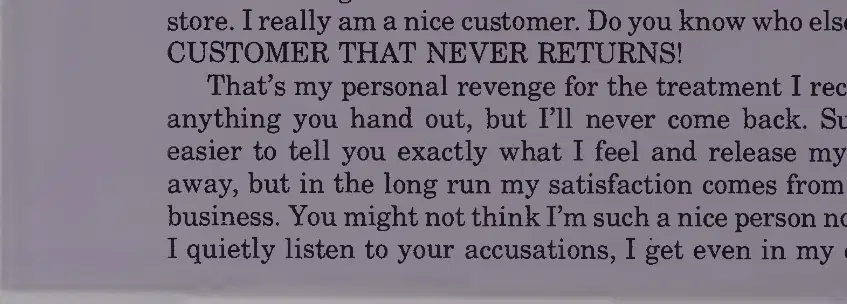
A customer quietly accepts poor treatment and never complains. Which outcome should a salesperson anticipate?
Social media praise for politeness
Silent departure and loss of repeat business
Legal action for defective products
Immediate confrontation and public criticism
You are the salesperson who suspects a customer intentionally damaged a product. Which approach best upholds customer satisfaction and retention?
Refuse service and cite store policies bluntly
Provide a repair option and hear the customer’s account
Suggest the customer pay full price again
Accuse the customer of misuse without listening
Which expectation best explains why employers value salespeople with strong human relations skills?
They avoid learning new product details
They reduce advertising costs immediately
They prioritize internal policies over customers
They build trust and customer satisfaction
What is the primary reason businesses expect salespeople to be good at selling?
It improves store layout instantly
It limits customer complaints quickly
It reduces training time needed
Profits depend on successful sales
Which attitude aligns with employers’ expectations for positive work behavior?
Cooperation and dependability
Rigidness and resistance
Indifference and withdrawal
Secrecy and isolation
A salesperson studies products, customer handling, and selling techniques to improve performance. Which expectation is being met?
Ability to criticize
Preference for routine
Loyalty to employer
Willingness to learn
When receiving directions as a new employee, what is the best action?
Adapt them immediately
Publicly question them
Follow them precisely
Ignore them quietly
Why should a new salesperson hold suggestions until certain they improve procedures?
Policies never evolve over time
Managers rarely accept any new ideas
Experienced staff may resent premature changes
Suggestions always reduce overall profits
What is the constructive way to respond to employer criticism?
Treat it as a personal insult
Use it to guide improvement
Argue to defend current methods
Avoid future feedback sessions
Which action demonstrates loyalty to your employer?
Spreading rumors about coworkers
Publicly criticizing store policies
Refusing to follow company rules
Representing the business favorably
A salesperson who avoids gossip, follows policies, and speaks well of the business is meeting which employer expectation?
Human relations skills
Loyalty to employer
Positive work attitudes
Strong selling skills
Which combination best supports success in retail selling according to employer expectations?
Inventory and store lighting
Discounts and return policies
Automation and vendor contracts
Attitude and human relations
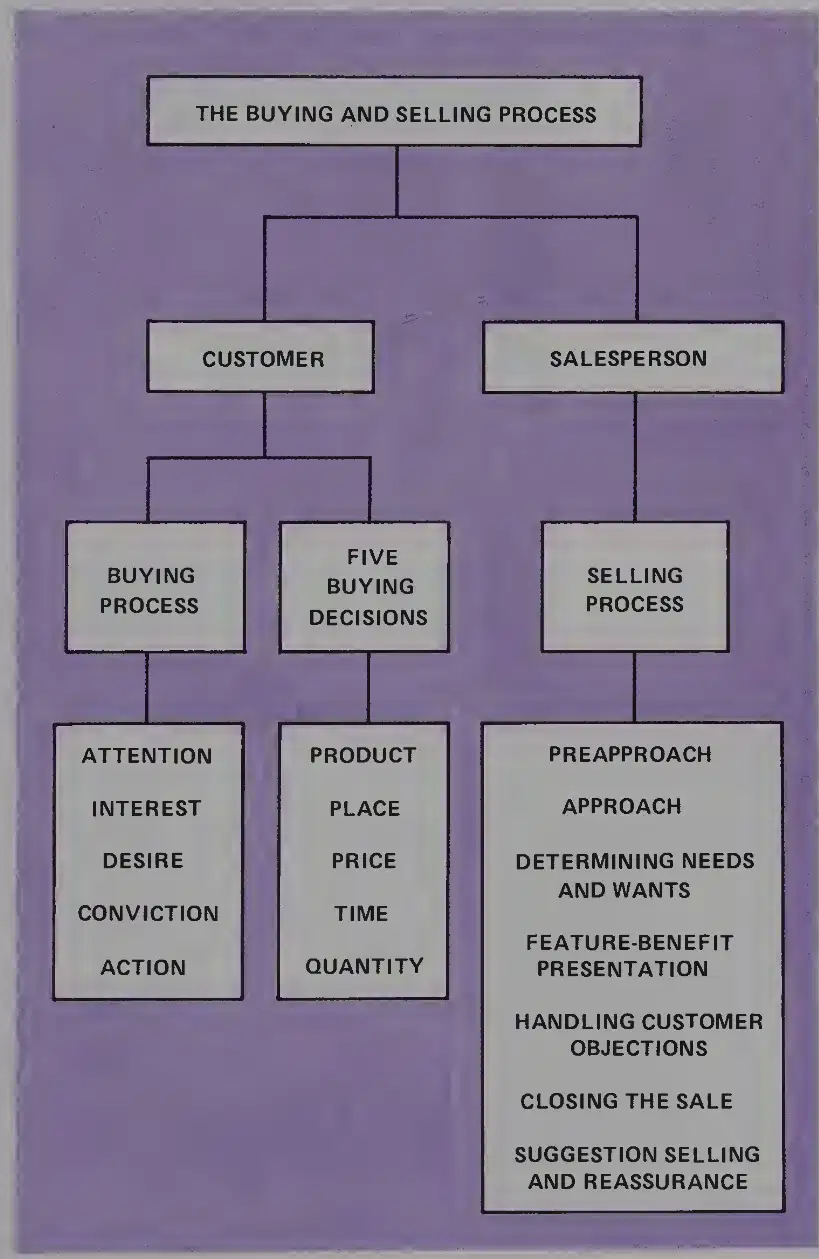
Which two parties are shown as the main branches of the overall buying and selling process in the diagram?
Customer and salesperson
Consumer and retailer
Buyer and manufacturer
Client and distributor

Which sequence correctly lists the five stages of the customer's buying process shown?
Attraction, inquiry, choice, confidence, payment
Discovery, evaluation, trust, decision, follow‑up
Awareness, research, preference, commitment, purchase
Attention, interest, desire, conviction, action

According to the diagram, which set represents the customer's five buying decisions?
Features, benefits, alternatives, financing, delivery
Need, budget, value, timing, risk
Brand, warranty, color, quality, service
Product, place, price, time, quantity

Which step belongs to the salesperson’s selling process rather than the customer’s buying process?
Deciding on price
Handling customer objections
Conviction stage
Choosing quantity

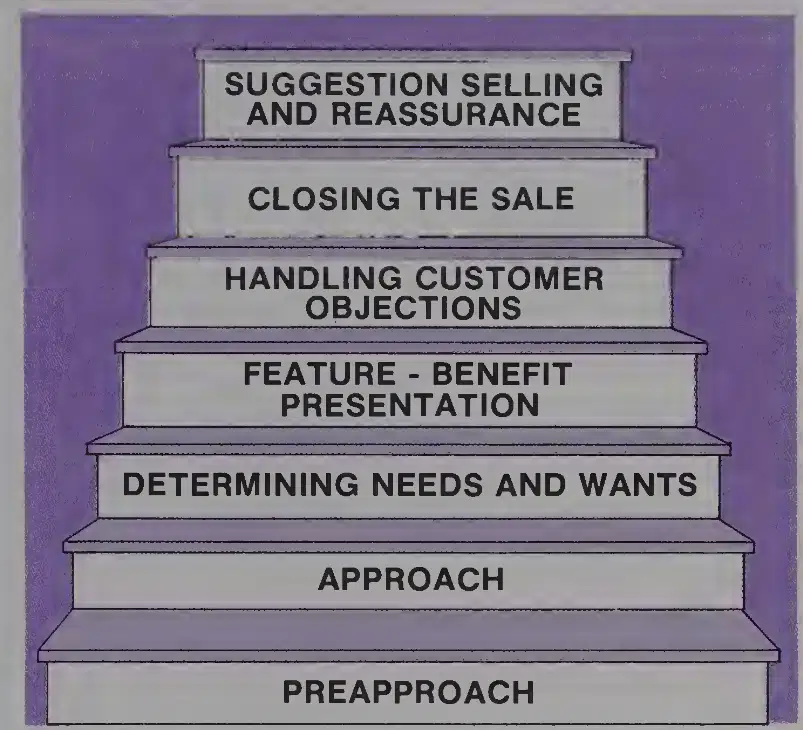
A salesperson plans activities before meeting the customer, then greets them, uncovers needs, presents features and benefits, resolves objections, closes, and reassures with suggestion selling. Which diagrammed sequence does this plan align with?
Research, evaluation, negotiation, agreement, delivery, service
Problem recognition, information search, alternative comparison, choice, post‑purchase
Interest, desire, conviction, action, follow‑up, retention, advocacy
Preapproach, approach, determining needs, feature‑benefit presentation, handling objections, closing the sale, suggestion selling and reassurance
Which sequence correctly lists the first two stages in the customer buying process?
Conviction then Interest
Attention then Interest
Interest then Attention
Desire then Attention
In the Attention stage, what is the customer primarily experiencing?
Post-purchase satisfaction
Commitment to purchase now
Evaluation of product features
Awareness of a need or want
Which salesperson action best initiates customer Attention in-store?
Price negotiation before questions
Friendly greeting and needs-based approach
Detailed warranty explanation first
Immediate closing techniques used
During the Interest stage, which tactic most effectively develops customer interest?
Offer a discount without context
Ask questions to uncover personal needs
Present every product specification
Compare competitors extensively
A couple seeks a graduation gift. Which product suggestion aligns with guiding Attention toward needs?
Promote high-end executive luggage only
Recommend a durable briefcase for a student
Discuss store return policy immediately
Suggest unrelated seasonal décor items
Why is learning about what the customer personally values essential in the Interest stage?
To sell benefits matched to those values
To finalize payment method selection
To calculate sales tax accurately
To determine store closing time
Which dialogue move demonstrates transitioning from Attention to Interest?
Showing unrelated merchandise randomly
Quoting total price before discovery
Opening with weather small talk only
Asking about scholarship and longevity needs
When customers already use similar products at work, how should a salesperson proceed to build Interest?
Delay demonstration until checkout
Avoid discussing features to prevent bias
Relate product features to their daily use
Focus solely on company history details
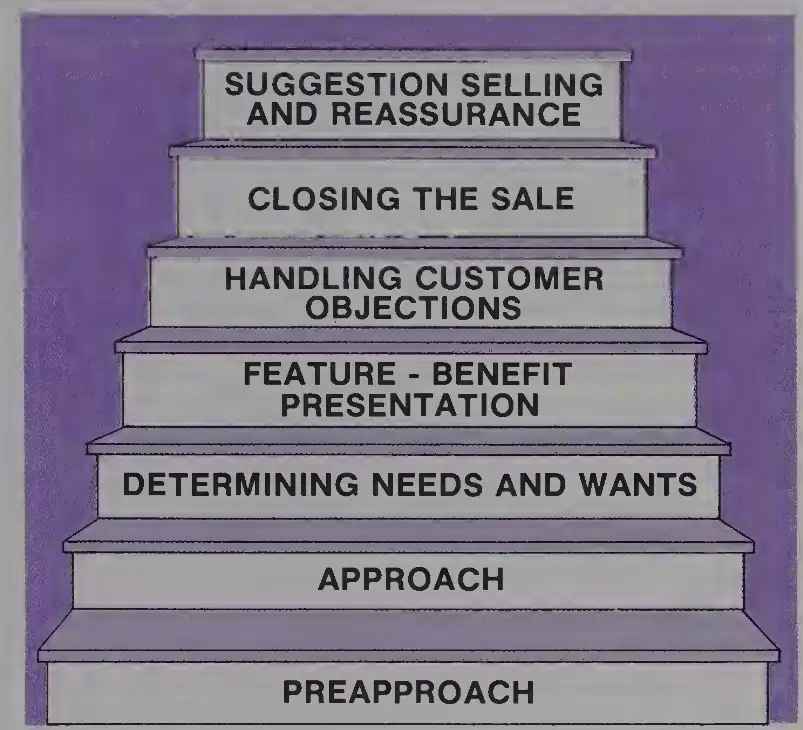
Which stage focuses on preparing yourself and learning customer motives before any greeting occurs?
Objection handling stage focused on concerns
Preapproach stage focused on preparation
Approach stage focused on first impressions
Closing stage focused on final agreement
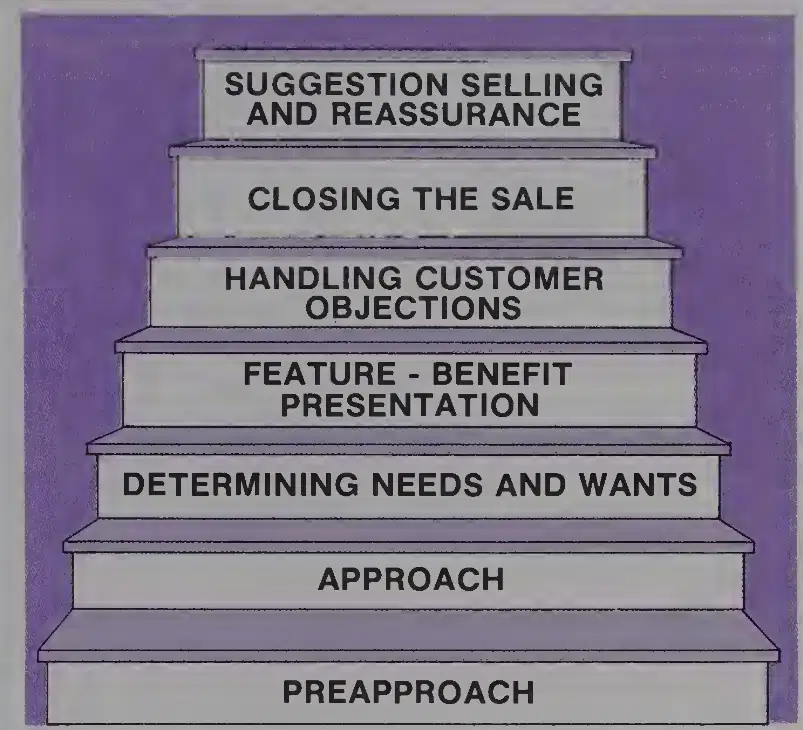
What is the primary purpose of the approach when you first meet a customer?
Conduct detailed feature-benefit analysis
Create a favorable impression of yourself
Negotiate final purchase terms immediately
Review post-sale reassurance messages
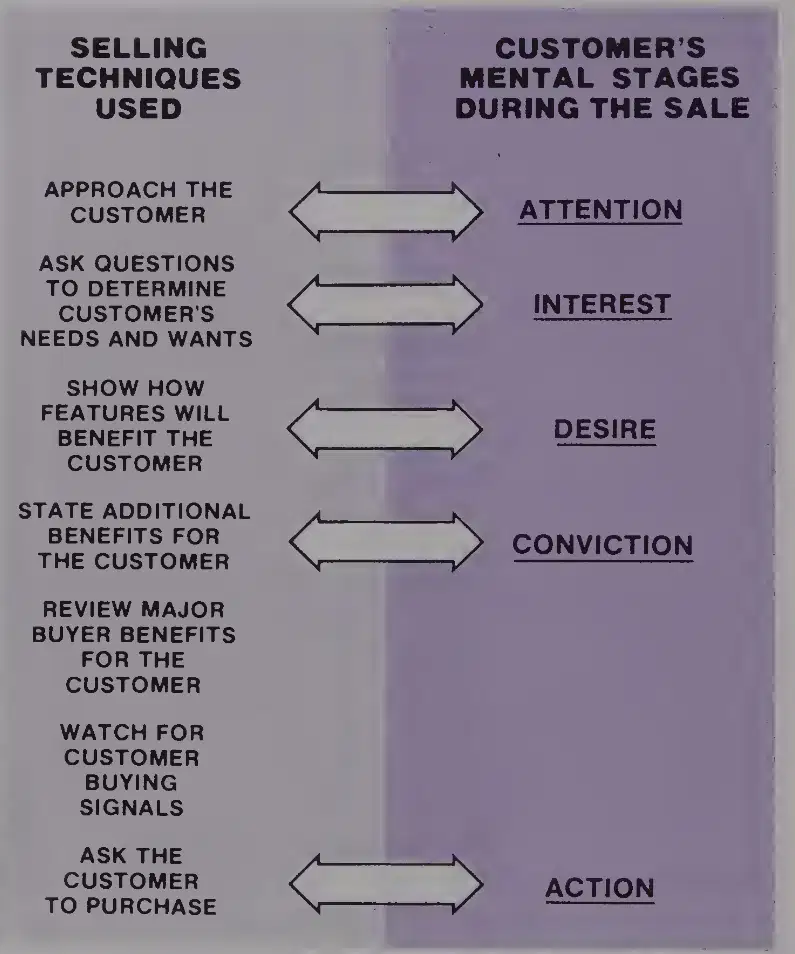
Match the selling technique to the customer mental stage it primarily supports, according to the illustration.
Show benefits → Action
Ask questions → Desire
Ask for the purchase → Interest
Approach the customer → Attention
Which statement best reflects the emphasis experts place on preparation versus presentation in selling?
Preparation is 70 percent, presentation 30 percent
Preparation equals presentation at 50 percent each
Preparation is 10 percent, presentation 90 percent
Preparation is 90 percent, presentation 10 percent
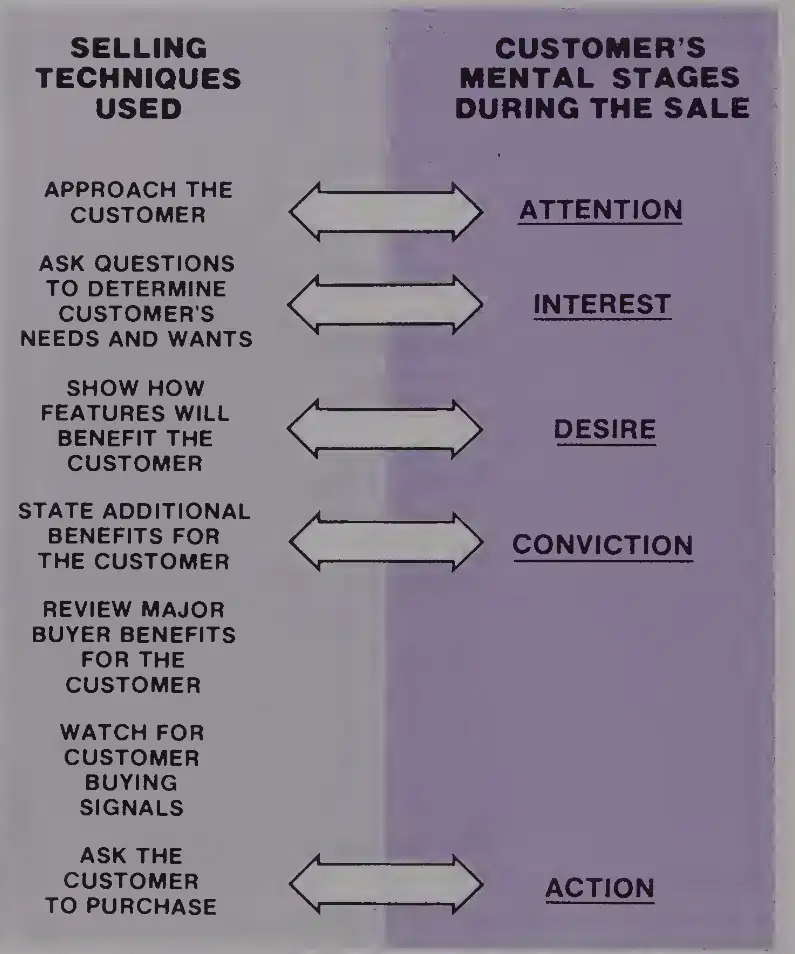
During the early steps of a sale, what action helps move a customer from attention to interest?
Approach with a professional greeting
Ask questions to find needs and wants
Review major buyer benefits list
Watch for late-stage buying signals
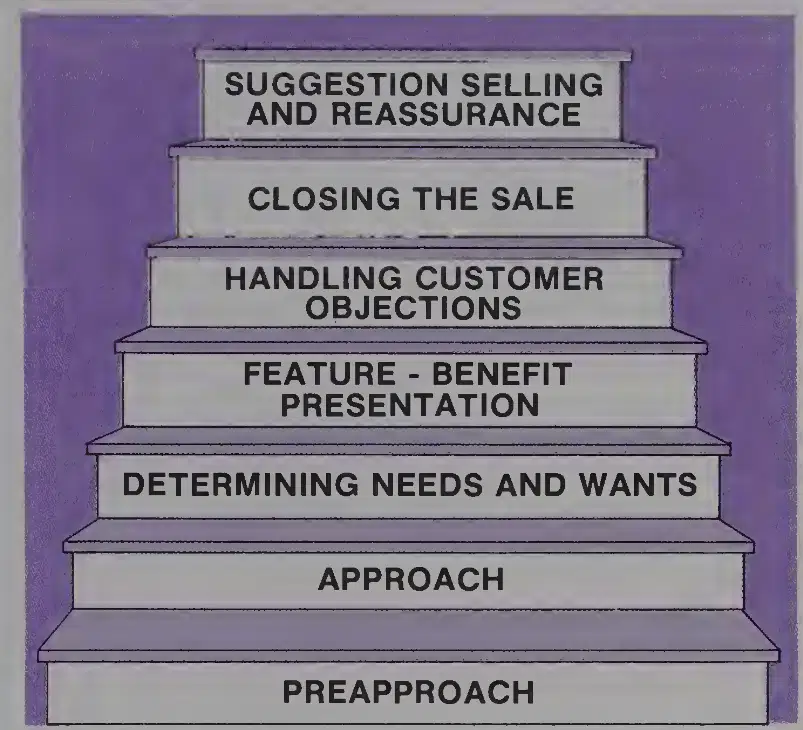
You are preparing to sell a new service tomorrow. Which plan best applies the preapproach principles?
Study customer motives and product benefits
Design closing scripts and payment terms
Prepare add-on suggestions for reassurance
Practice responses to late-stage objections
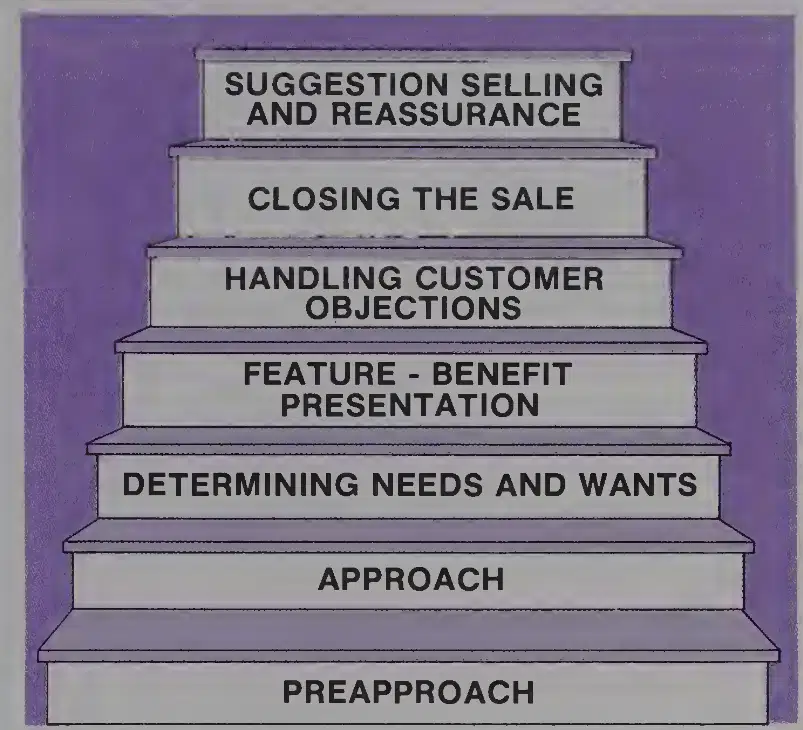
A customer appears undecided after the feature-benefit presentation. What step should you be ready to perform next in the process sequence?
Approach and greeting again
Suggestion selling and reassurance
Handling customer objections
Determining needs and wants

