
 Worksheets
Fall 2025 Micro Final Exam
Total questions: 60
Worksheet time: 33mins
Which laboratory technique amplifies DNA to produce billions of copies in a short amount of time?
ELISA
Western blot
Polymerase Chain Reaction (PCR)
DNA fingerprinting
In an ELISA test, which statement correctly describes a key difference between DIRECT and INDIRECT ELISA?
Direct ELISA detects antibodies, while indirect ELISA detects antigens.
Direct ELISA detects antigens, while indirect ELISA detects antibodies.
Direct ELISA requires DNA probes, while indirect ELISA requires protein gels.
Direct ELISA involves hybridizing DNA from different organisms, while indirect ELISA uses fluorescence.
Which statement best describes microbial identification using molecular methods like PCR?
It is inexpensive, requires no specialized equipment, and identifies colony morphology.
It detects and uses nucleic acids and is useful for identifying organisms that cannot be cultured.
It replaces the need for serological tests and microscopy entirely.
It is less accurate than biochemical testing and used only for environmental microbes.
A microbiologist identified the following characteristics about a bacterium: it is gram-positive, it can form endospores, it has low G+C content, and it is medically important. Which of the following phyla would this organism most likely be classified as?
Algae
Spirochaetes
Archaea
Firmicutes
Which Clostridium species is associated with muscle contractions due to neurotoxin activity in the central nervous system?
Clostridium botulinum
Clostridium difficile
Clostridium perfringens
Clostridium tetani
Which phylum includes many medically important, Gram-negative bacteria, and is often identified by the presence of an outer membrane containing LPS? E. coli is found in this phylum.
Proteobacteria
Firmicutes
Cyanobacteria
Bacteroidetes
Which phylum contains bacteria that carry out oxygenic photosynthesis, are extremely important to the environment, and often appear as blue-green pigments in water samples?
Actinobacteria
Proteobacteria
Cyanobacteria
Plactomycetes
Which of the following complications can arise if Streptococcus pyogenes (Strep A) infections are left untreated?
Neonatal meningitis
Scarlet fever, rheumatic fever, glomerular nephritis
Osteomyelitis and endocarditis
Dental caries and gingivitis
Which is not a characteristic of fungi?
Fungal cells have cell walls.
Fungi include single-celled and filamentous forms.
Fungi are photosynthetic.
Fungi are heterotrophs.
Fungal diseases are generally referred to as
mycoses.
systemics.
infections.
infestations.
Fungi that grow as yeast at one temperature but will grow as mold at another temperature are called
dimorphic.
pseudohyphae.
saprobes.
spores.
Protozoan classification used to be based on their means of
locomotion.
reproduction.
growth.
obtaining nutrients.
Which of the following statements about dinoflagellates is TRUE?
They are multicellular organisms that live only in freshwater environments.
They are all harmless marine symbionts and pose no threat to human or animal health.
Some produce neurotoxins that accumulate in shellfish and can cause paralytic shellfish poisoning in humans.
They are a type of bacteria responsible for red tide and skin infections.
Which of the following is the cause of malaria?
Toxoplasma gondii
Giardia
Plasmodium
Trypanosoma
Which of the following does not pertain to helminths?
in kingdom Protista
eggs and sperm for reproduction
parasitic worms
have organ systems
How do humans typically become infected with Trichinella spiralis, and what is a key symptom of the infection?
By drinking contaminated water; causes skin rash and joint swelling
By inhaling spores from wild animals; causes lung damage
By eating undercooked pork or wild game; causes muscle pain due to encysted larvae
By swimming in freshwater lakes; causes intestinal bleeding
What does it mean when an arthropod acts as a vector for a pathogen?
It causes disease by directly invading human cells.
It produces toxins that infect food and water.
It transmits pathogens from one host to another.
It enhances the immune response against microbes.
The correct sequence of events in viral multiplication is
replication, penetration, maturation, assembly, absorption, release.
adsorption, penetration, replication, maturation, assembly, release.
assembly, maturation, replication, release, penetration, adsorption.
adsorption, release, maturation, replication, assembly, penetration.
Which of the following is a type of cytopathic effect?
inclusions in the nucleus
inclusions in the cytoplasm
multinucleated giant cells
All of these choices are correct
The envelope of a virus is derived from the host’s
Nucleic acids
Membrane
cytoplasm
genome
What is the key difference between the lytic and lysogenic cycle in bacteriophages?
the lytic cycle destroys the host cell, while the lysogenic cycle does not immediately destroy it.
the lysogenic cycle involves RNA synthesis, while the lytic cycle does not.
the lytic cycle integrates viral DNA into the host genome, while the lysogenic cycle does not.
the lysogenic cycle is specific to animal viruses, while the lytic cycle is specific to bacteriophages.
What is the primary function of RNA-dependent RNA polymerase?
to transcribe DNA into RNA
to synthesize proteins from mRNA
to replicate RNA strands
To reverse transcribe RNA into DNA
What is a bacteriophage?
a virus that infects plants
a type of bacteria that infects other bacteria
a virus that infects bacteria
a fungal organism
What is the function of reverse transcriptase in viral replication?
to synthesize RNA from an RNA template
to synthesize DNA from an RNA template
to synthesize RNA from a DNA template
to replicate DNA from a DNA template
HIV is a type of virus that can insert its genetic material into the host’s genetic material and hide from the immune system. HIV is an example of what type of virus?
Oncogenic
Retrovirus
Prion
DNA virus
After a DNA virus enters a host cell, where will it begin to replicate and make new virions?
In the cytoplasm
In the ribosomes
In the mitochondria
In the nucleus
The Epstein-Barr virus can potentially lead to Burkitt’s lymphoma, which is a type of cancer. Some DNA and RNA viruses can alter the cell growth regulations of the host cell. What do we call viruses that are able to potentially trigger cancer?
Persistent
Virulent
Cytopathic
Oncogenic
What are prions?
viral particles that infect humans and animals
misfolded proteins that cause other proteins to misfold
Bacteria that cause neurodegenerative diseases
fungal spores responsible for infections
How are prion diseases typically transmitted?
Through inhalation of airborne particles
By consuming contaminated food or through infected medical devices
Through insect bites
Via direct contact with prion-producing bacteria
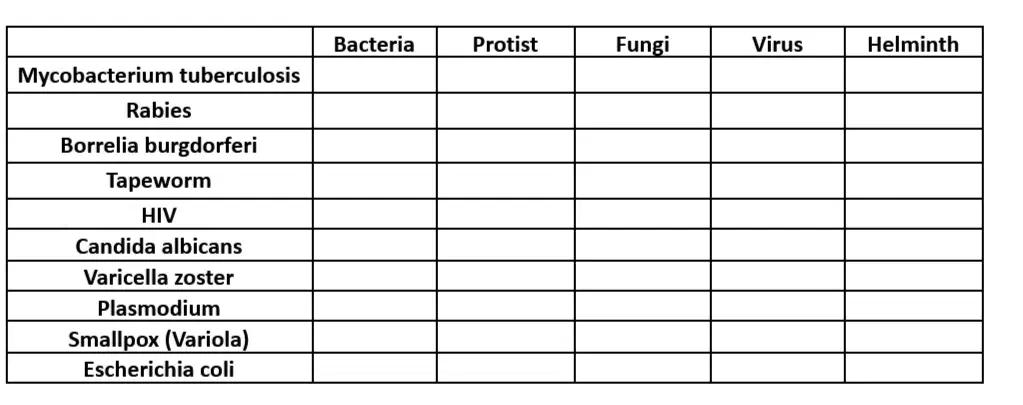
Mark the category that correctly matches each organism. You can make the chart bigger using the icon on the left hand side of the chart. Simply make a mark in the correct cell of the chart for each organism. You can put a line or color in the box for the correct category of the organisms. (1 point each=10 points).
Disease-causing microorganisms are called
decomposers.
prokaryotes.
pathogens.
eukaryotes.
Which of the following are not considered microorganisms?
Mosquitoes
Protozoa
bacteria
viruses
All of the following are correct about prokaryotes, except
they are smaller than eukaryotes.
they lack a nucleus.
they are less complex than eukaryotes.
they have organelles.
Which of the following is the correct way to write the scientific name of this bacterium?
Staph Aureus
Staphylococcus Aureus
Staphylococcus aureus
Staphylococcus Aureus
Peptidoglycan is a unique macromolecule found in bacterial
cell walls.
cell membranes.
capsules.
slime layers.
Which of the following statements correctly differentiates Gram positive bacteria from Gram negative bacteria?
Gram-positive and Gram-negative bacteria have an outer LPS layer and both stain purple.
Gram-positive stain red, while Gram-negative stain purple.
Gram-positive bacteria have a thin layer of peptidoglycan and an LPS layer, while Gram-negative do not.
Gram-positive bacteria stain purple and have a thick layer of peptidoglycan, while Gram-negative stain red and have a thin layer of peptidoglycan.
The term obligate refers to
the ability to exist in a wide range of conditions.
using chemicals for energy production.
existing in a very narrow range of conditions.
using light for energy production.
An organism that cannot tolerate any oxygen gas in its environment is a(n)
aerobe.
obligate aerobe.
facultative anaerobe.
obligate anaerobe.
What is the primary function of bacterial endospores?
To aid in bacterial reproduction.
To allow bacteria to survive extreme environmental conditions
To help bacteria move toward nutrients
To enhance bacterial toxin production
Which of the following processes would generate the most ATP?
Aerobic respiration of one molecule of glucose
Anaerobic respiration of one molecule of glucose
Fermentation of one molecule of glucose
The light dependent reaction of photosynthesis
A pathogen would most accurately be described as a
parasite
commensal
saprobe
symbiont
When DNA is read and changed into mRNA this is called?
Transcription
Replication
Translation
Transmutation
When mRNA is read at the ribosome and turned into proteins, what is occurring?
Transcription
Replication
Translation
Transmutation
What are the three main shapes of bacteria?
cocci, bacilli, spiral
bacilli, strep, spiral
cocci, eukaryotic, prokaryotic
spiral, oval, cocci
Microbial resistance to drugs is acquired through
conjugation
transformation
transduction
all of these
What is the main function of penicillinase (also known as beta-lactamase)?
to enhance bacterial DNA replication
to stimulate bacterial toxin production
to promote bacterial spore formation
to break down the beta-lactam ring of penicillin and related antibiotics
Antimicrobials effective against a wide variety of microbial types are termed
antibiotics.
synthetic drugs.
narrow-spectrum drugs.
broad-spectrum drugs.
Enzymes are
Broken down in reactions that require energy input
Proteins that function as catalysts
Used up in chemical reactions
Not needed for catabolic reactions
Why is it important for healthcare professionals to understand antibiotic resistance?
To develop vaccines against all bacterial infections
To select appropriate antibiotics and prevent treatment failure
To encourage the overuse of broad-spectrum antibiotics
To reduce the need for infection control measures
Which type of archaea lives in very salty environments like the Great Salt Lake?
Methanogens
Cyanobacteria
Halophiles
Thermophiles
What bacterial arrangement consists of rod-shaped bacteria aligned in chains?
Streptobacilli
Coccobacilli
Spirilla
Staphylobacilli
Which bacterial arrangement describes clusters of spherical bacteria?
Diplococci
Streptococci
Staphylococci
Tetrads
Which taxonomic rank is the most specific in the classification of microorganisms
Kingdom
Phylum
Genus
Species
Which of the following best explains why vaccinated individuals are less likely to develop serious illness if exposed to a pathogen?
Vaccines increase the number of white blood cells permanently
Vaccines cause the pathogen to mutate and it becomes harmless
The immune system can respond faster and more effectively due to memory cells
The body becomes naturally resistant without an immune response
Why do bacteria and fungi produce antibiotics in nature?
To kill other organisms and compete for resources
To speed up their reproduction rate
To protect themselves from herbivores
To regulate their metabolic processes
Disinfection of beverages, such as apple juice, milk, and wine, is optimally achieved by
Pasteurization
Moist heat autoclave
Chlorination
Filtration
Helper T cells play a key role in activating which type of immune response to fight off intracellular infections?
Humoral immunity
Cell-mediated immunity
Complement activation
Phagocytosis
Which statement below accurately describes how innate immunity is different from adaptive immunity?
Innate immunity requires prior exposure to a pathogen to be activated.
Innate immunity involves a slower, more specific response.
Adaptive immunity provides long term immunity after the initial exposure to a pathogen.
Adaptive immunity provides a nonspecific and immediate response to pathogens.
What is herd immunity?
When a group of animals become immune to an illness
The number of people someone with an infection can possibly spread illness to
Becoming immune to a vaccine and having it not work
When a large amount of vaccinated people protects those who haven’t gotten vaccinated
What is the best definition of a virulence factor?
Any trait that allows bacteria to survive, invade, or cause disease in a host
A gene that makes bacteria kill viruses
A structure used only for bacterial reproduction
A molecule that can kill pathogens

