
 Worksheets
Quiz on Ethiopian Aspirations
Total questions: 15
Worksheet time: 8mins
Why might asking a young Ethiopian girl about her future aspirations be significant in the context of the image?
It highlights the importance of hope and ambition despite challenging circumstances.
It is a common question asked in all cultures without any deeper meaning.
It is meant to test her knowledge of different professions.
It is only relevant for children in developed countries.
What does the Infant Mortality Rate (IMR) measure?
The ratio of infant deaths registered in a given year to the number of live births registered in the same year, usually expressed as a rate per 1000 live births
The ratio of adult deaths to total population in a year
The number of births per 1000 people in a year
The percentage of children vaccinated in a year
Which formula is used to calculate the Infant Mortality Rate (IMR)?
IMR = (number of deaths of children <1 year in a year / number of live births in the same year) × 1000
IMR = (number of live births / total population) × 1000
IMR = (number of deaths of adults / number of live births) × 1000
IMR = (number of deaths of children <5 years / number of live births) × 1000
Which of the following best defines neonatal mortality?
Deaths of live-born infants in the first four weeks
Deaths of live-born infants between 4 to 52 weeks of age
Deaths of infants before birth
Deaths of infants after one year of age
During which period is early neonatal mortality recorded?
0-7 days
7-28 days
4-52 weeks
1-3 years
Explain the difference between neonatal mortality and post neonatal mortality.
Neonatal mortality occurs in the first four weeks, while post neonatal mortality occurs between 4 to 52 weeks of age.
Neonatal mortality occurs after one year, while post neonatal mortality occurs before birth.
Neonatal mortality occurs between 4 to 52 weeks, while post neonatal mortality occurs in the first four weeks.
Neonatal mortality and post neonatal mortality refer to the same age group.
What does IMR stand for in the context of health indicators?
Infant Mortality Rate
International Medical Record
Immediate Medical Response
Infectious Morbidity Ratio
Explain how IMR can be used to assess the effectiveness of Maternal and Child Health (MCH) programs in a community.
A decrease in IMR suggests improved effectiveness of MCH programs, as fewer infants die due to better health care and interventions.
An increase in IMR suggests improved effectiveness of MCH programs.
IMR does not relate to MCH programs.
IMR only measures adult health, not maternal or child health.

What is the definition of infant mortality as given in the image?
The share of children dying before their 1st birthday
The number of children born each year
The percentage of adults dying before age 30
The rate of childhood diseases

Which of the following years corresponds to the NFHS-1 survey?
1992-93
2005-06
2015-16
1985-86
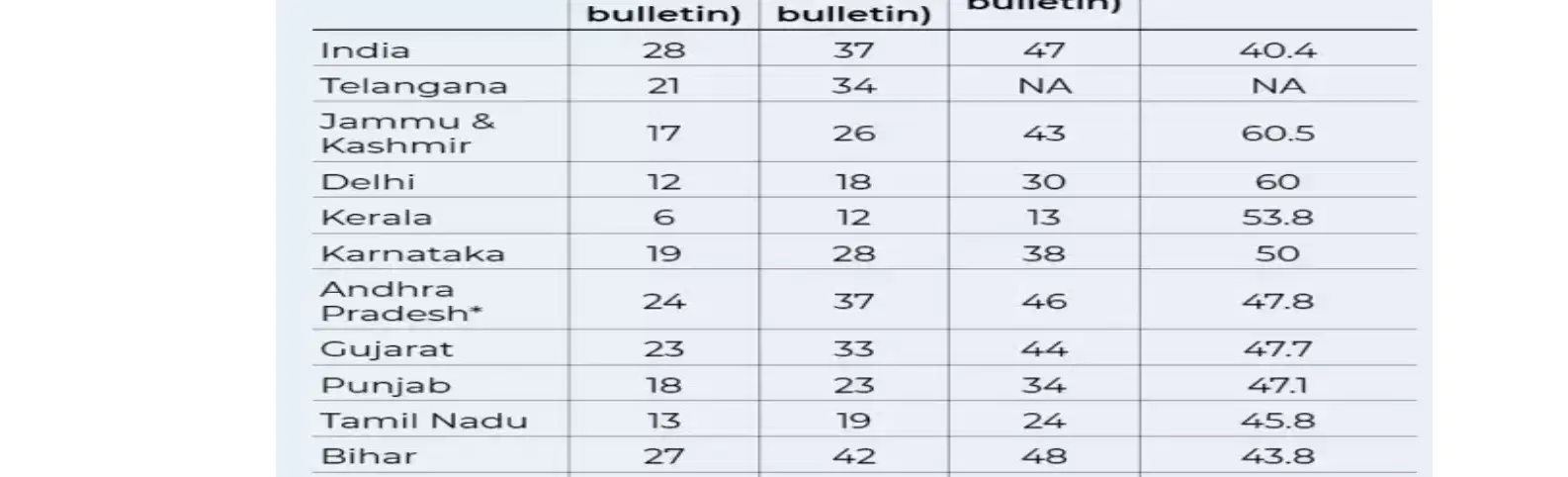
Which state had the lowest value in 2020 according to the table?
Kerala
Delhi
Punjab
Assam
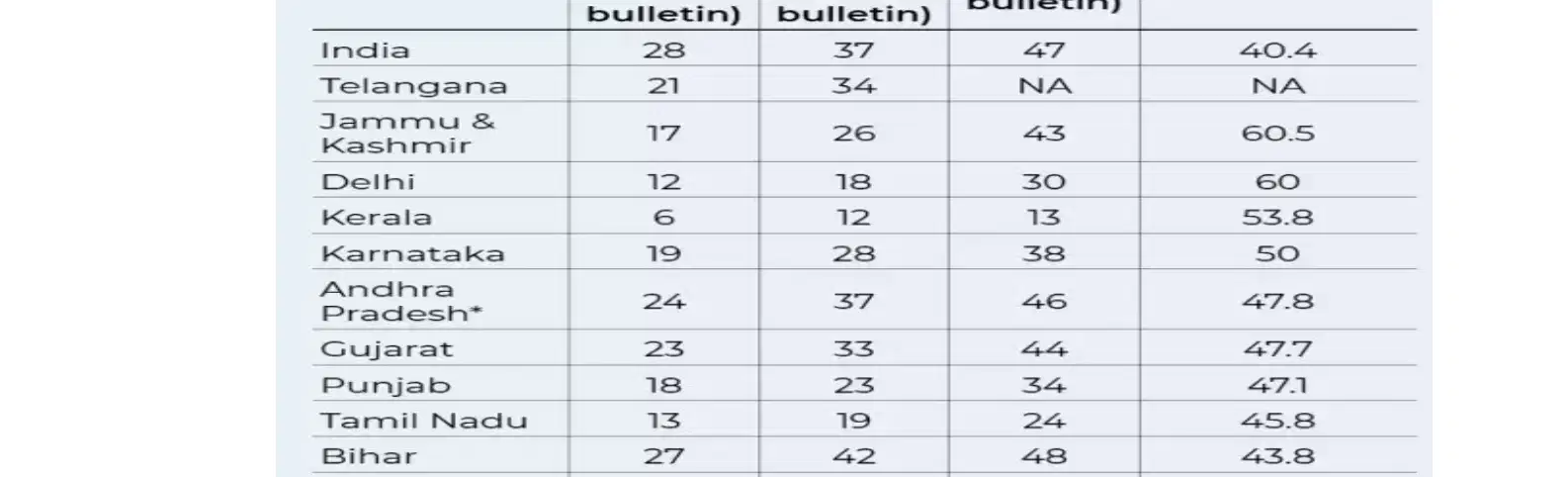
Analyze and explain why Jammu & Kashmir might have shown the highest improvement between 2010 and 2020.
Because it started with a very high value in 2010
Because its value decreased the least over the years
Because it had a significant reduction from 43 in 2010 to 17 in 2020
Because it had the lowest value in 2020
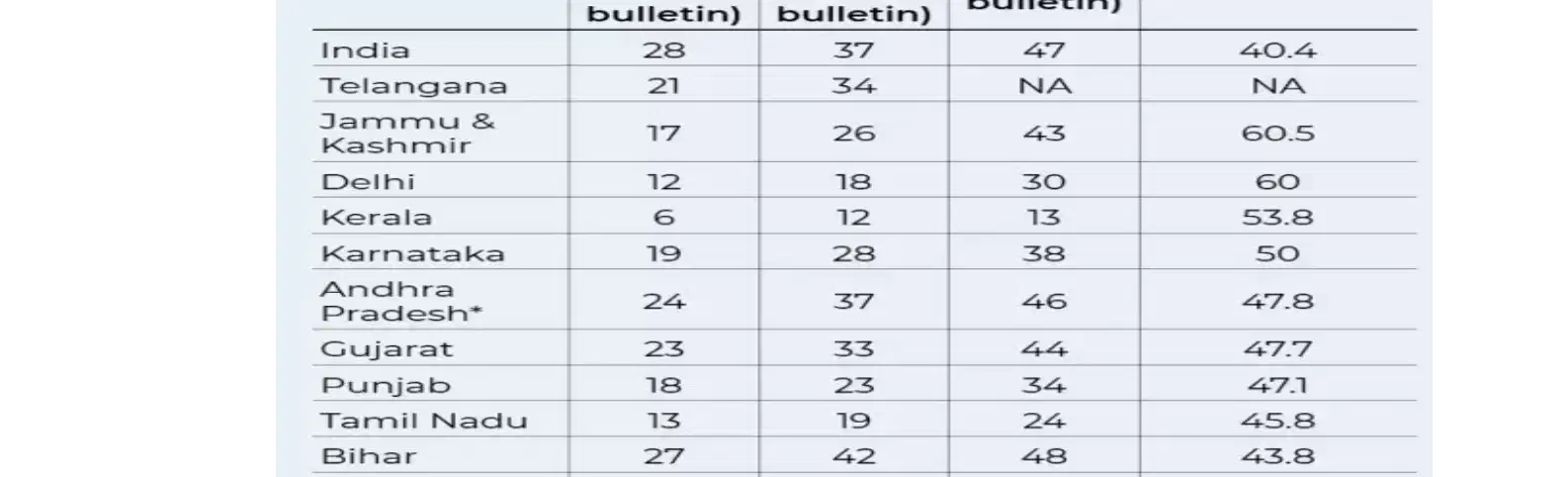
If a state had a value of 50 in 2010 and 43 in 2020, what would be its improvement according to the method used in the table?
7
43
50
30.6
Which of the following is a common health issue in developed countries?
Low birth weight
Diarrhoeal diseases
Congenital anomalies
Malnutrition
Which of the following is a factor affecting infant mortality?
Biological
Technological
Environmental
Political

