
 Worksheets
Weather and Climate Test
Total questions: 22
Worksheet time: 11mins
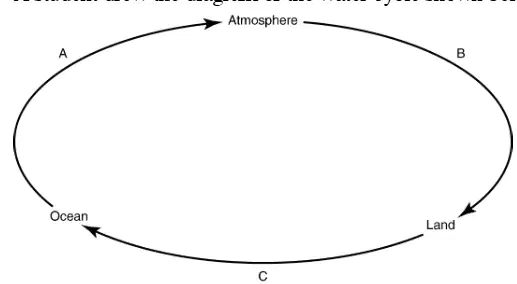
A student drew the diagram of the water cycle with arrows labeled A, B, and C around an oval that moves from Ocean to Land to Atmosphere. What would be a correct label for arrow C?
condensation
evaporation
precipitation
runoff
On most days, a warm air mass is situated over Florida. Which claim about air masses can be supported by evidence?
This air mass is a small body of air.
This air mass has a wide temperature range.
The moisture is the same throughout this air mass.
The weather will not be affected by this air mass.
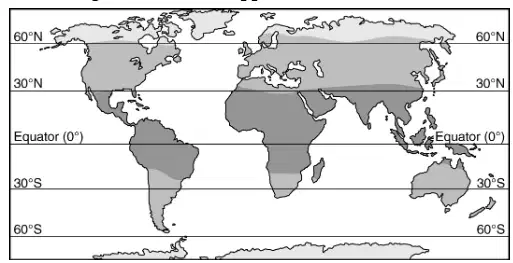
The Köppen Climate Classification System is widely used for classifying the world’s climates. The shaded areas on the map show the three main climate zones on Earth. In which two climate zones is Florida located?
polar and tropical
polar and temperate
tropical and temperate
Earth’s atmosphere pushes on its surface. Which of the following is a measure of the force with which air molecules push on a surface?
air pressure
temperature
precipitation
relative humidity
What reasoning explains the main role of plants in the water cycle?
They take in water from the air.
They store water in their stems and leaves.
They release water vapor into the air.
They provide a surface for condensation.
Certain places in the United States occasionally experience weather events caused by violently rotating columns of air stretching from a cloud to the ground. What are such weather events called?
tornadoes
hurricanes
storm surges
thunderstorms
A low-pressure system is an area where air masses come together and rise. What happens to this rising air mass in a low-pressure system?
The air cools.
The air gets warmer.
The air absorbs moisture.
The air becomes crisp and clear.
The television weather forecaster said that warm, humid air near the ground was moving vertically into the cooler air above. What is likely to happen as a result?
a tornado
a hurricane
a storm surge
a thunderstorm
One measure of weather includes the maximum distance at which large objects can be seen and identified with the unaided eye. What does this describe?
visibility
wind speed
air pressure
temperature
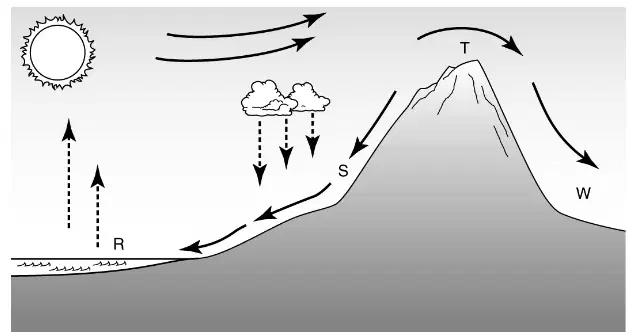
The wind in the following diagram moves from the body of water up and over the mountain. Which letter represents the part of the diagram that will receive the most precipitation?
R
S
T
W
As many as 15 tropical storms and hurricanes have happened in Florida each season during recent years. Based on this evidence, why are hurricanes so common in Florida?
Limestone exists at or near the ground surface in most areas of the state of Florida.
Much of Florida is located at or near sea level and can be easily covered by rising water.
In much of Florida, the ground beneath the top layers of soil is made of organic material that can easily catch fire.
Florida is located near warm oceans and has flat topography that is vulnerable to the full force of winds and storm surges.
Most of Florida is no more than about 50 m above sea level. Jayla hears on a news report that there is a chance of severe flooding in her area. Jayla lives in a low-lying area. What may be her best course of action?
Jayla should evacuate.
Jayla should go sit in her car.
Jayla should stay home and wait out the flood.
Jayla should stay out of her home and go outside.
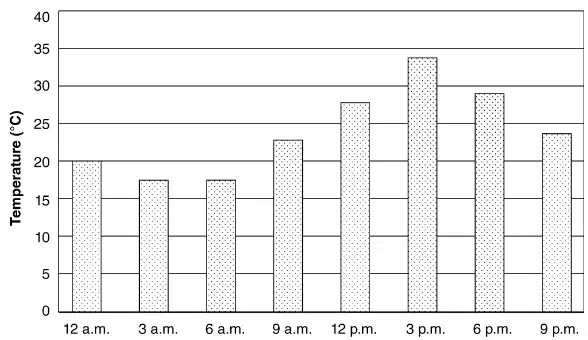
The following graph shows the temperature in Tallahassee at different times of a day. Each temperature was determined at the same location. Based on evidence in the graph, what is most responsible for the warmer temperatures at midday?
the sun
the wind
the altitude
the dew point
The topography of an area can affect the climate of that area. Which of these could be part of the topography of a place?
a person
a mountain
a heavy rain
a delivery truck
Describe two ways that water, in solid form, can change state. Include the state that water changes to and the name of the process.
Melting to liquid and sublimation to gas
Evaporation to gas and condensation to liquid
Freezing to solid and deposition to solid
Boiling to gas and melting to gas
Precipitation is an important part of the water cycle. Which set lists the four major types of precipitation?
rain, snow, sleet, hail
rain, fog, dew, frost
sleet, hail, clouds, fog
hail, mist, drizzle, dew
Weather reports always include the speed and direction of the wind. What causes wind?
Differences in air pressure caused by uneven heating make air move from high pressure to low pressure.
The Moon’s gravity pulls on the atmosphere and creates steady global winds.
Earth’s rotation pushes air directly from east to west at all latitudes.
Mountains force air to move even when pressures are equal.
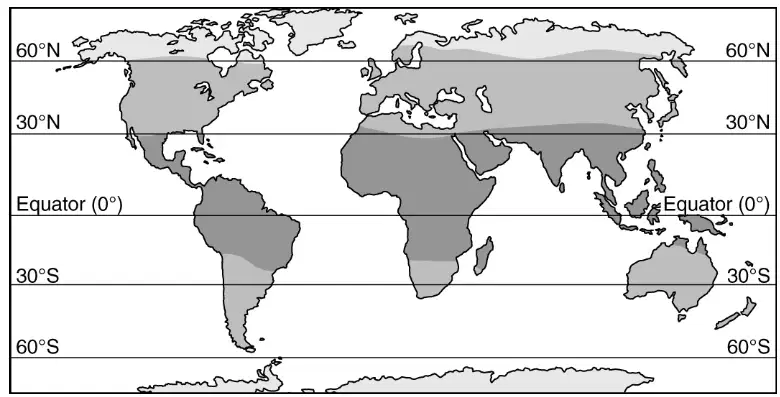
The shaded areas on the following map show the divisions of the climate zones on Earth. There is one of each of three zones in the Northern Hemisphere and one of each of the same zones in the Southern Hemisphere. Referring to the map, identify each climate zone from top to bottom.
temperate, polar, tropical, temperate, polar
polar, tropical, temperate, tropical, polar
polar, temperate, tropical, temperate, polar
tropical, temperate, polar, temperate, tropical
Before a severe-weather storm, it is important to prepare in advance and stay informed. One way is to check local severe-weather announcements on TV or the radio. Which pieces of information do such announcements provide to the public? Select all that apply.
The storm’s location, path, and areas under watches or warnings
Expected timing and intensity of the storm
Entertainment advertisements unrelated to safety
Evacuation routes and locations of public shelters
Safety instructions, such as when to take cover or secure property
What is wind, and what causes it?
Wind is the movement of air from areas of high pressure to areas of low pressure, driven by uneven heating of Earth’s surface by the Sun.
Wind is air that circulates because Earth revolves around the Sun once per year.
Wind is the upward motion of warm air caused only by mountains and tall buildings.
Wind is motionless air that changes temperature without moving.
Identify two processes that transfer water vapor into the atmosphere. Select all statements that correctly name the processes.
Evaporation moves liquid water from oceans, lakes, or puddles into the air as water vapor; transpiration releases water vapor from plant leaves.
Condensation turns water vapor into liquid droplets in clouds; precipitation returns water to Earth’s surface.
Evaporation occurs at the surface of water bodies; transpiration occurs through tiny openings in plant leaves.
Transpiration and runoff both move water into rivers; both remove water vapor from the atmosphere.
Describe four conditions that accompany thunderstorms that can affect Florida. Select all that apply.
Lightning
Heavy rainfall
Strong winds
Hail
Clear skies

