
 Worksheets
Unit 10 Sound Review
Total questions: 30
Worksheet time: 15mins
How does the concept of resonance relate to the sound produced by a musical instrument?
Resonance occurs when a musical instrument vibrates at its natural frequency.
Resonance decreases the amplitude of the sound produced by the instrument.
Resonance is unrelated to the sound produced by musical instruments.
Resonance only occurs in non-musical objects.

Sarah is tuning her guitar and notices that one of the strings produces a fundamental frequency of 500 Hz. What is the frequency of the second harmonic for this string?
250 Hz
750 Hz
1000 Hz
1500 Hz
Sarah is tuning her violin and notices that one of the strings vibrates at a fundamental frequency of 440 Hz. If she shortens the length of the string by half while keeping the tension constant, what will be the new fundamental frequency?
220 Hz
440 Hz
880 Hz
1760 Hz
When a guitar string is plucked, what is the primary reason the sound produced is classified as a mechanical wave?
It is produced by the vibration of an object.
It travels at the speed of light.
It can travel through a vacuum.
It is a form of electromagnetic radiation.
When a musical instrument produces sound, what is the source of the wave motion?
a region of variable high and low pressure.
a vibration.
the movement of matter.
a harmonic object.
Two musicians are tuning their guitars. One guitar plays a note at 440 Hz and the other at 442 Hz. What phenomenon will they hear as the notes interfere?
Resonance
Doppler Effect
Beat frequency
Echo
A musician plays a note on a flute, and the vibrations produce a sound wave with a frequency of 650 hertz. The sound wave produced can best be described as a
transverse wave of constant amplitude
mechanical wave of varying frequency
longitudinal wave of constant frequency
electromagnetic wave of varying wavelengths
A musician uses a special device to reduce unwanted background sounds while playing a guitar. This device works on the principle of
constructive interference.
destructive interference.
beats.
resonance.
When a musician plays a note on a guitar, which property of the sound wave produced determines how loud the note sounds to a listener?
Frequency
Amplitude
Wavelength
Speed
A piano key is pressed, causing a string inside the piano to vibrate at a frequency of 512 hertz. The sound produced by the piano string will travel through the air as a
longitudinal wave with air molecules vibrating parallel to the direction of travel
transverse wave with air molecules vibrating parallel to the direction of travel
longitudinal wave with air molecules vibrating perpendicular to the direction of travel
transverse wave with air molecules vibrating perpendicular to the direction of travel
When a musician playing a trumpet moves towards you, what does the Doppler Effect illustrate about the sound you hear?
The reflection of sound waves.
The absorption of sound in different materials.
The change in pitch (frequency) of sound due to relative motion.
The change in amplitude of sound waves.
When a musician strikes a tuning fork and places it against different musical instruments, through which instrument will the sound travel the fastest?
Water
Steel
Air
Wood
In a concert, a musician playing a trumpet accidentally falls off a stage while continuously playing a note. If the physical situation is portrayed correctly, from the vantage point of an observer standing at the edge of the stage, the pitch of the note as the musician falls should be:
higher than the original pitch and constant.
higher than the original pitch and increasing as he falls.
lower than the original pitch and constant.
lower than the original pitch and decreasing as he falls.
A 256-hertz tuning fork is struck and placed near a non-vibrating guitar string tuned to 256 hertz. The guitar string begins to vibrate. Which phenomenon causes the non-vibrating guitar string to begin vibrating?
resistance
resonance
refraction
reflection

A musician plays a note of constant frequency on a trumpet while walking away from a stationary listener. As the musician speeds up while moving away, the sound wave detected by the listener
decreases in amplitude and decreases in frequency
decreases in amplitude and increases in frequency
increases in amplitude and decreases in frequency
increases in amplitude and increases in frequency

A musician plays a note on a flute, producing a sound wave that travels through the air. Points A, B, C, D, and E represent the positions of air particles as the sound wave moves to the right.
The energy of this sound wave is related to its
period
speed
amplitude
wavelength
When two musicians play notes of slightly different frequencies on their guitars, they notice alternating loud and soft sounds. What is this phenomenon called?
Resonance
Beats
Doppler Effect
Echo

A sound wave travels to the right through the air inside a flute, as shown below. Points A, B, C, D, and E represent the positions of air particles in the flute.
The wavelength of this sound wave is equal to the distance between points:
A and C
B and C
A and B
B and E
Two musical instruments, a flute and a violin, produce sounds with wavelengths of 6.0 m and 7.0 m, respectively. What beat frequency is heard when both instruments are played together on a day when the speed of sound is 340 m/s?
5 Hz
6 Hz
7 Hz
8 Hz
When a musician plays a flute, which of the following describes the region inside the instrument where the air density and pressure are greater than normal due to the sound wave?
rarefaction
compression
spherical wave
Doppler effect
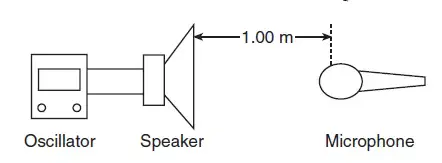
A system (see image below) consists of a musical instrument, such as a tuning fork or a guitar, that produces a 1,000-hertz sound wave. A microphone detects the sound wave 1.00 meter from the instrument.
The microphone is then moved to a new fixed location 0.50 meters in front of the instrument.
Compared to the sound waves detected at the 1.00-meter position, which property of the sound wave has changed?
wave speed
frequency
wavelength
amplitude
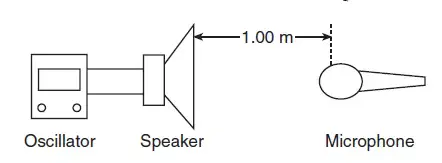
A system consists of a musical instrument (such as a tuning fork or a flute) that emits a 1,000-hertz sound wave. A microphone detects the sound wave 1.00 meter from the instrument.
The microphone is moved at a constant speed from the 0.50-meter position back to its original position 1.00 meter from the instrument. Compared to the 1,000-hertz frequency emitted by the musical instrument, the frequency (pitch) detected by the moving microphone is
lower
higher
the same
When you listen to a piano and a violin playing the same note at the same loudness, which quality allows you to distinguish between the two musical instruments, even though the pitch and volume are identical?
tone
timbre
periodic waveform
pitch
When playing a clarinet, which is a musical instrument closed at one end, which harmonic is missing from the sound produced?
Fundamental frequency
Odd harmonics
Even harmonics
All harmonics are present

A pianist plays two notes simultaneously, one with a frequency of 440 Hz and the other with a frequency of 522 Hz. What is the beat frequency heard?
962 Hz
481 Hz
82 Hz
55 Hz



A musician uses a 554-Hz C# tuning fork to tune their guitar. If the musician hears a beat frequency of 2 Hz, what is the frequency of the guitar string?
It must be 556 Hz.
It must be 552 Hz.
It could be either 556 Hz or 552 Hz.
It could be either 553 Hz or 555 Hz.

A sound of constant frequency is produced by a musician playing a trumpet on a street corner. Compared to the frequency produced by the trumpet, the frequency observed by a person who is walking towards the musician is
lower
higher
the same
When a musician plays a flute, which of the following best describes the motion of air particles as the sound wave travels through the air?
Particles move in circles.
Particles vibrate parallel to the direction of wave travel.
Particles vibrate perpendicular to the direction of wave travel.
Particles remain stationary.
What happens to the pitch of a sound as a musician playing a trumpet moves toward a stationary listener?
The pitch remains the same.
The pitch increases.
The pitch fluctuates randomly.
The pitch decreases.

