
 Worksheets
25-26 Midterm
Total questions: 63
Worksheet time: 37mins
What is popular sovereignty?
the idea that government power is derived from military strength
the concept that laws are created without public input
the principle that the authority of a government is created and sustained by the consent of the governed
the belief that citizens should have no role in governance
How does the concept of popular sovereignty connect with a ruler's power?
a ruler's power comes from divine right and tradition
a ruler's power is absolute and does not require consent
a ruler's power is derived from military strength and fear
a ruler's power comes from the people he/she rules
Describe the concept of the "social contract".
The social contract is an agreement where people agree to give up certain rights in exchange for certain protections & benefits from the government.
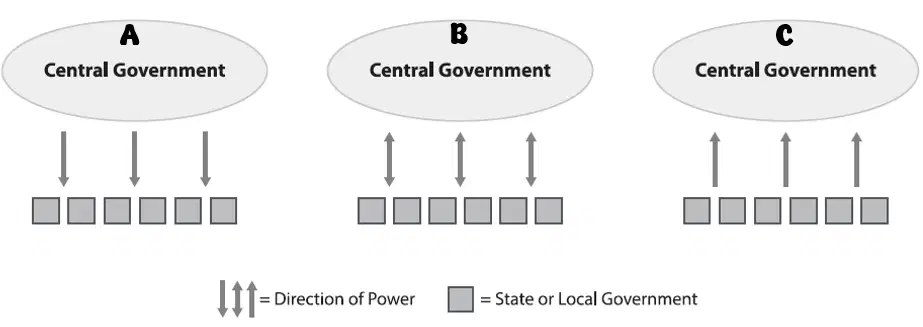
Match the following systems of government to its diagram.
unitary
federal
confederate
What is a unitary system of government?
A unitary system of government is where the states have most of the power & the central/national government is weak.
A unitary system of government is known for giving regions their own freedom and independence.
A unitary system of government is is where the central/national government has the power, & any power that the smaller governments have comes from the central/national government.
What were the Articles of Confederation?
The Articles of Confederation were the 1st constitution of the US, creating a loose alliance of individual states.
The Articles of Confederation acted as treaties made between nations.
The Articles of Confederation created a strong central government with a lot of power.

Take a look at the picture. Which option BEST explains where the horses are trying to lead the cart?
a country with a greater respect for individual rights & freedoms
a better relationship between the colonies and their king
A successful start to the revolution against British rule
A stronger government for the former colonies
Why was the national government unable to enforce laws on the individual states under the Articles of Confederation?
What was the result of the Constitutional Convention?
the establishment of a new monarchy
the creation of the Bill of Rights
the signing of the Declaration of Independence
the writing of the United States Constitution
What weakness of the Articles of Confederation was shown by both the Philadelphia Mutiny & Shays' Rebellion?
the federal government's excessive taxation and regulation
the lack of a strong executive branch to enforce laws (including repaying debts)
the Articles of Confederation gave the president too much control over the military
the ability of states to ignore federal mandates and treaties
What is the Supremacy Clause of the U.S. Constitution?
The Supremacy Clause says that the Constitution & federal laws are more important than state laws.
The Supremacy Clause declares that state laws are above federal laws.
According to the Supremacy Clause, the federal government’s power is limited.
Match the following forms of government to their correct definition.
a single person has unlimited political power
autocracy
a type of government where the people hold the power
democracy
a small elite group holds power
oligarchy
a government where religious leaders control the government, & government rules follow religious laws
theocracy
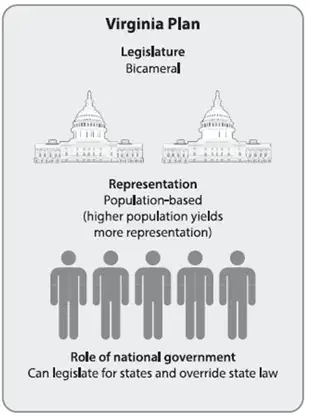
Look at the image. What TWO parts of the Virginia Plan do you see currently in the U.S. Congress?
equal voting rights
population-based representation
bicameral legislature
federal government/law has more power than state governments/laws
What does enumeration mean when it comes to government?
Enumeration deals with dividing resources among different parts of the government.
Enumeration means counting or listing of individuals in a population for government purposes.
Sort these phrases based on whether they describe a Federalist or an Anti-Federalist.
people who supported the Constitution
thought the Articles of Confederation were too weak
supported dividing powers among 3 branches of government
wanted a strong central government to keep order & unite states
one person to be head of the executive branch
did not think a Bill of Rights was needed since states already protected individual rights
opposed the Constitution because they felt it gave the national government too much power
wanted important political powers to stay with the states
felt legislative branch should have the most power
very supportive of a Bill of Rights
What addition to the U.S. Constitution protected people's rights, alleviating [taking care of] a major concern of the Anti-Federalists?
Which of the following are powers given to Congress specifically by the U.S. Constitution?
creating federal courts
capturing pirates
giving money to the states
issuing patents for inventions

Study the diagram. Which part of the bill-making process only happens in the House of Representatives?
House Rules Committee
What is an executive order?
an official issued by the President of the United States that can have the force of law
a law passed by Congress and signed by the President
a decision made by the Supreme Court
a regulation created by a state governor
How are executive orders used to influence government policy?
This refers to the first court to hear and give a verdict on a case.
original jurisdiction
subject matter jurisdiction
exclusive jurisdiction
a federal court’s power to hear cases that involve the US Constitution, government, or federal laws,
The Supreme Court has original jurisdiction in what types of cases?
cases involving federal laws
cases involving a foreign diplomat
cases involving state laws
appeals cases from lower courts
What term means that the government divides its power at each level between three branches, so that no person or group is too powerful?
separation of powers
checks and balances
federalism
consent of the governed
Which phrase BEST completes the diagram?
What is a representative democracy?
a system where leaders are chosen by hereditary succession
a system of government where citizens elect representatives to make decisions on their behalf
a form of governance where decisions are made by a single ruler
a government where citizens vote directly on all issues
What cause the Supreme Court case of U.S. v. Nixon?
Nixon refused to follow a law about taxes.
Nixon refused to turn over tapes of secret recordings.
Nixon tried to declare war without Congress.
Nixon vetoed a bill passed by Congress.
What was the Supreme Court decision in U.S. v. Nixon?
The Supreme Court said that President Nixon must release the tapes because no one is above the law.
What was the effect of the Supreme Court's decision in U.S. v. Nixon?
The decision limited what the president could say was covered by executive privilege.
What was the decision of the Supreme Court in Plessy v. Ferguson (1896)?
The Black Codes were unconstitutional.
The 15th Amendment failed to guarantee the right to vote to all males.
The citizenship principle established in Dred Scott v. Stanford was repealed.
Segregation is legal as long as equal public facilities are provided.
What effect did Plessy v. Ferguson have on civil rights?
It legitimized racial segregation and discrimination, slowing civil rights progress.
Correctly match the constitutional clause with its description.
(a) Constitution & all federal laws are the most powerful laws
(b) Congress can regulate trade with other countries & between the states
What was the main issue in the Supreme Court case of Gibbons v. Ogden?
federal vs. state authority in regulating commerce
women's suffrage
taxation without representation
the legality of slavery
What did the Supreme Court's decision in Gibbons v. Ogden emphasize?
the importance of state laws
individual liberties
state's rights
only the federal government can regulate interstate commerce
The ability to run state governments without federal intervention is known as...
commissioner
superintendent
home rule charter
assessor
What is a police jury?
A police jury is a local government body, unique to Louisiana, that acts as both the legislative & executive branch of parish government.

Use the image to help you complete the following sentence:
The (1)_____ Department was on of the first 2 Cabinet departments created in 1789; its main responsibility is to (2)___________________.
State (1)
oversee foreign policy & diplomacy (2)
Treasury (1)
Justice (1)
create new income streams for the U.S. (2)
ensure that all U.S. citizens pay their taxes in a timely manner (2)
What is the 19th Amendment?
It gave women the right to vote.
It gave Native Americans the right to vote.
It gave immigrants the right to vote.
It gave African Americans the right to vote.
This law was passed to ensure the quality of food and medication prior to ingesting; it was created in response to revelations about health & sanitary issues going on in the meatpacking industry.
The Meat and Drug Act
The Pure Food and Drug Act
Government Regulations Act
Mann-Elkins Act
(a) - not getting involved in the affairs of other countries
(b) - when a country actively involves itself in the affairs of other countries

Read the quote. What foreign policy basis do you think George Washington supported?
interventionism
isolationism
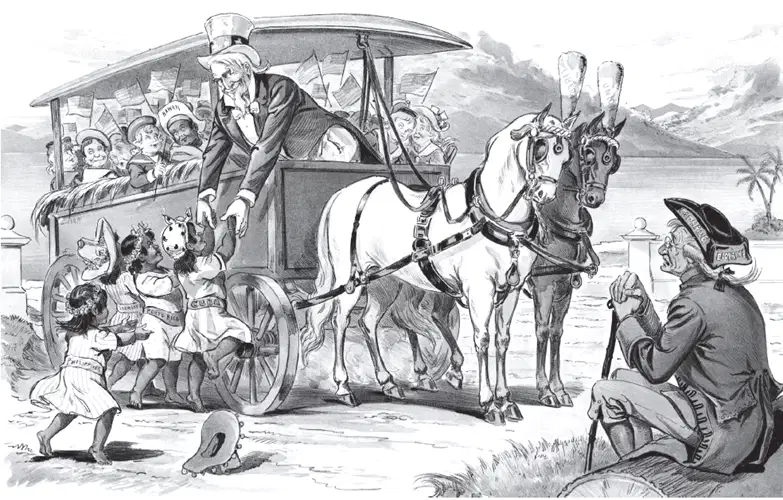
Look at the picture. What do you think the children in the picture are representing?
different Central American countries
poor people begging for food
workers for Uncle Sam
children looking to be adopted by American families
What did the Monroe Doctrine declare?
no new European colonies in the Americas
free trade with Europe
alliance with Spain
expansion of U.S. territories
What was the purpose of the Monroe Doctrine?
to promote European colonization
to prevent European interference
to establish trade routes
to form military alliances
What did the United States promise in the Monroe Doctrine?
to help Spain regain its colonies
to stay out of European business
to colonize South America
to form a European alliance
Debate calmly, and always be willing to negotiate.
Speak quietly, but yell if necessary.
Negotiate peacefully, but always have the threat of the military to back you up.
Which of the following is NOT a goal of the Affordable Care Act?
expand access to health insurance
protect patients
lower healthcare costs
increase insurance company profits
The Affordable Care Act (Obamacare) is an example of the federal government doing what?
reducing its role in healthcare
expanding its involvement in an existing government policy
eliminating all healthcare programs
privatizing all hospitals
What is the goal of the Social Security Act/program?
to provide financial assistance and income security for the elderly, disabled, and survivors
to provide healthcare services for all citizens.
to fund public education and youth programs
to support job training and employment initiatives
What policy area does social security fall under?
healthcare
economic
labor
social welfare

Look at the cartoon and quoted act. The cartoon illustrates a situation that Congress aimed to resolve by passing the quoted law. The law itself was the _____.
Judicial Act of 1789
What was the main purpose of the Sherman Antitrust Act?
to encourage businesses to form large monopolies
to make attempts to create monopolies illegal
to eliminate all taxes on businesses
to control prices of all goods sold in the U.S.
Complete the following sentence:
_____ is how the government uses taxation & spending to influence economic activity & achieve specific economic goals.
What is discretionary government spending?
Discretionary government spending is when Congress gets to choose how much to spend on which programs or services each year.
What is mandatory government spending?
Mandatory government spending is spending on certain programs that is required by law.
How do payroll & income taxes relate to mandatory & discretionary spending?
Payroll and income taxes are optional payments that citizens can choose to make.
Payroll and income taxes fund mandatory & discretionary spending.
Payroll and income taxes have nothing to do with government spending.
A tariff is...
a fee for shipping goods domestically
a subsidy for local businesses
a regulation on product quality standards
a tax on imported goods
Which of the following statements BEST describes the general effect of tariffs?
Tariffs generally make imported goods more expensive, which ends up increasing consumers' cost.
Tariffs always lower prices for consumers & make foreign goods cheaper.
Tariffs have no impact on trade between countries.
Tariffs only affect luxury items & do not influence the overall economy.
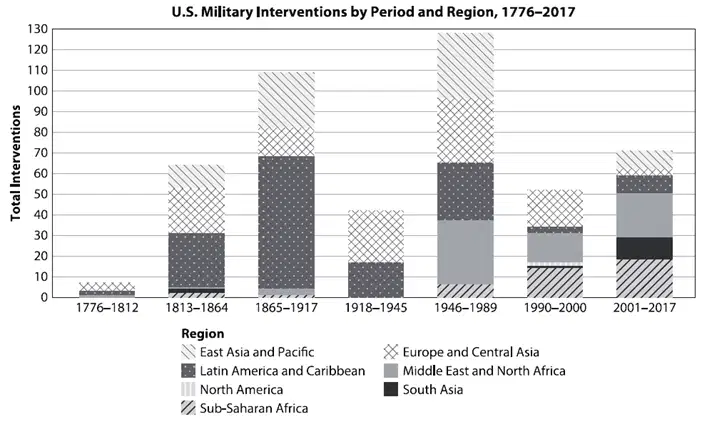
According to the graph, what do the Roosevelt Corollary period (1904) & the Truman Doctrine period (1947) have in common regarding U.S. intervention?
Both show the lowest level of U.S. interventions.
Both show no U.S. interventions.
Both show the highest level of U.S. interventions between 1776 & 2017.
Both show a complete end to U.S. interventions.
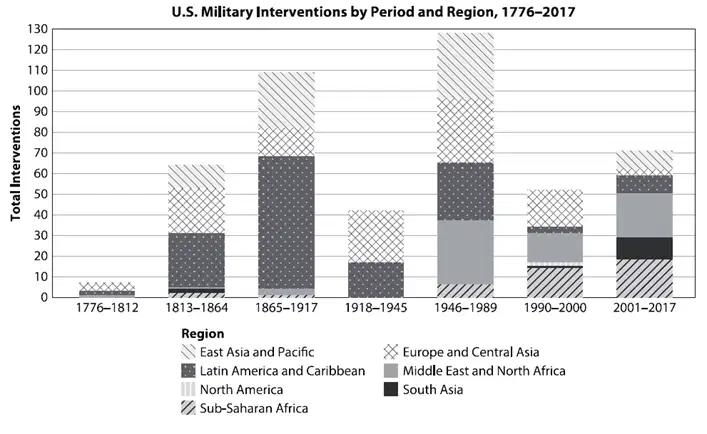
According to the graph and using your previous knowledge, why do you think U.S. military interventions increased after 1945?
WW2 was still going on, & the U.S. fought in many places.
During the Cold War, the U.S. often helped other countries fight instead of sending large numbers of American troops.
U.S. & Soviet soldiers fought each other directly in several wars.
The U.S. focused most of its military efforts on sub-Saharan Africa.
What was the purpose of the League of Nations?
to prevent another world war from happening
promote world peace
avoid a repetition ofWW1
all of the above
True or False: The U.S. was never a member of the League of Nations.
True
False
The _____ was a series of programs & policies created by FDR to help the U.S. start to recover from the Great Depression.
Did the United Nations replace the League of Nations after the League broke apart?
Yes
No

