
 Worksheets
APG Unit 1 Practice Test
Total questions: 60
Worksheet time: 10hrs 0mins
Which of the following statements would best support the assertion that the United States is a participatory democracy?
A college education has become an informal qualification for holding national office.
Most political candidates accept contributions from political action committees and interest groups.
The sheer number of interest groups in the United States has significantly slowed the legislative process.
Throughout the nineteenth and twentieth centuries, the right to vote was expanded to more citizens in the United States.
The Declaration of Independence is the basis for which of the following principles of American government?
Federalism
Popular sovereignty
Separation of powers
Checks and balances
In the Declaration of Independence, Thomas Jefferson wrote that all men have 'certain unalienable rights, that among these are Life, Liberty, and the pursuit of Happiness.' These rights are an example of
The social contract.
Republicanism.
Natural rights.
Popular sovereignty.
In the early part of the twenty-first century, public opinion polls showed that a majority of Americans believed it should be illegal to burn the American flag. As a result, many members of Congress introduced amendments to make it illegal to burn or desecrate the American flag. However, these efforts have been unsuccessful. Which of the following statements best explains why these efforts have been unsuccessful?
The framers made the amendment process difficult in order to protect individual rights.
Congress and the states have agreed to add this amendment; however, recent presidents have refused to sign it.
The Supreme Court has stated such an amendment is unconstitutional, thus blocking its ratification.
The framers specifically wrote the amendment process to prevent using it to limit freedom of expression.
The government designed at the Constitutional Convention allowed the voters to directly elect
Only the Senate.
Only the House of Representatives.
Only the president.
Both the House and Senate.
When was the Bill of Rights added to the Constitution?
During the ratification process
After the ratification process was complete
Before the ratification process
During the Constitutional Convention
What is the practical effect of the necessary and proper clause?
Allow the national government to extend its powers beyond those enumerated in the Constitution
Give the President uncontested powers in the area of foreign policy
Ensure that any powers not delegated by the Constitution to the United States government are reserved to the states and the people
Allow state governments to nullify federal laws within their borders
What is federalism?
A three-branch government with a system of checks and balances
A system of divided power by the state and national governments
Sole government authority in the national government
The same as unitary government
States and localities have the most discretion in establishing policy when federal funding is derived from
categorical grants
grants-in-aid
project grants
matching grants
block grants
All of the following are specifically mentioned in the Constitution EXCEPT
length of term of federal judgeships
the state of the Union address
judicial review
rules of impeachment
the national census
The selection of U.S. senators by the state legislatures prior to the adoption of the Seventeenth Amendment is an example of
pluralist democracy.
elite democracy.
socialist democracy.
participatory democracy.
Anti-Federalists argued that the Constitution would
give too much power to the states.
provide for elite control, endanger liberty, and weaken the states.
produce excessive democracy.
promote pluralism, which would threaten liberty.
strengthen the power of state governors
In the 1780s, proponents of the new Constitution cited Shays’ Rebellion as an example in support of which of the following criticisms of the national government under the Articles of Confederation?
States with larger populations were underrepresented in Congress.
The national government did not provide sufficient protection of individual rights.
There was a lack of a national military power to address security concerns.
The lack of a centralized judiciary made enforcement of national laws difficult.
Which of the following court cases could be used as a precedent for the Supreme Court to overturn a state law that legalizes recreational marijuana?
Citizens United v. Federal Election Commission (2010)
Shaw v. Reno (1993)
United States v. Lopez (1995)
McCulloch v. Maryland (1819)
The federal system
decreases opportunities for political participation.
decreases judicial power.
centralizes our politics
decreases the number of government officeholders.
decentralizes our politics.
In 1974, the House of Representatives approved a resolution granting the Judiciary Committee authority to investigate impeachment of President Nixon for obstruction of justice, abuse of power, and contempt of Congress. Which constitutional ideal of democracy is demonstrated in this scenario?
Judicial review
Limited government
Federalism
Popular sovereignty
Under the Articles of Confederation, most governmental power rested in
the president.
the national government.
the town councils
the judiciary.
the state governments.
Which of the following powers allows both the federal and state governments to make policies involving taxation?
Enumerated powers
Exclusive powers
Concurrent powers
Implied powers
One way Congress can respond to a Supreme Court ruling that declares a law unconstitutional is to
pass new legislation that addresses the issues raised by the Court
reargue the case in a state court
appoint new justices
draft a referendum that the voters would approve
pass a law limiting the terms of the justices
Which of the following is commonly identified as a failure of the Articles of Confederation?
The national government lacked an effective power to raise revenue.
The executive branch was granted too much power over the legislature.
The judicial branch was elected and did not consistently adhere to rule of law.
The federal government had too much control over interstate commerce.
The reserved powers of the state governments can best be described as those powers
exercised by both national and state governments
granted to states as part of the implied powers doctrine
listed specifically in the Tenth Amendment
implied in the Fifth Amendment
not specifically granted to the national government or denied to the states
The author of Brutus No. 1 wrote that a “that a free republic cannot succeed over a country of such immense extent.” This quote argues that the United States
should adopt a unitary form of government.
is destined to expand.
should be broken into smaller countries.
is too large to govern as a single entity.
The procedure for formally amending the United States Constitution best illustrates which of the following?
The Foundign Fathers’ desire to facilitate rapid constitutional revisions
The Supreme Court’s power to review constitutional amendments
The dominance of the national government over the state governments
The dominance of the state governments over the national government
The federal structure of the United States
The Tenth Amendment most often comes into conflict with which section of the Constitution?
The “necessary and proper” clause
The provisions for constitutional amendment
The provisions for the impeachment of a president
The “full faith and credit” clause
The clause prohibiting states from coining money and entering into treaties
Which of the following statements provides the best evidence to support that the United States is a pluralist democracy?
The number of citizens of eligible to vote has increased.
The number of interest groups increased dramatically in the late twentieth century.
Voter turnout has increased in recent presidential elections.
The costs of campaigns have increased in the twenty-first century.
James Madison argued in Federalist No. 10 that the Constitution would protect against the “mischiefs of faction” because the Constitution
made it nearly impossible for factions to form due to significant limits on civil liberties.
limited the influence of factions by giving interest groups created by the government preferential status.
created a large republic, which would prevent any single faction from causing trouble.
created public financing for election campaigns, which would reduce the influence that factions could exert in politics.
The expansion of the right to vote through various amendments best supports which of the following models of representative democracy?
Elite democracy
Hyperpluralist democracy
Pluralist democracy
Participatory democracy
In Marbury v. Madison (1803), the Supreme Court assumed the power to
decide whether internal congressional procedures are constitutional
regulate slavery
decide on the constitutionality of a law or an executive action
approve executive agreements
advise Congress on the constitutionality of a proposed law
We should remember that the Declaration of Independence is not merely a historical document. It is an explicit recognition that our rights derive not from the King of England, not from the judiciary, not from government at all, but from God.
—Mark Levin
The quotation best represents which concept?
Natural rights
Constitutional democracy
Republicanism
Participatory democracy
The new Republican majority in Congress in the 1990s preferred block grants to categorical grants because it:
wanted the federal government to exercise less authority over the states.
wanted federal money to be spent at the neighborhood level rather than the state level.
wanted to decrease federal aid to state governments.
intended to raise more money from state governments to reduce the federal budget deficit.
wanted to increase federal aid to state governments.
Which of the following provisions of the Constitution best supports the elitist theory of representative democracy?
The president is limited to two terms.
Members of the House of Representatives serve two-year terms.
The Seventeenth Amendment established the direct election of senators.
Members of the judicial branch are not elected by citizens.
All of the following issues were decided at the Constitutional Convention EXCEPT
representation in the legislature
voting qualifications of the electorate
qualifications for members of the House and Senate
method of electing the President
congressional power to override a presidential veto
The Declaration of Independence states “Governments are instituted among Men, deriving their just powers from the consent of the governed.” This was a revolutionary change from the system of British monarchy, which was based on the divine right of kings. For which of the ideals of democracy does this quote provide a foundation?
Limited government
Separation of power
Popular sovereignty
Federalism
The Framers of the United States Constitution
were distrustful of direct democracy.
established a unitary system of government.
established the British system of parliamentary government.
were opposed to the concept of limited government.
were interested in promoting equality above all else.
Which of the following actions by the federal government best illustrates the concept of unfunded mandates?
Requiring states and municipalities to provide certain services for their citizens without providing resources to pay for chose services
Requiring state governments to guarantee short-term bonds issued by large municipalities in their states
Requiring that polling booths remain open beyond the hours of the workday
Requiring all municipalities to impose a minimum property tax on all residential and business properties
Requiring states and municipalities to privatize many previously publicly funded services
A birth certificate issued in one state is valid in all states under the constitutional provision of
privileges and immunities.
national licensure.
separation of powers.
national supremacy.
full faith and credit.
Pluralist theory contends that in the United States
the many members of Congress dominate a singular official such as the president.
many groups vie for power with no one set of groups dominating.
too many influential groups cripple government's ability to govern.
most citizens fail to pay attention to serious issues.
society is governed solely by an upper-class elite.
Federal mandates impose burdens upon:
foreign governments.
Congress
the President.
state and local governments.
federal taxpayers.
In 2015, the United States Supreme Court decided the case Obergefell v. Hodges (2015), which ruled that states must recognize same sex couples’ right to marry. Which of the following ideals of democracy would the attorneys for the same sex couple most likely put forth as their argument?
Limited government would more likely defer to state laws on same sex marriage rather than a blanket directive from the Supreme Court.
Social contract theory guarantees that the right to marry is enshrined in a constitutional framework.
Popular sovereignty requires that elected representatives in the state should decide right-to-marry issues.
Natural rights of life and liberty include the right to marry whom you choose.
The framers of the Constitution all believed that one of the primary functions of government is
educating citizens
protecting new immigrants from persecution
protecting individual property rights
ensuring that anyone accused of a crime has the right to legal representation
expanding the borders of the nation
In 2001, Congress passed the No Child Left Behind Act, which President George W. Bush signed. This act required states to administer regular standardized exams to students starting in the third grade. States that refused to do this would not receive federal education funds. This is an example of
the national government using the grant process to influence state behavior.
Congress exercising its enumerated power over education policy.
a president using an executive order to bypass states’ obstruction of policy.
an unfunded federal mandate.
Concurrent powers have which of the following effects on the United States political system?
They foster cooperation between the states and the national government by requiring that the two levels of government work together.
They make it possible for the states and the national government to simultaneously exercise influence in the same areas of public policy.
They eliminate disputes between the states and the national government by creating completely separate spheres of influence.
They reinforce the expansion of the power of the national government and the supremacy of the national law.
Informal changes to the Constitution have come about as a result of all of the following EXCEPT
tradition
constitutional amendments.
judicial interpretation.
custom
congressional legislation.
Proposal of a formal amendment to the Constitution requires:
a two-thirds vote in Congress.
state conventions
the president's approval.
a simple majority vote in Congress.
a majority vote of the Supreme Court.
The Connecticut Compromise at the Constitutional Convention
settled the dispute over whether slavery should be allowed in the final constitution.
involved the federal judiciary
added the Bill of Rights to the Constitution.
resolved the impasse over the issue of representation in Congress.
established an indirectly-elected president.
The Supreme Court in Marbury v. Madison (1803) asserted the power of the Court to
determine its own size and makeup.
nullify constitutional amendments.
confirm presidential appointments.
check the actions of the other branches through judicial review.
impeach the president.
Brutus was an example of an Anti-Federalist because he
argued that the laws passed by the national government were supreme over state laws
believed a centralized government posed a major threat to individual rights
argued that a national military force was needed to deal with insurrections
believed that compromise between the branches of government would ensure a limited government
A consequence of separation of powers and checks and balances has been
an "imperial presidency."
fragmented policymaking processes.
the inability of groups to get their grievances heard.
streamlined, but hasty, government decision making.
the tyranny of the majority.
The decision in United States v. Lopez (1995) reflected new ideas about federalism at the time that can be best characterized by which of the following?
A consolidation of power in the national government based on national supremacy
A delegation of power from the federal government to state governments, increasing state and local sovereignty
A delegation of power from the state governments to the federal government, increasing the power of the United States government
An increase in cooperative federalism, where power and duties are shared between the federal and state governments
Cooperative federalism can best be described by which of the following statements?
Different levels of government are involved in common policy areas.
Government must have cooperation from the people in order to make legislative decisions.
Local levels of government can make decisions on issues more efficiently than state and national governments can.
The federal government must make regulations that can be applied across every state in the same way.
Business and government can work together to more effectively accomplish shared goals.
Arizona enacted an immigration law in 2010, claiming the legislation complemented existing federal law. The Obama administration disagreed, claiming the state law conflicted with national law. Which clause of the Constitution did the Supreme Court most likely use to strike down a section of the state law?
Commerce clause
Necessary and proper clause
Full faith and credit clause
Supremacy clause
Which of the following is an accurate description of the decision in McCulloch v. Maryland (1819) ?
The federal government exceeded its authority in establishing a national bank, and Maryland’s tax was unconstitutional.
Maryland was within its authority to tax the federal government, but the Bank of the United States exceeded federal authority.
The federal government had the authority to establish a national bank, but it had to pay Maryland’s tax.
The federal government had the authority to establish a national bank, and Maryland’s tax was unconstitutional.
In The Federalist No. 10, James Madison argued that factions in a republic are
a more serious threat if the republic is large
natural but controllable by institutions
not likely to occur if people are honest
prevented by majority rule
prevented by free elections

Which of the following pairs is correct regarding representation as created by the Great (Connecticut) Compromise?
A
B
C
D

Which of the following pairs is correct in regard to the amendment process?
A
B
C
D

The author explains that the powers given to each branch “sometimes appear to swing like a pendulum” from one branch to another. Which of the following best describes how these shifts ensure that constitutional government is functional?
Each branch of government is elected by the people, which ensures that they all reflect the preferences of the population.
Separation of powers divides responsibilities and authority between branches, which allows each branch to be checked by the other two branches to ensure accountability.
The greatest power resides within the legislative branch of government, but the legislature can give this power to the executive branch.
The coequal branches have power evenly distributed between them and are not permitted to check another branch of government.

Which of the following best explains how the view of the author of the passage compares with The Federalist 51 regarding separation of powers and checks and balances?
The author of the passage views separation of powers as a limitation on the authority of government, whereas The Federalist 51 argues in favor of using separation of powers as a means to expand the role of government.
The author of the passage views the structure of government as providing a balance between the branches of government, whereas The Federalist 51 supports the idea of a powerful executive branch.
Both the author of the passage and The Federalist 51 assert that the structure of government helps control ambitions among the branches in such a way as to promote effective government.
Both the author of the passage and The Federalist 51 argue that elections are a sufficient means to ensure good government.
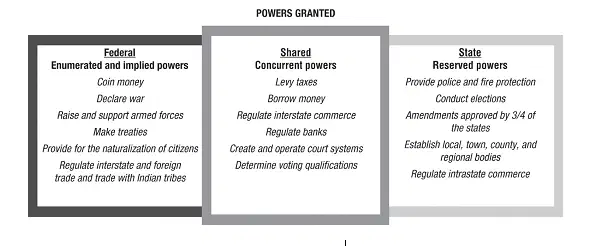
Which of the following would be an exclusive power of the federal government, according to the infographic above?
To approve amendments
To establish a 911 service
To create a process to gain citizenship
To oversee elections for public office

Which of the following constitutional provisions limits the power of the national government in Hamilton’s argument?
Judicial review in Article III
Enumerated powers in Article I
Supremacy Clause in Article VI
Faithful execution of the laws in Article II
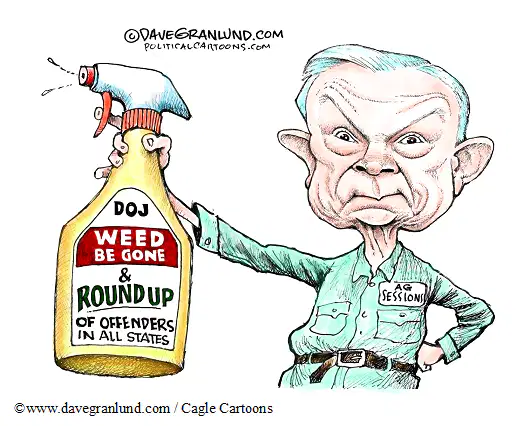
The conflict depicted in the cartoon above is best explained as a result of which of the following political concepts?
Limited government
Enumerated powers
Concurrent powers
Checks and balances

